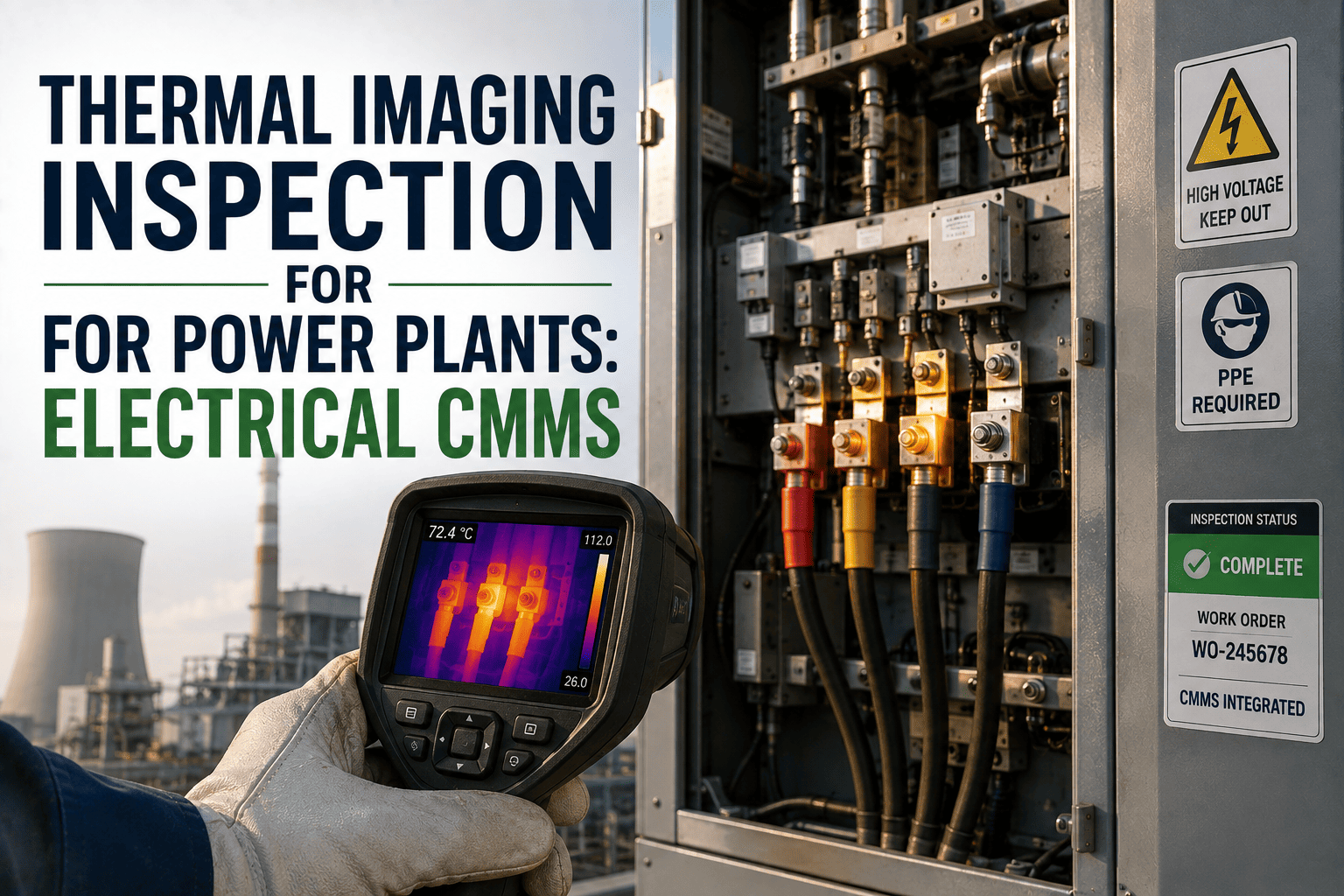
A thermal anomaly in a substation transformer bushing costs nothing to detect with a camera and everything to miss — a single overheated connector left uninspected has caused bushing explosions, transformer fires, and multi-day outages costing millions in lost generation revenue. Infrared thermography is now the front-line inspection method for substation electrical equipment, capable of identifying resistive heating, insulation breakdown, overloaded circuits, and failing connections before they fail visibly. The challenge is not the technology — it is the workflow: inconsistent load conditions during scanning, images not tied to specific assets, temperature deltas without severity context, and findings that never convert to work orders. OxMaint's inspection management platform structures thermography as a closed-loop workflow: field image capture, severity classification, automatic work order creation, and a growing asset-specific baseline history that makes trending meaningful — not just a collection of hot pictures.
40%+
Minimum load required for valid thermographic findings
3 Methods
Baseline, trending, and comparative — each suits different equipment
Annual
Minimum thermography frequency for critical substation assets
EPRI
Infrared Thermography Guide governs severity classification
Pre-Scan Requirements
Before Your Thermographer Picks Up the Camera
The most common cause of missed thermal anomalies is not equipment or technique — it is scanning under conditions that mask hot spots. Load level, environmental conditions, and camera calibration determine whether findings are defensible or meaningless.
Required
System load at 40% or above
At loads below 40% of rated capacity, resistive heating from marginal connections is too small to detect reliably. Document actual load as a percentage of rated at time of scan — this becomes part of the inspection record for trend comparisons.
Required
Camera calibrated within 12 months
Thermal camera calibration certificate must be current. Document camera make, model, serial number, and calibration date in the work order. Uncalibrated camera data cannot be used for trending or severity classification.
Required
Baseline images available for comparison
Without a baseline of the same equipment under similar load conditions, current findings can only be classified by absolute temperature — not by trend. Pull prior scan images from the asset record before entering the substation.
Conditional
Wind speed below 5 mph at scan location
Wind actively cools exposed connections and can mask hotspot severity. If wind speed exceeds 5 mph, apply the EPRI extrapolation formula to correct temperature delta to nominal conditions — or reschedule if wind exceeds 15 mph.
Conditional
Solar loading accounted for
Direct sunlight on dark-coloured equipment can generate surface temperatures of 15–20°C above ambient, masking thermal signatures. Scan metallic enclosures and bus work during low-solar periods or correct for solar loading in the report.
Required
Emissivity settings set per target material
Polished copper bus has emissivity near 0.03; oxidised copper near 0.7. Using the wrong emissivity can produce temperature readings 20–40°C off. Document emissivity value applied for every reported hotspot.
Scan Sequence
Substation Thermography — Zone-by-Zone Inspection Order
Starting from transmission entry and working inward reduces re-scanning and ensures no upstream anomaly contaminates downstream severity assessments. Follow this sequence every cycle for comparable baseline data.
01
Transmission Line Entry — Incoming Conductors and Strain Insulators
Scan incoming conductors from the transmission line feed and strain insulators on dead-end structures. Transmission conductor connections and compression splices are failure-prone at high load. Look for non-uniform heating along the conductor span — a warm splice against a cool conductor is the key indicator.
Compression splice temperature vs. adjacent conductor
Strain insulator thermal pattern — uniform heating indicates contamination
Dead-end hardware connections — bolted and compression types
02
High-Side Disconnects, Surge Arresters, and Bus Work
Work from the incoming line to the main transformer high-side, scanning all disconnect switches, surge arresters, and high-voltage bus connections. Surge arresters operate near ambient when healthy — elevated temperature indicates leakage current and imminent failure. Document arrester temperature against ambient and against adjacent phases.
Three-phase arrester temperature — flag phase imbalance exceeding 5°C delta
Disconnect blade contact points — main jaw, hinge, and jaw pressure springs
High-voltage bus splice and tap connections
03
Power Transformer — Bushings, Cooling System, and Tank
Transformers are the highest-consequence asset in the substation. Scan bushings from ground level with a wide-angle lens first — bushing connector overheating is a classic, easily detected thermal signature. Then scan cooling equipment: fan motors, OFAF cooling coils, and oil pumps. A blocked cooler bank shows as a temperature gradient across the transformer tank.
HV and LV bushing connectors — compare all phases, flag delta above 10°C
Bushing oil sight glass — warm glass with cool oil indicates clogged conservator tube
Cooling fan motor bearings and housing temperature
Tank temperature gradient — top-to-bottom expected; side-to-side anomaly
OLTC compartment — temperature difference from main tank indicates switching contact wear
04
Circuit Breakers — Main Contacts, Operating Mechanism, and CTs
Scan breaker bushings and current transformers from outside the safety fence. Internal heating from main contact wear manifests as a symmetric warm pattern across all three bushings; an asymmetric pattern on one phase indicates that phase's contacts are degraded. CT overheating indicates saturation or winding insulation issues — flag immediately.
Three-phase bushing temperature balance — asymmetric pattern is priority finding
Current transformer temperature against ambient and adjacent CTs
Control cabinet thermal scan — look for failed heating elements in cold climates
05
Switchgear and Control Building — Bus, Connections, and Panels
Inside the control building, scan bus connections, panel terminations, and all bolted connections with doors or panels removed where safe to access. Switchgear bus connections are the most frequent source of thermal findings — loose torque or galvanic corrosion at bolted bus joints creates resistance heating detectable well before it becomes a problem.
Main bus and feeder cable terminations — record absolute temperature and delta
Control panel fuse blocks, contactors, and terminal blocks
Battery charger and inverter modules — uniform heat signature expected
DC distribution board — compare phases for load imbalance
Severity Classification
Temperature Delta to Work Order Priority — EPRI Framework
Marginal connection or minor load imbalance. Monitor at next scheduled cycle. Record in asset history with load conditions for trend comparison.
Action: Document and trend — schedule follow-up within 12 months
Significant resistance or loading issue. Requires follow-up inspection under higher load if possible and scheduled corrective maintenance within 90 days.
Action: Work order within 90 days — verify at higher load first
Significant defect that will worsen rapidly under load increase or during peak periods. Corrective work must be scheduled before the next peak load period.
Action: Priority work order — correct before next peak load event
OxMaint Inspection Management
From Camera Finding to Closed Work Order — in One Workflow
Thermal images attach directly to the asset record in OxMaint. Severity classification auto-sets work order priority. Every finding links to a baseline history so your team can trend, not just spot.
Reporting Standard
What a Compliant Thermography Report Must Include
A thermal image without context is an anomaly without consequence. Each finding in a compliant substation thermography report must include enough data to recreate the inspection conditions and justify the corrective action taken.
| Report Element |
Why It Matters |
Where It Lives in OxMaint |
| Asset ID and location |
Links finding to specific equipment for trend tracking and work order routing |
Asset record — auto-populated when work order opened from asset |
| Scan date, time, and thermographer name |
Enables interval compliance verification and chains evidence to a qualified inspector |
Work order header — timestamped on record closure |
| Load at time of scan (amps and % rated) |
Required to apply EPRI severity classification correctly — same delta at 40% load vs 90% load is a different risk level |
Custom field on thermography work order template |
| Ambient temperature and wind conditions |
Environmental correction factors required by EPRI guide — without these, temperature delta cannot be normalised |
Inspection field — required before record can be saved |
| IR and visible image pair for each finding |
Visible image confirms the equipment photographed; IR image shows thermal anomaly — both required per EPRI standards |
Photo attachment — both images linked to the same finding record |
| Emissivity value applied |
Without the emissivity used during measurement, temperature values in the report cannot be verified or reproduced |
Custom field on finding record — prompted on image upload |
| Severity classification and recommended action |
Translates thermal data into a maintenance decision — Watch, Investigate, Urgent, or Immediate |
Severity drop-down — auto-sets work order priority on selection |
FAQs
What Substation Teams Ask About Thermography Programs
How often should substations receive thermal imaging inspections?
Most utilities perform annual thermographic surveys on primary substation equipment as a minimum. High-load or aging facilities — and those with prior thermal findings — warrant semi-annual scans, with a targeted re-scan within 90 days whenever an Investigate-level finding is recorded. Post-outage scans after each planned maintenance window help confirm that work has resolved the anomaly.
OxMaint schedules inspection cycles by asset class and auto-triggers follow-up work orders based on finding severity.
What load level is needed to get valid thermography results?
The EPRI Infrared Thermography Guide recommends scanning at 40% of rated load as an absolute minimum, with findings at loads above 60% considered more reliable. At low loads, the resistive heating from marginal connections is often below the thermal resolution of even a high-quality camera. When scheduling scans, check generation dispatch forecasts and align the thermography window with periods of higher system demand.
How do you distinguish a real hotspot from solar heating or environmental interference?
Three-phase symmetry is the key diagnostic tool. If a hotspot appears on one phase but not the other two identical components, it is almost always a real electrical anomaly — solar heating or ambient temperature affects all three phases equally. For equipment exposed to direct sunlight, schedule scans in the early morning or apply the EPRI solar correction formula. Always capture a visible-light image alongside every IR image to confirm you are looking at the right equipment.
Book a demo to see how OxMaint pairs IR and visible images per finding.
Can OxMaint store thermography images and build trending history by asset?
Yes — each thermal finding attaches to a specific asset record with the scan date, load conditions, severity classification, and both IR and visible images. Over successive inspection cycles, the asset builds a baseline history that allows your team to trend delta temperature over time. A connection that was Watch-level at 5°C delta three cycles ago and is now at 12°C delta is telling a story that only appears when findings are linked to the same asset record.
What qualifications should a substation thermographer have?
Substation thermographers should hold at minimum an ITC Level II certification for electrical equipment inspection, covering camera operation, emissivity measurement, and severity classification methodology. All substation thermography work must also comply with site-specific electrical safety rules — thermographers must be qualified to work within the substation fence and follow arc flash PPE requirements. Some utilities require Level III for report sign-off on findings above the Investigate threshold.
Hot Spots Found. Work Orders Created. Assets Protected.
Run Substation Thermography as a Closed-Loop System
OxMaint connects your thermography finds directly to prioritised work orders, asset-specific baseline history, and the scheduling calendar that ensures no asset is missed cycle after cycle.