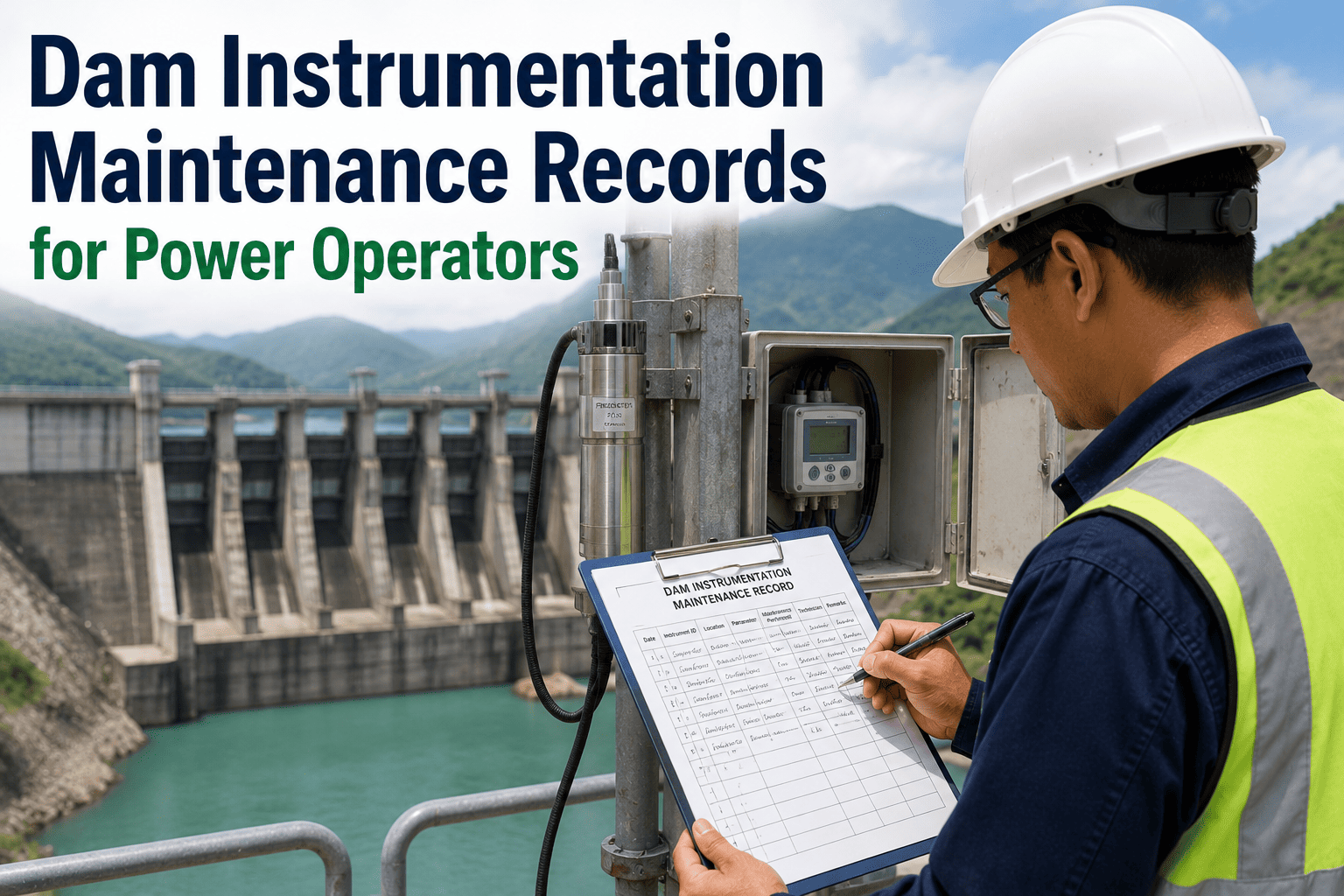
Every piezometer, weir, settlement monument, crack gauge, and inclinometer at a FERC-licensed hydropower dam has a reading frequency in the project's approved monitoring program — and every missed reading, undocumented action level exceedance, or gap in instrument calibration history is a regulatory liability that compounds over the 5-year Part 12 inspection cycle. Power operators who manage dam instrumentation on spreadsheets and paper field notebooks spend more time defending record gaps during Independent Consultant reviews than they spend on actual remediation. OxMaint CMMS structures every instrument reading, action level threshold, calibration record, and exceedance response into a compliant, searchable digital record — so your facility arrives at every FERC inspection with evidence, not apologies.
18 types
Of dam instruments requiring scheduled readings under typical FERC O&M programs — each with its own frequency and action level thresholds
5-year
Part 12 inspection cycle — every documentation gap across that window is reviewable by the Independent Consultant
72 hrs
FERC-expected response time after an action level exceedance — untracked exceedances are among the most common Part 12 findings
< 5 min
Time to retrieve complete instrument history in OxMaint vs. hours searching paper logbooks and shared drives
The 6 Instrument Categories Power Operators Must Track
Dam safety instrumentation monitoring is not uniform — each instrument type has its own reading protocol, failure mode, and action level logic. OxMaint configures each instrument class with its own reading schedule, threshold triggers, and required response workflows — so a rising piezometer trend receives different escalation handling than a settlement monument reading outside its seasonal range.
P
Piezometers
Measures pore water pressure in embankment and foundation. Action level exceedance requires immediate dam safety engineer notification and investigation documentation within 72 hours per FERC protocol.
Reading frequency: Weekly to monthly depending on hazard class and season
W
Seepage Weirs
Measures total and zoned seepage flow rate through embankment. Sudden flow increase or turbidity change triggers emergency inspection protocol — not a routine observation log entry.
Reading frequency: Weekly minimum; daily during high reservoir or post-seismic event
S
Settlement Monuments
Survey monuments on embankment crest and downstream slope track vertical and horizontal movement over time. Trend acceleration — even within individual action levels — requires engineering review.
Reading frequency: Annual to semi-annual; post-seismic or post-flood event reading required
C
Crack Gauges
Installed at structural cracks in concrete dams and spillway structures to measure width change over time. Each gauge requires individual action level thresholds based on crack history and structural analysis.
Reading frequency: Monthly; after seismic, thermal extreme, or reservoir fluctuation events
I
Inclinometers
Measures internal deformation of embankment slopes and abutments. Readings require professional interpretation — raw data must be linked to analysis records and engineer sign-off in the maintenance record.
Reading frequency: Semi-annual to annual; trending review required at each reading cycle
A
Strong-Motion Accelerometers
Triggered by seismic events above threshold PGA. Post-event data download, equipment check, and structural inspection must be documented before next reading cycle. Calibration records required annually.
Reading frequency: Calibration annually; triggered readings logged per event
Build an Audit-Ready Instrumentation Record System
OxMaint structures every instrument type, reading schedule, action level, and exceedance response into a FERC-compliant digital record — accessible from any device, retrievable in minutes at inspection time.
How OxMaint Manages Dam Instrumentation Records
Reading Schedule Automation
Each instrument is configured with its FERC-approved reading frequency — daily, weekly, monthly, or event-triggered. OxMaint generates reading work orders in advance and escalates overdue readings before they become compliance gaps. Seasonal frequency changes (higher readings during spring runoff or high reservoir) are configured per instrument per project.
Action Level Threshold Alerts
Every instrument in OxMaint carries the action level thresholds defined in the project's FERC-approved monitoring program. When a submitted reading crosses an action level, the system immediately notifies the designated dam safety engineer and creates a condition report requiring investigation and response documentation — timestamped and linked to the instrument record.
Trend Chart Visualization
Readings are automatically plotted on instrument trend charts against historical values and action level lines. Gradual threshold approaches — the most dangerous readings because they miss spot-check review — are visible to any engineer reviewing the monitoring dashboard, even between formal inspection cycles.
Mobile Field Data Capture
Field technicians receive reading work orders on mobile — arriving at each instrument with prior values and action level thresholds visible before taking the new reading. Measurements, photos, and observations are recorded at the instrument and synced automatically. No paper transcription, no data entry delay, no lost field readings.
Calibration Record Tracking
Each instrument carries its calibration schedule, last calibration date, calibrating party, and calibration results in OxMaint — with automated alerts when calibration intervals approach. Instruments past calibration due dates are flagged on the dashboard so no reading from an out-of-calibration instrument enters the compliance record silently.
FERC Evidence Export
When Part 12 documentation is requested, OxMaint exports a complete record package per instrument — reading history, action level exceedance responses, calibration records, and finding remediation — organized by instrument ID and date range. What took 72 hours to compile from paper logbooks is retrieved in minutes.
Common Instrumentation Compliance Gaps and How OxMaint Closes Them
Reading frequency documented in O&M Manual but not automated — missed readings during outages or staff changes
Automated reading work orders per instrument at configured frequency — escalation alerts before readings go overdue
Action level exceedances noted in field logbook but no formal response documentation or closure record
Automatic condition report on exceedance with required investigation fields, responsible engineer assignment, and closure documentation
Post-seismic and post-flood event readings required but no system to trigger or track completion
Event-triggered work order batch creation for all required instruments — no event inspection falls through without a record
Instrument calibration records kept in separate binders not linked to reading history or maintenance schedule
Calibration history linked to instrument asset record — out-of-calibration instruments flagged before readings are submitted
Trend data exists in SCADA but is not linked to inspection findings or accessible to IC during Part 12 review
Trend charts generated automatically per instrument, exportable with reading history and finding records in a single evidence package
Frequently Asked Questions
What does FERC require operators to document for dam instrumentation monitoring programs?
FERC requires licensed operators to document reading schedules per instrument, actual readings against action level thresholds, engineer response to action level exceedances with timestamped investigation records, and calibration history for all instruments. These records are reviewed by the Independent Consultant at each Part 12 inspection and must be retrievable by instrument and date range. OxMaint structures all required documentation into digital records from the first field reading — building a compliant evidence package continuously, not retrospectively.
How does OxMaint handle instruments that require different reading frequencies during high-water or seismic events?
OxMaint supports conditional reading schedules — piezometers that read weekly under normal conditions can be configured to shift to daily when reservoir elevation exceeds a defined trigger level, or when a seismic event notification is entered into the system. Event-triggered reading batches can also be created manually by the dam safety engineer for all affected instruments simultaneously. Every frequency change and event-triggered reading is recorded against the instrument's compliance history.
Can OxMaint support multi-dam portfolios with instruments at multiple structures?
Yes. OxMaint's portfolio dashboard aggregates instrumentation compliance status across all structures — showing reading completion rate, open action level exceedances, overdue calibrations, and active condition reports per dam on one screen. Book a demo to see how a utility managing instruments across multiple FERC-licensed projects uses OxMaint to maintain visibility from a central engineering office without being on-site at each dam.
How quickly can existing instrument reading history be imported into OxMaint?
Most facilities complete instrument asset registration and historical data import within 3–5 weeks of deployment. OxMaint's implementation team works from existing Excel monitoring logs, SCADA historian exports, and paper logbook data to pre-populate reading history per instrument — giving the trend chart a meaningful baseline from day one rather than starting from zero.
Does OxMaint support photo documentation during instrument reading field visits?
Yes. Field technicians can capture photos at each instrument location during mobile reading work orders — documenting instrument condition, visible seepage, structural observations, and any anomalies observed near the instrument. Photos are permanently attached to the reading record with timestamp and GPS coordinates, and are included in the FERC evidence export alongside the numerical reading data.
Digitize Your Dam Instrumentation Records Before Your Next FERC Inspection
OxMaint connects every instrument, reading schedule, and action level threshold into a searchable compliance record — retrievable in minutes, not hours. Most facilities are fully operational within 4 weeks.