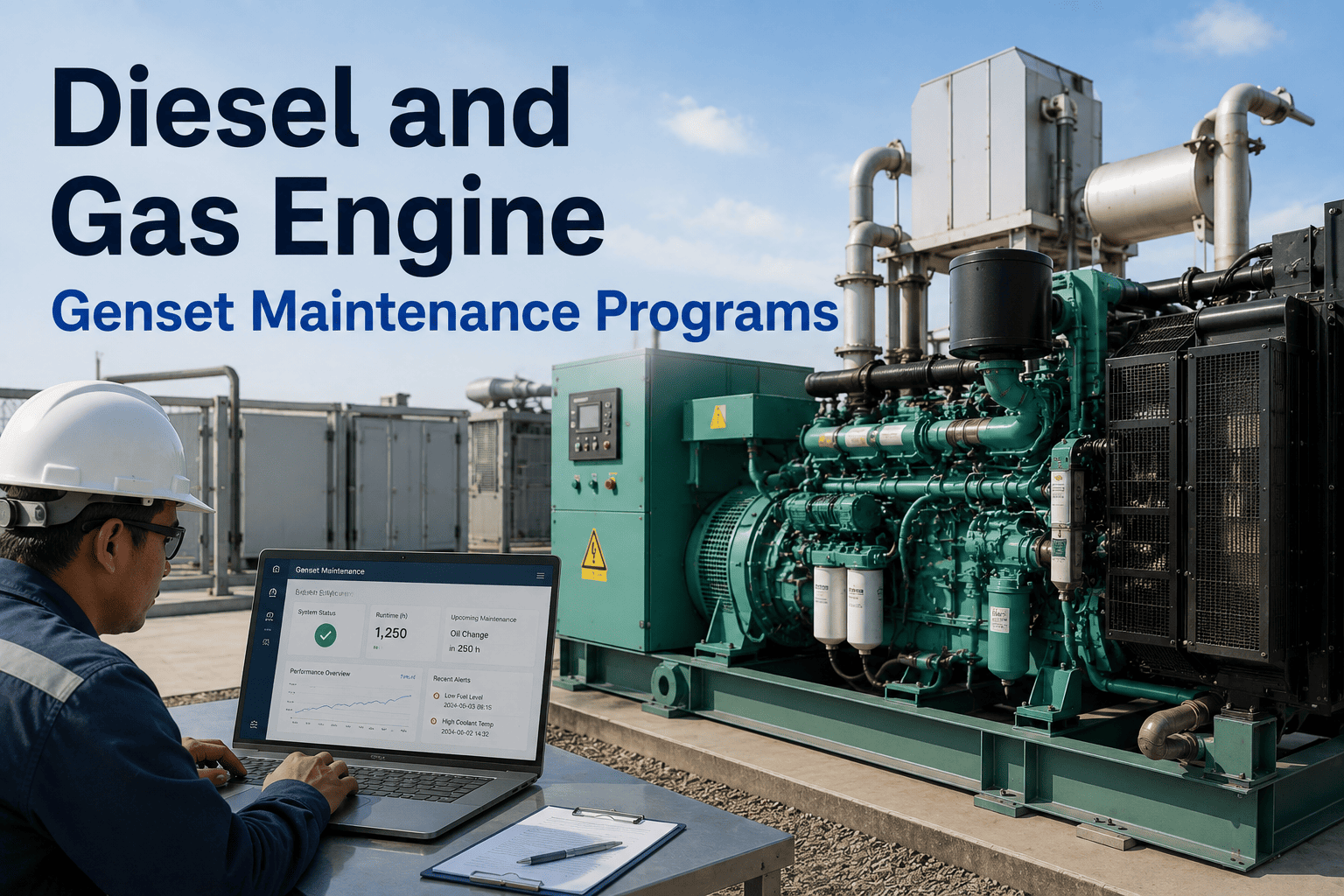
Diesel and gas engine gensets are the last line of defense in critical power infrastructure — data centers, hospitals, industrial facilities, and utilities depend on them to start within 10 seconds and run under full load for days. Yet most genset failures trace back to the same root cause: missed oil changes, unchecked turbochargers, and PM intervals tracked in spreadsheets that nobody updates. OxMaint's CMMS gives maintenance teams automated PM scheduling, parts consumption tracking, and compliance-ready service records — so your gensets are ready when the grid isn't. Start your free trial — no credit card required, live in under 60 minutes.
Diesel Genset · Gas Engine · Emergency Power · CMMS
Gensets That Fail During Emergencies Were Missed During Maintenance.
90% of unplanned genset failures are preventable with structured PM programs. The other 10% are caught early enough to avoid complete failure — if your records are accurate and your alerts fire on time.
Genset Failure Root Causes
Battery / Starting Failure
25%
Turbocharger / Exhaust
10%
Source: EGSA industry data
The Real Problem
Why Most Genset Maintenance Programs Fail
Gensets sit idle for months, then must start and carry full load in seconds. That demand pattern creates a false sense of security — the engine runs when tested, so maintenance teams deprioritize PM tasks. Until it doesn't run when it matters.
$50K–$500K
Cost of a single unplanned genset failure in a critical facility
The Downtime Cost
For hospitals, data centers, and manufacturing plants, a genset that won't start isn't a maintenance problem — it's a business continuity event. Fines, lost revenue, and equipment damage stack up fast when backup power fails.
6–12 wk
Lead time for turbocharger and cylinder head components
The Parts Problem
Critical genset components — turbochargers, injector sets, cylinder heads, governor assemblies — have multi-week lead times. Without predictive PM records to anticipate needs, emergency procurement costs 3–5x more.
72%
Of facilities have incomplete genset service records per NFPA 110 audit findings
The Compliance Gap
NFPA 110, ISO 8528, and local AHJ requirements mandate documented PM intervals, load bank test records, and fuel quality logs. Missing records create liability exposure and can void manufacturer warranties during critical failures.
PM Program Structure
Complete Genset PM Interval Reference
OxMaint automates work order generation for every interval below — triggered by hours, calendar, or fuel consumption — and timestamps completion records for full compliance documentation.
Weekly
- Visual inspection — leaks, exhaust color
- Battery charger voltage check
- Coolant level and condition
- Fuel level and day tank status
- Control panel alarm review
Monthly
- 30-minute no-load exercise run
- Transfer switch operation test
- Battery load test and terminal inspection
- Air filter condition check
- Belts and hoses inspection
Semi-Annual
- Full load bank test (NFPA 110 compliance)
- Oil and filter change
- Fuel polishing and filter replacement
- Coolant pH and freeze protection test
- Turbocharger visual and oil feed check
Annual / 500hr
- Injector inspection and calibration
- Cylinder compression test
- Valve clearance adjustment
- Governor and AVR calibration
- Exhaust system integrity check
How OxMaint Works
From Paper Logs to Digital PM Automation
OxMaint replaces disconnected spreadsheets and paper logs with a unified CMMS that tracks every genset asset, automates PM schedules, and gives compliance officers the documentation they need — instantly. See it live — book a 30-minute demo.
01
Asset Registry with Full Genset Specifications
Every genset catalogued with make, model, serial number, kW rating, installation date, warranty terms, and OEM PM schedule. Mobile access means technicians have specs on-site without hunting for manuals.
02
Hour-Meter and Calendar-Based PM Triggers
PM work orders trigger on engine hours, calendar intervals, or fuel consumption thresholds — whichever comes first. No more missed oil changes because the clock said 90 days but the engine has 600 hours on it.
03
Load Bank Test Record Management
NFPA 110 requires documented load bank tests at defined intervals. OxMaint generates the work order, captures test results — load percentage, voltage, frequency, exhaust temp — and stores the record with timestamp and technician sign-off.
04
Cylinder Head and Turbocharger Overhaul Tracking
Major component overhauls tracked with before/after measurements, parts installed, and labor hours logged. Overhaul history tied to asset ID — so the next technician knows exactly what was done, when, and what was measured.
05
Oil Analysis and Fuel Quality Integration
Oil analysis results and fuel quality test data logged against asset records. Trend deviations — rising metal content, fuel microbial contamination — trigger corrective work orders before they become engine failures.
06
Compliance Export for NFPA 110 and AHJ Audits
One-click export of complete PM history, load test records, and corrective maintenance documentation — formatted for NFPA 110 audits, insurance inspections, and AHJ submittals. No more scrambling for paper records before an audit.
Automated PM · Compliance Records · Mobile-Ready
Stop Hoping Your Gensets Will Start. Know They Will.
OxMaint gives every genset a structured PM program, documented service history, and compliance-ready records — so when the grid goes down, your backup power goes up.
Before vs. After
Manual Genset Records vs. OxMaint CMMS
| Maintenance Function |
Without CMMS |
With OxMaint |
| PM Scheduling |
Calendar reminders — frequently missed or skipped |
Auto-generated work orders by hours or calendar |
| Load Bank Test Records |
Paper logs — hard to find during audits |
Digital records with instant compliance export |
| Oil Change Tracking |
Sticky notes and spreadsheets |
Hour-meter triggered — never missed again |
| Turbocharger History |
Lost with turnover — no institutional memory |
Complete overhaul history tied to asset ID |
| Fuel Quality Records |
Manual logs — rarely trended |
Lab results logged and trended — alerts on deviation |
| NFPA 110 Compliance |
Scramble before each audit |
Always ready — one-click export |
| Parts Availability |
Discovered missing when job starts |
Checked and reserved when work order opens |
What Teams Report
Outcomes After Deploying Structured Genset PM Programs
90%
Reduction in Unplanned Failures
Structured PM catches developing issues before they become emergency failures — particularly battery, cooling, and fuel system faults.
100%
NFPA 110 Audit Readiness
Complete digital records — always current, always exportable. No more pre-audit scrambles or missing documentation that voids warranty claims.
3x
Longer Major Component Life
Turbochargers, cylinder heads, and injectors last significantly longer with consistent oil analysis, proper PM intervals, and early defect detection.
40%
Lower Emergency Parts Cost
Predictive PM identifies component wear trends early — enabling planned procurement at standard pricing instead of emergency expediting fees.
Frequently Asked Questions
Genset Maintenance Programs — What Teams Ask Most
Does OxMaint support both diesel and gas engine gensets?
Yes. OxMaint supports diesel, natural gas, propane, and dual-fuel gensets with asset-specific PM templates for each engine type. Gas engine programs include additional spark plug, ignition, and gas train PM tasks not present in diesel programs.
Set up your genset assets in a free trial.
How does OxMaint handle NFPA 110 compliance documentation?
OxMaint stores all PM records, load bank test results, transfer switch test logs, and fuel quality data with timestamps and technician sign-offs. Compliance exports are formatted to meet NFPA 110 requirements and can be generated in minutes before an inspection.
See compliance reporting in a demo.
Can PM work orders trigger on engine hours rather than calendar dates?
Yes. OxMaint supports hour-meter triggered PM, calendar-triggered PM, or a combination — whichever threshold occurs first. This prevents the common problem of under-maintained high-use gensets and over-maintained standby units that rarely run.
Does OxMaint integrate with our existing BMS or SCADA system?
OxMaint connects to BMS, SCADA, and ERP systems via standard APIs — importing run hours, alarm data, and operational parameters directly into asset records. No manual hour-meter logging, no data entry errors.
Discuss your integration requirements in a demo.
How quickly can a multi-site genset fleet be onboarded to OxMaint?
Most fleet onboarding completes in 2–4 weeks. Asset data imports from existing spreadsheets, PM templates deploy from OxMaint's library and customize per OEM spec, and field technicians are trained on mobile app within one session. No long IT projects required.
Trusted by Critical Facility Operators
Every Missed PM Is a Risk You're Carrying Unnecessarily.
Genset failure during an emergency isn't bad luck — it's the outcome of maintenance that wasn't documented, tracked, or automated. OxMaint gives your gensets the structured PM program they need and your compliance team the records they require.