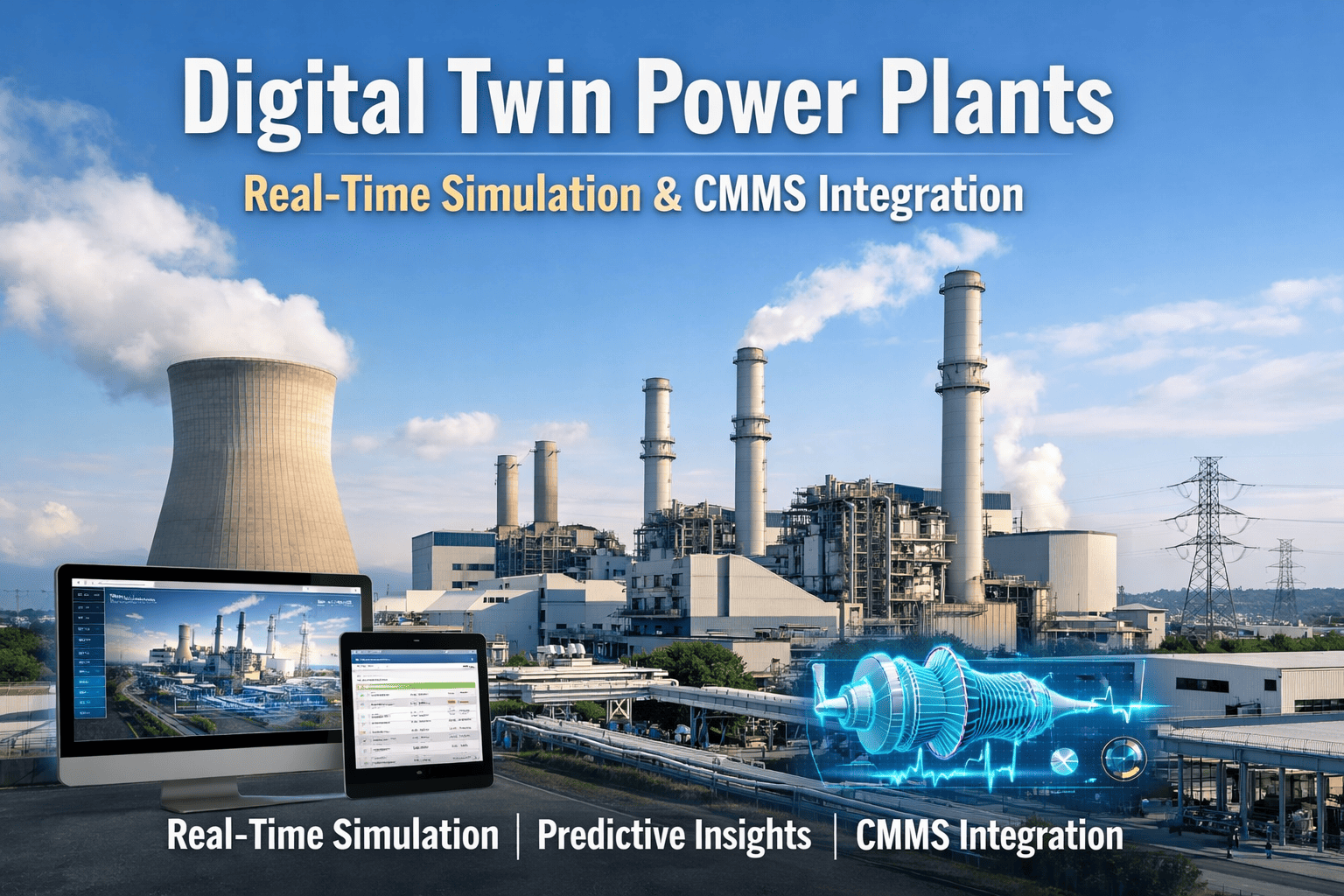
Power plant digital twins are no longer an experimental technology — they are the operational backbone of every top-quartile generation asset in the world, and the gap between plants that have deployed them and those still running on reactive maintenance is widening by every operating cycle. The hard truth is that a gas turbine, steam turbine, HRSG, or cooling tower running without a real-time virtual model is essentially flying blind: you get the reading, not the trend; you get the alarm, not the prediction; you get the failure, not the warning. OxMaint's CMMS integrates directly with your plant's digital twin data streams — translating simulation outputs, sensor anomalies, and remaining useful life projections into structured work orders, inspection schedules, and asset health records that your maintenance team can actually act on. If your plant is ready to move from time-based PM to condition-driven, simulation-backed maintenance intelligence, book a 30-minute demo and see how digital twin data becomes maintenance action in under one hour.
Digital Twin · Real-Time Simulation · CMMS Integration
Your Physical Plant Has a Twin.
Does Your CMMS Know What It's Seeing?
Digital twin simulations generate real-time anomaly signals, degradation curves, and remaining-life projections every second. Without a CMMS that ingests and acts on that data, those insights evaporate at the control room screen — never becoming a work order, never becoming a scheduled repair, never preventing the failure.
35%
Average reduction in unplanned downtime after digital twin deployment
$1.2M
Average annual savings per 300MW combined cycle plant with digital twin maintenance
72hrs
Average advance warning before failure when digital twin anomaly triggers CMMS work order
The Technology Explained
What a Power Plant Digital Twin Actually Does — and What It Can't Do Without a CMMS
A digital twin is a physics-based, data-driven virtual model of a physical asset that runs in real time alongside its physical counterpart. For power plants, this means the turbine, boiler, HRSG, generator, and cooling system each have a living mathematical model that receives live sensor data, calculates internal states that sensors cannot directly measure, and projects how those states will evolve. The simulation knows when blade path temperature is diverging from design, when rotor vibration harmonics suggest bearing wear, or when steam chemistry is accelerating tube corrosion — before any hard alarm fires. But a digital twin that outputs anomaly flags to a control room screen and nothing else is only half a solution. The maintenance intelligence it generates must flow directly into the CMMS as structured, actionable work.
What the Digital Twin Generates
Real-time deviation signals when operating parameters diverge from the model baseline
Degradation rate curves for rotating, pressure-boundary, and heat-transfer components
Remaining Useful Life (RUL) projections updated continuously with operating history
What-if simulation outputs for planned maintenance window scheduling and outage risk modeling
Root cause probability scores linking observed symptoms to failure mechanism libraries
What the CMMS Must Provide
Automatic work order generation triggered by digital twin anomaly flags with asset context pre-populated
Asset health history that links each simulation state back to physical inspection findings and corrective actions
PM schedule adjustment based on RUL projections — not fixed calendar dates that ignore actual asset condition
Maintenance record feedback that continuously improves the twin's failure model with real-world outcome data
Compliance documentation for every inspection, repair, and component change tied to the asset's simulation baseline
Asset Coverage
Every Major Power Plant Asset Has a Digital Twin Use Case — and a Maintenance Integration Point
Gas Turbine
Twin Monitors
Compressor efficiency · Hot section metal temperature · Blade path delta-T · Combustion dynamics · Vibration spectrum
Primary Failure Risk
Hot Section Degradation
CMMS Action: Borescope inspection work order auto-triggered when blade path temperature deviation exceeds 8°C from model for 3 consecutive starts
Steam Turbine
Twin Monitors
Differential expansion · Shaft eccentricity · Bearing metal temperature · Steam purity index · Casing distortion model
Primary Failure Risk
Blade Erosion & Rotor Imbalance
CMMS Action: Vibration trending work orders opened when rotor model diverges from measured spectrum by configurable threshold
HRSG
Twin Monitors
Tube wall temperature distribution · FAC thinning rate model · Thermal stress cycle accumulation · Pressure drop trends
Primary Failure Risk
Tube Rupture & Forced Outage
CMMS Action: UT inspection checklist pre-populated with high-risk locations identified by thermal model at each outage
Generator
Twin Monitors
Stator winding temperature · Hydrogen purity · Partial discharge trend · Core flux density · Cooling circuit delta-T
Primary Failure Risk
Winding Insulation Failure
CMMS Action: Insulation resistance test scheduled automatically when partial discharge index trend crosses warning threshold
Cooling Tower
Twin Monitors
Approach temperature trend · Fill media fouling index · Fan blade pitch efficiency · Drift eliminator condition model
Primary Failure Risk
Thermal Performance Loss
CMMS Action: Fill media inspection work order generated when approach temperature exceeds model prediction by 2°C for 7 days
Transformer
Twin Monitors
Oil DGA trend · Hot spot temperature model · Load aging acceleration factor · Paper insulation RUL projection
Primary Failure Risk
Winding Insulation Breakdown
CMMS Action: Oil sample work order triggered by DGA model when dissolved gas ratios indicate incipient fault development
Integration Architecture
How Digital Twin Data Flows Into CMMS Maintenance Action — Step by Step
01
Sensor Data Ingestion & Model Synchronization
Live DCS/SCADA sensor streams feed the digital twin's physics model every 30–60 seconds. The model updates internal state variables — temperatures, stresses, wear indices, and fluid properties — that cannot be directly measured. This creates a continuously synchronized virtual asset running in parallel with the physical plant.
02
Anomaly Detection & Severity Classification
The twin continuously compares actual measurements against model-predicted values. Deviations beyond configurable thresholds are classified by severity — informational trend, maintenance advisory, or action-required flag — based on rate of change and proximity to failure boundary conditions.
03
CMMS Work Order Auto-Generation
Action-level flags pass directly to the CMMS via API. OxMaint receives the anomaly type, affected asset, severity classification, and recommended inspection scope — creating a structured work order pre-populated with the asset's maintenance history, relevant procedure, and assigned team. No manual transcription from control room to maintenance planning.
04
Inspection Execution & Finding Capture
Maintenance technicians complete the digital inspection checklist on mobile — capturing measurements, observations, and photographic evidence against the specific parameters that the twin flagged. Findings are timestamped and stored against the asset's inspection history, closing the loop between simulation alert and physical verification.
05
Outcome Feedback to the Twin Model
Inspection findings — confirmed degradation, replaced components, corrected anomalies — feed back into the digital twin to update its baseline and recalibrate degradation rate models. Each maintenance cycle makes the twin's predictions more accurate and the work order generation more precisely targeted.
Bridge the Gap Today
Digital Twin Signals Without CMMS Action Are Just Expensive Alerts
OxMaint connects your plant's condition monitoring and simulation data to structured maintenance workflows — automatically. Set up your first digital twin-triggered work order template in under 60 minutes, no IT project required.
The Maturity Gap
Four Maintenance Maturity Levels — Where Does Your Plant Stand?
| Maturity Level |
How Maintenance Is Triggered |
Typical Downtime Profile |
Digital Twin Role |
CMMS Role |
| Level 1 — Reactive |
Equipment fails. Repair begins. |
8–14% unplanned downtime annually |
None deployed |
Paper work orders or spreadsheets |
| Level 2 — Preventive |
Fixed calendar intervals regardless of condition |
4–8% unplanned, 15–20% over-maintained |
Not integrated |
PM schedules, manual work orders |
| Level 3 — Condition-Based |
Sensor alarm thresholds trigger maintenance |
2–5% unplanned downtime |
Sensor data only, no simulation |
Condition-triggered work orders |
| Level 4 — Predictive + Twin |
Digital twin RUL projection triggers maintenance 48–96 hrs before failure boundary |
Under 1% unplanned downtime |
Full physics simulation, RUL projection, what-if modeling |
Auto-generated work orders with simulation context, feedback loop to twin model |
Measurable Outcomes
What Plants Report After Digital Twin + CMMS Integration
35%
Reduction in Unplanned Downtime
Combined cycle plants that integrate digital twin anomaly detection with CMMS-triggered maintenance consistently report 30–40% reduction in forced outage events within 24 months of deployment.
22%
Lower Maintenance Labor Cost
Eliminating unnecessary time-based inspections — replaced by condition-triggered work orders from simulation data — reduces total maintenance labor hours while improving coverage of actual high-risk locations.
4–6×
ROI vs. Reactive Maintenance
Industry case studies across gas turbine fleets show 4–6x return on digital twin program investment when CMMS integration converts simulation intelligence into planned repair versus emergency response.
18%
Improvement in Heat Rate
Thermal performance digital twins identify fouling, leakage, and degradation points in heat transfer equipment. Maintenance triggered at optimal intervals maintains design heat rate closer to nameplate across the operating year.
Implementation Best Practices
Six Practices That Separate Successful Digital Twin Programs From Expensive Proof-of-Concepts
01
Start With Your Highest-Value Asset, Not Your Entire Fleet
The most common failure mode in digital twin programs is scope explosion. Deploy the twin on the asset with the highest failure consequence first — typically the gas turbine or HP steam turbine — demonstrate measurable ROI, then expand. A working twin on one asset outperforms a partially-deployed twin across ten.
02
Validate the Twin Against Known Historical Failures
Before trusting RUL projections with maintenance planning decisions, back-test the twin against your plant's documented failure history. If the model would have flagged the 2019 blade failure 72 hours in advance, you have a reliable signal. If it would not have, the model needs calibration before it drives work orders.
03
Connect Twin Outputs to CMMS Before Deploying to Operations
A digital twin that outputs flags to a dashboard but not to the CMMS creates alert fatigue without action. The CMMS integration — automated work order generation, pre-populated inspection templates, asset history linkage — must be in place before the twin goes live, or the signal-to-noise ratio will undermine adoption.
04
Build the Feedback Loop From Day One
The twin improves with every inspection outcome fed back into its model. Configure your CMMS to capture inspection findings — confirmed degradation, replaced components, baseline measurements — in structured format that maps to the twin's model parameters. Plants that establish this feedback loop in year one see dramatically better prediction accuracy by year three.
05
Use What-If Simulation for Outage Window Planning
Digital twins enable scenario modeling: if you delay the planned outage by six weeks, what does the blade path temperature projection show? What is the incremental failure probability for the HP turbine at current degradation rate? These questions — answered in minutes by the twin — replace conservative fixed-schedule decisions with risk-quantified outage planning.
06
Establish KPIs That Close the Loop Between Twin Accuracy and Maintenance Outcomes
Track prediction accuracy (how often did the twin flag issues that inspections confirmed), false positive rate, and work-order-to-failure rate monthly. These metrics identify when the twin model needs recalibration and demonstrate program value to plant leadership in terms of avoided downtime cost and maintenance labor efficiency.
We had vibration monitoring on the HP turbine for four years. The digital twin was added in 2022. Within eight months, the twin generated three work orders that our condition monitoring system never would have flagged — because they involved internal temperature distributions the sensors cannot measure directly. Two of those inspections confirmed early-stage blade damage that would have been a forced outage event in the next operating season. The CMMS integration is what made the difference — the twin outputs became maintenance actions, not dashboard noise.
Plant Engineering Manager · 480MW Combined Cycle Facility · Triple-Pressure HRSG
Free Trial · No Credit Card · Works With Your Existing Sensor Infrastructure
Your Digital Twin Is Generating Maintenance Intelligence Right Now. Is Your CMMS Listening?
OxMaint gives your engineering and maintenance teams the structured CMMS backbone to receive digital twin anomaly signals, convert them into asset-specific work orders, capture inspection findings against simulation parameters, and feed real-world outcomes back into the model. Set up your first integrated inspection workflow today — no implementation fee, no minimum contract.
Frequently Asked Questions
Digital Twin + CMMS Integration — What Power Plant Teams Ask Most
What sensor data does a power plant digital twin actually require to generate reliable RUL projections?
Gas turbine digital twins typically require compressor inlet and discharge temperatures, exhaust temperature spread, vibration signatures at each bearing, fuel flow rates, and power output — most of which are already available in your DCS. HRSG twins require pressure, temperature, and flow data at each pressure section inlet and outlet, plus water chemistry parameters. The physics-based model fills in what sensors cannot measure directly.
Book a demo to map your existing sensor infrastructure against digital twin requirements.
How does OxMaint receive and act on digital twin anomaly signals automatically?
OxMaint's API receives structured anomaly payloads from your digital twin platform — including asset ID, anomaly type, severity level, and recommended inspection scope — and automatically generates a pre-populated work order assigned to the correct maintenance team. The integration is configurable by anomaly type: informational flags create inspection reminders, action-required flags create immediate work orders. No manual transfer from the control room to the maintenance planning team.
Set up your first integration in a free trial.
Can OxMaint track digital twin model accuracy by comparing simulation predictions against actual inspection findings?
Yes. Every work order generated from a digital twin anomaly flag is linked to the inspection findings that resulted — confirmed degradation, false positive, or parameter within acceptable range. OxMaint calculates prediction accuracy rates by asset, anomaly type, and time period, giving your engineering team the data to recalibrate the twin model and demonstrate ROI to plant leadership. This feedback loop is the mechanism by which the twin gets more accurate with every operating cycle.
See how prediction accuracy tracking works in a live demo.
How long does it take to move from digital twin deployment to CMMS-integrated work order generation?
With OxMaint, the integration between your digital twin platform's anomaly outputs and structured work order generation can be configured in under 60 minutes for plants with an existing API-accessible twin. Asset hierarchy setup — mapping turbine, HRSG, generator, and BOP components — takes one to two days. Full inspection checklist configuration for each asset section adds another day. Most combined cycle plants are generating their first digital twin-triggered work orders within a week of starting the setup.
Start your free trial and configure your first asset today.
Does digital twin integration require replacing our existing DCS or condition monitoring systems?
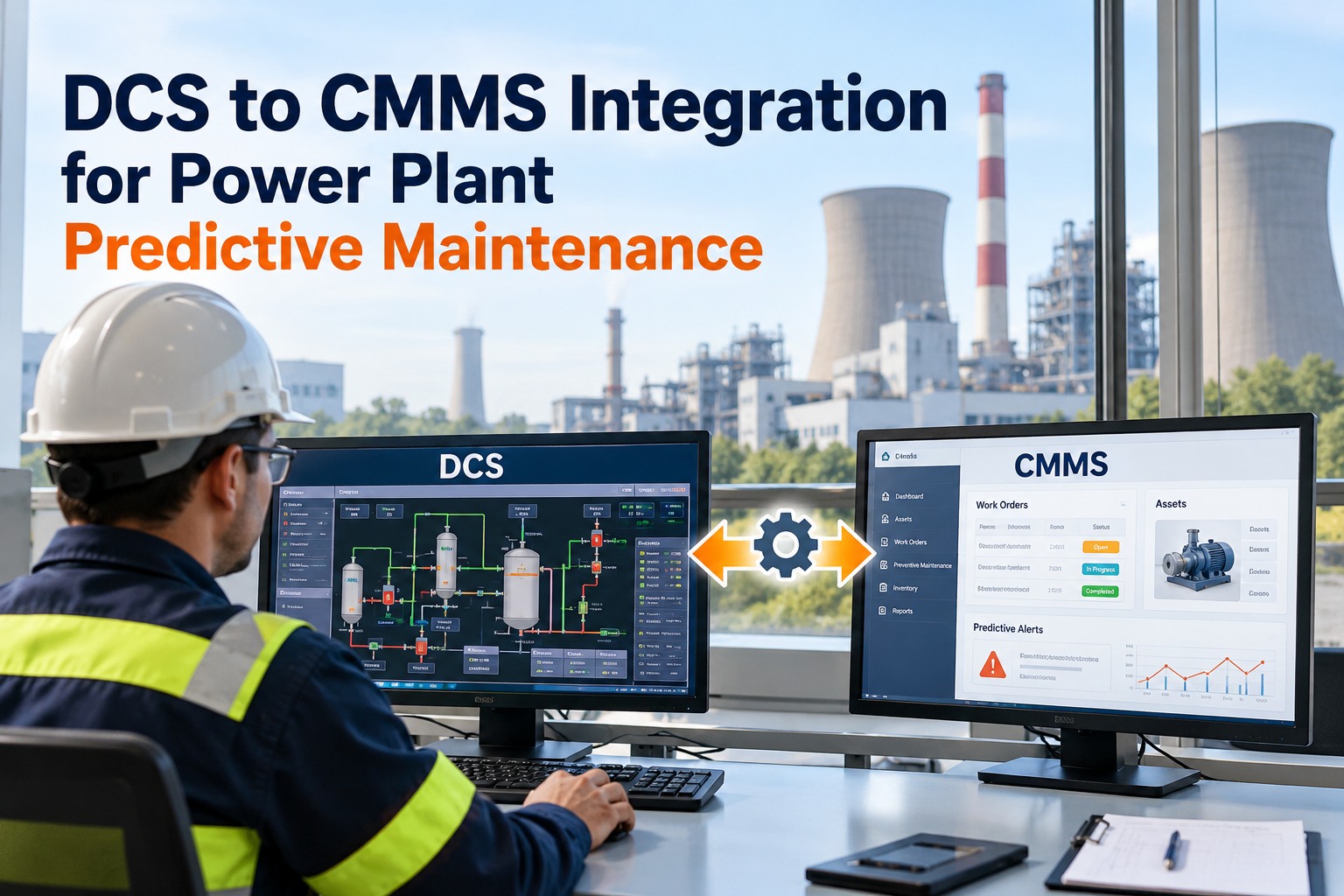
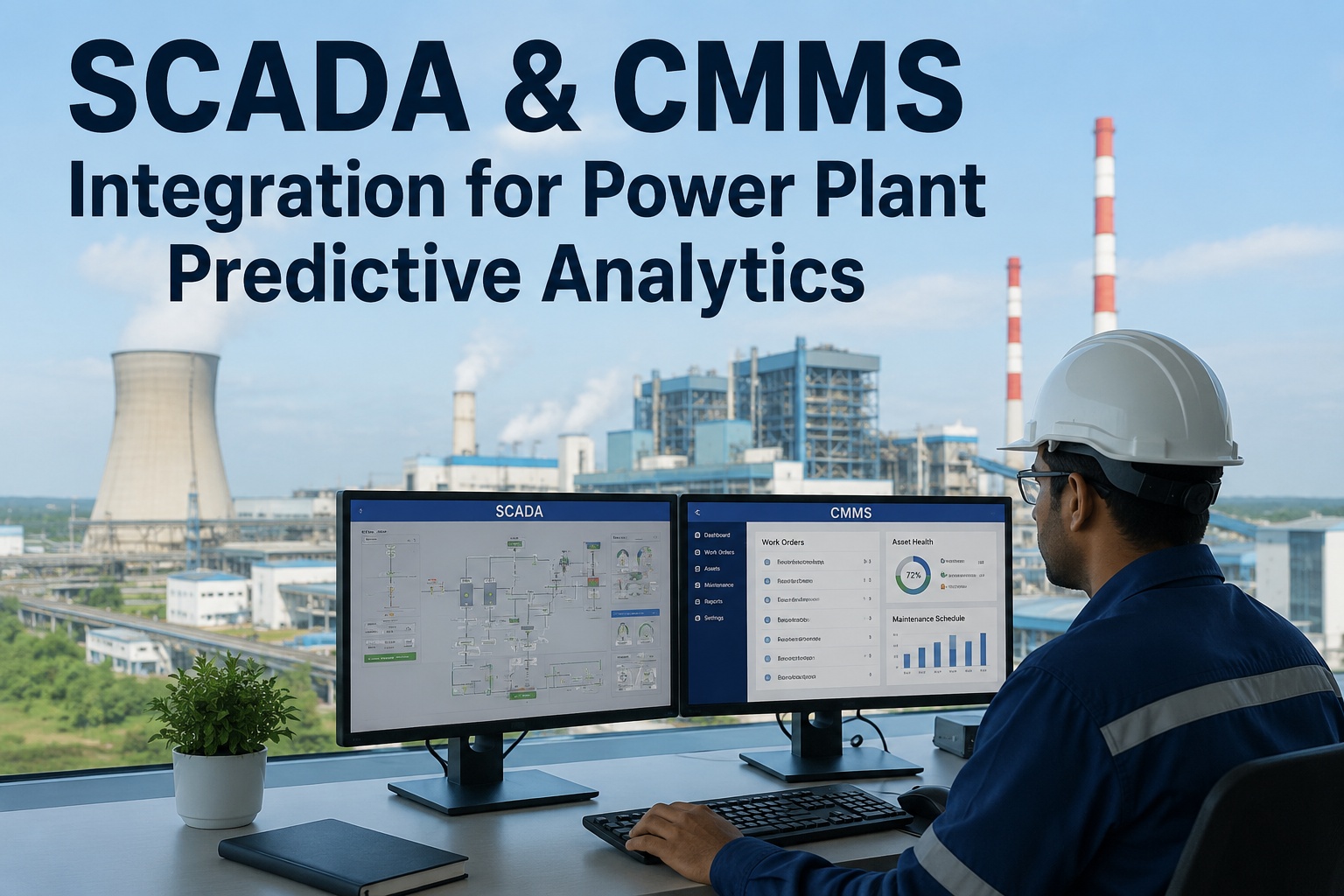
No. Digital twin platforms are designed to sit on top of your existing DCS and SCADA infrastructure, consuming live data through standard historians like OSIsoft PI, GE Proficy, or Honeywell Uniformance. OxMaint then integrates with the twin platform's output layer — not with the underlying sensor network. Your existing control system, alarm management, and historian infrastructure remain unchanged. The CMMS integration adds a maintenance action layer on top of what you already have.
Discuss your existing infrastructure in a 30-minute architecture review.