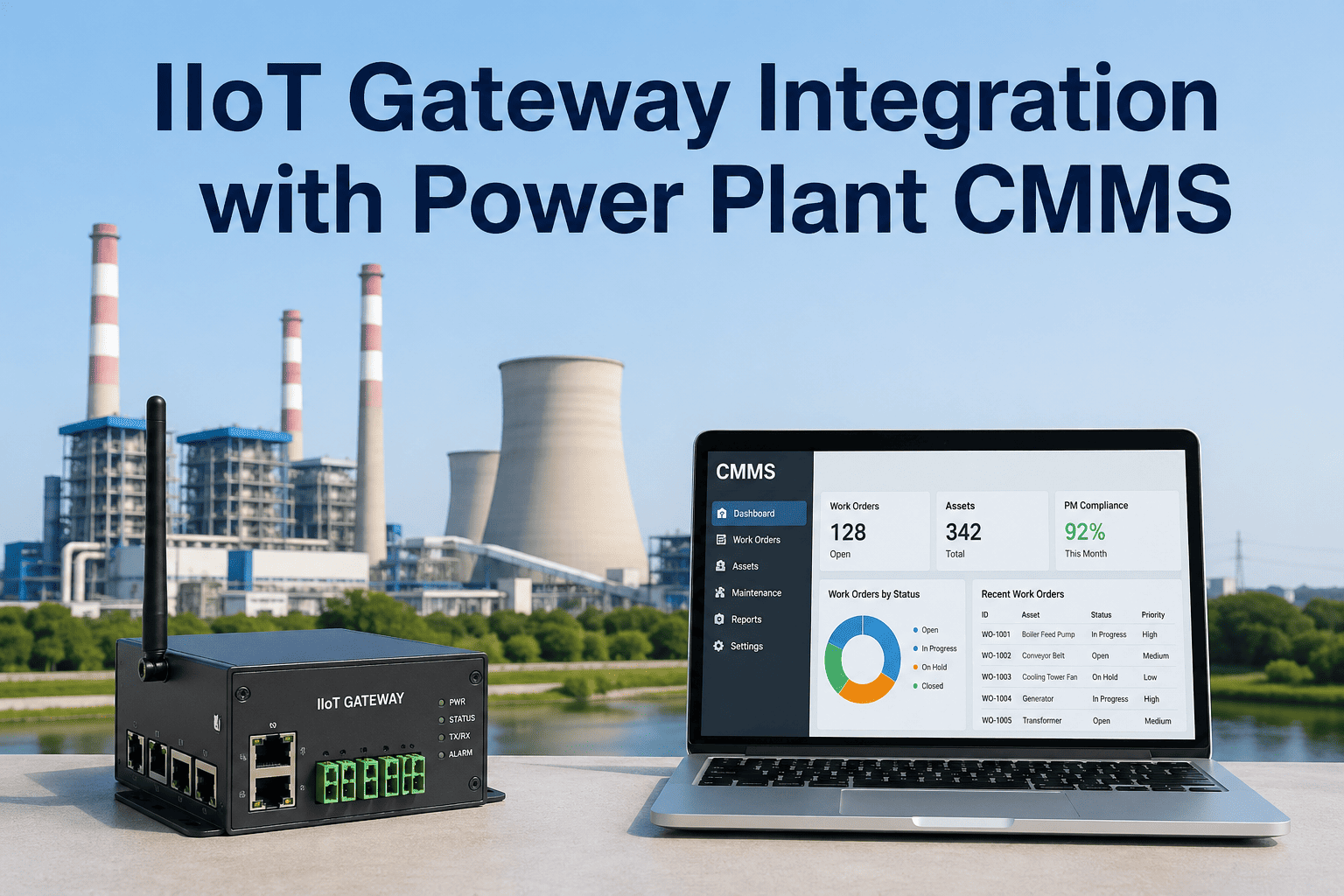
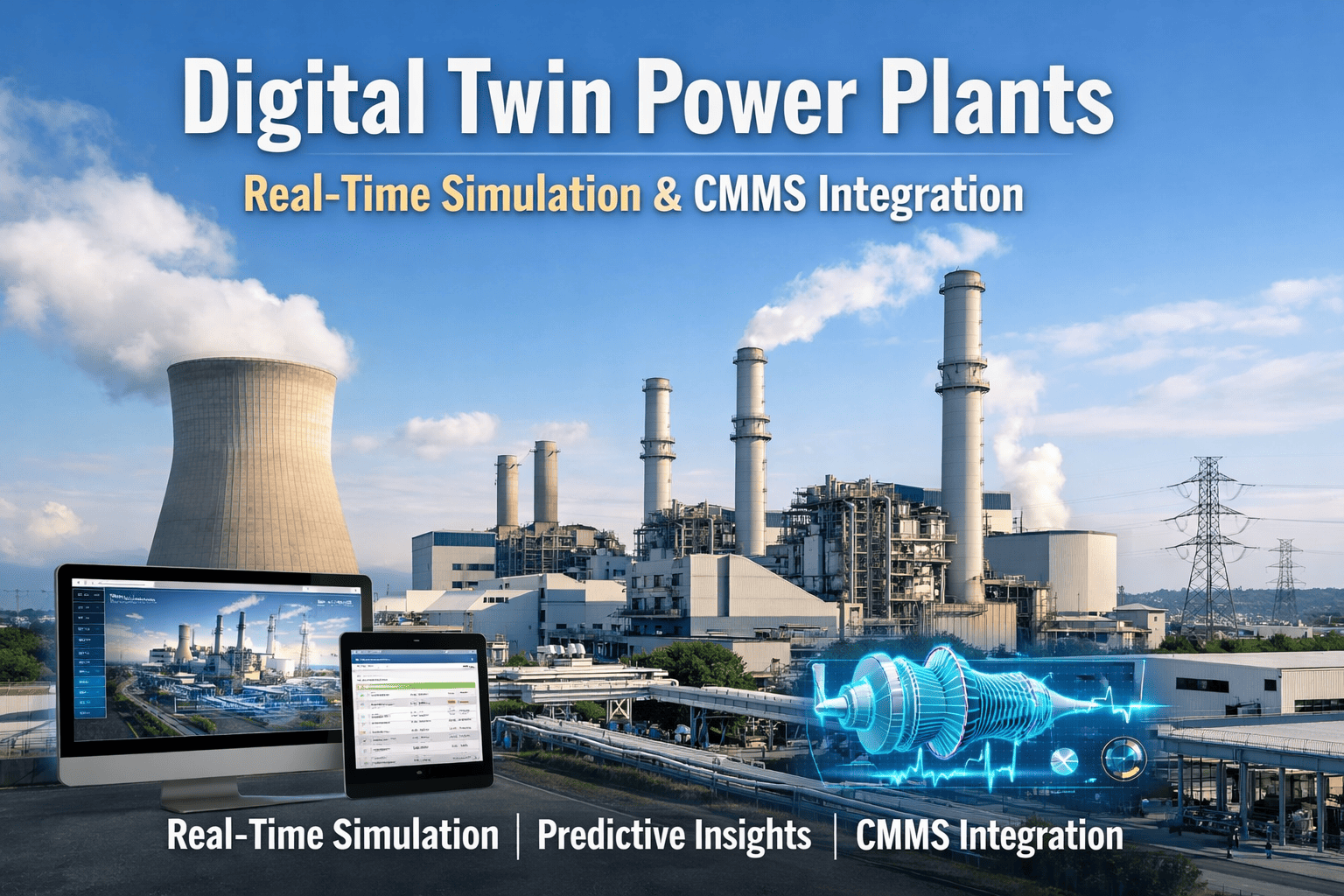
Power plants running NVIDIA Omniverse generate thousands of physics-based simulation signals every hour — compressor efficiency trends, bearing load anomalies, thermal stress distributions that no SCADA system can see. But simulation intelligence sitting in an engineering workstation is not a maintenance strategy. OxMaint bridges that gap by integrating directly with NVIDIA Omniverse's GPU-accelerated simulation engine, converting every predicted failure into a prioritized work order, a parts staging request, and a documented maintenance record — automatically, within seconds of detection. The result is the first closed-loop system where your digital twin doesn't just predict what will break; it triggers exactly what your team needs to do about it. Power plants that deploy this integration recover an average of 3% in annual fuel efficiency, prevent 60% of unplanned outages, and see full ROI within the first quarter of operation. Book a Demo to see how OxMaint turns your Omniverse simulation into live maintenance intelligence.
When GPU-Accelerated Simulation Meets Your Maintenance Workflow — Nothing Breaks Unexpectedly Again
OxMaint connects NVIDIA Omniverse's physics-accurate digital twin engine directly to your CMMS — so every simulation insight becomes a scheduled work order, not a missed failure.
The Gap Nobody Talks About
NVIDIA Omniverse can simulate your entire power plant with photorealistic, physics-accurate fidelity. It can run 1,200x faster than traditional engineering simulation and model every corrosion point, thermal stress zone, and bearing load profile in real time. Siemens Energy is already doing it. Utilities are saving billions. The problem? A simulation that doesn't connect to your maintenance team is just a very expensive screensaver.
OxMaint closes that gap. When Omniverse's GPU-accelerated physics engine detects a divergence — a compressor losing 2.3% efficiency, a bearing temperature trending 4°C above baseline — OxMaint automatically translates that signal into a prioritized work order, assigns it to the right technician, tracks parts availability, and logs it in your maintenance history. The simulation finally does something.
What NVIDIA Omniverse Brings to This Integration
Omniverse is not a traditional SCADA overlay. It is a GPU-powered simulation platform built on OpenUSD — the same open standard that Siemens, Rockwell Automation, Microsoft, and Ansys have all adopted. Here is what it contributes to a joint deployment with OxMaint:
Real-Time GPU-Accelerated Simulation
NVIDIA PhysicsNeMo and PhysX libraries run full thermodynamic, fluid dynamics, and structural models of your rotating equipment on GPU clusters — calculating internal states no sensor can directly measure, updated continuously as live plant data streams in.
Photorealistic 3D Digital Twin
Omniverse's RTX rendering engine creates a physics-accurate 3D replica of your plant. Engineers can visualize stress distributions on turbine blades, corrosion in HRSG pipes, and bearing load profiles in spatial context — not just dashboard numbers.
OpenUSD — Universal Scene Description
The open standard that makes Omniverse interoperable with every major industrial software platform. Your CAD models, SCADA data, sensor streams, and OxMaint maintenance records can all live inside one unified data environment, updated in real time.
Cosmos World Foundation Models
NVIDIA's physics-aware AI generates synthetic degradation scenarios your equipment hasn't experienced yet — training OxMaint's prediction models on failure modes before they occur in the real plant, dramatically expanding predictive coverage.
Before This Integration: The Broken Loop
Most power plants that adopt digital twin technology run into the same problem — a simulation environment completely disconnected from their operational maintenance system. The result is a loop that never closes.
- Omniverse flags turbine efficiency loss — engineers email maintenance team
- Maintenance team manually creates a work order days later
- No parts pre-staging — wait time extends 2–3 weeks
- Simulation results not linked to historical maintenance records
- Failure prediction expires before anyone acts on it
- ROI from simulation investment never fully materializes
- Omniverse detects efficiency divergence — OxMaint work order created automatically
- Technician notified, parts inventory checked, schedule proposed in minutes
- Maintenance history linked to simulation event for future model calibration
- Every intervention logs back to the twin — models get smarter over time
- Finance dashboard shows cost-per-prevented-failure in real time
- Full ROI on Omniverse investment captured and reportable
How the Integration Works: The Data Pipeline
The integration runs as a continuous bidirectional loop between four layers. Understanding this pipeline is key to understanding why predictions actually become maintenance actions.
The loop closes when completed maintenance data feeds back into Omniverse, recalibrating the physics models to your plant's specific operating history. Models improve continuously — your first-year prediction accuracy of 82% grows to 90%+ by year two.
Capability Comparison: SCADA vs. Omniverse vs. Omniverse + OxMaint
Not all monitoring approaches are equal. Here is an honest breakdown of what each layer can and cannot do for a power generation operation team.
Annual ROI Breakdown — 400–600 MW Plant with Omniverse + OxMaint
GPU simulation intelligence translating into quantified financial outcomes across five value streams
Deployment Timeline: From SCADA to GPU-Powered Digital Twin in 6 Weeks
OxMaint is pre-integrated with NVIDIA Omniverse APIs and pre-built physics models for every major power generation asset. There is no custom software development. Deployment is a configuration exercise.
Frequently Asked Questions
Does OxMaint require us to already have NVIDIA Omniverse licensed and deployed?
No. OxMaint can deploy as a standalone digital twin platform using its own physics-based simulation engine, or in a full integrated configuration with NVIDIA Omniverse Enterprise for GPU-accelerated simulation. Most power plants start with OxMaint's built-in simulation layer, which goes live in 4–6 weeks, and upgrade to the full Omniverse integration as their digital twin strategy matures. NVIDIA Omniverse Enterprise is licensed at $4,500 per GPU per year with a 90-day free trial — OxMaint's team can help you scope the GPU requirements for your plant's asset inventory.
What does "GPU-accelerated simulation" actually mean for a maintenance team?
Traditional physics simulation of a single HRSG pipe corrosion model takes up to eight weeks on CPU-based systems. NVIDIA's GPU acceleration — demonstrated by Siemens Energy — runs the same model in real time, continuously, updated as live plant data streams in. For maintenance teams, this means failure predictions are not based on last month's data or a scheduled quarterly analysis. They reflect what your equipment is doing right now, with the physics calculated every few seconds rather than every few weeks.
How does OpenUSD connect Omniverse to OxMaint's CMMS?
OpenUSD is NVIDIA's open data standard for describing 3D scenes, assets, and simulation states. OxMaint uses the Omniverse Cloud APIs — specifically USD Query and USD Notify — to subscribe to simulation state changes in real time. When Omniverse's physics engine calculates a divergence from baseline (such as a bearing temperature trending 5°C above its simulated normal), the USD Notify API pushes that event to OxMaint's AI layer, which scores the failure probability and translates it into a prioritized work order within seconds. No manual handoff, no email chain.
Can the Omniverse digital twin be used to train operators on abnormal events?
Yes — and this is one of the highest-value applications of the integrated platform. Once your Omniverse twin has established accurate baselines, NVIDIA Cosmos world foundation models can inject synthetic fault scenarios — a generator hydrogen seal leak, a boiler tube rupture, a turbine bearing cascade — into the simulation. Operators experience and respond to these events in a photorealistic virtual environment before ever encountering them on real equipment. OxMaint's procedure library integrates directly into the training environment, so operators practice the actual documented response procedure against a physics-accurate simulation of your specific plant.
Your Plant's Physics Are Being Simulated Right Now. You Just Can't See the Results Yet.
OxMaint connects NVIDIA Omniverse's GPU-accelerated simulation to your maintenance workflow — turning invisible degradation signals into scheduled interventions before they become forced outages. Start with your highest-consequence assets and prove ROI in the first quarter.