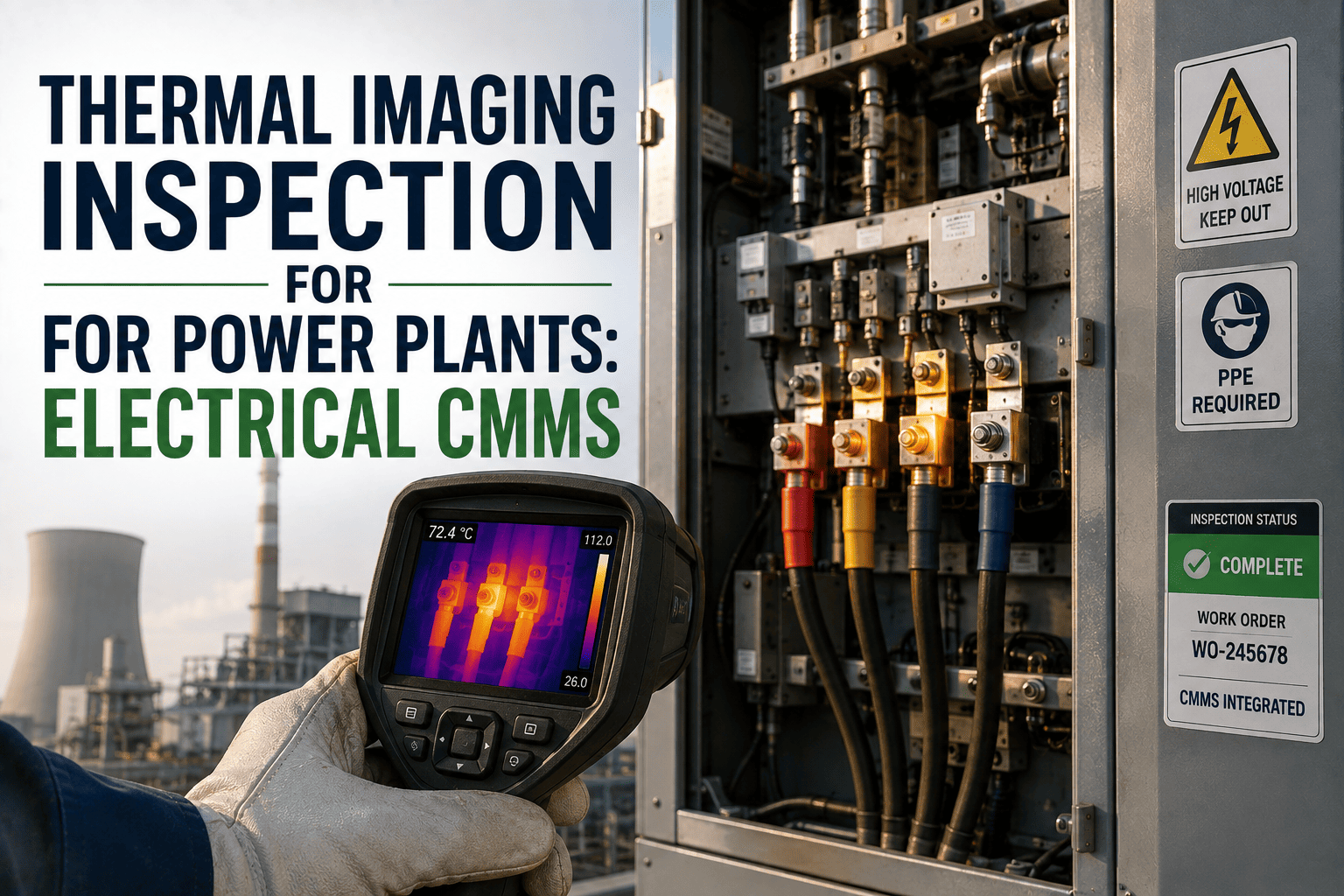
Electrical equipment failures are the leading cause of unplanned outages at power plants — not because plant teams lack knowledge, but because inspection findings, test results, and calibration records are scattered across spreadsheets, paper logs, and individual engineer files that nobody is systematically trending. A switchgear panel that has generated three arc flash events in eighteen months is not a surprise failure — it is a pattern that a connected CMMS would have flagged after event two. Sign in to OxMaint to activate a dedicated electrical asset maintenance CMMS for your power plant, or book a demo to see how OxMaint tracks switchgear inspections, relay calibration schedules, cable test histories, and busbar health across your entire electrical infrastructure.
Electrical Equipment CMMS · Power Plant Asset Management · OxMaint
Switchgear Inspection. Relay Calibration. Cable Testing. Busbar Health. One CMMS That Connects Every Electrical Asset's Maintenance History Into a Single Reliability Picture.
Power plant electrical infrastructure is complex, safety-critical, and chronically under-trended. OxMaint gives electrical maintenance teams the asset management platform that converts inspection findings, test results, and calibration records into the predictive reliability intelligence that prevents forced outages.
45%
of power plant forced outages are caused by electrical equipment failures that had prior warning signals in maintenance data
€2.4M
average cost of a major switchgear failure at a grid-connected power plant including outage, repair, and regulatory response
55%
reduction in electrical equipment-related forced outages at plants using digital inspection trending and threshold alert management
45%
of power plant forced outages caused by electrical equipment failure had at least one abnormal inspection reading or test result in the 90 days prior to the failure event. Insulation resistance trends showing consistent decline. Relay calibration results drifting from set-point. Partial discharge measurements increasing over successive tests. This data existed. The trend analysis did not. OxMaint connects every electrical asset's inspection and test history into a unified reliability record that generates action alerts before failures become forced outages.
Four Electrical Asset Domains OxMaint Tracks at Power Plants
SWG — Switchgear
Switchgear Inspection & Condition Monitoring
HV and MV switchgear at power plants operates under fault current stress, thermal cycling, and SF6 or vacuum arc interruption duty that progressively degrades insulation, contact surfaces, and operating mechanisms. Scheduled inspection intervals alone cannot reliably detect the developing insulation degradation, contact erosion, or mechanism wear that precedes a switchgear failure. OxMaint records every switchgear inspection finding, partial discharge measurement, SF6 gas analysis result, and contact resistance test against the specific panel asset — creating the trending data that identifies degrading switchgear before it fails under fault current.
Sign in to OxMaint to configure switchgear asset records and inspection tracking for your power plant.
Key Diagnostic Parameters Tracked
Contact resistance (mΩ) — trend against commissioning baseline
Partial discharge magnitude — pC measurement per phase
SF6 gas density — trend for leak detection in GIS installations
Insulation resistance — phase-to-phase and phase-to-earth
Trip mechanism operation time — compare to specification
Primary Failure Modes OxMaint Tracks
Insulation breakdown — detected via PD trend and IR decline
Contact overheating — identified by resistance trend increase
Mechanism failure — detected by operation time drift
RLY — Protection Relays
Relay Calibration & Protection System Management
Protection relays are the last line of defense against catastrophic electrical equipment damage at power plants — and they are only as reliable as their most recent calibration test confirms. Relay calibration drift, incorrect set-point settings following plant configuration changes, and uncalibrated relays in service are among the most consequential maintenance failures in power plant electrical systems. OxMaint tracks every relay calibration result, set-point record, and test interval against the individual relay asset — generating alerts when calibration intervals are approaching, when test results show drift from specification, and when plant configuration changes require relay setting review.
Book a demo to see relay calibration record management in OxMaint.
Key Diagnostic Parameters Tracked
Operating time at rated pick-up current — compare to curve
Set-point values — record every setting change with authorization
Contact resistance at test terminals — flag degradation
Burden at rated current — compare to CT/VT specification
Primary Failure Modes OxMaint Tracks
Incorrect operation — caused by uncalibrated timing at set-point
Non-operation — contact failure or control circuit fault
Over-reach/Under-reach — set-point drift after plant changes
CBL — Cable Systems
Cable Testing & Insulation Health Tracking
HV and MV cables at power plants degrade through thermal ageing, moisture ingress, mechanical damage at joints and terminations, and partial discharge activity that eventually punctures the insulation under operating voltage stress. Cable failures — particularly at joints — cause long outages and expensive remediation. Cable insulation testing, partial discharge measurement, and thermal imaging of cable routes and terminations are the diagnostic tools that detect degrading cable insulation before it fails in service. OxMaint records every cable test result, joint inspection finding, and thermal survey outcome against the cable segment asset — building the trend data that identifies high-risk cable sections for targeted intervention.
Sign in to OxMaint to activate cable health tracking for your power plant HV infrastructure.
Key Diagnostic Parameters Tracked
Insulation resistance — per phase at 1kV or 5kV DC
Partial discharge — phase-resolved PD measurement at joints
Thermographic survey temperature — trend delta at terminations
Tan delta (dissipation factor) — water tree degradation indicator
Primary Failure Modes OxMaint Tracks
Joint insulation failure — detected by PD activity increase
Termination overheating — identified by thermal survey trend
Water tree formation — tan delta rise indicates ageing cable
BSB — Busbars
Busbar Health & Connection Monitoring
Busbars at power plants carry the highest sustained current loads in the electrical distribution system — and their failure mode, when it occurs, is typically a catastrophic arc flash event that destroys the switchboard and shuts down entire sections of the plant. Busbar health is monitored through thermographic surveys that detect developing hot joints, contact resistance measurement at bolted connections, and visual inspection for signs of tracking, corrosion, or mechanical damage. OxMaint records thermographic survey findings, contact resistance measurements, and torque inspection records against each busbar section and connection point — enabling maintenance engineers to identify high-resistance joints before they develop into arc flash events.
Book a demo to see busbar thermal trend tracking in OxMaint.
Key Diagnostic Parameters Tracked
Thermographic temperature at connections — delta-T vs. ambient
Contact resistance at bolted joints — trend per connection
Bolt torque verification — record at installation and re-torque
Visual condition grading — tracking, corrosion, insulator damage
Primary Failure Modes OxMaint Tracks
Arc flash at joint — preceded by thermal hotspot trend
Insulation tracking — detected by visual grading trend
OxMaint Electrical Asset CMMS · Power Plant Maintenance Management
Every Switchgear Inspection, Relay Calibration, Cable Test, and Busbar Survey Your Team Conducts Should Connect Into a Single Asset Reliability Record
Disconnected spreadsheets and paper logs don't trend. OxMaint does — and the trend alerts you before the failure costs you a forced outage.
The Four Most Valuable Electrical Asset Diagnostic Trends OxMaint Automates
How OxMaint Converts Disconnected Test Results Into Reliability Intelligence
Trend Type · Thermal
Switchgear & Busbar Thermal Trending
Every thermographic survey temperature reading is recorded against the specific joint or panel. OxMaint plots delta-T values across consecutive surveys and generates an alert when temperature rise exceeds the configured threshold or when a consistent upward trend is detected across three or more surveys.
Alert trigger: Delta-T increase 15°C above baseline or consistent 3-survey rise
Trend Type · Insulation
Insulation Resistance Trend Monitoring
IR test results for switchgear panels, cables, and motor windings are recorded per phase and trended across consecutive tests. A declining IR trend — even above the minimum acceptable value — generates a maintenance alert with the trend slope, asset details, and recommended action timing for engineer review.
Alert trigger: 30% IR decline from previous test or below minimum threshold
Trend Type · Calibration
Relay Calibration Drift Detection
Operating time results from relay calibration tests are recorded against the relay's specified time/current characteristic. OxMaint calculates deviation from the operating curve at each test and generates an alert when drift exceeds the acceptable tolerance band — flagging relays that are moving out of calibration before the next scheduled test interval.
Alert trigger: Timing deviation exceeds ±5% of relay specification at test current
Electrical Equipment Failure Risk by Asset Type: What OxMaint Monitors
Critical Risk
Main Generator Circuit Breaker
Failure here during generation causes full unit trip and potential generator damage. Requires quarterly contact resistance, annual full mechanical inspection, and every calibration of generator protection relays logged in OxMaint.
Critical Risk
Unit Auxiliary Transformer HV Switchgear
Failure removes auxiliary supply from the operating unit. SF6 pressure trending, contact resistance, and partial discharge testing results must all be tracked per switchgear panel to provide early warning of developing insulation failure.
Critical Risk
Protection Relay Systems — Generator & Transformer
An uncalibrated generator differential relay or transformer overcurrent relay that fails to operate under fault conditions can result in equipment destruction and extended outages. Annual calibration with full curve testing must be scheduled and recorded against every protection relay in the plant.
Elevated Risk
MV Distribution Switchgear Panels
Distribution panel failures affect multiple plant auxiliaries simultaneously. Thermal imaging of busbar connections, contact resistance testing, and vacuum/SF6 interruption mechanism checks at planned outages — all tracked in OxMaint against each panel asset.
Elevated Risk
HV Cable Circuits to Auxiliary Transformers
Joint failures on HV cables to auxiliary transformers can remove supply to entire station services. Cable circuits require 3-year insulation resistance testing with tan delta measurement at joints and terminations, tracked by cable segment in OxMaint.
Elevated Risk
LV Motor Control Centre Busbars
MCC busbar failures from loose connections cause widespread LV auxiliary outages. Annual thermographic surveys and biennial bolt torque verification on all main connections should be recorded per MCC section to identify developing hot joints before they arc.
Electrical Asset Maintenance Frequency and OxMaint Tracking Coverage
Documented Outcomes from Electrical Asset CMMS Implementation at Power Plants
55%
reduction in electrical equipment-related forced outages at plants using digital inspection trending with threshold alert management
30%
reduction in relay protection misoperation incidents at plants with digital calibration record trending and interval management
€1.8M
average annual savings at a European thermal plant from preventing two major switchgear failures detected via partial discharge trending
4–6
electrical asset types typically lacking systematic trend history at plants without a dedicated electrical CMMS
90
days — typical lead time between first detectable diagnostic signal and switchgear or cable failure event
10×
return on investment from predictive electrical maintenance programs vs. time-based inspection alone
72h
typical minimum forced outage duration for an unplanned HV switchgear failure — parts, crane, and specialist contractor
Your next switchgear inspection result is either going into a trend that protects your plant — or into a spreadsheet that nobody will open until after the failure investigation.
OxMaint makes every electrical equipment test result count by automatically connecting it to the asset's history and trending it for early warning alerts.
Frequently Asked Questions — Electrical Equipment Maintenance CMMS for Power Plants
How does OxMaint track switchgear inspection results across a large power plant electrical system?
Every switchgear panel is registered as a discrete asset in OxMaint with its own inspection history, test result records, and maintenance schedule. Inspection findings — contact resistance, IR, PD measurements — are recorded against the specific panel and trended automatically.
Sign in to OxMaint to configure your switchgear asset register and inspection tracking templates.
How does OxMaint manage relay calibration intervals and ensure no relay goes out of calibration in service?
OxMaint tracks the calibration due date for every protection relay based on configurable intervals. Alerts are generated when calibration is approaching, when calibration results show drift from specification, and when plant changes require relay set-point review.
Book a demo to see relay calibration management in practice at a power plant using OxMaint.
Can OxMaint track thermographic survey results for busbar connections and generate alerts when temperature rises?
Yes. Thermal survey results — delta-T readings at individual connection points — are recorded against each busbar section or connection asset in OxMaint. The platform trends the delta-T value across consecutive surveys and generates an alert when the temperature rise crosses a configured threshold or shows a consistent upward trend across multiple surveys, enabling targeted joint re-torque or replacement before an arc flash event.
How does OxMaint handle cable test results from HV cable circuits with multiple joints and terminations?
Cable circuits can be registered in OxMaint as a circuit asset with individual joint and termination sub-records. Test results — IR, tan delta, PD — are recorded per test point location and trended across consecutive tests. This structure allows the system to identify which specific joint is generating abnormal PD readings, rather than flagging the entire cable circuit.
Sign in to OxMaint to configure cable circuit and joint asset records for your HV infrastructure.
Does OxMaint support integration with external test equipment or laboratory results for electrical asset data?
OxMaint supports manual entry of all electrical test results from external instruments and laboratories — partial discharge analyzers, relay test sets, oil analysis labs, tan delta bridges. Where test equipment provides structured data export, results can be imported directly. All data is trended automatically regardless of input method, enabling the pattern detection that prevents forced outages.
The Switchgear That Will Fail Your Plant Next Quarter Is Already Showing Signs in Your Last Inspection Report. Is Anyone Trending It?
Partial discharge readings increasing across three consecutive quarters. Contact resistance trending upward. Relay calibration drift approaching tolerance limits. This data is generated by every electrical inspection your team conducts. OxMaint converts it from filed results into live reliability alerts that prevent forced outages.