Electrical Safety & Arc Flash Protection Program Managemen

By Johnson on March 12, 2026

electrical-safety-arc-flash-protection-power-plants

There are 5 to 10 arc flash incidents every single day in the United States. Each one releases energy measured in calories per square centimeter — the same unit used to describe bomb blast exposure. A 40-cal/cm² arc flash event, common at medium-voltage switchgear in power plants, generates a thermal pulse equivalent to having a stick of dynamite explode 12 inches from your face. Yet the vast majority of these incidents are entirely preventable: the worker was not wearing the right PPE for the incident energy level at that specific equipment because the arc flash hazard analysis had not been completed, had expired, or could not be located when the work order was issued. Sign up free on OxMaint to connect your arc flash study data, PPE requirements, equipment records, and electrical safety training into one platform — so the right protection level reaches the right worker at the right equipment every time.

NFPA 70E 2024 Edition + OSHA November 2024 Update Now in Effect

Arc Flash Kills in Milliseconds. Your Safety Program Must Work in the Same Timeframe.

OSHA released its first major arc flash safety update in over two decades in November 2024 — coinciding with the 2024 NFPA 70E edition. Both now require proactive risk assessments, documented PPE selection rationale, and updated approach boundaries for every energized work task above 50V.

ARC FLASH INCIDENT ENERGY SCALE
CAT 1

1.2–4 cal/cm²
Arc-rated shirt + pants
CAT 2

4–8 cal/cm²
Arc-rated coveralls + face shield
CAT 3

8–25 cal/cm²
Arc flash suit + hood required
CAT 4

25–40+ cal/cm²
Maximum protection — heavy arc suit
Arc flash study must be reviewed every 5 years or after major system modification — NFPA 70E 130.5

Four Pillars of an NFPA 70E-Compliant Electrical Safety Program

An electrical safety program at a power plant is not a single document — it is four interlocking program elements that must all function together. When any one pillar is missing or outdated, the entire program fails the OSHA General Duty Clause review that uses NFPA 70E as its benchmark. Book a consultation with OxMaint's safety team to assess where your current program stands against the 2024 standard requirements.

01
NFPA 70E 130.5

Arc Flash Risk Assessment

Every piece of electrical equipment where energized work may be performed must have a documented arc flash risk assessment determining incident energy levels and arc flash boundaries. The 2024 NFPA 70E now emphasizes "Operating Condition" — assessments must reflect actual maintenance state, not just design specifications. Assessments expire every 5 years or after any major system modification, whichever comes first.

Common failure: Assessments performed once and never updated after protective device changes
02
NFPA 70E 130.7

PPE Selection & Tracking

The incident energy method requires matching PPE arc rating to the calculated incident energy at each specific equipment location. Under the 2024 edition, anyone inside the arc flash boundary must wear hearing protection regardless of whether they are actively working. PPE selection rationale must be documented per task — and arc-rated garment inspection, arc rating verification, and replacement tracking must all be maintained with records available for OSHA review.

Common failure: Workers select PPE category by equipment voltage class instead of incident energy calculation
03
NFPA 70E 110.2 + 120

Electrically Safe Work Condition (ESWC)

The 2024 NFPA 70E now requires employers to establish, document, and implement an ESWC policy that makes hazard elimination the first priority — not the fallback after PPE selection. The policy must specify how equipment is de-energized, locked out, tested for absence of voltage, and restored after work. This written policy must be referenced in all work authorizations for energized electrical work.

Common failure: LOTO procedures exist but ESWC policy is not explicitly referenced in work permit workflows
04
NFPA 70E 110.2 + 29 CFR 1910.332

Qualified Worker Training & Requalification

Only "qualified persons" as defined by NFPA 70E may perform energized electrical work. Qualification is equipment-specific and task-specific — being qualified to work on 480V MCC buckets does not qualify a worker for 15kV switchgear. Training must be documented, tied to specific equipment and voltage levels, and refreshed whenever there are changes to tasks, equipment, or applicable regulations. The 2024 edition's new scope language strengthens the employer's documentation obligation.

Common failure: Training records exist by name but cannot be filtered by equipment type or voltage level during OSHA inspection
NFPA 70E 2024 — Electrical Approach Boundaries Explained
Arc Flash Boundary
Distance where incident energy equals 1.2 cal/cm² — minimum threshold for second-degree burn. Calculated per IEEE 1584 for each piece of equipment. Varies by system voltage and fault clearing time.
Arc-rated PPE required inside this boundary
Limited Approach Boundary
Distance from energized conductor where electric shock risk exists. Only qualified persons may cross without escort. Unqualified persons may enter only with qualified escort and under continuous supervision.
Shock protection PPE + qualified person required
Restricted Approach Boundary
Closer distance where increased shock risk exists from inadvertent movement. Qualified persons only — must use shock protection equal to the voltage level present. An insulated tool must be used for any contact with energized parts.
Insulated PPE + insulated tools + qualified person only
Prohibited Approach Boundary
Treated as direct contact with energized conductor. Working within this boundary requires the same protection as direct contact with the conductor. Specific written authorization and maximum PPE required for any work at this distance.
Written authorization + maximum PPE + qualified person

Does Your Arc Flash Study Still Reflect Your Plant's Actual Equipment Condition?

Every protective device change, transformer replacement, or system modification that has occurred since your last arc flash study means your current labels may show the wrong PPE requirement. OxMaint tracks arc flash study status per equipment asset, triggers 5-year review alerts, and connects updated incident energy data directly to work order PPE requirements — so workers always get the right protection level.

How OxMaint Manages Your Electrical Safety Program

OxMaint connects the four pillars of your electrical safety program into a single managed workflow — arc flash data linked to equipment assets, PPE requirements embedded in work orders, training records tied to qualified person authorizations, and ESWC policy compliance tracked with every permit. Here is how each element operates inside the platform.

01
Equipment Asset Registry with Arc Flash Data
Every switchgear panel, MCC, transformer, and electrical distribution board is registered as an asset in OxMaint with its arc flash study data — incident energy in cal/cm², arc flash boundary distance, PPE category, and study date. When the 5-year review window approaches, the system generates a review work order automatically. If a major system modification occurs, the asset's arc flash status is flagged as requiring reassessment before any energized work is authorized.
NFPA 70E 130.5 compliance automated
02
PPE Requirements Embedded in Work Orders
When a work order is created for energized electrical work, OxMaint pulls the arc flash data from the equipment asset record and displays the required PPE category, minimum arc rating, and specific garment requirements as mandatory work order fields. The work order cannot be approved without documented PPE selection — and the selection is recorded with a timestamp in the asset's compliance history. Workers cannot proceed with an incorrect PPE selection for that specific equipment.
PPE selection error prevention at authorization point
03
Qualified Person Authorization by Equipment & Voltage
OxMaint stores training records linked to specific equipment types and voltage classes — not just a generic electrical safety certification. When a work order is assigned, the system verifies that the assigned technician has current qualified person status for that specific equipment category. Expired or missing qualifications block work order assignment and trigger a training notification to the supervisor. OSHA inspection requests for qualified person documentation are fulfilled from this record in under two minutes.
Equipment-specific qualification enforcement
04
Arc-Rated PPE Inventory & Condition Tracking
Arc-rated garments degrade with washing and use — and arc ratings cannot be verified visually. OxMaint tracks each arc-rated garment by asset tag, assigned worker, arc rating (cal/cm²), issue date, inspection status, and wash count. Garments approaching manufacturer-specified replacement thresholds are flagged before they are deployed in the field. Annual arc flash PPE inspection records are stored with photo documentation — producing the garment maintenance records that NFPA 70E 130.7 requires employers to maintain.
Arc-rated PPE degradation tracking per garment

Real OSHA Enforcement: What Non-Compliance Actually Costs

NFPA 70E is not law — but OSHA uses it as the benchmark for General Duty Clause citations for electrical hazards. When an arc flash incident occurs and investigators find a missing risk assessment, an incorrect PPE selection, or an unqualified worker, OSHA cites the General Duty Clause and references NFPA 70E to establish what the employer should have done. The following enforcement actions from 2024 show what the documentation gap actually costs.

Incident / Citation (2024) Violation Found OSHA Citation Basis Penalty What a Safety Platform Prevents
Employee electrocuted — utility pole operations (Jan 2024) No arc flash risk assessment for specific task; PPE not matched to incident energy level present General Duty Clause + NFPA 70E 130.5 referenced $16,131 serious citation Arc flash study linked to task type; PPE requirement enforced at work order issuance
Worker killed — energized electrical equipment contact (March 2024) Energized work performed without documented ESWC policy; no qualified person verification 29 CFR 1910.333(b)(1) + NFPA 70E 110.2 $49,650 (Tesla 2024 citation) ESWC policy compliance enforced in permit workflow; qualification check blocks unqualified assignment
Multiple arc flash exposures — industrial facility inspection (2024) Arc flash study data present but not communicated to workers at point of work; labels missing on 30% of panels NFPA 70E 130.5(C) — failure to inform workers of hazard $15,000–$75,000 range per willful pattern Arc flash data displayed on work order per equipment asset; missing label flagged as open compliance item
Repeat citations — PPE not maintained per manufacturer specifications Arc-rated garments used beyond rated service life; wash count exceeded; arc rating not verified NFPA 70E 130.7(E) + General Duty Clause Up to $165,514 for willful / repeat Per-garment wash count and service life tracking; replacement triggered before field deployment

Frequently Asked Questions

NFPA 70E 130.5 requires that arc flash risk assessments be reviewed and updated at intervals not to exceed 5 years, and also after any major modification or renovation to the electrical system. The 2024 edition added important clarity: the assessment must reflect the actual "Operating Condition" of the equipment — meaning the assessment must account for the maintenance state of protective devices, not just their design specifications. A correctly designed overcurrent protective device that has not been maintained and tested per NFPA 70B may have a longer clearing time than its design value, which increases incident energy significantly. In OxMaint, each equipment asset carries its arc flash study date and a system-generated 5-year review alert. Any maintenance work order that modifies protective devices, transformers, or fault current sources automatically flags the associated arc flash assessment for re-evaluation — ensuring studies stay current with the actual system state rather than the original design.
NFPA 70E 130.5(C) allows two methods for PPE selection. The PPE Category Method uses tables in NFPA 70E to assign a category (1–4) based on equipment type and task — it is faster but only applicable when the system parameters fall within the table's defined ranges of fault current and clearing time. If the system parameters exceed the table boundaries, the table method cannot be used and an arc flash study is required. The Incident Energy Method uses actual calculated incident energy values from an IEEE 1584-based arc flash study to select PPE with a minimum arc rating equal to or exceeding the calculated incident energy at the working distance. The Incident Energy Method is more precise and is typically required for medium-voltage equipment in power plants where system parameters routinely exceed the table method's applicable range. OxMaint stores both the PPE category and the calculated incident energy value for each equipment asset, and displays both to workers — but flags equipment where only the category method was applied and where a study is recommended given the system configuration.
NFPA 70E defines a qualified person as one who has demonstrated skills and knowledge related to the construction and operation of electrical equipment and has received safety training to recognize and avoid electrical hazards. Crucially, qualification is task-specific and equipment-specific — a worker who is qualified for 480V work is not automatically qualified for 15kV switchgear. In OxMaint, training records are stored with equipment-type and voltage-level attributes, not just a generic course name. When a work order is created for energized electrical work, the platform checks the assigned worker's qualification record against the specific equipment type and voltage class of the work order's equipment asset. If the worker lacks a current qualification record for that specific combination, the work order assignment is blocked and the supervisor receives a notification identifying the specific qualification gap. This prevents the common failure mode where a worker is assigned to energized work based on general electrical experience rather than documented qualification for that specific equipment category.
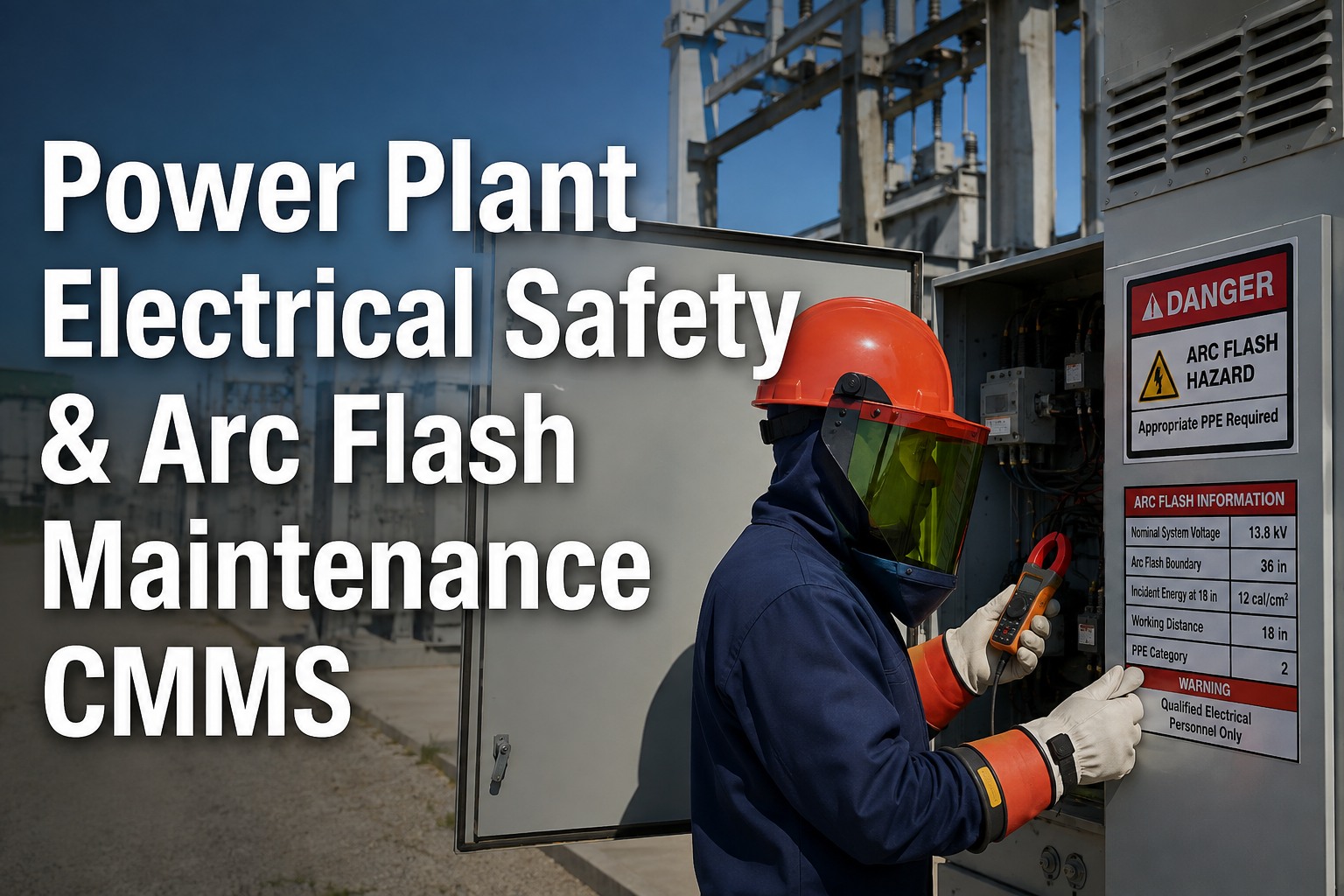
OxMaint stores all the data elements required for NFPA 70E arc flash labels — nominal system voltage, arc flash boundary, required PPE category or minimum arc rating, incident energy level, working distance, and date of study — linked to each equipment asset record. This data can be exported in a label-ready format for integration with label printing systems. For facilities conducting new or updated arc flash studies, the study data imported into OxMaint populates all label fields automatically, eliminating manual data entry errors between the study results and the physical labels applied to equipment. When an arc flash study is updated and incident energy values change, OxMaint flags all affected equipment assets as requiring label replacement — with a generated work order for the re-labeling activity to ensure no panel is left with an outdated label showing the previous, potentially incorrect PPE requirement. Label currency is tracked as a compliance item with open-date documentation.
OSHA electrical safety inspections following an arc flash incident typically request arc flash study records and study dates for affected equipment, PPE selection records for the work task performed, qualified person training records for the workers involved, ESWC policy documentation, and any prior citations or hazard communications related to the equipment. OxMaint generates each of these document types as a filtered report in under two minutes. The arc flash study record shows the study date, the calculated incident energy, and the required PPE for the specific equipment involved. The PPE selection record shows every work order where energized work was authorized on that equipment, who selected the PPE, and what category was documented. The training record shows the worker's qualification history filtered by equipment type. The ESWC policy is stored as a document with version history and acknowledgment records. This documentation package — which paper-based programs typically require hours or days to assemble and frequently cannot produce in complete form — is available on demand and carries a complete digital audit trail establishing its integrity.

Arc Flash Incidents Happen in Milliseconds. Compliance Failures Take Months to Build Up.

5 to 10 arc flash incidents happen every day in the United States. The workers who get hurt are almost never at facilities without safety programs. They are at facilities where arc flash study data did not reach the worker at the right time, where PPE selection was not verified before work began, or where training records could not confirm qualification. OxMaint closes every one of those gaps.
Share This Story, Choose Your Platform!