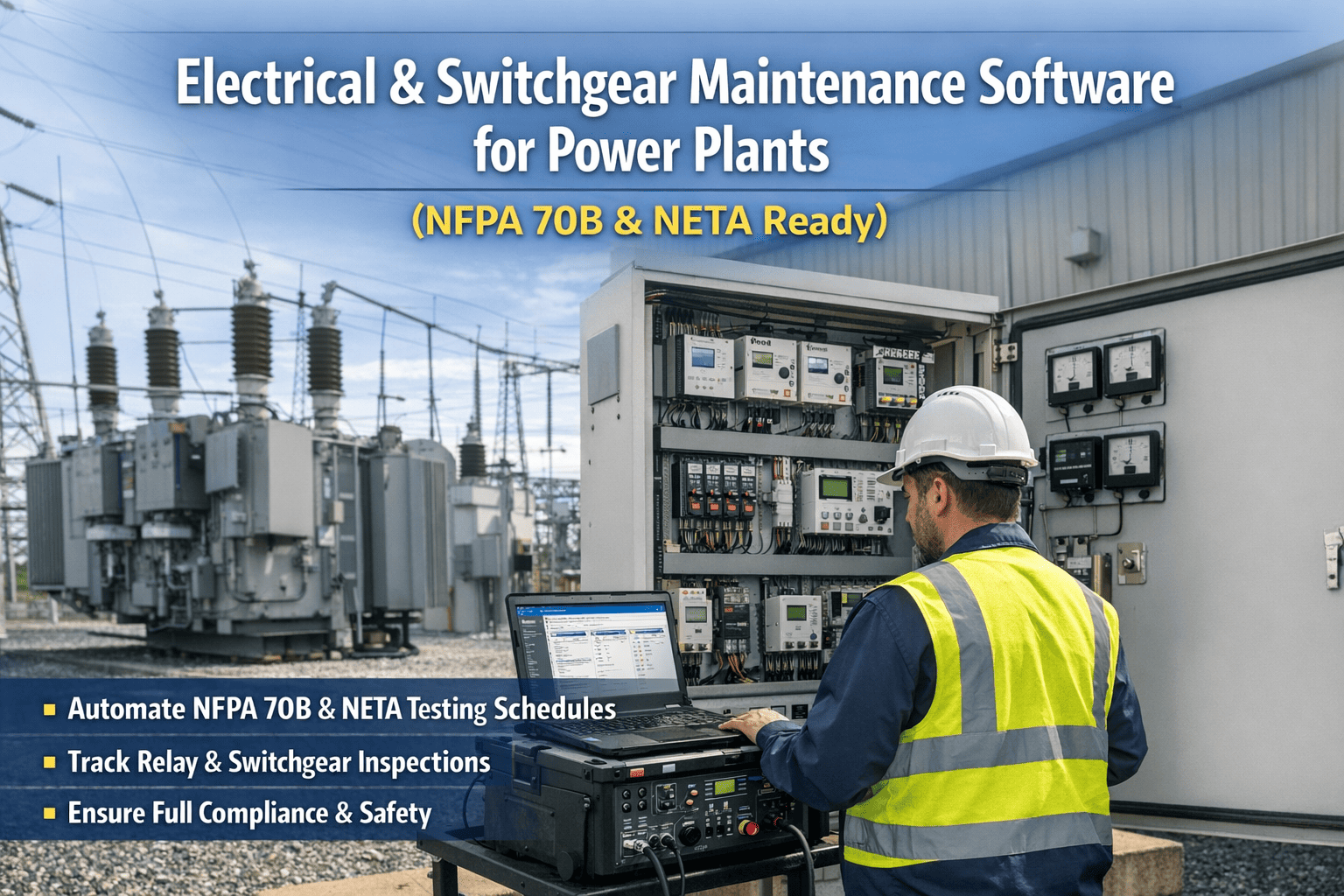
Electrical & Switchgear Maintenance Software for Power Plants (NFPA 70B & NETA Ready)

By Johnson on March 23, 2026

electrical-switchgear-maintenance-software-power-plant-nfpa-neta

As of 2023, NFPA 70B transitioned from a recommended practice to an enforceable standard — making structured electrical equipment maintenance legally mandatory for power plants, not just best practice. If your switchgear testing schedules still live in spreadsheets, your relay calibration history is scattered across paper binders, and your transformer inspection records are impossible to pull during an audit, the compliance gap is already costing you more than you realize. Start your OxMaint free trial and bring your electrical maintenance program into compliance within days.

Electrical CMMS · NFPA 70B · NETA Testing Management

Your Switchgear Does Not Fail Without Warning. You Just Missed the Warning.

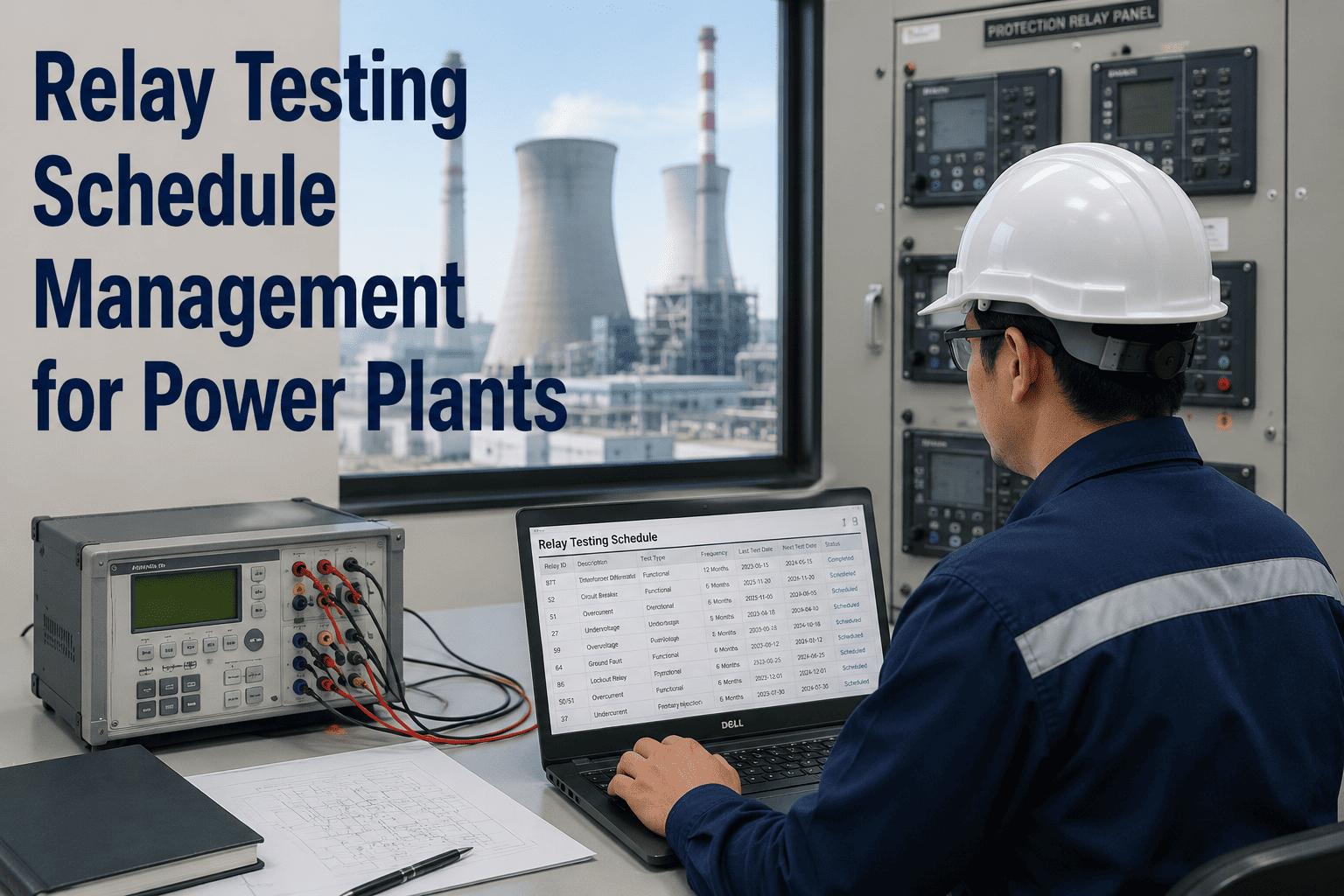
Switchgear is the most reliable — and most overlooked — system in your plant's electrical distribution. Testing every 3 to 5 years per NETA MTS-2023, tracking relay calibration cycles, and documenting transformer test results to NFPA 70B-2023 standards requires a system built for electrical assets. OxMaint is that system.

Electrical Asset Testing Status
11kV Main Switchgear
Due: Apr 2026
On Schedule
Protective Relay — Bay 3
Due: Jun 2026
On Schedule
132kV Transformer — T1
Overdue: 18 days
Action Required
LV Switchboard — Aux
Due: Aug 2026
On Schedule
Bus Duct — Unit 2
Overdue: 34 days
Critical
The Compliance Landscape in 2025–2026

Three Standards Every Power Plant Electrical Team Must Now Manage Together

The electrical maintenance compliance environment for power generation has grown significantly more complex since 2023. Staying on the right side of all three major frameworks simultaneously — without a dedicated system — is increasingly difficult for even experienced maintenance teams.

NFPA 70B — 2023 Edition
Now enforceable, not just recommended
Mandates documented preventive maintenance programs for all electrical equipment — transformers, circuit breakers, switchgear, relays. Chapter 9 sets mandatory maintenance intervals based on three equipment condition ratings. Insurance companies are increasingly using NFPA 70B compliance as an underwriting factor.
Scope: Transformers · Breakers · Switchgear · Relays · Cables
ANSI/NETA MTS-2023
Maintenance Testing Specifications
Specifies the exact field tests and inspections required to confirm continued serviceability of electrical power equipment. Chapter 7 covers switchgear assemblies, protective relays, instrument transformers, cables, circuit breakers, and rotating machinery. Test results must be documented and trended against baseline data.
Scope: Switchgear · Relays · Transformers · Cables · Breakers
ANSI/NETA ATS-2025
Acceptance Testing Specifications
Covers acceptance testing for new and retrofitted equipment — establishing the baseline test data that all future NETA MTS maintenance testing is compared against. New content in 2025 edition includes Battery Energy Storage Systems (BESS) and Solar PV systems — critical for plants adding renewable generation capacity.
Scope: New Equipment · Retrofits · BESS · PV Systems · UPS
The Spreadsheet Problem

What Managing Electrical Maintenance Without a Dedicated CMMS Actually Looks Like


Testing Intervals Missed Silently
Switchgear testing should occur every 3 to 5 years per NETA MTS. Without automated tracking, a unit that passes its first NETA test simply falls off the radar. By the time someone notices, the test is two years overdue and your arc flash study is based on breaker performance data that no longer reflects the equipment's actual condition.

Relay Calibration Has No Ownership
Protective relays require periodic functional checks and calibration to confirm they will trip at the correct threshold when a fault occurs. When calibration records are stored in PDF reports on individual engineers' drives, there is no system-level visibility into which relays are due, overdue, or have failing trends.

Transformer Test Results Cannot Be Trended
NETA MTS requires that maintenance test results be compared against baseline data to identify degradation trends. Paper records and disconnected PDF reports make trend analysis impossible without hours of manual data extraction. A transformer whose insulation resistance is declining year-over-year goes undetected until it fails.

Condition Ratings Not Recorded Systematically
NFPA 70B-2023 Chapter 9 defines three equipment condition ratings that determine the required maintenance interval. Without a system that records and escalates condition ratings, teams default to fixed-interval schedules that do not account for equipment degradation — missing one of the core mechanisms the 2023 standard was designed to enforce.

Audit Evidence Assembled Under Pressure
When a regulatory inspection or insurance audit covers the electrical maintenance program, producing a complete, organized history of every NETA test, relay calibration, and transformer inspection across all assets — across years — from binders and shared drives is a days-long scramble that often reveals gaps nobody knew existed.
Typical Electrical Asset Tracking Reality
Switchgear Records
PDF binder, 2019
Relay Calibration
Engineer's local drive
Transformer Tests
Spreadsheet + emails
Next Test Due
Unknown — no alert
Condition Rating
Not tracked
Audit Readiness
3–5 days scramble
vs. OxMaint
All Asset Records
Centralized, live
Test Schedules
Auto-triggered
Trend Data
Per-asset history
Condition Ratings
Tracked, escalated
Audit Readiness
One-click export
OxMaint · Electrical CMMS · NFPA 70B + NETA Ready

Stop Tracking Switchgear Tests in Spreadsheets.

OxMaint automates NETA testing schedules, tracks relay calibration cycles, and keeps every transformer record audit-ready. See the electrical maintenance workflow live in 30 minutes.

OxMaint Electrical Maintenance Capabilities

Five Capabilities Built for Power Plant Electrical Assets

OxMaint is not a generic CMMS with an electrical module. The platform is built to manage the specific testing cadences, condition-based escalation logic, and documentation requirements that NFPA 70B-2023 and NETA MTS-2023 demand from power generation facilities. See the full feature set in a live demo.

01
Automated NETA Testing Schedules
Define the testing interval for every electrical asset — switchgear, protective relays, transformers, cables, circuit breakers — aligned with NETA MTS-2023 Chapter 7 requirements. OxMaint automatically generates work orders when a test is approaching and escalates overdue items before they become compliance violations. Testing history is logged per asset with every result, technician, and date captured.
Covers all NETA MTS-2023 Chapter 7 equipment categories
02
Relay Testing and Calibration Tracking
Protective relays are the last line of defense before a fault becomes a catastrophic arc flash event. OxMaint tracks every relay's calibration status, trip setpoint, and test date. Calibration due dates are scheduled automatically. When a relay's test results deviate from the baseline, the system flags it for review — giving your team the lead time to act before the next planned outage.
Individual relay records with calibration trend tracking
03
NFPA 70B Condition Rating Management
NFPA 70B-2023 Chapter 9 defines three condition ratings — each with a different mandatory maintenance interval. OxMaint records condition ratings at every inspection, automatically adjusts the next maintenance due date when a rating changes, and maintains a full condition history per asset. Equipment moving from Condition 1 to Condition 2 triggers an automatic schedule recalculation without manual intervention.
Automatic interval adjustment based on condition rating
04
Transformer Maintenance and Test Records
Power transformers require insulation resistance testing, turns ratio (TTR) testing, power factor testing, and transformer oil analysis on regular schedules. OxMaint stores every test result against the transformer's asset record, enables trend analysis across multiple test cycles, and alerts teams to results deviating from baseline — the exact documentation framework required by both NETA MTS-2023 and NFPA 70B.
Full test history with deviation alerts and trend view
05
Compliance Documentation and Audit-Ready Reporting
Every maintenance activity, test result, condition rating, and corrective action is automatically documented with timestamp, technician ID, and asset linkage. When an insurance underwriter requests your electrical maintenance records, or a regulatory body audits your NFPA 70B compliance program, OxMaint produces a complete, organized report covering all assets across the requested period — in minutes. No manual assembly. No gaps. No last-minute discoveries.
Full audit trail export for NFPA 70B, NETA MTS, and insurance reviews
Equipment Coverage

Every Electrical Asset in Your Plant. One Maintenance System.

OxMaint manages the full range of electrical power equipment addressed by NETA MTS-2023 Chapter 7 and NFPA 70B-2023 Chapter 9 — all within the same platform your mechanical maintenance team already uses.

Switchgear Assemblies
Test interval: Every 3–5 years
Contact resistance · Insulation resistance · Timing tests · Visual and mechanical inspection · Partial discharge survey
Protective Relays
Calibration: Condition-based
Functional calibration checks · Trip timing verification · Secondary injection testing · Setpoint confirmation · Trend analysis
Power Transformers
Test interval: Condition-based
Insulation resistance · Turns ratio (TTR) · Power factor · Oil sampling and analysis · Winding resistance · Thermographic survey
Circuit Breakers
Test interval: Every 3–5 years
Contact resistance · Timing and travel · Insulation resistance · Primary and secondary injection · Mechanism lubrication · Operating tests
Medium-Voltage Cables
Test interval: Every 3–5 years
Insulation resistance · High-potential testing · Partial discharge survey · Sheath integrity testing · Splice and termination inspection
Instrument Transformers
Test interval: Condition-based
Ratio accuracy tests · Polarity verification · Insulation resistance · Burden and excitation tests · Visual and mechanical inspection
Before vs. After OxMaint

Electrical Maintenance Program — The Difference a Dedicated System Makes

Maintenance Area Without Dedicated CMMS With OxMaint
NETA Test Scheduling Calendar reminders and spreadsheets — tests slip when the responsible engineer changes roles or leaves Automated work order generation at configured intervals — tests never slip regardless of personnel changes
Relay Calibration Calibration records in PDF reports on local drives — no system-level visibility of which relays are overdue Every relay tracked with calibration status, due date, and trend history — overdue items escalated automatically
Transformer Test Trends Individual test reports filed separately — trend analysis requires manual comparison across multiple documents All test results stored per asset — trend view shows insulation resistance and power factor changes over time
Condition Rating Updates NFPA 70B condition ratings recorded on paper, not linked to scheduling — interval adjustments done manually if at all Condition rating changes trigger automatic schedule recalculation — Condition 2 assets get shorter intervals without manual action
Audit Preparation Days of manual document gathering across shared drives, email threads, and physical binders — gaps discovered under pressure Filter by asset, date, or standard — complete compliance report generated and exported in minutes
Insurance Underwriting Cannot demonstrate a structured NFPA 70B-compliant program — higher premiums or coverage exclusions possible Full maintenance history available as documented proof of compliance — supports favorable underwriting decisions
Program Outcomes

What a Structured Electrical Maintenance Program Delivers

75%
Reduction in unplanned downtime

Scheduled electrical maintenance and condition-based testing catch failing breakers, degraded insulation, and relay drift before they cause forced outages that cost $50,000 to $100,000 per hour.
25–30%
Reduction in maintenance costs

CMMS-managed electrical preventive maintenance eliminates emergency repair costs, extends equipment life, and replaces reactive spending with predictable planned work.
100%
Test schedule visibility

Every asset's next test date, last test result, and condition rating visible in one dashboard. No asset falls through the scheduling gap when engineers change roles or leave the organization.
Minutes
vs. days for audit response

When an insurer or regulator requests your NFPA 70B compliance documentation, a complete, organized record export replaces what previously took a maintenance team days to assemble manually.
"
We had three 132kV transformers and a full substation switchgear bay with no centralized maintenance record system. Every NETA test report was a separate PDF in someone's email. When our insurer asked for a five-year maintenance history during an underwriting review, we spent four days pulling files together — and still could not account for one transformer's 2021 insulation test. OxMaint solved that problem permanently. Everything is in one place, every test is scheduled automatically, and the next insurance review will take an afternoon, not a week.
Chief Electrical Engineer · 900 MW Coal and Gas Combined Facility, Southeast Asia
Electrical CMMS · NFPA 70B · NETA MTS-2023 · Free to Start

Your Next NETA Audit Should Not Be a Surprise.

OxMaint keeps every switchgear test, relay calibration, and transformer inspection on schedule — automatically. NFPA 70B condition ratings tracked. NETA test histories stored. Audit reports ready in minutes. Go live across your full electrical asset register with no IT overhead and no lengthy implementation.

Frequently Asked Questions

Electrical Maintenance CMMS for Power Plants — Common Questions

How does OxMaint handle the three NFPA 70B-2023 condition ratings and their different maintenance intervals?
OxMaint allows you to assign a Condition 1, 2, or 3 rating to any electrical asset during each inspection. When the condition rating changes — for example, when a switchgear assembly moves from Condition 1 to Condition 2 after a deviation is found — the system automatically recalculates the next maintenance due date to reflect the shorter interval required by NFPA 70B Chapter 9. The full condition history is retained per asset so you can demonstrate the documented decision trail to an auditor. See condition rating management in a live demo.
Can OxMaint manage both time-based NETA testing intervals and condition-based maintenance for the same asset?
Yes — OxMaint supports both maintenance scheduling models simultaneously. A power transformer can be set on a 3-year time-based NETA test cycle while also having condition-based work orders triggered automatically when an oil analysis result or insulation resistance reading crosses a defined threshold. Both types of maintenance history are stored together in the asset record, giving a complete picture for compliance purposes. Start a free trial and configure your first electrical asset schedule.
How does OxMaint support protective relay calibration tracking specifically?
Each protective relay in OxMaint has its own asset record that includes the current calibration status, trip setpoints, last calibration date, and the technician who performed the work. Calibration work orders are generated automatically when the due date approaches. Test results — including timing and setpoint verification data — are logged against the relay record and available for trend analysis. When a relay's calibration results show progressive drift, the system flags it for engineering review before the next planned outage. Ask about relay tracking in a product demo.
What does the NFPA 70B compliance audit export actually contain?
The OxMaint audit export for a given asset or group of assets includes the full maintenance history — work orders completed, inspection dates, test results recorded, condition ratings assigned, corrective actions taken, and the technician or contractor responsible for each activity. The export is filterable by asset type, date range, and standard, so you can produce exactly the documentation an insurer or regulator requests without manual assembly. Records are timestamped and user-attributed, providing the defensible documentation trail that NFPA 70B-2023 and insurance underwriters expect.

Share This Story, Choose Your Platform!