Most power plants still run maintenance on a mix of paper logbooks, shared spreadsheets, and institutional memory held by a shrinking workforce of experienced engineers. This worked when equipment was simpler and failure consequences were manageable. Today, a single unplanned turbine trip can cost more than $500,000 in lost generation and emergency repairs — and regulators increasingly require documented proof of maintenance compliance that paper systems cannot produce. The shift to digital maintenance is no longer a technology upgrade project. It is an operational resilience decision. Power plants that have completed this transition using platforms like OxMaint's digital CMMS report 35% fewer unplanned outages, 28% lower maintenance labor costs, and audit-ready compliance documentation generated automatically — not assembled the week before an inspection.
Digital Maintenance Transformation in Power Plants
A practical roadmap for moving from paper logs and disconnected spreadsheets to a fully digital CMMS — including phased implementation, stakeholder buy-in strategies, and the quick wins that build momentum.
Why Paper-Based Maintenance Fails Modern Power Plants
The problems with paper maintenance are not just inefficiency — they are systemic risks that compound over time. Each limitation below represents a real failure mode that digital CMMS eliminates.
60% of the power sector workforce will retire within the next decade. Paper-based maintenance stores critical equipment knowledge in human memory — when the engineer leaves, the knowledge leaves. Digital CMMS captures asset history, failure patterns, and repair procedures in a searchable institutional database.
During high-load periods, planned maintenance gets deferred. On paper, there is no automatic rescheduling, no escalation, and no visibility into how far the backlog has grown. Deferred PMs accumulate silently until equipment fails. CMMS tracks every overdue task and forces a scheduling decision — no silent deferrals.
NERC, ISO, and environmental permit audits require complete maintenance records. Paper-based plants spend 200–400 hours before each audit manually compiling records from logbooks, invoices, and email chains. Digital CMMS generates compliance reports on demand with timestamps, technician signatures, and parts traceability already attached.
Paper systems tell you what was spent last month — they cannot tell you which asset is consuming 40% of your maintenance budget, or whether contractor invoices match the work scope. CMMS provides real-time cost attribution by asset, crew, and work type — enabling proactive budget decisions instead of reactive accounting.
Critical information gets lost at every shift change — in-progress repairs, partial fault diagnoses, parts on order. The incoming crew starts from scratch. Digital shift logs with asset-linked notes eliminate this communication failure entirely.
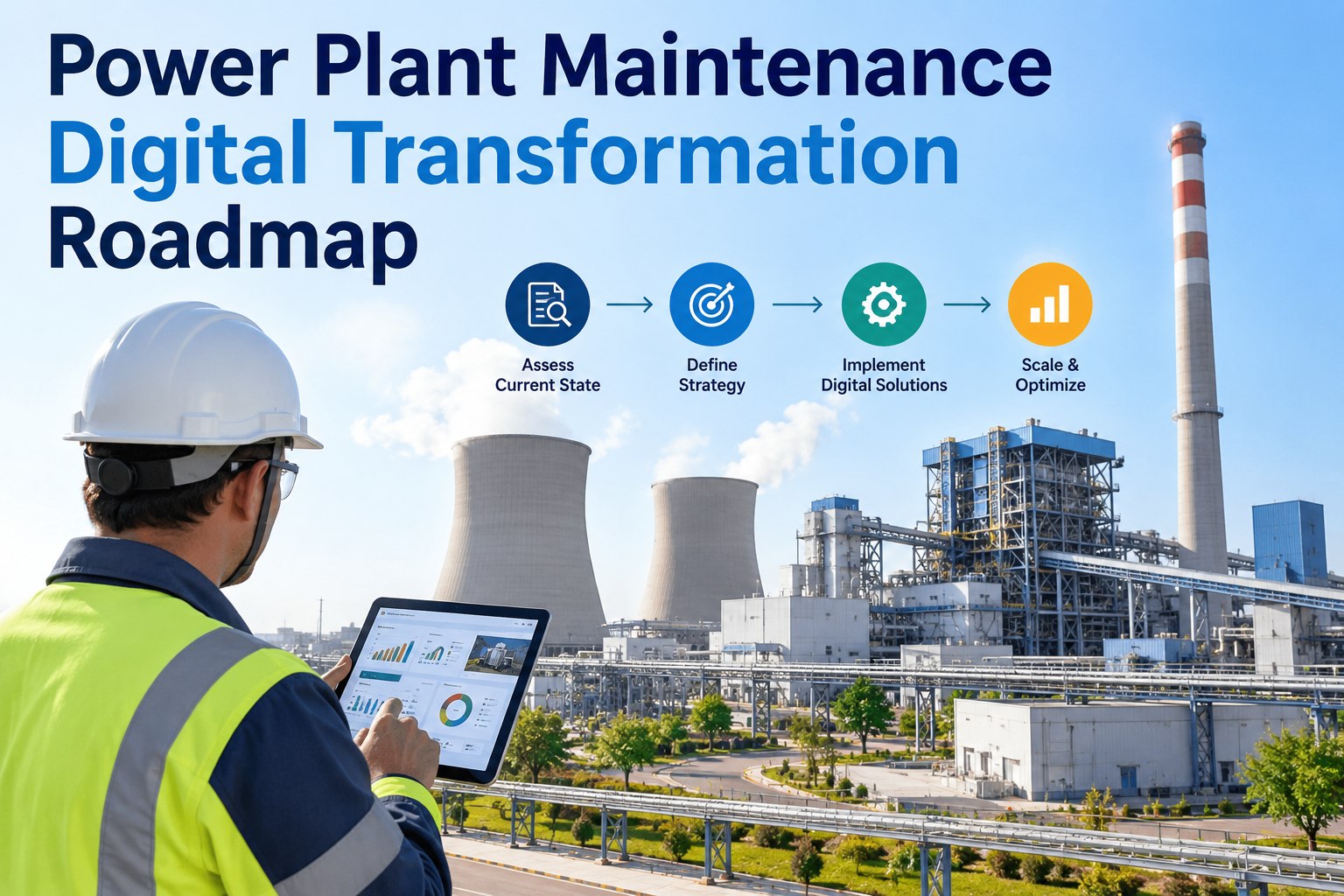
The 4-Phase Digital Transformation Roadmap
Successful digitization happens in phases — not all at once. This roadmap is drawn from real power plant implementations and is designed to produce measurable wins within 90 days of starting.
Build the digital backbone. Import your asset list into OxMaint — turbines, pumps, transformers, auxiliary systems. Configure PM templates for your top 20 critical assets. Set baseline frequency intervals from OEM documentation.
Migrate reactive maintenance to digital work orders. Train maintenance crew on mobile app task completion. Establish approval workflows for high-cost repairs. Begin tracking labor hours and parts per work order.
Activate OxMaint's analytics layer. Review asset-level cost reports, PM compliance rates, and mean-time-to-repair trends. Adjust PM frequencies based on actual failure data. Build the first compliance report for regulatory review.
Connect plant-floor sensor data through IIoT gateways for condition-based work order triggers. Integrate with ERP for purchase order automation. Enable mobile offline mode for field crews in remote areas of the plant.
OxMaint's implementation team guides power plant customers through every phase of this roadmap — from asset import to IIoT integration. Most plants are generating digital PM work orders within their first week. See the full onboarding process in a 30-minute walkthrough.
Stakeholder Buy-In: What Each Group Needs to Hear
Digital transformation fails when it is positioned as an IT project. Each stakeholder group has different concerns — and each needs a different value story. Here is how to build alignment across the plant organization.
| Stakeholder | Primary Concern | Your Message | Proof Point |
|---|---|---|---|
| Plant Manager | Generation reliability and compliance risk | CMMS reduces unplanned trips and produces audit-ready records automatically | 35% fewer unplanned outages |
| Maintenance Superintendent | Crew productivity and workload visibility | Eliminates paper work orders, gives real-time view of backlog and technician utilization | 2 hrs/day saved per technician |
| Finance Controller | Budget accuracy and cost justification | Real-time cost per asset, variance within 5% of budget, contractor invoice matching | ±5% budget variance vs ±30% paper |
| Compliance Officer | NERC/ISO documentation and audit preparation | All maintenance records timestamped and exportable in audit format on demand | Audit prep from weeks to hours |
| Field Technicians | Extra admin work and learning curve | Mobile app requires no training — most techs complete first work order in one shift | 90% crew adoption within 30 days |
| Operations Team | Maintenance windows disrupting dispatch | CMMS coordinates PM scheduling around generation commitments, not around it | Fewer surprise outage conflicts |
What Digital Maintenance Looks Like Day-to-Day
The abstract case for CMMS becomes concrete when you trace a single maintenance event from start to finish in a digitized plant versus a paper-based one.
Metrics That Signal Transformation Progress
Transformation is not a one-time event — it is measured through operational KPIs that improve progressively. These are the metrics OxMaint tracks automatically and that plant leadership should review monthly.
Frequently Asked Questions
The Transformation Starts With One Building Block
You do not need a perfect plan to start. OxMaint is built for power plants that are moving from paper to digital — with guided onboarding, a mobile-first crew interface, and implementation support that gets you generating real PM work orders in your first week. Book a walkthrough and see your transformation roadmap mapped to your specific plant type.