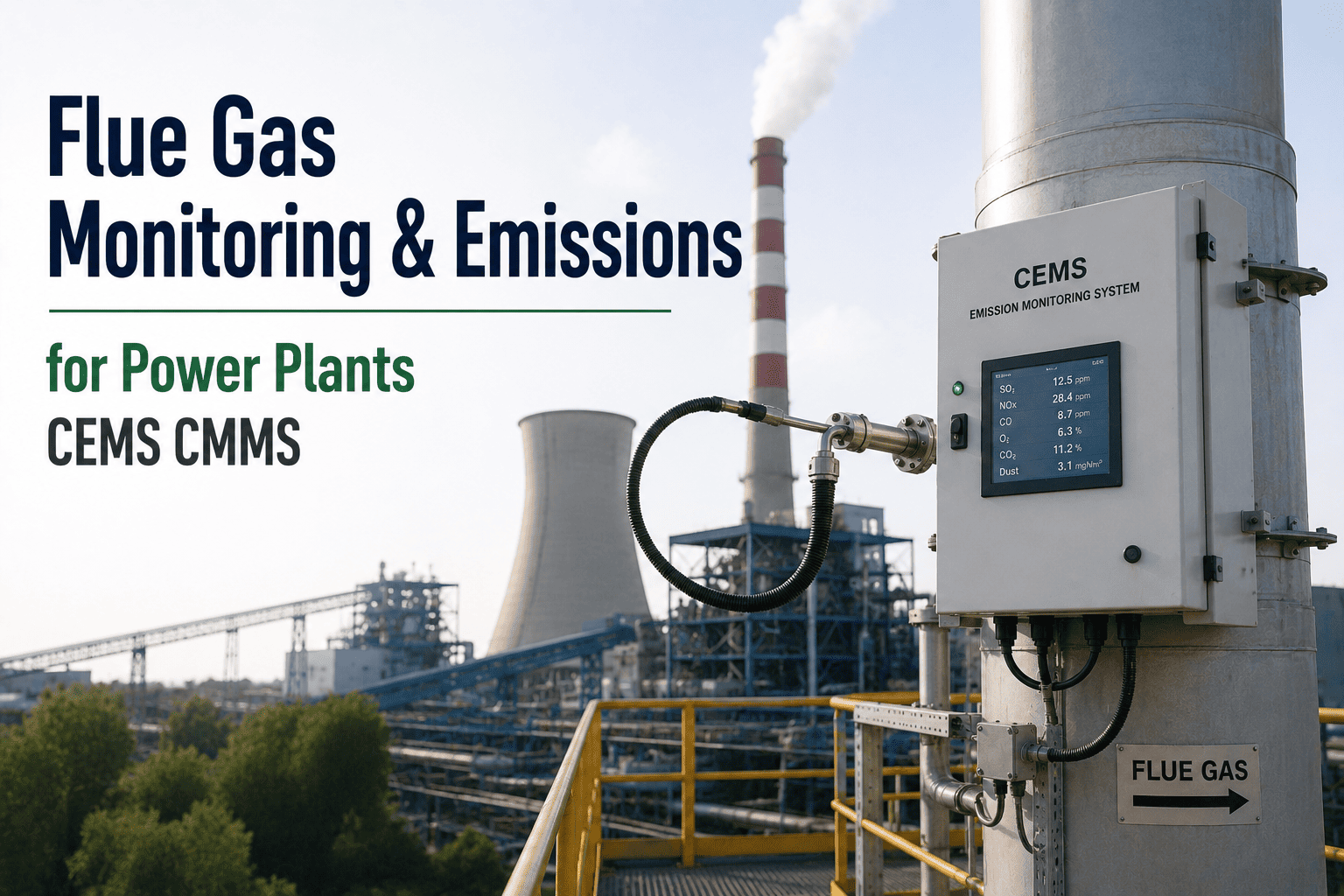
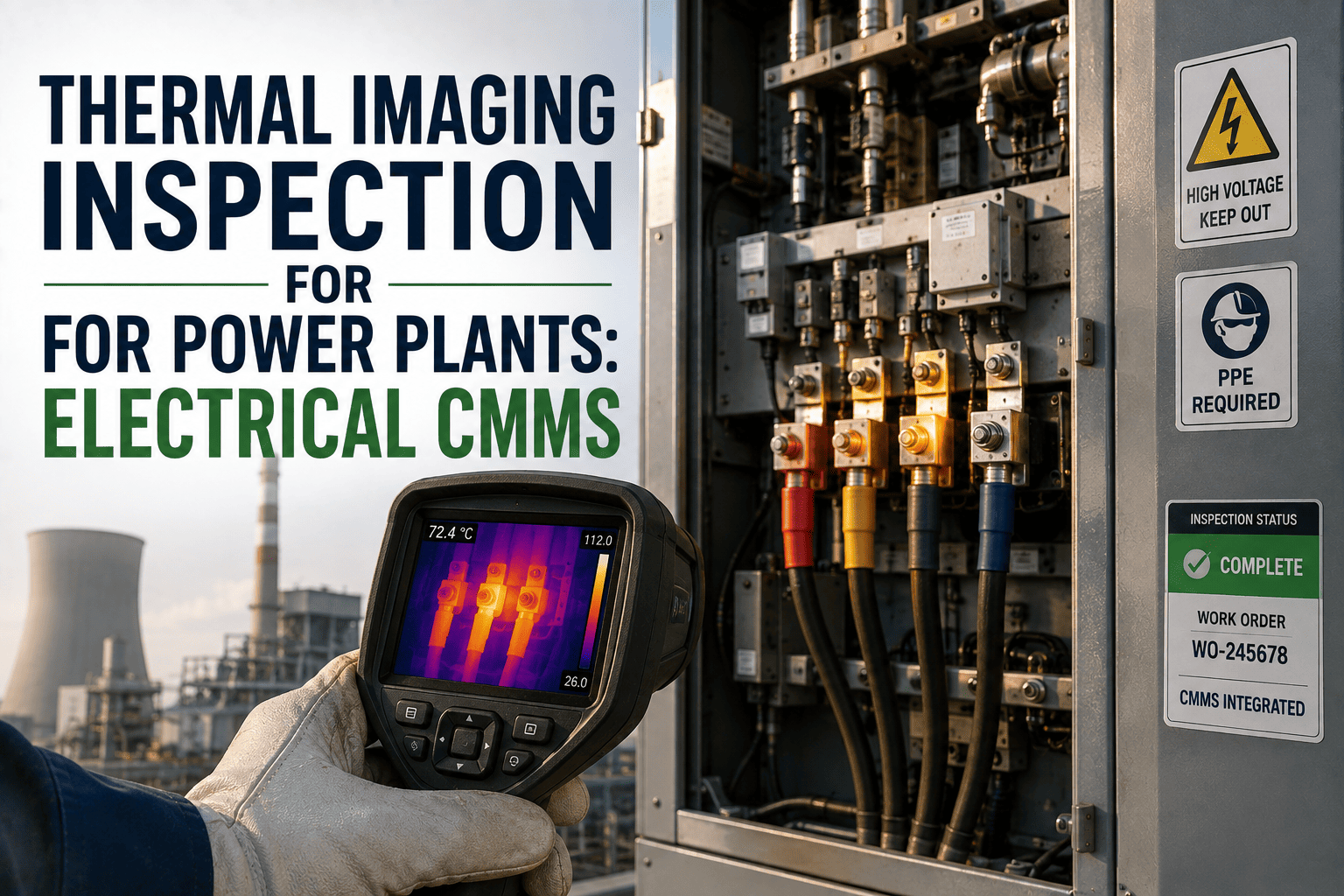
In a thermal power plant, the flue gas treatment train — ESP, FGD, SCR, and stack CEMS — sits between boiler combustion and regulatory compliance. Each system targets a different pollutant: the electrostatic precipitator removes particulate matter before it reaches the absorber, the FGD scrubber strips SO₂ from the gas stream, the SCR reactor converts NOx to nitrogen and water, and the CEMS provides the continuous emissions data that regulators use to verify permit compliance. When any one of these systems degrades, the effect is not just operational — it is a permit exceedance recorded in your CEMS data, visible to the regulator, and triggering a mandatory corrective action report. This checklist covers all four systems with inspection tasks structured by cadence — daily operational checks through annual outage inspections — aligned with EPA 40 CFR Part 60, 40 CFR Part 75 CEMS requirements, and MATS Rule reporting obligations. Start your free Oxmaint trial to automate your flue gas system PM schedules, log CEMS calibration results, and maintain the compliance documentation your environmental permit requires.
Emissions Control · EPA 40 CFR Part 60 & 75 · MATS Rule · CEMS Compliance
Flue Gas System Maintenance Checklist for Thermal Power Plants
ESP, FGD, SCR, and CEMS inspection tasks — daily through annual — with regulatory thresholds, corrective action triggers, and the documentation requirements your environmental permit demands.
ESP — Particulate Control
FGD — SO₂ Scrubbing
SCR — NOx Reduction
CEMS — Stack Monitoring
Regulatory Reference
Emission Limits & Compliance Thresholds
ESP
Opacity
20%
Max 6-minute average — 40 CFR Part 60 Subpart D; three or more exceedances in a quarter trigger a performance test
FGD
SO₂ Removal
90%+
Minimum removal efficiency for wet limestone FGD; permit may specify absolute outlet limit (e.g., 200 mg/Nm³)
SCR
NH₃ Slip
<3 ppm
Ammonia slip above 3 ppm indicates catalyst degradation or reagent overdosing — downstream aerosol formation risk
CEMS
Data Availability
90%
40 CFR Part 75 requires minimum 90% valid operating hours per quarter; below this triggers substitute data requirements
Flue gas system PM requires precise multi-system scheduling, CEMS calibration logs, and corrective action documentation — all in one audit-ready record. Oxmaint handles every interval automatically.
System 01 — Electrostatic Precipitator (ESP)
ESP Maintenance Checklist — Particulate Matter Control
The ESP is the primary particulate control device in the flue gas train. Opacity — the key EPA performance indicator — is continuously monitored by a transmissometer. A properly maintained ESP maintains opacity well below the 20% limit, but rapper deck failures, hopper plug-ups, and T-R set voltage drift can erode that margin within hours without daily operational attention.
Daily — Operational Checks
EPA 40 CFR Part 60 Subpart D
Opacity reading from transmissometer or CEMS reviewed — any 6-minute average approaching 15% requires immediate investigation of rapper operation and hopper levels before the 20% limit is exceeded
Record: CEMS data log · Role: Environmental / Control Room Operator
T-R set primary and secondary voltage and current recorded hourly — suppressed secondary voltage with high spark rates indicates high dust resistivity requiring gas conditioning review
Record: T-R hourly log · Role: ESP Operator
Rapper deck walk-down completed in sequential mode — audibly verify each rapper is firing; a silent rapper means the field below it stops shedding collected ash within 4 to 8 hours
Record: Daily rapper check log · Role: Maintenance Technician
Hopper ash levels verified — high hopper level alarm actioned immediately; ash bridging over the discharge outlet re-entrains collected particulate directly into the clean gas stream
Record: Hopper level log · Role: ESP Operator
ESP exterior inspected for air in-leakage — audible hissing at access doors or joints indicates cold air infiltration that raises dust resistivity and degrades collection efficiency
Record: Daily inspection log · Role: Maintenance Technician
Weekly & Monthly — Preventive Maintenance
EPA CAM TGD / OEM Spec
Hopper heater operation verified at all hoppers — failed heater allows ash to cool below dew point, causing cement-like bridging that requires outage to clear
Record: Weekly inspection form · Role: Maintenance Lead
Top-housing pressurising fan and thermostat operation confirmed — purge air prevents moisture condensation on high-voltage insulators that causes field-to-field flashover
Record: Weekly inspection form · Role: Maintenance Lead
Transmissometer calibration drift checked against zero and span reference — calibration drift above 2% opacity units requires recalibration before CEMS data validity is affected
Record: CEMS calibration log · Role: Environmental Technician
Annual Outage — Internal Inspection
OEM Spec / EPA Guidance
Internal electrode and collection plate inspection — check for wire breakage, bowing or skewing of plate alignment; misaligned plates reduce electrical field strength and collection efficiency across the affected field
Record: Annual inspection report · Role: ESP Specialist / OEM Engineer
All electrical insulating surfaces and top housing compartment cleaned — contaminated insulators are the leading cause of T-R set faults; cleaned with dry compressed air and lint-free cloth
Record: Annual outage work order · Role: Maintenance Technician
Air load test performed after all internal maintenance — provides baseline voltage-current curve for comparison with subsequent operating data; deviations predict developing insulation or electrode problems
Record: Air load test report (retain for permit compliance history) · Role: ESP Specialist
System 02 — Flue Gas Desulfurisation (FGD)
FGD Maintenance Checklist — SO₂ Scrubbing System
A wet limestone FGD system achieving 90%+ SO₂ removal operates within narrow chemical and mechanical tolerances. Absorber pH below 5.0 sharply reduces SO₂ absorption. Clogged spray nozzles reduce liquid-to-gas contact area silently — SO₂ removal drops weeks before any process alarm fires. Mist eliminator blockage forces stack gas through reduced cross-sectional area and raises outlet particulate. Every item below targets one of these silent failure modes.
Daily — Process Parameter Log
EPA 40 CFR Part 75 / Permit Conditions
Absorber pH
5.0 – 5.5 optimal
Below 5.0: increase limestone feed rate; pH deviation of 0.1 unit reduces SO₂ absorption by 8–12%
SO₂ inlet / outlet (CEMS)
Removal ≥ 90%
Calculate removal efficiency each shift; declining trend triggers spray nozzle and pump inspection
Recirculation pump flow rate
Per design L/G ratio
Reduced flow cuts liquid-to-gas contact; impeller wear or inlet strainer blockage are primary causes
Limestone slurry density
Per design spec (g/L)
Low density indicates ball mill or classifier issue; high density risks nozzle plugging across spray banks
Gypsum dewatering output
<10% moisture content
High moisture in dewatered gypsum indicates vacuum belt filter or cyclone issue requiring maintenance action
Weekly — Mechanical Inspection
OEM Spec / Environmental Permit
Spray nozzle condition inspected at accessible banks — clogged or eroded nozzles create uneven coverage; scale buildup inside spray headers reduces liquid-to-gas contact area and SO₂ removal silently drops
Record: Weekly inspection form · Role: Maintenance Lead
Mist eliminator differential pressure checked — rising pressure drop indicates partial blockage; a blinded mist eliminator increases stack outlet particulate and risks water carryover into downstream ductwork
Record: Weekly inspection form · Role: Maintenance Lead
Oxidation air blower operation confirmed — oxidation of calcium sulfite to gypsum (calcium sulfate) requires adequate air supply; inadequate oxidation degrades gypsum quality and increases scaling in the absorber
Record: Weekly inspection form · Role: FGD Operator
Absorber agitator operation verified — agitators keep slurry solids in suspension; a stopped agitator allows settling that can plug outlets and recirculation pump inlets within 2 to 4 hours
Record: Weekly inspection form · Role: FGD Operator
Monthly & Outage — PM Tasks
OEM Spec
Recirculation pump impeller wear measurement — worn impellers reduce slurry flow rate and cut L/G ratio below design spec; compliance margin narrows without triggering any process alarm
Record: Pump inspection report · Role: Maintenance Technician
Mist eliminator wash nozzles cleaned and tested — blocked wash nozzles allow scale accumulation on eliminator chevrons until pressure drop forces an unplanned outage for cleaning
Record: Monthly PM work order · Role: Maintenance Technician
Gas-gas heater (GGH) surface condition inspected — scale fouling on the GGH reduces flue gas reheat after scrubbing, creating visible stack plume and corrosion in downstream ductwork and stack liner
Record: Monthly PM work order · Role: Maintenance Technician
System 03 — Selective Catalytic Reduction (SCR)
SCR Maintenance Checklist — NOx Control System
SCR catalyst deactivation is the primary long-term maintenance challenge in NOx control. Fresh catalyst provides NOx conversion efficiencies above 85%, but catalyst activity declines with ash blinding, alkali poisoning from flue gas, and thermal sintering during high-load operation. A structured PM programme extends catalyst service life and delays the capital cost of catalyst replacement, which runs from $500,000 to several million dollars per reactor.
Daily Operational Checks
- NOx inlet and outlet concentrations logged from CEMS — calculate SCR efficiency each shift; efficiency decline of more than 5% from baseline triggers a catalyst inspection
- Ammonia injection rate and NH₃ slip monitored — slip above 3 ppm indicates either reagent overdosing or catalyst deactivation reducing conversion at current AIG settings
- Reactor inlet and outlet temperatures confirmed within catalyst operating range — catalyst below minimum temperature (typically 300–400°C) causes ammonia salt deposition on catalyst surface
- Differential pressure across catalyst layers logged — rising pressure drop indicates ash bridging or structural catalyst damage accumulating in the bed
Monthly PM Tasks
- Ammonia injection grid (AIG) nozzle check — blocked AIG nozzles create uneven ammonia distribution across the flue gas cross-section, causing local NH₃ slip while leaving NOx pockets unreacted
- Sootblower operation verified — sootblowers remove ash accumulation from catalyst surface; a failed sootblower allows progressive blinding that reduces active catalyst area
- Reagent (urea or ammonia) storage and dosing system inspection — check dilution water flow, nozzle atomisation, and storage tank level; incorrect reagent concentration causes dosing errors
- Catalyst layer visual inspection through access ports — look for cracked, broken, or deformed catalyst modules indicating thermal stress or ash impaction damage
Annual / Outage Inspection
- Catalyst activity testing by laboratory sample — extract representative samples from each layer and submit for activity measurement; declining activity determines layer rotation or replacement schedule
- Full catalyst module visual and physical inspection — check for structural cracking, pitch distortion, or erosion at module edges from high-velocity ash impaction
- AIG distribution test — inject tracer gas and sample across catalyst face to verify uniform NH₃ distribution; uneven distribution degrades NOx removal and increases average slip
- Reactor casing and expansion joint inspection — check for flue gas bypass leakage through casing welds or failed expansion joints that allows untreated NOx to pass the SCR boundary
System 04 — CEMS & Stack Monitoring
CEMS Maintenance Checklist — Continuous Emissions Monitoring
CEMS data is the regulatory record. Under 40 CFR Part 75, every valid operating hour must have a corresponding CEMS measurement, and quarterly data availability must reach 90% minimum. A CEMS that is not maintained to its QA/QC plan produces data that regulators treat as missing — triggering substitute data provisions that assume worst-case emissions for missing hours.
Daily — QA/QC Checks
EPA 40 CFR Part 75 / Part 60 Appendix F
Zero and span calibration drift check performed on all CEMS analysers (SO₂, NOx, O₂, flow) — drift exceeding 2.5% of span triggers recalibration before that hour's data is flagged as invalid
Record: Daily calibration drift log (required by 40 CFR 75 QA/QC plan) · Role: Environmental Technician
Probe and sample line heat trace verified operational — unheated sample lines cause condensation that shifts analyser readings and physically damages SO₂ and NOx sensors within days
Record: Daily CEMS maintenance log · Role: Environmental Technician
Data acquisition system (DAS) confirmed logging valid data — verify data gaps, instrument fault flags, and out-of-control conditions in the electronic log; any gap over 1 hour triggers substitute data protocol
Record: DAS data log · Role: Environmental Technician
Weekly & Quarterly — Mandatory QA Tests
40 CFR Part 75 Appendix B / 40 CFR Part 60 Appendix F
Sample probe and filter inspected and cleaned — ash accumulation on the probe head increases sample extraction resistance, creating a partial vacuum that dilutes the sample gas and depresses measured concentrations
Record: Weekly maintenance log · Role: Environmental Technician
Quarterly linearity check (cylinder gas audit) completed — four-point linearity test using certified reference gases required per 40 CFR Part 75 Appendix B; failure triggers a relative accuracy test audit (RATA)
Record: Linearity test report (submit to regulatory authority) · Role: Environmental Technician / CEMS Specialist
Flow monitor calibration verified quarterly — stack flow measurement error directly affects mass emission calculations (tons/year) that determine permit compliance and potential excess emission penalties
Record: Quarterly flow calibration report · Role: Environmental Technician
Annual — Relative Accuracy Test Audit (RATA)
40 CFR Part 75 Appendix B Section 3
RATA conducted by certified testing contractor — reference method measurements compared to CEMS; relative accuracy must be within 20% (or 10 ppm absolute) for SO₂ and NOx analysers; failure requires CEMS recertification
Record: RATA report filed with regulatory authority (retain minimum 3 years on site) · Role: Certified Testing Contractor
Analyser components replaced per OEM schedule — detector cells, UV lamps, reference gas cylinders, and filter elements replaced on OEM recommended intervals regardless of apparent instrument performance
Record: Annual PM work order with component serial numbers · Role: CEMS Specialist
Compliance Reference
Maintenance Frequency & Regulatory Reference Table
| System |
Inspection Task |
Frequency |
Regulatory Reference |
| ESP — Opacity CEMS |
Opacity monitoring and T-R set data log |
Continuous / Hourly |
EPA 40 CFR Part 60 Subpart D |
| ESP — Rappers |
Rapper deck walk-down and firing verification |
Daily |
OEM Spec / EPA CAM TGD |
| ESP — Insulators |
Top housing cleaning and air load test |
Annual outage |
OEM Spec |
| FGD — Process |
Absorber pH, SO₂ removal, slurry density log |
Daily (each shift) |
EPA 40 CFR Part 75 / Permit |
| FGD — Spray Nozzles |
Nozzle condition and mist eliminator DP check |
Weekly |
OEM Spec / Environmental Permit |
| SCR — NOx & NH₃ Slip |
NOx efficiency and ammonia slip log |
Daily CEMS data |
EPA 40 CFR Part 75 / MATS Rule |
| SCR — Catalyst |
Activity testing by laboratory sample |
Annual outage |
OEM Spec / State Permit |
| CEMS — All Analysers |
Zero and span calibration drift check |
Daily |
40 CFR Part 75 Appendix B |
| CEMS — Linearity |
Four-point cylinder gas audit |
Quarterly |
40 CFR Part 75 Appendix B |
| CEMS — RATA |
Relative accuracy test by certified contractor |
Annual |
40 CFR Part 75 Appendix B §3 |
| Stack — Emissions Report |
Quarterly excess emissions and CEMS availability report |
Quarterly |
40 CFR Part 60 / State Permit |
FAQs
Frequently Asked Questions
What is the consequence of CEMS data availability falling below 90% in a quarter?
Under 40 CFR Part 75, hours with missing CEMS data are filled using substitute data provisions — which assume the 90th percentile emissions value from available operating data for that period. This means missing data is treated as if the unit was operating at near-worst-case emissions, which can push reported quarterly totals above permit limits even if actual emissions were compliant.
How does a failed ESP rapper affect opacity compliance?
A rapper that stops firing allows ash to build up on collection plates in that field. Within 4 to 8 hours, the ash layer becomes thick enough to re-entrain into the gas stream with each vibration of adjacent rappers. Opacity rises progressively. A single failed rapper in a rear field can push a compliant ESP to the 20% opacity limit within one operating shift if not identified and corrected.
What triggers a Relative Accuracy Test Audit (RATA) ahead of the annual schedule?
A failed quarterly linearity check, an out-of-control period exceeding 20 consecutive operating hours, or a calibration drift failure that cannot be corrected by recalibration all require an unscheduled RATA. During the out-of-control period, substitute data provisions apply — making prompt corrective action critical to protecting compliance status.
How can Oxmaint CMMS support multi-system compliance tracking for flue gas equipment?
Oxmaint manages separate recurring PM schedules for each flue gas system — daily CEMS drift checks, weekly FGD inspections, quarterly linearity tests, and annual RATA and catalyst inspections — each with a named owner and completion record. Compliance reports for environmental audits are generated automatically from completed work orders, with all calibration results, corrective actions, and contractor reports stored against the asset record.
What documentation must be retained on site for EPA compliance inspections?
EPA requires retention of CEMS QA/QC records, calibration drift logs, linearity test reports, RATA reports, excess emissions reports, and corrective action records for a minimum of 3 years at the facility. For Part 75 facilities, electronic records must also be submitted to EPA's Electronic Data Reporting (EDR) system on a quarterly basis regardless of whether exceedances occurred.
Manage ESP, FGD, SCR, and CEMS Compliance in One Platform.
Oxmaint automates your flue gas system PM schedules, logs CEMS calibration results with pass/fail thresholds, tracks corrective actions from detection to close-out, and generates the compliance documentation your environmental permit and EPA reporting obligations require.