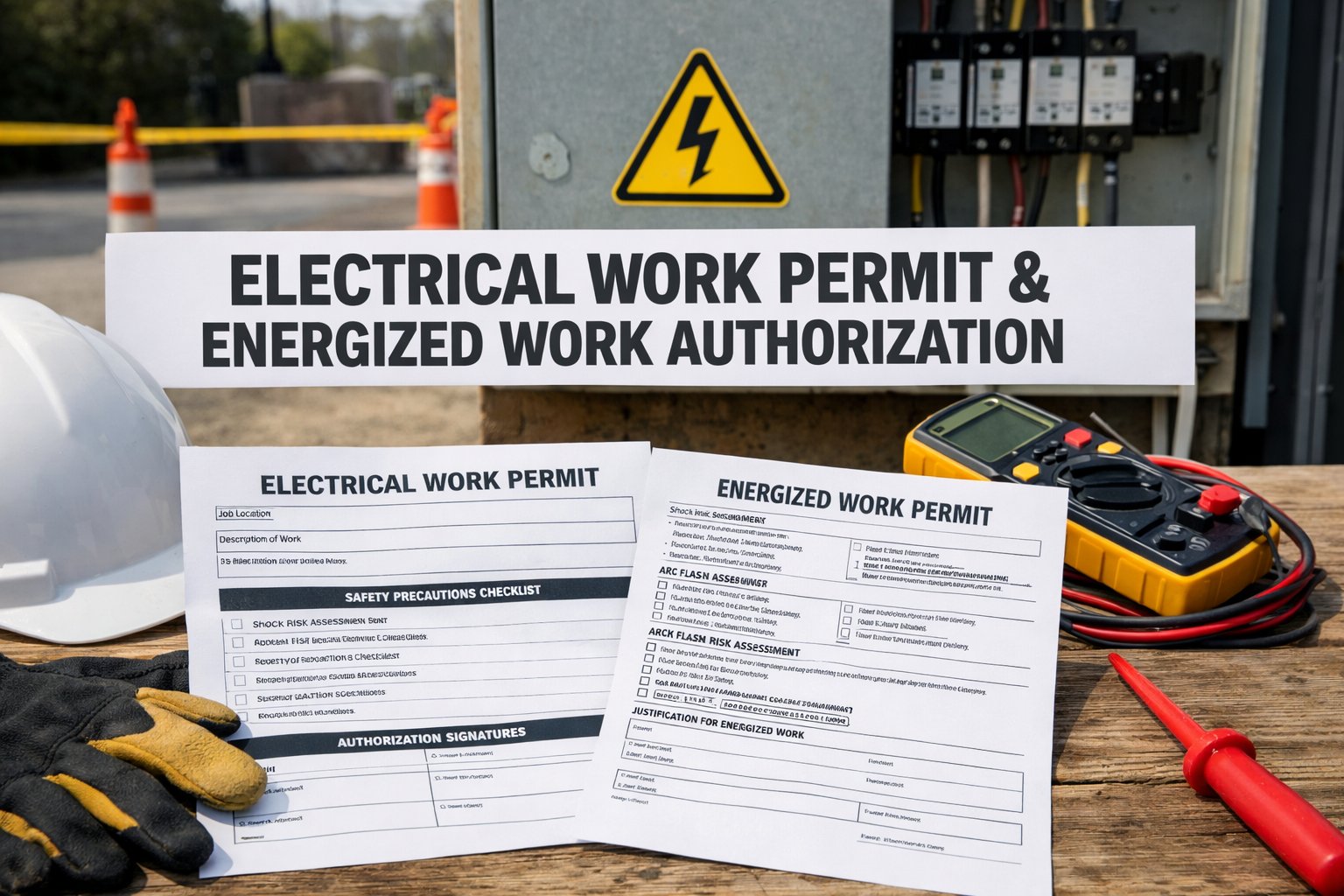
Electrical Work Permit and Energized Work Authorization
By shreen on February 23, 2026
Every year, electrical incidents account for nearly 160 workplace fatalities and thousands of severe arc flash injuries across industrial facilities — not because electricians lack skill, but because permit-to-work systems fail to enforce proper authorization before energized tasks begin. A chemical plant in Texas recorded three arc flash events in 18 months, each traced back to incomplete energized work authorizations where hazard assessments were either missing or outdated. After integrating digital electrical work permits with a CMMS-driven authorization workflow, the facility achieved 26 consecutive months without an electrical safety incident while reducing permit processing time from 4.5 hours to 38 minutes.
160+
Annual workplace fatalities from electrical contact incidents across U.S. industrial facilities
78%
Of arc flash injuries occur when energized work authorization procedures are bypassed or incomplete
$4.2M
Average total cost per electrical fatality including OSHA penalties, legal fees, and operational shutdown
Paper electrical work permits and manual energized work authorizations were designed for a slower era — when a single supervisor could review every permit request personally and job sites had predictable electrical configurations. Modern facilities operate with complex power distribution, rotating crews, and simultaneous maintenance activities that overwhelm paper-based tracking. Permits get approved without current arc flash hazard analysis data, authorization signatures are collected after work has already started, and there is no mechanism to verify that lockout-tagout procedures are active before an energized work permit is issued. These gaps do not just risk OSHA citations — they put electricians in front of energized equipment without verified protection. Sign up to digitize your electrical work permit process and eliminate authorization blind spots.
Core Failure Points
Missing Hazard Analysis
Permits issued without current arc flash boundary calculations or incident energy data — workers enter zones without knowing the PPE category required for the specific equipment voltage and available fault current
Retroactive Signatures
Authorization collected after work begins because paper forms require physical routing between supervisors, safety officers, and operations managers — creating a compliance fiction where approvals exist on paper but not in practice
No LOTO Verification Link
Energized work authorizations issued without confirming whether de-energization was actually attempted first — NFPA 70E requires documented justification that de-energizing creates a greater hazard before energized work is approved
Expired Qualifications
No automated check that assigned electricians hold current NFPA 70E training, arc flash PPE certification, and equipment-specific qualifications before permit approval — expired credentials discovered only during audits
Key Insight
92%
of OSHA electrical citations in the last three years referenced inadequate energized work authorization documentation — not the electrical work itself, but the failure to properly document hazard assessment, justification for energized work, and PPE requirements before the task began.
Electrical Work Permit Components That Prevent Incidents
An effective electrical work permit is not a single form — it is a controlled workflow that verifies hazard data, enforces authorization sequences, and links directly to the equipment records in your maintenance system. Each component below addresses a specific failure mode that contributes to electrical injuries and compliance violations. Facilities using Oxmaint for digital permit management enforce every component automatically before work authorization is granted.
EWP
Electrical Work Permit Essentials
The foundational permit document that captures job scope, equipment identification, and authorization chain before any electrical work begins on energized or de-energized equipment.
Digital Permit Workflow
EWA
Energized Work Authorization
The supplemental authorization required when work must be performed on energized conductors — documenting the justification, hazard analysis, and additional protective measures beyond the standard electrical work permit.
Energized Task Controls
QVL
Qualified Worker Verification and LOTO Link
The personnel qualification gate that ensures only trained, certified electricians receive authorization — and that lockout-tagout status is verified before any energized work authorization is considered.
Credential Verification
Your electrical work permits should enforce compliance automatically — not rely on someone remembering to check a box. Oxmaint blocks permit approval until hazard data, worker qualifications, and LOTO verification are all confirmed digitally.
A compliant electrical work permit system follows a strict sequence — each step must complete before the next begins. Skipping steps is how incidents happen. The workflow below shows how Oxmaint enforces sequential authorization so that no electrical work begins without full compliance verification.
01
Permit Request Submission
Electrician submits digital permit request identifying equipment by asset tag, describing the task scope, specifying voltage class, and selecting whether work is on de-energized or energized equipment. The system auto-populates arc flash data from the equipment record.
02
Automated Qualification Check
System verifies that the requesting electrician holds current NFPA 70E training certification, appropriate voltage class authorization, and equipment-specific qualification. Expired or missing credentials block the request from advancing.
03
Hazard Data Validation
Arc flash study date, incident energy values, PPE category, and boundary distances are verified against the equipment record. If the study is older than 5 years or the equipment has been modified since the last study, the system flags the permit for updated analysis.
04
LOTO Status and EWA Gate
For energized work requests, the system requires documented justification for why de-energization is infeasible. LOTO records are checked — if equipment can be safely de-energized based on current operations data, the energized work authorization is denied.
05
Sequential Authorization and Activation
Supervisor, safety officer, and operations manager approve in sequence with timestamped digital signatures. Permit activates with a defined expiration time and shift boundary — work must cease when authorization expires.
06
Work Execution and Closeout
Electrician confirms task completion, documents any findings or deviations, and closes the permit digitally. Closeout data feeds back into the equipment maintenance history in Oxmaint for future reference and audit readiness.
Comparison: Paper Permits vs. Digital Permit Management
Paper-Based Permits
Permits completed after work starts — authorization is retroactive
No automated check on worker training or certification currency
Arc flash data manually looked up — often outdated or missing
Permits stored in filing cabinets — audit preparation takes hours
No link between LOTO status and energized work authorization
Permit expiration tracked manually — overruns go unnoticed
Digital CMMS Permits
Sequential gates block work until every authorization step completes
Automatic credential verification before permit advances
Arc flash data auto-populated from equipment records with currency flags
Complete digital audit trail accessible in under 2 minutes
LOTO records checked before energized work authorization is possible
Auto-expiration with alerts to electrician, supervisor, and safety officer
CMMS Integration: Connecting Permits to Maintenance Operations
Electrical work permits should not exist in isolation — they are part of the maintenance workflow. When permits connect directly to work orders, equipment records, and compliance tracking inside your CMMS, every electrical task carries its full safety context from request through closeout. Schedule a demo to see how Oxmaint links permits to your maintenance operations.
Work Order Integration
Every electrical work permit auto-links to its parent work order in Oxmaint. Technicians see permit status, hazard data, and PPE requirements directly on their mobile work order screen — no separate systems to check.
Asset LinkingMobile Access
Arc Flash Data Management
Equipment-level arc flash study data stored in Oxmaint asset records — incident energy, PPE category, boundary distances, and study date. Permits auto-populate this data and flag equipment where studies need updating.
Hazard TrackingAuto-Populate
Qualification Tracking
Worker certifications, NFPA 70E training dates, voltage class authorizations, and equipment-specific qualifications tracked per technician. Expiration alerts trigger 60 days before credentials lapse.
Cert ManagementAuto-Alerts
Compliance Audit Trail
Every permit action — request, approval, modification, extension, closeout — logged with timestamp, user ID, and digital signature. OSHA inspectors access a complete permit history for any equipment in minutes.
Digital SignaturesOSHA Ready
We had an OSHA inspector request electrical work permit records for the previous 18 months on a specific switchgear. With our paper system, that would have been two people searching filing cabinets for half a day. With Oxmaint, I pulled every permit, authorization, hazard assessment, and closeout record in 90 seconds on my tablet. The inspector said it was the most organized electrical safety documentation he had seen at any facility that year.
Eliminate Electrical Permit Gaps Before Your Next Audit
Oxmaint digitizes your electrical work permit and energized work authorization process — enforcing sequential approvals, verifying worker qualifications, auto-populating arc flash data, and generating complete audit trails for every permitted task. Request a walkthrough to see how the system maps to your facility's electrical safety program.
What is the difference between an electrical work permit and an energized work authorization?
An electrical work permit is required for all electrical maintenance tasks — both on de-energized and energized equipment. It documents the scope of work, equipment identification, hazard data, and authorization chain. An energized work authorization is an additional layer required only when work must be performed on exposed energized conductors. It adds mandatory documentation of why de-energization is infeasible, arc flash incident energy calculations, specific PPE requirements, and approach boundary distances. Sign up for Oxmaint to manage both permit types in a single integrated workflow.
Does OSHA require electrical work permits for all electrical maintenance?
OSHA requires employers to follow NFPA 70E as the recognized standard for electrical safety. NFPA 70E Article 130.2(A) requires an energized electrical work permit when work is performed on energized conductors or circuit parts, unless the task falls under specific exceptions like testing, thermography, or visual inspections performed at safe distances. Many facilities extend the permit requirement to all electrical work as a best practice — and Oxmaint supports configurable permit triggers based on your facility's safety policies.
How often must arc flash studies be updated for permit accuracy?
NFPA 70E requires that arc flash hazard analysis be reviewed every 5 years or whenever changes occur that could affect arc flash conditions — new equipment installations, transformer replacements, utility fault current changes, or protective device setting modifications. Book a demo to see how Oxmaint tracks study currency per equipment and flags permits when arc flash data needs updating.
Can Oxmaint integrate with existing arc flash study software?
Yes. Oxmaint accepts arc flash study data imports from major analysis platforms including SKM Power*Tools, ETAP, EasyPower, and Paladin DesignBase. Incident energy values, PPE categories, boundary distances, and label data are stored at the equipment level and auto-populate into electrical work permits when a permit is initiated for that asset.
What happens when a permit expires during active work?
When a permit reaches its expiration time, Oxmaint sends alerts to the assigned electrician, supervising foreman, and safety officer simultaneously. Work must stop until the permit is either renewed through the re-authorization process or formally closed out. The system logs the expiration event and any extension requests with timestamps — creating an audit trail that demonstrates active permit lifecycle management. Sign up to configure permit expiration rules for your facility.