Bearing and lube oil failures are among the fastest paths to a gas turbine forced outage — a single wiped journal bearing or a varnished lube system can take a unit offline for weeks and cost millions in lost generation. This guide lays out the inspection intervals, clearance limits, oil-analysis triggers, and filtration targets that keep gas turbine bearings reliable between major overhauls. Explore OxMaint CMMS free trial or book a demo to see how fired-hour-based PM scheduling and automated oil-trend alerts work in practice.
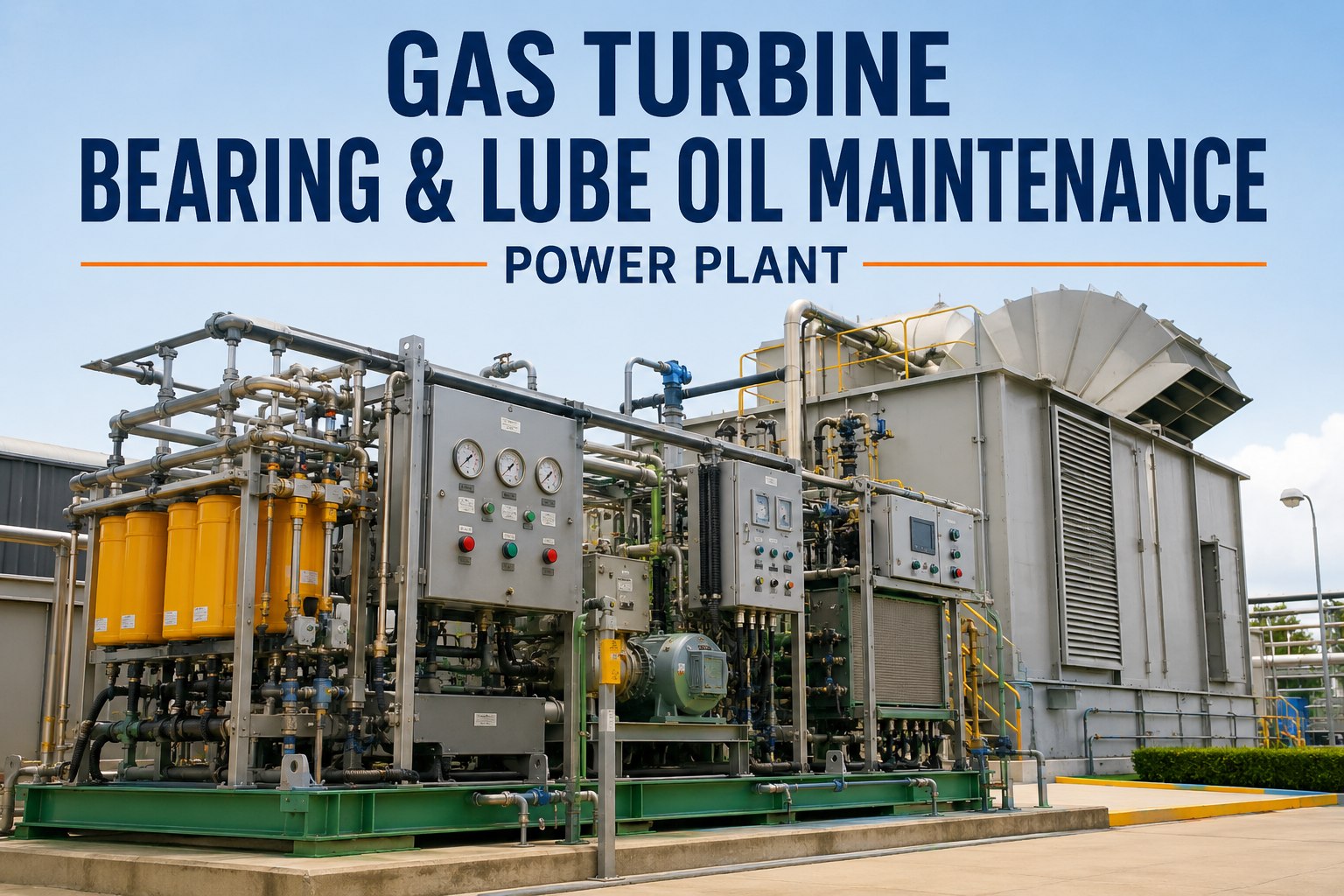
Gas Turbine Bearing & Lube Oil Maintenance for Power Plants
A structured inspection and monitoring program for journal bearings, thrust bearings, and the lube oil system — built around fired-hour PM triggers, oil-analysis trend limits, and OEM cleanliness targets to prevent forced outages between major overhauls.
Journal Bearing Inspection Methods & Clearance Limits
Journal bearings carry the rotor's radial load. Wear accelerates quietly — by the time vibration rises, the babbitt lining is often already compromised. Inspection combines running checks (vibration, temperature, oil-film pressure) with offline bore-scope and lift measurements at fired-hour intervals.
| Inspection Method | What It Detects | Interval | Action Limit |
|---|---|---|---|
| Vibration spectrum analysis | 1× and 2× components, oil-whirl sub-synchronous | Continuous / monthly trend | >7.1 mm/s RMS (ISO 10816 zone C) |
| Babbitt temperature (RTD) | Overheating, oil-film breakdown | Continuous | Alarm 85 °C / Trip 93 °C |
| Bore-scope via inspection ports | Babbitt wiping, scoring, fretting | 4,000 fired hours | Any visible wiping >10% pad area |
| Rotor lift / clearance check | Wear, ovality, journal-to-bearing gap | 8,000 fired hours or CI | Clearance > 1.5× OEM nominal (e.g. 0.18 mm → 0.27 mm) |
| Oil-film pressure tap | Loss of hydrodynamic wedge | Continuous | Drop >15% from baseline |
On Frame 7FA class units, journal bearing clearance is typically 0.15–0.20 mm diametral. If lift measurement shows the upper half-pad gap has opened beyond 0.28 mm, schedule a bearing swap at the next combustion inspection (CI) — do not wait for the hot-gas-path (HGP) interval.
Thrust Bearing PM & Axial Position Monitoring
Thrust bearings fix the rotor's axial position. A failure here is catastrophic — rotor surge into the diaphragms within seconds. PM centers on axial-position probes, thrust-pad temperature, and pad load distribution at every CI and HGP outage.
Monitor axial position continuously
Two redundant eddy-current probes track rotor position against the active thrust collar. Alarm at ±0.8 mm from zero reference; trip at ±1.0 mm. Trend the zero-reference drift weekly — a slow walk toward the active face signals pad wear.
Trend thrust-pad temperatures
RTDs embedded in each tilting pad. Any pad reading >93 °C or a spread >14 °C between pads indicates uneven loading or oil-film distress. Investigate before the next start-up.
Inspect pads at every CI (4,000–8,000 fh)
Remove thrust shoes, measure babbitt thickness, check for hairline cracks at the pivot point. Re-shim to restore the OEM rotor float band (typically 0.5–0.8 mm total travel).
Verify oil supply to thrust bearing
Confirm spray-bar nozzles are clear and oil flow matches the OEM chart. A blocked jet on one pad is the most common root cause of asymmetric thrust temperatures.
Lube Oil Analysis Intervals & Trend Interpretation
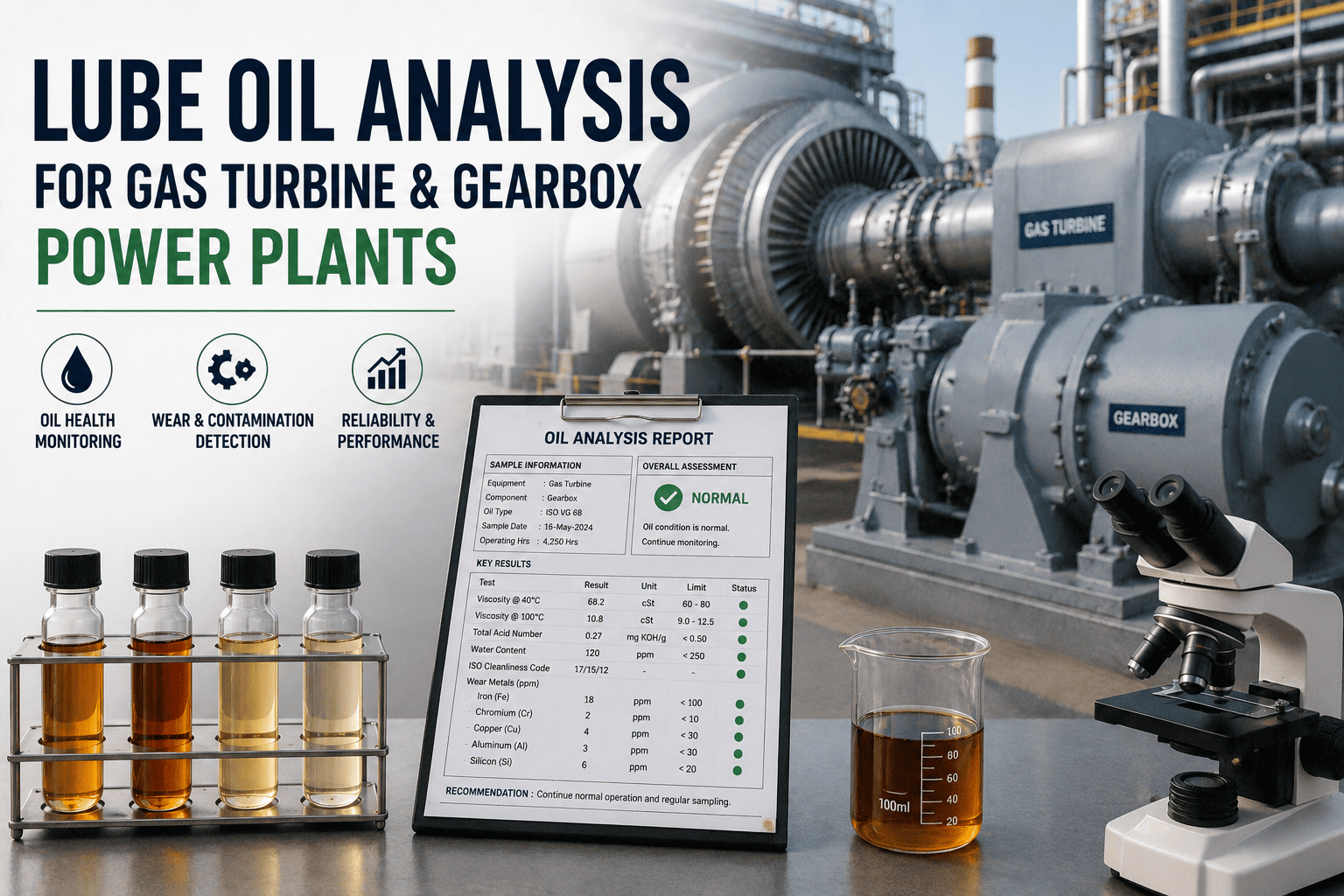
Turbine oil analysis is the earliest indicator of bearing distress — wear metals appear in the oil long before vibration or temperature responds. Sample from the main return header, not the reservoir, so particles haven't settled.
| Test | Sampling Interval | Normal | Alarm / Action | What It Means |
|---|---|---|---|---|
| Elemental metals (Fe, Cu, Sn, Pb) | 500 fired hours | Fe <10 ppm, Sn <5 ppm | Sn >15 ppm or rising trend | Babbitt (tin) wear — journal or thrust bearing |
| Viscosity @ 40 °C | 500 fired hours | 32 cSt ±10% | >36.4 or <27.0 cSt | Oil degradation or wrong top-up grade |
| ISO cleanliness code | 250 fired hours | ≤ 16/13 | > 18/15 | Filter bypass, ingestion, or filter element failure |
| Water content (Karl Fischer) | 500 fired hours | <100 ppm | >200 ppm | Cooler leak or steam seal ingress — risk of hydrogen embrittlement |
| PQ index (ferrous density) | 500 fired hours | <20 | >50 or sharp rise | Large ferrous wear event — inspect bearing bore-scope |
| RPVOT (oxidation stability) | Annual | >50% of new oil | <25% of new oil | Antioxidant depletion — plan oil change or reclamation |
| MPC (varnish potential) | Quarterly | <30 | >40 | Varnish forming — will coat bearing pads and restrict orifices |
A rising MPC (varnish potential) combined with increasing thrust-pad temperature spread is the signature of varnish depositing on tilting-pad pivots. Do not treat it as an oil problem alone — the bearing is already running hotter because the oil film is compromised. Initiate an electrostatic oil flush and inspect the thrust bearing at the next outage.
Filtration System Maintenance & Cleanliness Targets
Gas turbine lube systems use duplex filters with a continuous bypass. The goal is to hold the oil at ISO 14/11 or better at the bearing supply header — not just at the filter outlet. Filter element condition, differential pressure, and cooler integrity all matter.
Filter DP Switching
Switch the duplex when differential pressure reaches 1.5 bar (or OEM limit). Replace the off-line element within 24 hours — never run with one clogged and one empty. Log DP trend weekly; a sudden flat-line means the bypass valve has lifted.
Element Beta Rating
Use β₆ ≥ 1,000 elements (99.9% efficient at 6 µm) for gas turbine bearing oil. A common mistake is fitting a β₁₂ element — it passes the particles that cause babbitt scoring. Verify the rating on every replacement purchase order.
Reservoir & Header Sampling
Sample at the return header for wear metals (before settling) and at the reservoir bottom for water. Pull a sample from the bearing supply header quarterly to confirm the filter is actually delivering ISO 14/11 to the bearings.
Cooler Tube Inspection
Eddy-current test lube oil cooler tubes at every HGP outage (24,000–32,000 fh). Tube-to-tubesheet leaks are the #1 source of water in turbine oil. Pressure-test the shell side to 1.25× design pressure before returning to service.
Varnish Mitigation
If MPC trends above 30, deploy a kidney-loop electrostatic or depth-media varnish removal unit. Run it continuously until MPC drops below 20 and thrust-pad temperatures return to baseline. Do not rely on cartridge filters alone — varnish is sub-micron and passes through them.
Top-Up Oil Compatibility
Mix only oils of the same ISO VG and additive family. A top-up with a Group I oil into a Group II/III fill will destabilize solubility and accelerate varnish. Record every top-up volume and batch number against the asset in the CMMS.
Integrating Bearing & Lube Programs into Fired-Hour PM Scheduling
Gas turbine maintenance is driven by fired hours and starts — not calendar time alone. A CMMS that can't trigger on operating hours will either over-maintain (wasting outage windows) or under-maintain (missing wear trends). Here's how the PM hierarchy should look.
| PM Task | Trigger | System | Linked Data |
|---|---|---|---|
| Oil sample — full suite | 500 fired hours | Lube oil | Lab report → asset trend chart |
| ISO cleanliness check | 250 fired hours | Filtration | Particle counter reading |
| Filter element swap | DP ≥ 1.5 bar or 4,000 fh | Filtration | DP trend, element serial |
| Journal bearing bore-scope | 4,000 fh or CI | Bearing | Vibration trend, oil Sn trend |
| Thrust pad inspection & re-shim | 8,000 fh or HGP | Bearing | Axial position trend, pad temps |
| Cooler tube eddy-current | 24,000 fh or HGP | Lube oil | Water ppm trend, pressure test record |
| RPVOT / MPC lab test | Quarterly (calendar) | Lube oil | MPC trend, RPVOT % retention |
How OxMaint Schedules Bearing & Lube Oil Maintenance
OxMaint CMMS ties every bearing and lube oil task to the asset, the fired-hour meter, and the oil-analysis trend — then generates work orders automatically when readings drift. No spreadsheets, no missed samples, no "we found out at the outage" surprises.
Fired-Hour & Calendar Triggers
Configure each PM on either fired hours, starts, or calendar days — whichever comes first. OxMaint reads the turbine operating-hour feed and auto-generates the work order at 500 fh for oil sampling, 4,000 fh for bore-scope, or any custom interval your OEM requires.
Oil Trend History per Bearing
Every lab report — metals, viscosity, ISO code, MPC, RPVOT — is stored against the specific bearing asset, not just the turbine. Open the #1 journal bearing and see a 5-year trend of Sn, Fe, and PQ index alongside vibration and pad temperature.
Drift-Based Auto Work Orders
Set limits once: Sn >15 ppm, MPC >40, axial position >0.8 mm, pad temp >93 °C. When a reading crosses the line, OxMaint creates a priority work order with the trend chart attached and notifies the reliability engineer — no manual review needed.
Outage Planning Integration
At CI or HGP planning, OxMaint rolls up every overdue and due-soon bearing/lube task into a single outage work list, sequenced by turbine access path. No more discovering a thrust-pad inspection was due after the upper half is already lifted.
NERC & OEM Compliance Log
Every inspection, sample, filter change, and clearance measurement is timestamped and signed. Generate a compliance report for NERC PRC-005 or OEM warranty audit in one click — the chain of custody is already built in.
Mobile Capture in the Field
Technicians log bore-scope findings, clearance measurements, and filter element serials on a tablet at the turbine deck. Photos attach directly to the bearing asset record. Offline mode syncs when the plant Wi-Fi reconnects.
Gas Turbine Bearing & Lube Oil Maintenance — Common Questions
How often should I sample gas turbine lube oil?
Sample every 500 fired hours for the full elemental and viscosity suite, and every 250 fired hours for ISO cleanliness if the unit runs on continuous-duty. Add a quarterly RPVOT and MPC test on calendar time regardless of operating hours, since oxidation and varnish potential advance even when the turbine is idle.
What is the most common cause of gas turbine journal bearing failure?
The leading cause is babbitt wiping from oil-film breakdown — usually triggered by contaminated oil (high ISO particle count), low oil supply pressure at start-up, or excessive vibration from rotor imbalance. Catching it early means watching tin (Sn) trend in oil analysis and babbitt temperature RTDs, not waiting for vibration to spike.
What ISO cleanliness code should gas turbine bearing oil meet?
Target ISO 14/11 at the bearing supply header. Most OEMs (GE, Siemens, Mitsubishi) specify 16/13 as the maximum acceptable, but 14/11 is the reliability best practice for extending bearing life. Measure at the header, not the filter outlet — the piping between can reintroduce particles if it hasn't been flushed.
When should I inspect thrust bearings on a gas turbine?
Inspect thrust pads at every combustion inspection (CI), typically 4,000–8,000 fired hours depending on the OEM, and perform a full thrust bearing removal and re-shim at every hot-gas-path (HGP) outage (24,000–32,000 fh). Between outages, rely on axial-position probes and pad-temperature RTDs — alarm at ±0.8 mm axial displacement or any pad above 93 °C.
Can OxMaint CMMS trigger PMs on fired hours instead of calendar dates?
Yes. OxMaint supports fired-hour, start-count, and calendar triggers — and can fire on whichever comes first. The CMMS reads the turbine's operating-hour meter via integration (OPC, PI, or manual entry) and auto-generates work orders at the configured interval, so a bearing inspection due at 4,000 fh is never missed because the calendar said "next month."
Stop Guessing About Bearing Health
OxMaint CMMS schedules every journal bearing inspection, thrust bearing PM, oil sample, and filter change on fired-hour triggers — and alerts you the moment a trend drifts. Set it up in a day, not a quarter.