A gas turbine operating above 1,100°C under 30+ atmospheres of pressure is burning through its inspection budget every single fired hour — and when that budget runs out, unplanned downtime costs between $50,000 and $250,000 per hour in lost generation, penalty payments, and cascade failures. OxMaint's gas turbine inspection management platform tracks Factored Fired Hours, Factored Fired Starts, and every OEM-aligned scope item across all three inspection tiers — Combustion, Hot Gas Path, and Major — so your maintenance team executes the right scope at the right interval, every time. This guide gives you the complete 2026 checklist framework, built on GER-3620 intervals and field-validated inspection scope, covering compressor section, combustion hardware, hot gas path, bearings, fuel nozzles, transition pieces, and rotor systems. Book a live demo to see how leading combined-cycle plants automate their entire GT inspection program in OxMaint.
GER-3620 Aligned · 2026 Edition
Gas Turbine Inspection Checklist
Combustion · Hot Gas Path · Major Overhaul · Compressor · Bearings · Fuel Nozzles · Transition Pieces
Combustion Inspection
Every 8,000–12,000 Fired Hours
Fuel nozzles, liners, crossfire tubes, transition pieces, end covers
Hot Gas Path Inspection
Every 24,000 Fired Hours
CI scope + turbine blades, nozzles, shrouds, ring segments
Major Inspection
Every 48,000 Fired Hours
Flange-to-flange: compressor, rotor, all HGP and combustion components
What Drives Your Actual Inspection Interval
Calendar time is the wrong measure for gas turbine inspections. Factored Fired Hours and Factored Fired Starts consume your maintenance budget at rates that vary dramatically based on how you operate your unit.
Cold Start
2.0–5.0× FFH multiplier
Each cold start from ambient temperature subjects turbine blades and combustion liners to peak thermal stress cycles. A single cold start can consume the equivalent of 5 fired hours of inspection budget on cycling units.
Trip from Load
4.0–8.0× FFH multiplier
An unplanned trip from full load imposes the most severe thermal shock of any operating event. Repeated trips accelerate fatigue cracking in transition pieces and first-stage nozzles faster than any other single factor.
Distillate / Liquid Fuel
1.5–3.0× FFH multiplier
Liquid fuel operation drives higher combustion deposit buildup on fuel nozzles and accelerated corrosion on transition pieces compared to natural gas operation. Combustion inspection intervals shorten significantly.
Baseload Natural Gas
1.0× FFH baseline
Continuous baseload operation on natural gas is the least demanding operating profile. Maintenance intervals align to nominal OEM recommendations, with the fewest FFH multipliers applied per hour of actual operation.
High Ambient / Salt Air
Compressor fouling accelerated
Coastal or high-humidity environments drive accelerated compressor blade fouling, requiring offline water washing every 1,000–2,000 hours and online washing every 24–72 hours to maintain output and heat rate.
Peaking / Cycling Service
Starts-based interval dominates
For cycling units, the starts-based interval often triggers before the hours-based interval. A unit making 300 starts per year may reach its combustion inspection threshold in under 18 months regardless of fired hours accumulated.
Daily & Weekly Operational Checks
Outage inspections find what daily checks missed. These are the readings that catch developing faults before they consume fired hours budget at accelerated rates.
Daily Shift Readings
Performance & Combustion
Compressor inlet air temperature and pressure — compare to corrected output baseline
Compressor discharge pressure and temperature — confirm no degradation from fouling
Exhaust temperature spread across all thermocouples — no individual TC deviation above 30°C from mean
Combustion dynamics pressure fluctuation levels — no exceedance of OEM limit at current load and mode
Power output and heat rate versus corrected baseline — degradation trend initiated if below 98% of expected
Lube & Seal Systems
Lube oil header pressure, reservoir level, and oil temperature — all within operating envelope
Bearing metal temperatures — all journals and thrust within alarm limits, no upward trend
Vibration on all bearing pedestals — shaft and casing readings logged against baseline and trip setpoints
Fuel gas pressure and heating value at control valve inlet — confirmed within combustion tuning envelope
No active alarms on DCS/Mark control system — all alarms investigated, no suppressed active alarms
Weekly Checks
Compressor & Inlet
Inlet filter differential pressure — compare to clean baseline, initiate replacement at OEM threshold
Inlet guide vane position confirmed — actual angle matches Mark control system command
Online compressor wash effectiveness — output recovery confirmed post-wash, washing interval reviewed
Inlet silencer and trash screens visually inspected — no debris accumulation or bird nesting
Fuel & Control Systems
Fuel gas filter differential pressure and moisture trap condition — no water accumulation
Combustion mode verification — DLN combustion mode confirmed appropriate for current load range
Overspeed trip test — at test speed confirmed, mechanical and electronic trip both functional
Lube oil sample drawn — viscosity, particle count, and water content sent to lab for trending
Cooling and sealing air system confirmed — no degradation in cooling air flow to hot section components
Exhaust expansion joints and duct visual — no hot gas bypass, insulation damage, or flex seal distress
Combustion Inspection (CI) Checklist
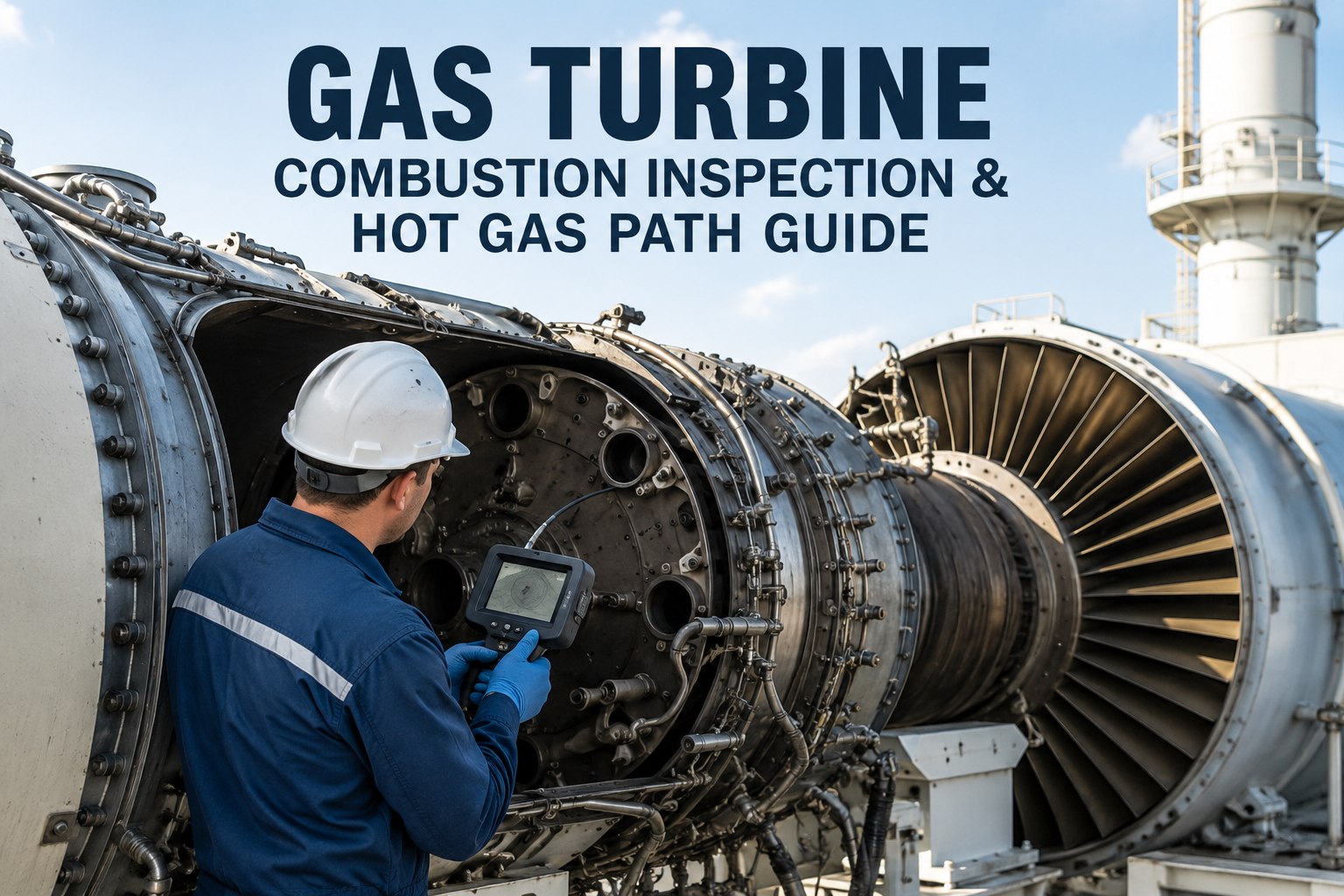
The combustion inspection is performed every 8,000–12,000 fired hours or 900 starts — whichever comes first. It targets the hardware that lives inside the combustion casing between the compressor exit and the first turbine stage, where temperatures and pressures peak. A CI is completed twice before any major inspection.
Scope: Components Removed and Inspected
Fuel Nozzles
Combustion Liners
Transition Pieces
End Covers
Crossfire Tubes
Flow Sleeves
Spark Plugs & Igniters
Flame Detectors
Cap Assembly
Combustion Casing
Fuel Nozzle Inspection
All fuel nozzles removed and sent to flow test bench — flow uniformity within 5% of reference nozzle
Nozzle tip erosion and carbon buildup assessed — plug wash or replacement per OEM criteria
Swirler vane condition — no cracking, erosion, or blockage at premix and diffusion circuits
Check valve and nozzle body for thermal distortion — dimensional check per OEM reparability limits
Fuel nozzle O-rings and seals replaced as-standard on every CI — no reuse of elastomeric seals
Reassembled nozzles torqued to OEM specification — torque values and sequence documented
Combustion Liner & Transition Piece
Combustion liner external surface inspected — evidence of hot spots, burnthrough, or oxidation documented
Liner cooling hole blockage — borescope or visual inspection of all film cooling hole rows
Transition piece aft frame inspected — cracking at seal lands, aft rail, and impingement holes assessed
UT wall thickness measurement of transition piece side walls — minimum wall confirmed vs. allowable
Crossfire tube and retainer assembly inspected — no cracking at tube ends, retainer spring intact
Flow sleeve condition — no buckling, cracking at attachment pins, or blockage of impingement holes
Combustion Casing & Hardware
Combustion casing external inspection — no exhaust leaks, hot spots, or distortion at flanges
End cover removal and inspection — no cracking at nozzle bores, no distortion at mating face
Spark plug condition — electrode gap and tip erosion assessed, replaced per OEM fired-hours limit
Flame detector optical surfaces cleaned — response time tested after reinstallation
All combustion hardware reassembled with new gaskets and seals — no reuse of combustion gaskets
Post-assembly leak check — compressed air pressure test at reconnected fuel nozzle fittings
Post-CI Return to Service
Combustion tuning verification on first fired start — exhaust temperature spread within acceptance band
Combustion dynamics levels checked at all load points — no exceedance vs. pre-CI baseline
NOx and CO emissions at rated load — within permit limits and compared to pre-CI performance
All CI scope items documented in CMMS work order — components replaced and findings recorded
Factored Fired Hours counter reset in maintenance management system — next CI interval confirmed
Parts removed for refurbishment tracked by serial number — shop report attached to work order record
Hot Gas Path Inspection (HGPI) Checklist
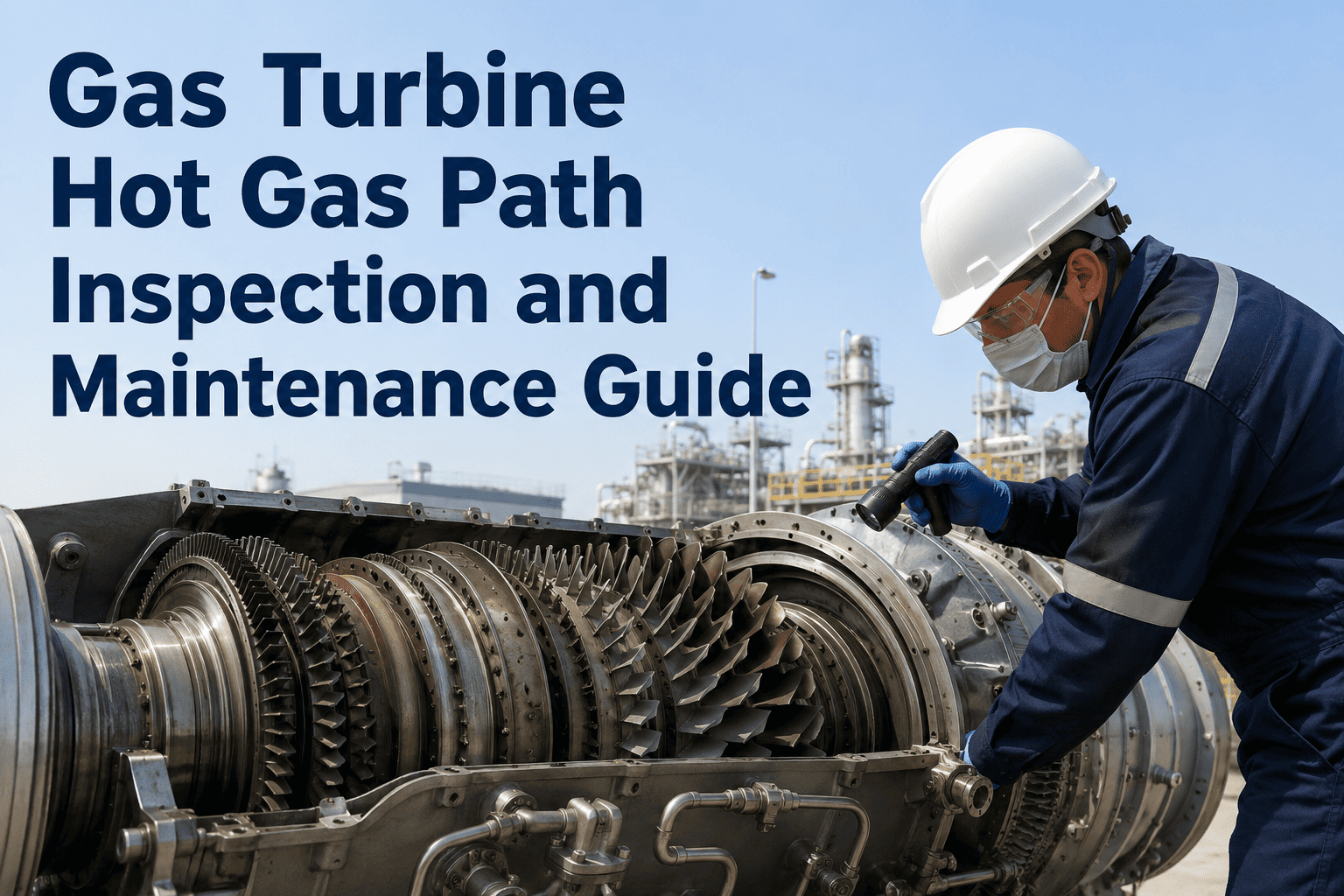
The hot gas path inspection occurs after approximately 24,000 fired hours — positioned between the two combustion inspections before a major. It includes the full CI scope plus a detailed inspection of the first and second stage turbine blades, nozzles, shrouds, and ring segments. An HGPI can run up to 368 hours of elapsed outage time.
Stage 1 Turbine Blades (Buckets)
All S1 buckets removed, numbered in situ, and inspected for thermal fatigue cracking at leading and trailing edges
Cooling hole blockage check — all film cooling and platform cooling holes verified open
Coating condition assessed — TBC spallation, oxidation depth, and hot corrosion pitting documented
Tip clearance measurements — all bucket tips measured against ring segment wear track
Dovetail and platform inspection — no fretting, cracking, or foreign object damage at attachment
Buckets assessed against OEM reparability criteria — repaired or replaced per factored fired hours consumed
Stage 1 Nozzles & Shrouds
S1 nozzle segments removed — throat area measured, erosion mapped against OEM acceptance limits
Nozzle leading edge cracking — fluorescent penetrant inspection (FPI) on all segments
Nozzle cooling hole blockage — all impingement and film cooling passages confirmed open
Shroud segment wear — contact surface wear documented, replacement if above OEM maximum
Ring segment hook condition — no cracking at attachment hooks, hook wear within reparability
All S1 nozzles and shrouds assessed for HGPI interval vs. 2-HGPI life expectancy
Stage 2 & Stage 3 Blades
S2 and S3 buckets removed — visual inspection for oxidation, corrosion, and leading edge erosion
Tip and platform condition — tip shroud cracking and Z-notch condition at tip shroud interlocks
S2/S3 nozzle throat area measured — confirm within OEM acceptance for continued service
S3 exhaust stage inspection — blade erosion from water droplet impingement and LP stage moisture
Rotating seal teeth condition — interstage labyrinth seal wear confirmed within OEM clearance
All stage components reassembled with moment-weight sorting — blade balance per OEM sequence
Turbine Casing & Rotor (HGPI)
Turbine casing split-line inspection — no fretting, flange distortion, or bolt torque loss
Horizontal joint gaskets and flex seals inspected — replaced if any evidence of hot gas bypass
Rotor visual inspection from exposed turbine stages — no surface cracking or deposit buildup on disc faces
Turbine bearing clearances measured with casing open — compared to OEM acceptance limits
Exhaust diffuser and last-stage stator vane condition — erosion and moisture damage assessed
All HGPI findings entered in CMMS — component life tracking updated with FFH consumed this interval
Major Inspection (MI) Checklist
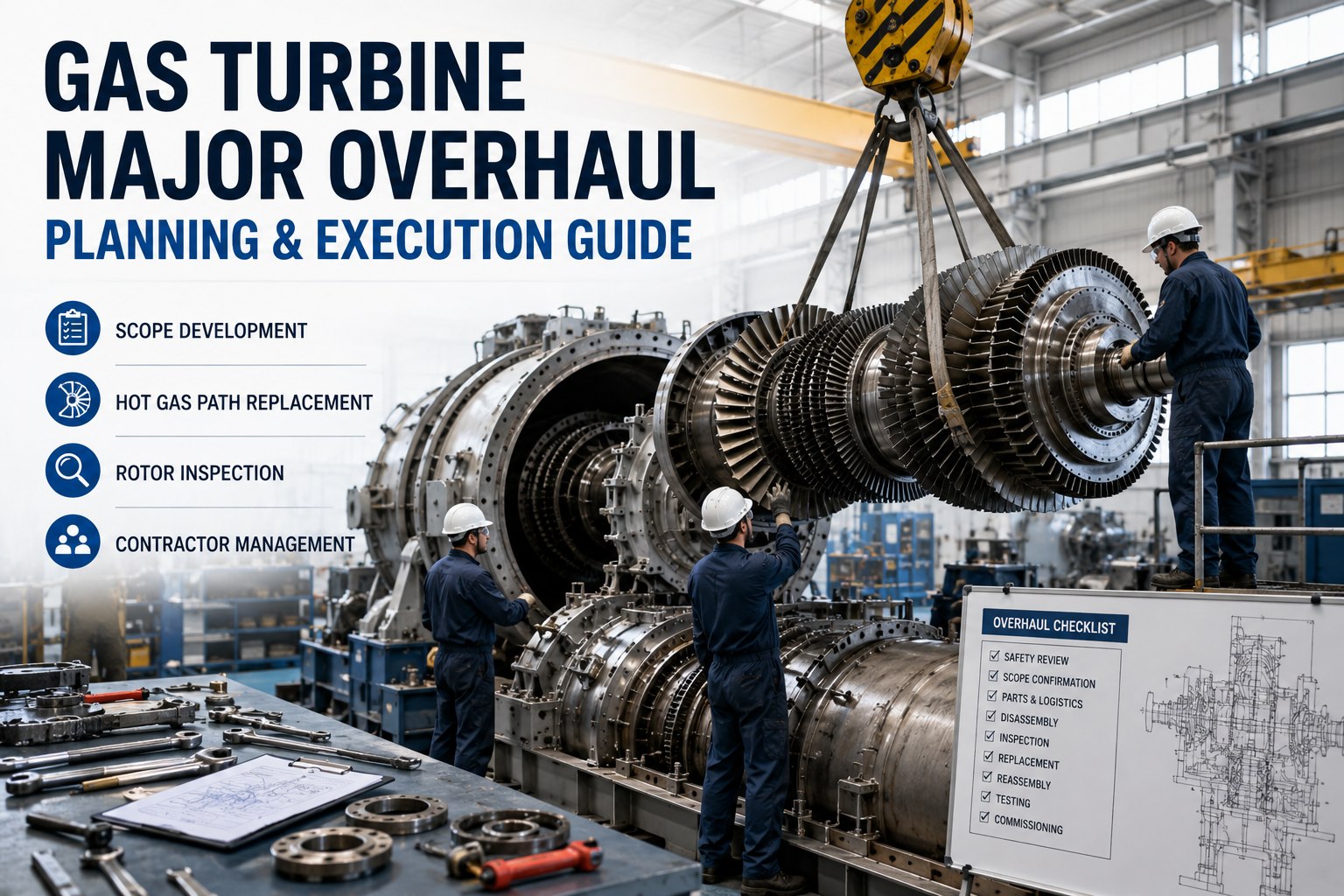
The major inspection occurs every 48,000 fired hours — a flange-to-flange disassembly from Bearing 1 at the bell mouth to Bearing 4 at the exhaust end. Planning should begin 18 months in advance to allow for parts procurement, OEM coordination, and outage scheduling. Every part will be exposed, checked, and replaced as required.
Compressor Section
Inlet guide vanes removed — vane surfaces, pivot pins, and actuator linkage condition documented
All compressor rotor stages accessible — blade foil erosion, FOD, and tip rub on all rows inspected
Stator vane segments — leading edge erosion, platform cracking, and vane-to-vane throat area measured
Compressor casing internal surfaces — corrosion, erosion at anti-rotation slots, and labyrinth seal condition
Offline water wash performed pre-disassembly — deposits sampled and analyzed for contamination source
Compressor discharge temperature compared to design — efficiency recovery target set post-reassembly
Rotor Assembly
Rotor removed from casing — shipped to OEM or repair facility for high-speed balance
All compressor and turbine disc face inspections — FPI on all disc bores, blade attachment slots, and web faces
Rotor runout measurements before and after — compared to OEM straightness and bow tolerance
Coupling condition — spline wear, alignment geometry, and flexible element condition checked
Turbine wheel disc temp paint or thermocouple evidence reviewed — peak temp exposure confirmed within material limits
All bucket wheel dovetail slots FPI inspected — no sub-surface cracking at retention geometry
Bearings & Seals
All journal and thrust bearings removed — babbitt condition, oil wiping pattern, and clearance measured
Bearing pedestals inspected — no cracking at oil supply ports, bearing seat roundness confirmed
Lube oil system flushed — cleanliness target of NAS 7 or better confirmed before restart
Bearing oil deflectors and seals replaced — no reuse of oil deflector labyrinth strips
Thrust bearing float measured — compare to OEM cold clearance limits before and after reassembly
All bearing clearances recorded in as-found and as-left condition — both sets entered in CMMS
Accessory Systems
Accessory gear and load gear refurbishment — gear tooth condition, bearing replacement, and seal kit
Hydraulic supply unit inspection — pump condition, filter replacement, accumulator pre-charge verified
Turbine compartment vent fans — motor condition, impeller balance, and drive belt or coupling replaced
Exhaust ducting and expansion joints rebuilt — flex element replacement, duct internal insulation inspected
Electronic overspeed protection system calibrated — redundant channels tested independently
Control system firmware updated to latest approved version — all sensor calibrations re-verified post-update
Borescope Inspection Program
Borescope inspections provide economical access to internal components without full disassembly. A structured borescope program between outage intervals can detect developing defects in first-stage blades, combustion hardware, and transition piece aft frames — often allowing condition-based scheduling adjustments that defer unnecessary outages.
Compressor Borescope
Inlet and first compressor stages — FOD, blade leading edge erosion, and deposit buildup
Mid-stage access ports — stator vane condition and inter-stage labyrinth seal wear
Compressor discharge scroll — no cracking at diffuser vanes or separation at liner joints
Anti-icing system components — no icing evidence or system residue at inlet struts
Combustion Borescope
Liner hot section — no burnthrough, local overheating, or loss of thermal barrier coating
Transition piece visible surfaces — cracking at aft frame, sealing strips, and impingement plate
Crossfire tube ends — no cracking or displacement from alignment in adjacent cans
Fuel nozzle tips visible in situ — carbon or erosion deposits compared to baseline photos
Hot Gas Path Borescope
S1 bucket leading edges — visible cracking, coating spallation, and tip erosion documented
S1 nozzle throat area — visible erosion compared to baseline and prior borescope photos
Ring segments visible from bucket tip access — wear pattern and hot spot evidence
S2 and S3 stages where accessible — oxidation and moisture damage documented with images
Inspection Interval Summary — All Three Tiers
FFH Tracking: Why Spreadsheets Fail Gas Turbine Teams
The single biggest gap in gas turbine inspection management is Factored Fired Hours accounting. Plants that track only clock hours miss the true inspection budget consumption of cycling operations, trips, and fuel switching events.
What Spreadsheets Do
Count actual fired hours only — no weighting for starts, trips, or fuel type
Miss cycling-unit start accumulation — 300 starts/year can trigger CI before hours interval
Cannot auto-trigger work orders when FFH threshold is crossed mid-month
Provide no component-level life tracking — parts repaired vs. replaced not linked to FFH consumed
Audit trail requires manual reconstruction — NERC and regulatory records not timestamped at task level
What OxMaint Does
Configurable FFH multipliers per event type — cold start, warm start, hot start, trip, fuel switch
Starts-based interval tracked in parallel — inspection triggers on whichever threshold is reached first
Auto-generates work order when FFH threshold crossed — assigned to technician immediately
Component-level serial number tracking — shop report, FFH consumed, and repair scope per part
Every inspection record timestamped and signed — one-click audit export by asset, date, or standard
Tracks FFH, Starts, and All Three Inspection Tiers Automatically
Replace Your GT Inspection Spreadsheet with OxMaint
OxMaint pre-loads your turbine's OEM inspection intervals, configures FFH multipliers for your operating profile, and auto-generates combustion, HGPI, and major inspection work orders the moment your threshold is crossed. Every scope item is tracked, every component's serial number is linked, and every completed inspection is audit-ready from day one.
Frequently Asked Questions
How often should a gas turbine combustion inspection be performed?
Combustion inspections are typically performed every 8,000–12,000 fired hours or 900 starts, whichever occurs first. Cycling units, liquid fuel operation, and sites with high trip rates may reach the starts-based threshold significantly before the hours threshold.
OxMaint tracks both fired hours and fired starts simultaneously, triggering a CI work order automatically when either threshold is reached — ensuring no cycling unit runs past its actual interval.
What is the difference between a Hot Gas Path Inspection and a Major Inspection?
An HGPI includes the full CI scope plus removal and detailed inspection of the turbine blades, nozzles, and shrouds exposed to extreme combustion temperatures, occurring at approximately 24,000 fired hours. A major inspection goes further — it is a full flange-to-flange disassembly covering the compressor, rotor, all HGP components, and all bearings at approximately 48,000 fired hours.
Book a demo to see how OxMaint structures all three inspection tiers on a single asset record with shared component life tracking.
What are Factored Fired Hours and why do they matter for GT inspection scheduling?
Factored Fired Hours apply multipliers to actual operating events — a cold start may consume the equivalent of 2–5 fired hours of inspection budget, and a trip from load can consume 4–8 fired hours per event. Plants that count only clock hours underestimate their true inspection consumption and run components past their safe service life.
OxMaint's FFH engine supports configurable multipliers based on your specific OEM manual and actual operating profile, keeping your inspection schedule calibrated to real equipment condition.
Can borescope inspections replace a scheduled combustion or HGPI outage?
Borescope inspections are a valuable condition-monitoring tool that can support interval optimization, but they do not replace scheduled combustion or HGPI outages. They cannot access fuel nozzle flow characteristics, perform UT wall thickness measurements on transition pieces, or assess coating condition on the bucket undersurface — all of which require component removal.
Talk to an OxMaint specialist about integrating borescope inspection findings into your CMMS to build a condition-based argument for interval extension within OEM-approved limits.
How should combustion inspection findings be documented for OEM warranty and audit purposes?
Each CI should produce a completed work order with as-found and as-left condition for every component removed, serial numbers for parts sent for refurbishment, photos of defects found, and torque records for all critical fasteners. OEM warranty typically requires documented evidence that inspections were performed within the specified interval with approved replacement parts.
OxMaint timestamps every inspection record at the task level with technician digital signatures, generating a complete audit package that satisfies both OEM warranty requirements and NERC audit documentation standards.
Go Live in Under One Week — No Credit Card Required
Stop Tracking Gas Turbine Inspections on Spreadsheets
Every checklist in this guide — combustion, hot gas path, major inspection, compressor, and borescope — can be deployed as a live, automated inspection schedule in OxMaint today. FFH counters run automatically. Work orders generate the moment thresholds are crossed. Technicians complete scope on mobile. Every component's life is tracked by serial number. Your first prevented unplanned outage pays for years of platform cost.