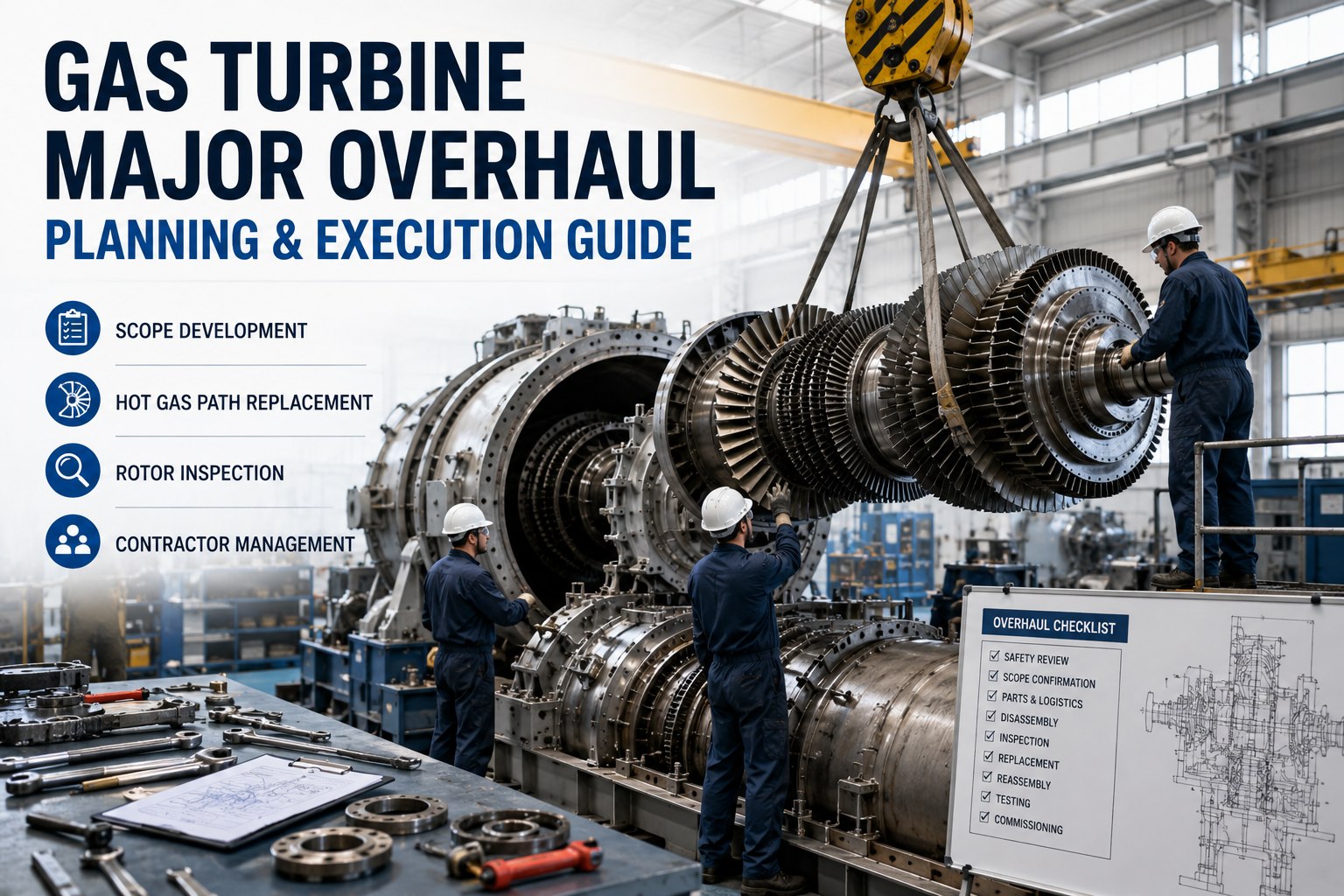
A gas turbine major overhaul is a 25-to-45-day, $4M-to-$12M event that determines whether your unit returns to nameplate heat rate or quietly loses 3% efficiency in its first restart week. The difference between a controlled outage and a slip of seven days comes down to planning maturity: long-lead parts booked 9 months out, rotor-stator clearances verified against OEM baselines, and a CMMS that closes every work order before the billet cover goes back on. This guide compresses the planning and execution playbook used by combined-cycle operators who hit 98% post-overhaul availability. When you're ready to move from spreadsheets to a system built for heavy outage work, Start Free Trial and import your BOM in minutes.
Can your next turbine overhaul finish on schedule, under budget, and at nameplate heat rate?
A major gas turbine inspection involves 3,800+ tagged parts, 14–22 subcontractor crews, and a critical path measured in hours. Without disciplined scope freeze, parts readiness, and shift-level execution, a single missed rotor delivery adds $1.8M in replacement energy. Here's the planning framework that keeps outages inside the window.
of major overhaul delays are caused by parts not on-site when the casing opens — not by labor.
Overhaul timeline: from scope freeze to first fire
A Frame 7FA-class major overhaul typically requires 9–12 months of preparation. Compressing the front-end planning below 6 months is the single largest predictor of schedule slip and unplanned change orders.
Scope development & budget lock
Define hot-gas-path (HGP) replacement scope from borescope findings, operating-hour trends, and OEM LSI thresholds. Lock the budget against historical $/MW benchmarks. Freeze the work-breakdown structure.
Long-lead parts & rotor reservation
Order combustion liners, transition pieces, first-stage nozzles, and blade rings. Reserve the spare rotor with the OEM exchange pool — typical lead time is 26–34 weeks. Confirm subcontractor NDA and site access.
Logistics, tooling & QA plan
Stage 40+ specialty tools (hydraulic tensioners, rotor lifts, casing heaters). Lock the inspection travel sheet. Verify NDE vendor calibration. Run a tabletop outage simulation with shift leads.
Shutdown, de-couple & open
Cool-down to 150°F, isolate fuels and lube oil, de-couple generator, remove upper casing half. Begin HGP teardown, clearance mapping, and rotor draw per OEM procedure.
Reassembly, alignment & first fire
Close unit, perform rotor alignment within 0.002" TIR, conduct LOTO release and purge. Fire on distillate, transfer to gas, and run a 4-hour hold at full load to validate heat rate and vibration.
What belongs in a major overhaul work scope
A complete major inspection scope covers five subsystems. Missing any one of them in the frozen scope document is the most common cause of mid-outage change orders, which cost 2.3x more than pre-planned work.
Hot gas path replacement
- Combustion liners, flow sleeves, fuel nozzles
- Transition pieces, cross-fire tubes
- Stage 1–2 nozzles & shrouds
Rotor inspection & NDE
- LP & IP blade dovetail FPI
- Rotor wheel rim ultrasonic exam
- Spacer & torque tube dimensional check
Bearing & seal refurbishment
- Tilting-pad journal bearing re-babbitt
- Thrust bearing pad replacement
- Labyrinth & brush seal clearance reset
Combustion & fuel system
- Gas manifold & orifice inspection
- DLN tuning & emission mapping
- Igniter & flame detector replacement
Controls & instrumentation
- Vibration & displacement probe calibration
- Exhaust thermocouple replacement
- Mark VIe firmware update & I/O bench test
Auxiliary & balance of plant
- Lube oil reservoir cleaning & flush
- Inlet filter & evap cooler media swap
- Exhaust frame & plenum insulation repair
Parts-readiness gates that prevent 90% of schedule slips
OEMs report that 42% of overhaul delays trace back to parts issues — wrong revision, missing certs, or a critical sub-assembly still in transit when the casing is opened. A structured readiness review at T-90 days catches these failures while there's still time to recover.
Bill of materials reconciliation
Cross-reference every part on the OEM job kit list against your CMMS master tag. Flag any item where the installed revision differs from the order revision. A typical 7FA major has 380 line items; expect 12–18 discrepancies.
Material certification & MTR review
Verify that every pressure-retaining and rotating component has a traceable Material Test Report on file before it ships. Missing MTRs are the top reason an inspector red-tags a part at receiving — and they take 5–10 days to reissue.
Spare rotor pool confirmation
Confirm the exchange rotor has passed its shop balance and overspeed test, and that shipping permits are filed. Rotor transit alone is 3 weeks; if the pool slot slips, your entire 28-day outage moves with it.
Consumables & staging area
Stage gaskets, bolts, sealant, and torque charts in a controlled laydown yard mapped to the teardown sequence. A 2-hour search for a missing casing stud at 2 a.m. is a classic, avoidable outage-killer.
The real economics of a major overhaul
A deferred or poorly executed overhaul doesn't just cost more to complete — it compounds through degraded heat rate, forced-outage risk, and replacement energy. Quantify the trade-off before you push the start date.
Example: a 200MW Frame 7FA unit with 1.2-day slip burns roughly $1.44M in replacement energy at $30/MWh premium — equal to 12% of the overhaul parts budget.
A well-executed major typically recovers 80–120 Btu/kWh of heat-rate degradation, worth $400K–$900K per year at 6,500 operating hours.
| Cost Driver | Planned Overhaul | Deferred or Rushed | Annual Impact |
|---|---|---|---|
| Parts procurement (long-lead) | $2.8M — OEM list | $3.4M — expediting +25% | +$600K |
| Replacement energy (slip) | $0 — zero slip | $1.8M — 1.5-day slip | +$1.8M |
| Heat-rate degradation | Recovered 100 Btu/kWh | Recovered 30 Btu/kWh | +$520K |
| Forced outage risk | 0.8 trips/year | 2.4 trips/year | +$960K |
| Total avoidable cost of a poorly planned overhaul | $3.88M | ||
Managing OEM, EPC & specialty subcontractor crews
A single major overhaul mobilizes 14–22 subcontractor crews — from the OEM technical field advisor to independent NDE labs and scaffold builders. Crew overlap, permit conflicts, and unclear scope boundaries create the idle-time that kills productivity.
A 180-MW combined-cycle plant, two-unit major overhaul
A Mid-Atlantic operator ran simultaneous majors on two Frame 7FAs with a shared laydown yard and a common CMMS. By sequencing rotor draws four days apart and routing NDE crews between units, they cut total outage duration from 56 to 41 days, avoided $2.3M in replacement energy, and closed 100% of work orders with photos and as-found dimensions attached. The post-overhaul heat rate came in 4 Btu/kWh better than the OEM guarantee.
Ready to run your next overhaul like the top-decile operators?
Oxmaint gives you scope-freeze templates, parts-readiness gates, and shift-level work-order tracking built specifically for heavy gas turbine outages.
Gas turbine major overhaul: what operators ask most
The five questions below cover the scope, timing, and digital-tool decisions that determine whether your next major inspection stays inside budget and schedule.
How often does a gas turbine need a major overhaul?
Most OEMs specify a major inspection at 24,000–30,000 fired hours or 1,200 starts for E-class fleet, and 32,000–48,000 hours for F-class units, whichever comes first. The exact interval depends on fuel type, peaking vs baseload duty, and the results of interim combustion and hot-gas-path inspections. Track fired hours and starts monthly in your CMMS so the T-12-month planning trigger fires automatically.
What's the typical cost of a gas turbine major overhaul?
A Frame 7FA-class major runs $4M–$8M in parts and labor; larger F-class units (7HA, 9HA) range $7M–$12M. Parts account for 55–65% of the total, labor 20–25%, and subcontractors the remainder. Add 10–15% contingency for discovered conditions like bucket distress or nozzle cracking. You can scope and budget these line items in a structured system — Start Free Trial to load your job kit list.
How long does a major turbine overhaul take?
Execution on-site is typically 25–45 days for an F-class unit, preceded by 9–12 months of planning. The critical path is rotor draw, inspection, and reinstallation — usually 12–18 days. Aggressive schedules are achievable only when long-lead parts are on-site, tooling is staged, and shift handoffs are documented in a real-time CMMS.
What happens if I defer a major overhaul past the OEM interval?
Operating beyond the inspection interval typically voids remaining OEM warranty on hot-section components and raises forced-outage probability by 2–4x. Heat rate degrades roughly 0.5% per 1,000 hours past due, and insurance carriers may decline coverage for rotor bursts. The annualized risk of deferral usually exceeds the cost of performing the overhaul on schedule.
What should a turbine overhaul CMMS track that a generic system misses?
It must capture as-found clearances against OEM baselines, attach photos to every work order, manage permit-to-work and LOTO in real time, and produce a restart-readiness report that lists every open item before first fire. Generic maintenance tools handle routine PMs but rarely support the 3,800-tag density and shift-level intensity of a major. To see the difference, Book a Demo with our outage team.
Plan your next major overhaul with confidence
Oxmaint brings scope templates, parts gates, shift tracking, and restart-readiness reporting into one system — so your turbine returns to nameplate performance, on schedule.
Free 14-day trial · No credit card