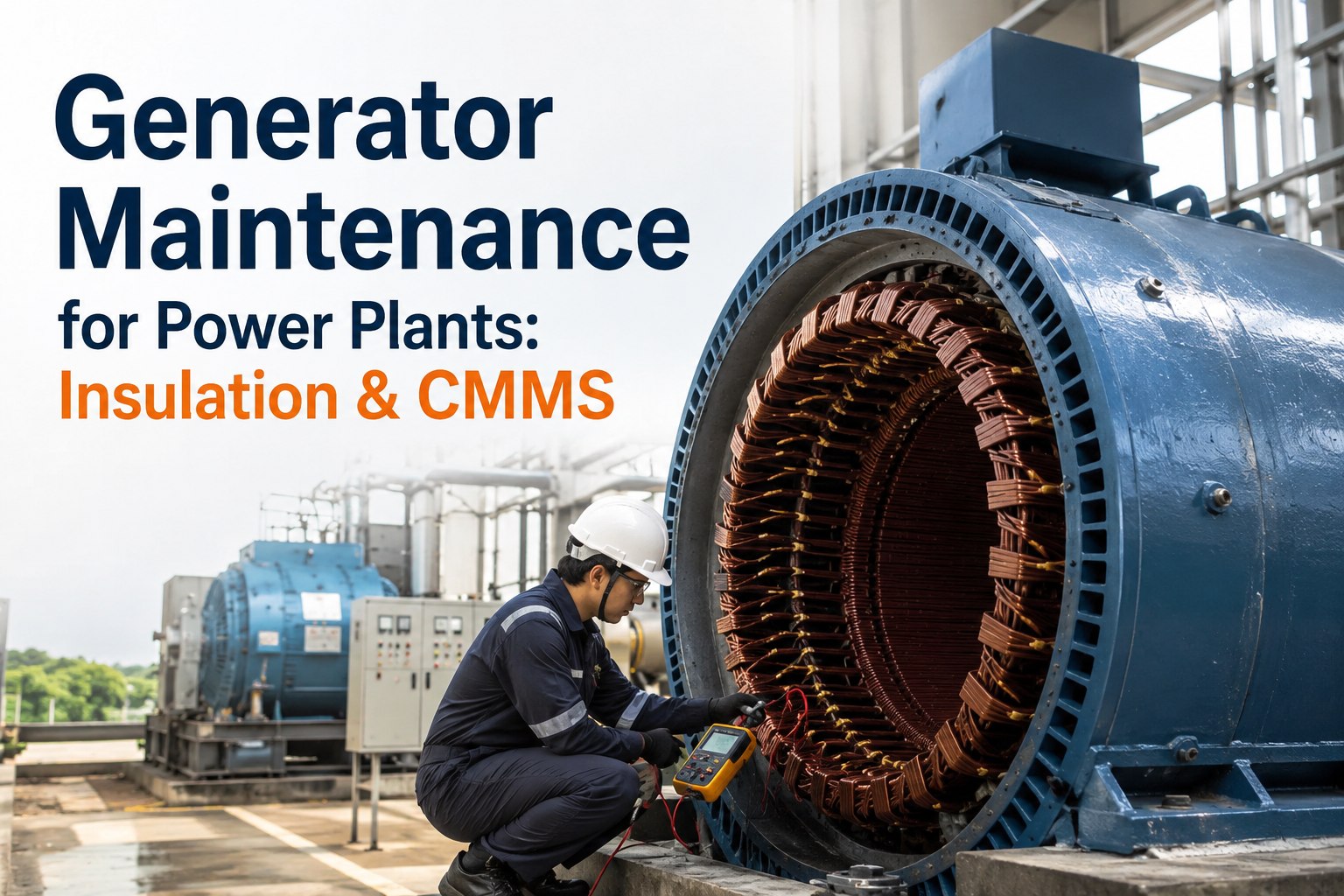
Generator failures cost power plants an average of $50,000–$150,000 per unplanned outage event, with major stator winding replacements exceeding $2M on a 500MW unit. A structured generator maintenance program—combining stator winding insulation testing, rotor inspection, exciter PM, and partial discharge monitoring—typically reduces unplanned downtime by 30–50% and extends asset life by 8–12 years. Modern CMMS platforms like OxMaint automate PM scheduling, capture trend data across IEEE-standard test intervals and turn reactive fire-fighting into condition-based maintenance. Start Free Trial to map your generator PM calendar in under 30 minutes.
Generator Reliability Playbook · 2026 Edition
Is your stator winding one partial discharge away from a forced outage?
Over 70% of generator failures trace back to insulation degradation that was detectable 12–24 months in advance. A disciplined maintenance schedule—anchored in IEEE 43, IEEE 115, and continuous PD monitoring—catches the warning signs before they become $2M rewind bills.
Core Insulation Tests
The four tests that catch 80% of stator winding failures early
Every test below maps to an IEEE standard and a specific failure mode. Trend the results in your CMMS across consecutive outages—single readings rarely tell the story; the slope does.
Insulation Resistance & Polarization Index
IEEE 43-2013
Apply DC voltage at 1× rated U-phase; PI = IR(10min)/IR(1min). A PI below 2.0 on Class F insulation signals moisture absorption or contamination. Log every reading with temperature correction to 40°C.
Partial Discharge Monitoring
IEEE 1434 / IEC 60270
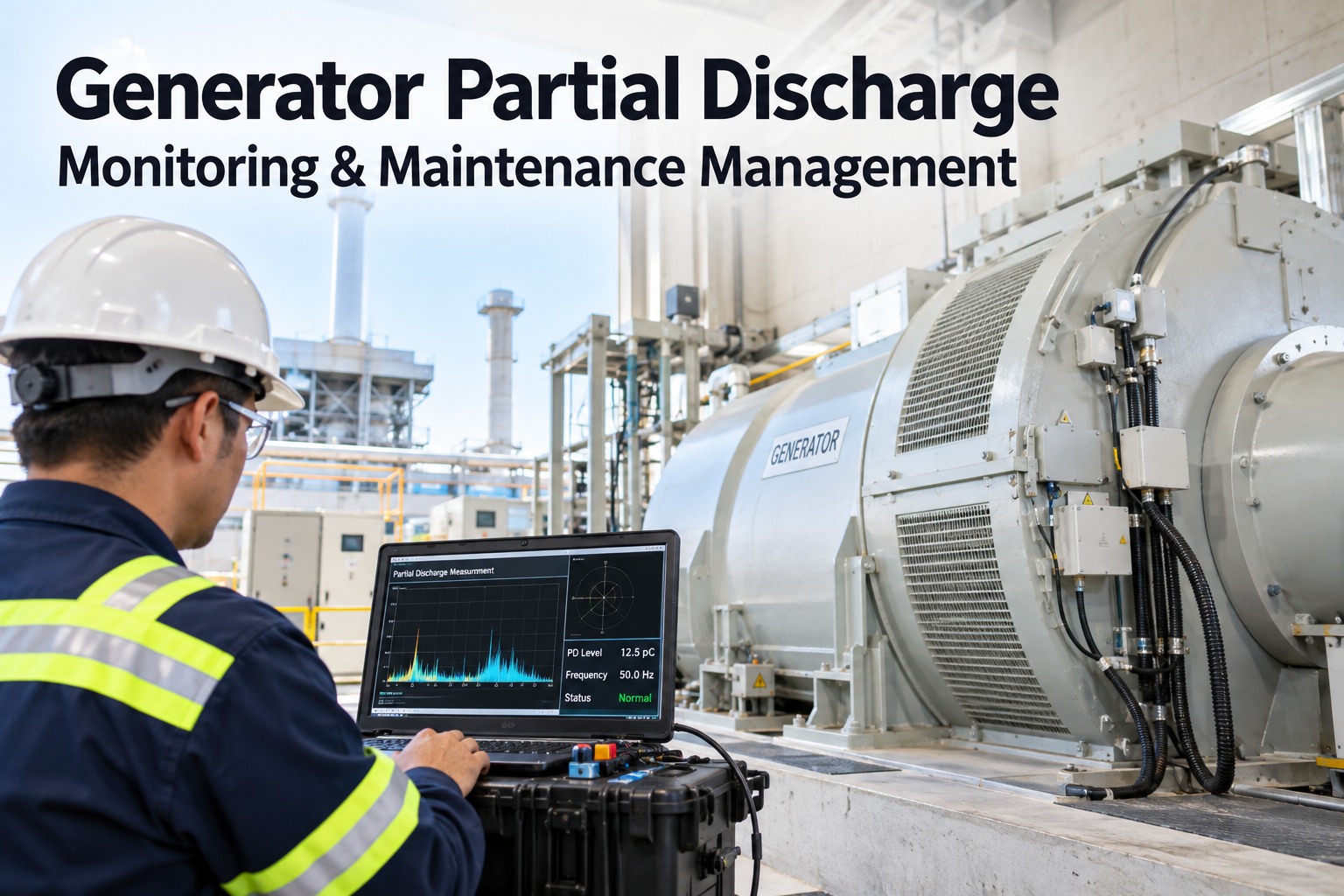
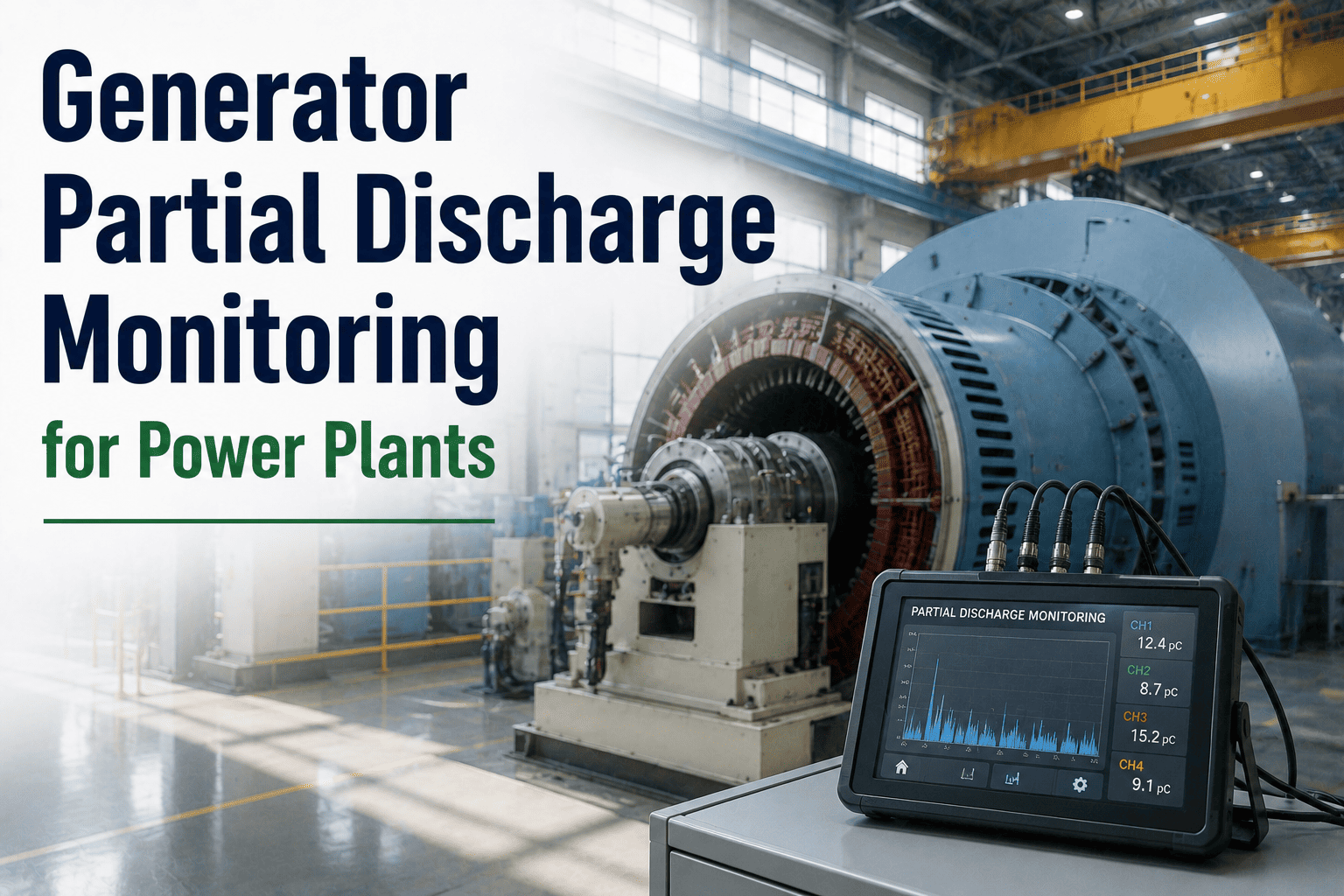
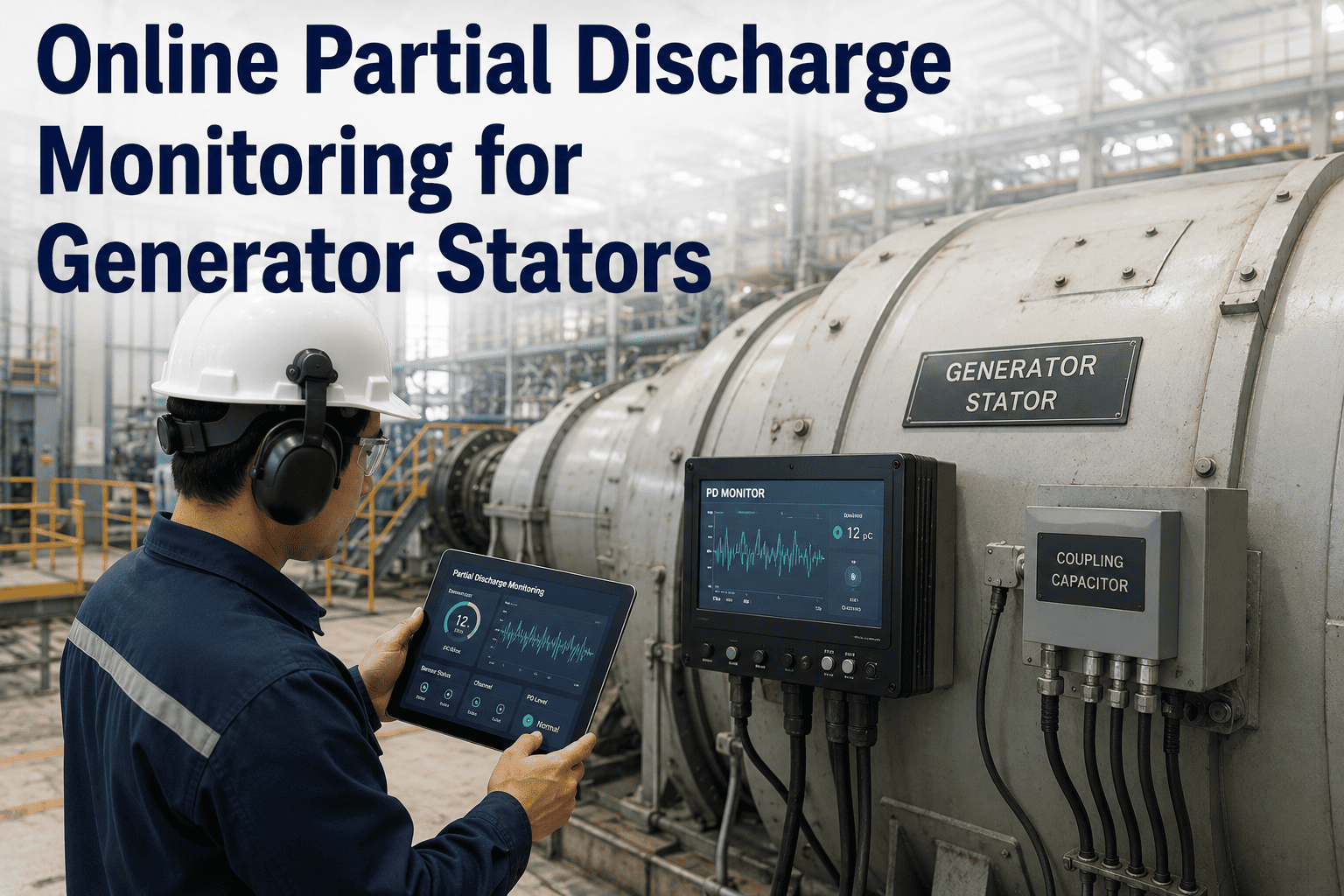
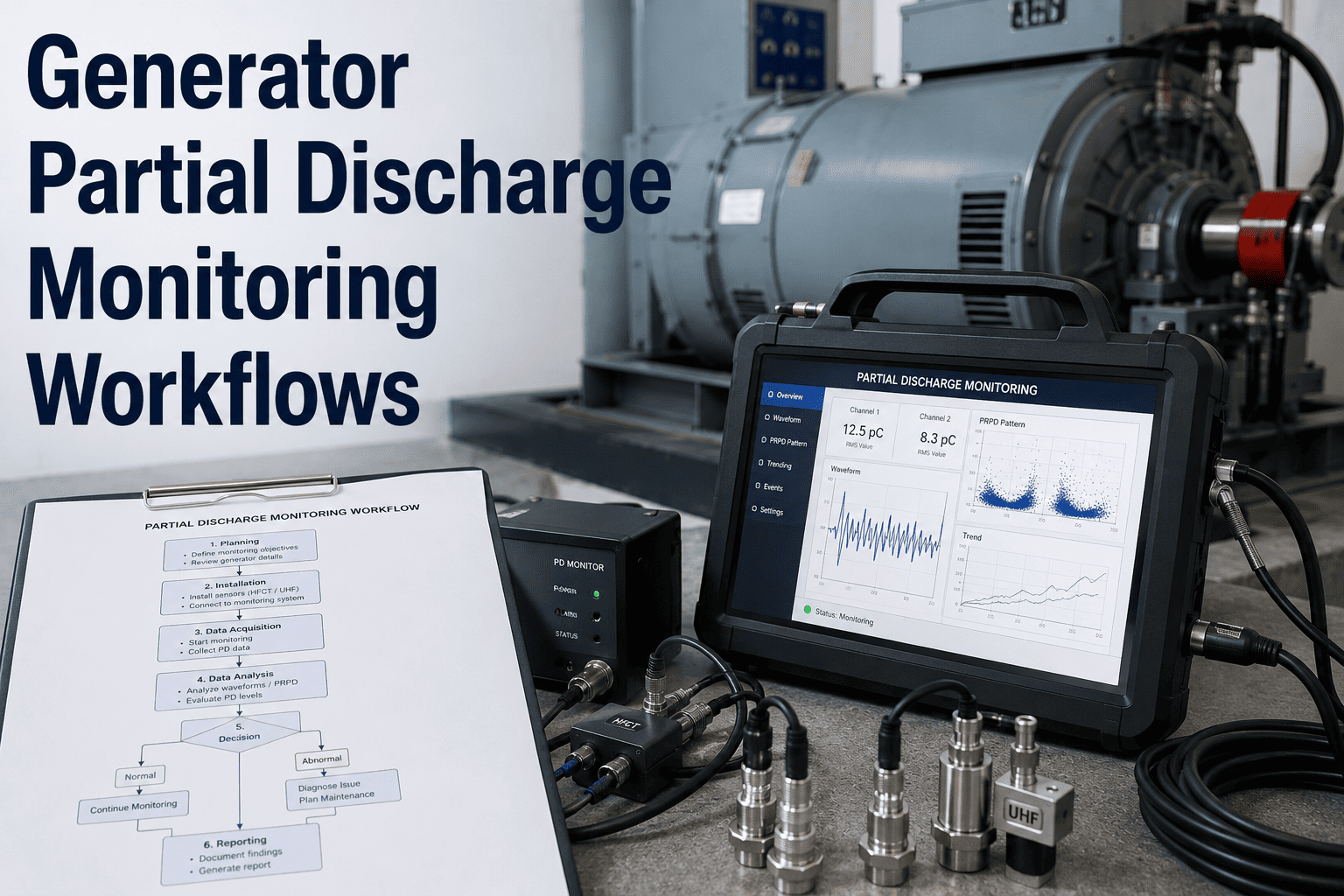
Online PD sensors detect slot discharge, end-winding corona, and delamination in epoxy-mica systems. Sustained activity above 5,000 pC at 0.7 pu voltage warrants a borescope inspection at the next planned outage.
Dielectric Absorption & Dielectric Loss Tangent
IEEE 286
Tan-δ tip-up measurements reveal bulk insulation health. A tip-up exceeding 0.5% between 0.2 and 0.8 pu voltage indicates void formation—typically 6–10 years before catastrophic ground fault.
EL-CID Core Flux Test
ASTM A977
Low-core-flux interlaminar inspection detects shorted stator iron laminations in under 4 hours without full disassembly. Fault currents above 100 mA at 4% flux warrant local re-insulation of the affected packets.
Annual PM Calendar
12-month generator maintenance timeline
A typical air-cooled 200–500MW unit follows a tiered cadence—monthly condition checks, quarterly electrical tests, and a major 4–6 week overhaul every 5–7 years. Align each task with your CMMS trigger rules so nothing slips between outages.
Online condition monitoring sweep
Review bearing vibration trends (ISO 10816 alarm >7.1 mm/s), stator winding temperature (RTD hotspot < 95°C Class F), hydrogen purity (>97%), and seal oil differential pressure. Trend in CMMS dashboard; auto-flag any 15% deviation from baseline.
Bearing inspection & brushgear PM
Inspect sleeve bearing oil for particulates (NAS 8 max), check brush length on slip-ring units (replace below 22mm), verify exciter air filter ΔP (< 250 Pa), and test bearing insulation resistance (>1 MΩ with shaft grounded).
Offline electrical test package
During a 3–5 day planned outage: perform IR/PI at 1× U-nominal, DC leakage (Ramped DC to 1.25× U-nominal), tan-δ tip-up, and EL-CID core test. Compare all values to previous-year CMMS records; initiate corrective work order on >20% drift.
Major stator & rotor overhaul
Full disassembly: rotor pole drop test, end-winding support inspection, stator wedge tightness tap-test (loose wedges <15%), field winding impedance, and re-wedging where voids exceed 10% of slot length. Budget $800K–$2.4M depending on unit size.
Stator rewind & rotor re-insulation
If PD activity exceeds 10,000 pC and tan-δ tip-up doubles from baseline, plan a full stator rewind ($1.5M–$4M for a 500MW unit) or rotor re-insulation ($600K–$1.2M). Schedule 18 months ahead to secure OEM slot allocation and avoid peak-demand outages.
Rotor & Exciter Deep-Dive
Rotor field and exciter maintenance checklist
Brushless excitation systems on modern turbogenerators are often neglected until forced outages occur. Below is a 16-point PM checklist covering field winding integrity, diode bridge health, and shaft-grounding—used by top-quartile plants to hold equivalent forced outage rate (EFOR) under 2%.
Rotor Field Winding
- Measure field winding resistance; ±2% deviation from OEM nameplate triggers investigation.
- Perform RSO (Repetitive Surge Oscilloscope) test to detect inter-turn shorts; trace deviation >0.5%.
- Inspect retaining-ring for stress-corrosion cracking (non-magnetic 18Mn-18Cr preferred over 18Mn-4Cr).
- Conduct pole-drop test; deviation between poles must stay under 5%.
- Verify fan blade integrity and runout; balance to ISO 1940 G2.5.
- Check field winding impedance at 50/60 Hz; flag >10% drift from baseline.
- Inspect collector rings for grooving, brightness, and patina; correct brush grade per OEM.
- Test shaft voltage and grounding brush current; keep below 20V peak to prevent bearing damage.
Brushless Exciter & PMG
- Megger exciter armature and field windings at 500V DC; minimum 100 MΩ at 40°C.
- Test rotating diode bridge forward/reverse leakage; replace any diode exceeding 10µA reverse current.
- Inspect AC exciter stator core for hotspots using thermal imaging; ΔT < 15°C across frame.
- Check permanent magnet generator output voltage within ±3% of nameplate.
- Verify Automatic Voltage Regulator (AVR) setpoints: V/Hz limiting, over-excitation, under-excitation trip limits.
- Clean exciter air cooler fins; verify outlet air temperature < 45°C at full load.
- Inspect coupling alignment between main shaft and exciter; laser align to 0.05mm face-and-rim.
- Test redundancy: switch AVR to standby channel; verify bumpless transfer within 2 cycles.
Cost of Inaction
What a single missed PM cycle really costs a 300MW plant
A worked example from a Midwestern coal plant running two 300MW air-cooled turbogenerators, baseline capacity factor 62%, wholesale energy price $48/MWh. Skipping the annual offline test package for two consecutive years turned a $24K preventive task into a $1.8M forced outage.
Incident Breakdown
Stator ground fault on Unit 2 — root cause timeline
A single $2,400 EL-CID core flux test, run 8 months earlier, would have flagged the localized slot discharge at 6,200 pC and triggered a $34K corrective wedge-retightening during the next planned weekend outage. Net avoided cost: $6.69M—a 2,787× return on a single PM task.
CMMS Impact
How a CMMS transforms generator PM from calendar-based to condition-based
Plants that deploy a purpose-built CMMS for generator maintenance report 35–50% fewer unplanned trips, 20% lower MRO inventory carrying costs, and full audit traceability across NERC PRC-005 and ISO 55000 requirements. Below: the shift most plants experience within 12 months of going live.
| Maintenance Dimension | Manual / Spreadsheet PM | CMMS-Driven (OxMaint) |
|---|---|---|
| PM trigger | Calendar date in Excel; often missed on shift handover | Auto-triggered on runtime hours, MW-hrs, or PD threshold breach |
| Test data trending | Paper logbooks; year-over-year comparison is manual, error-prone | Every IR/PI/tan-δ reading stored, temperature-corrected, auto-graphed |
| Spare part readiness | Reactive ordering; average 3.2-day lead time on critical parts | Min/max auto-reorder; kit-level pre-stage for each PM task |
| Audit readiness (PRC-005) | 2–4 weeks of manual report compilation per audit cycle | One-click export of every PM record, test result, and sign-off |
| Mean time to detect (MTTD) | ~180 days (next planned outage window) | <24 hours via online PD + vibration + thermal integration |
| Forced outage rate (EFOR) | 4.2% industry median, manual PM | 1.6% median after 12 months on CMMS |
We migrated 47 rotating assets onto OxMaint in six weeks. Within the first major outage cycle we caught a rotor inter-turn short on a 280MW unit that would have taken the generator down within four months. The CMMS paid for itself on that single event.
Stop tracking generator PMs on spreadsheets that silently expire
Build your full generator PM schedule—monthly monitoring, quarterly bearing checks, annual offline test package, 5-year overhaul—in OxMaint in a single afternoon. Free for 14 days, no credit card.
Frequently Asked Questions
Generator maintenance, answered
How often should stator winding insulation resistance tests be performed?
IEEE 43-2013 recommends IR and polarization index tests at every major planned outage—typically annually for critical utility-scale generators, and at minimum every 2–3 years for standby units. For units with active PD monitoring showing elevated activity (>3,000 pC), increase offline test frequency to semi-annual. Record every result in your CMMS with temperature correction; the trend matters more than any single reading. Start Free Trial to auto-schedule IEEE 43 intervals.
What partial discharge threshold indicates a stator rewind is necessary?
There is no single universal threshold—context matters. However, sustained PD magnitude above 10,000 pC on an epoxy-mica system, combined with a tan-δ tip-up that has doubled from baseline over three consecutive measurements, strongly indicates delamination severe enough to warrant rewind planning. A borescope inspection of end-windings and slot exits should confirm the diagnosis before committing the $1.5M–$4M rewind budget.
Can a CMMS really reduce generator forced outages by 35–50%?
Yes—but only when paired with disciplined execution. The reduction comes from three mechanisms: (1) no PM task falls through the cracks because triggers are automatic; (2) trend data catches degradation 6–18 months earlier than calendar-only programs; and (3) spare parts are pre-staged, cutting repair duration by 30–60%. Plants that simply install the CMMS but keep running manual workarounds see only 5–10% improvement. Book a demo to see the generator-specific workflow.
What is the typical payback period for implementing a generator CMMS?
For a mid-size plant (2–4 turbogenerators, 100–500MW each), the CMMS subscription cost is typically $12K–$28K per year. A single avoided forced outage—conservatively valued at $500K–$2M in lost margin plus repair—delivers 18×–80× ROI in year one. Most plants achieve full payback within 3–6 months of go-live, assuming the PM calendar is migrated completely and online monitoring data is integrated.
How do I migrate existing generator maintenance records into a new CMMS?
Start by exporting your current PM calendar, asset hierarchy, and last 3 years of test results from spreadsheets or your legacy system. Map each asset to OEM model number, rated MVA, voltage class, and insulation class. Import historical IR/PI/tan-δ/PD readings so trend baselines are preserved from day one. Most implementations take 4–8 weeks for a 10–50 generator fleet. Book a Demo and our team will scope your migration in 30 minutes.
Your generators deserve a maintenance system that never sleeps
Put every stator test, rotor inspection, and exciter PM on autopilot
Join the plants holding EFOR below 2% and extending generator life by 8–12 years. Set up your full PM calendar in OxMaint today—import assets, schedule IEEE-standard test intervals, and start trending insulation health before the next outage window closes.
Free 14-day trial · No credit card