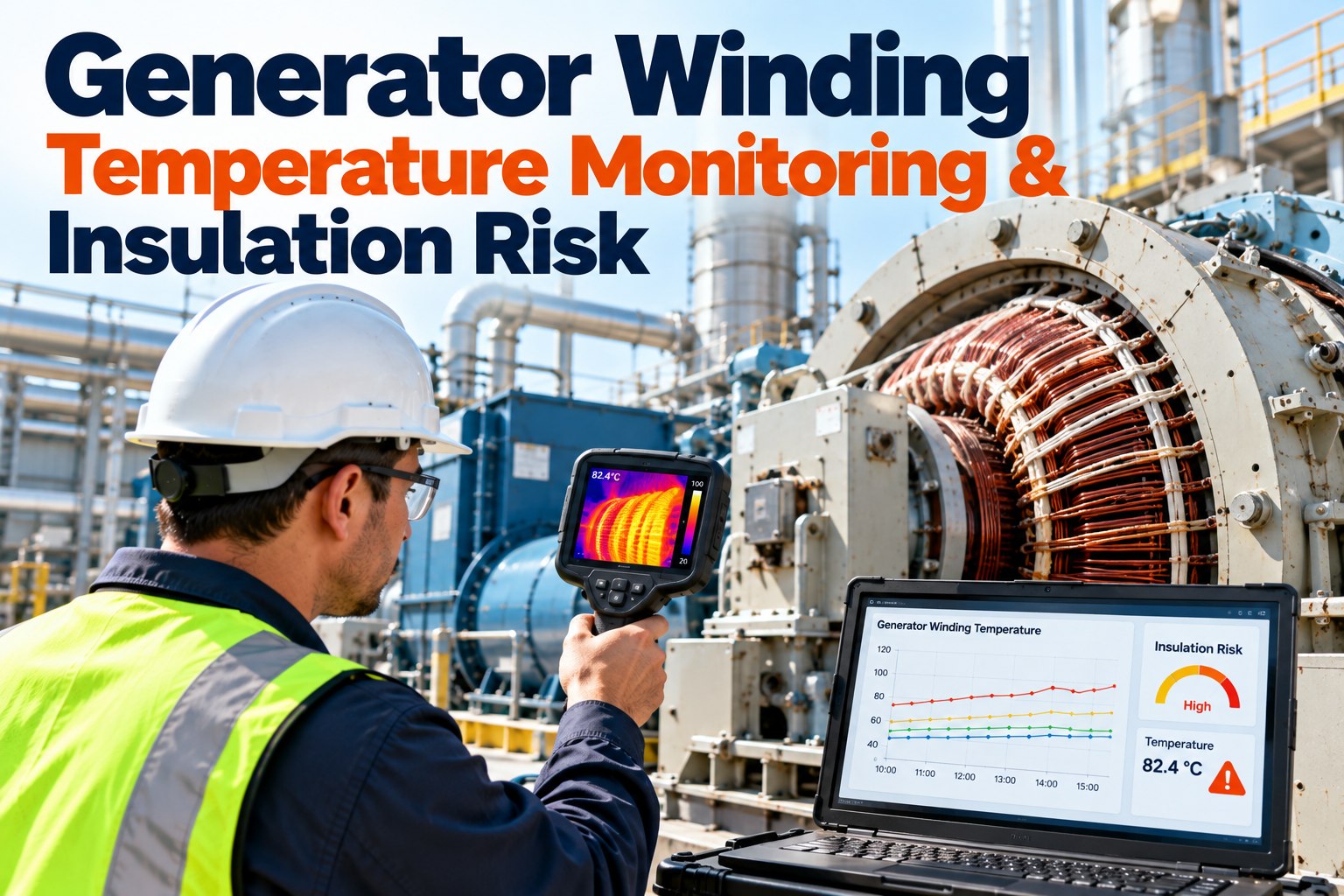
A generator's winding temperature is its clearest vital sign — but a single reading on screen rarely tells you much. What matters is the trend: a stator slot creeping two degrees warmer each month at the same load, an RTD sitting closer to its alarm point than it did last year, a hot spot the sensor can't quite see. Winding insulation doesn't fail all at once; it cooks slowly, and every excess degree shortens its life. This guide covers how to read winding-temperature trends and maintenance findings together to catch abnormal heating and insulation risk early — and how OXMAINT AI, the AI-powered CMMS, turns a rising trend into a tracked issue and work order.
Generator Winding Temperature Monitoring & Insulation Risk
A winding that runs a few degrees hot for months is quietly spending its insulation life — and a spot check won't reveal it. OXMAINT AI runs the workflow in one platform: RTD trends and inspection findings become tracked issues, then prioritized work orders, then preventive and predictive schedules. So abnormal heating shows up as a trend against the insulation-class ceiling, tied to the unit and its history.
The Ceiling You're Running Against
Every winding has a temperature ceiling set by its insulation class. Run below it and insulation lasts its design life; run above it and life falls away fast. Knowing which class a generator carries — and where its trend sits relative to that ceiling — is the whole basis of insulation-risk monitoring. Start free and track each generator against its class limit in OXMAINT AI.
These are standard reference limits for the total winding temperature, not exact setpoints for any one machine — always follow the OEM's ratings and protection settings. Typical practice sets an alarm below the limit and a trip above it, so the trend has room to be caught before protection acts.
What the Sensor Reads Isn't the Whole Story
A critical subtlety: the RTD embedded in the stator slot does not read the hottest point in the winding. The true hot spot — deeper in the copper or at the end-winding — runs hotter than the sensor, by a margin that depends on cooling design and RTD placement. That gap is why a reading that looks comfortably under the limit can still hide a hot spot near it. Book a demo to factor hot-spot margin into your trending.
Because the hot spot always runs hotter than the slot RTD, the safe reading isn't "how far under the limit is the sensor" — it's "how far under once you add the hot-spot margin, and which way is it trending." That's a trend question, not a snapshot one.
Why a Small Rise Is a Big Deal
Insulation aging is exponential, not linear. The long-established Montsinger rule captures it: for each roughly 10°C of sustained temperature above the rated limit, insulation life is cut by about half. A winding running "just a bit hot" isn't a small problem deferred — it's life being spent at an accelerating rate. Sign up free and catch sustained rises before life is spent.
Illustrative of the halving relationship, not a guaranteed figure for any specific winding — actual life depends on insulation system, load profile and cooling. The takeaway holds regardless: sustained overheating is far more costly to insulation than the temperature number alone suggests.
A Rising Trend Nobody Acts On Is Just Insulation Failure on a Timer.
The drift is usually visible months before an alarm — sitting in RTD logs nobody trends. OXMAINT AI turns a rising winding temperature into a tracked issue and a scheduled inspection, so it becomes an action instead of a data point.
What Drives Abnormal Heating
A rising trend is a symptom — the value is finding the cause. Most abnormal winding heating traces back to a handful of mechanisms, each with its own inspection follow-up. Logging the cause at close-out is what turns one hot generator into a pattern you can prevent. Book a demo to log heating causes by unit.
Several of these accelerate each other — poor cooling raises temperature, higher temperature degrades insulation, degraded insulation raises losses. Capturing which mechanism was found, per unit, is what lets OXMAINT AI surface a recurring cause instead of a repeating symptom.
From Rising Trend to Work Order
Here's how a slow winding-temperature drift moves through OXMAINT AI — from a trend crossing its threshold to a closed work order with the cause recorded against the generator. Start free and connect your winding-temperature trends in OXMAINT AI.
Frequently Asked Questions
Catch the Drift, Not the Trip.
Trend every generator's winding temperature against its insulation-class ceiling, factor in the hot-spot margin, and let a rising line become a tracked inspection and work order in OXMAINT AI — before insulation life is spent.