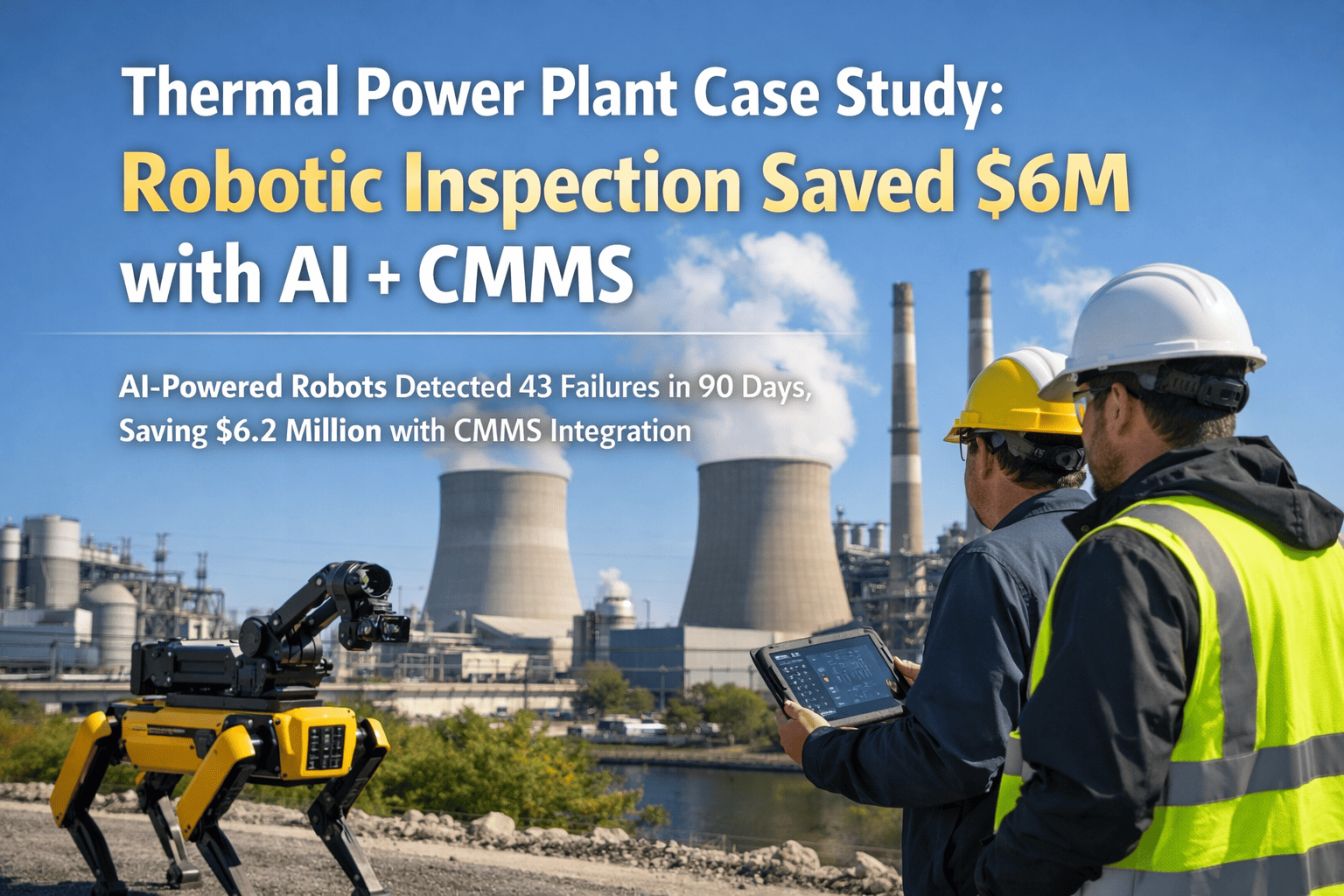
Power plants have always been high-stakes inspection environments. Gas turbine enclosures exceed 600°C. Boiler furnace interiors operate above 1,300°C. High-voltage switchyards carry lethal arc flash risks. Cooling tower internals expose workers to confined spaces, chemical residues, and structural collapse hazards. For decades, maintenance teams relied on manual walk-downs, clipboard checklists, and brief inspection windows during scheduled outages — collecting limited data under dangerous conditions. By 2026, that era is ending. Autonomous and teleoperated robots are entering the zones humans shouldn't go, collecting richer data in continuous cycles, and feeding inspection findings directly into computerised maintenance management systems like Oxmaint — transforming how power plants plan, prioritise, and execute maintenance.
The shift isn't theoretical. Leading power utilities across thermal, nuclear, hydro, and renewable generation have deployed robotic inspection platforms that integrate with CMMS software to close the loop between finding a defect and fixing it. When a quadruped robot detects a thermal anomaly on a transformer bushing or a drone identifies corrosion on a boiler tube, the data flows automatically into a prioritised work order — complete with location coordinates, thermal images, severity rating, and recommended corrective action. Plants using Oxmaint's maintenance management platform can receive these robotic findings directly, assign technicians, track repairs, and build historical trending — all without a single paper form or manual data entry step.
From Clipboards to Crawlers: Power Plants Are Replacing Risk With Robotic Precision
Why Power Plants Are Moving to Robotic Inspections in 2026
The convergence of aging infrastructure, stricter safety regulations, skilled labour shortages, and maturing robotic technology has created the conditions for rapid adoption. Here are the core drivers pushing power generation facilities toward automated inspection:
Aging Assets Demand More Frequent Monitoring
Over 60% of thermal power plants in operation today were built before 2000. Aging boilers, turbines, and generators require increasingly frequent inspections to catch degradation before catastrophic failure — inspections that stretch limited maintenance teams thin.
Safety Regulations Are Tightening
OSHA recordable incident rates, arc flash compliance (NFPA 70E), confined space entry requirements, and fall protection standards are all becoming more stringent. Every manual inspection in a high-risk zone carries liability exposure that robotic alternatives eliminate.
Skilled Inspector Shortage
The power generation workforce is aging faster than it is being replaced. Experienced boiler inspectors, turbine specialists, and high-voltage technicians are retiring without enough trained replacements — making robotic force multiplication essential for maintaining inspection coverage.
Robot Technology Has Matured
Quadruped robots, aerial drones, tracked crawlers, and pipe inspection robots have reached commercial reliability for industrial environments. AI-based anomaly detection, multi-sensor fusion, and direct CMMS integration via platforms like Oxmaint make these systems operationally practical — not just technically possible.
Where Robots Are Replacing Manual Inspections: Zone-by-Zone Breakdown
Different areas of a power plant present unique access, temperature, and hazard challenges. Here is how robotic platforms are being deployed across each critical zone:
Boiler and Furnace Interior
Manual method: Human inspectors enter during outage with full PPE, scaffolding, and rescue standby. Limited to visual checks and spot thickness measurements in 30-60 minute windows due to residual heat and confined space risks.
Robotic method: Heat-shielded crawlers and tethered drones deploy into the boiler during cool-down, scanning tube walls with thermal cameras and ultrasonic thickness gauges. AI-based analysis maps erosion and corrosion patterns across the entire waterwall, superheater, and economiser — generating findings that feed directly into maintenance planning.
Data advantage: 100% tube coverage versus 5-10% spot checks. Thickness trending over multiple outages predicts tube failures 6-12 months before leak occurrence.
Gas Turbine Enclosure
Manual method: Inspectors enter turbine enclosures only during shutdowns. Hot gas path inspections and combustion inspections require extensive disassembly, and visual checks of accessible components miss early-stage cracking and thermal barrier coating degradation.
Robotic method: Miniature crawlers and borescope-equipped robots inspect hot gas path components, combustion liners, transition pieces, and blade surfaces with millimetre-resolution cameras and eddy current testing probes — during shorter inspection windows and at temperatures that humans cannot tolerate.
Data advantage: Full blade-by-blade condition mapping with crack detection, coating thickness measurement, and thermal distortion analysis. Findings trigger specific work orders in the CMMS system for targeted repairs rather than blanket overhauls.
High-Voltage Switchyard
Manual method: Certified high-voltage technicians conduct walk-down inspections of transformers, circuit breakers, bus bars, and insulators while equipment is energised. Arc flash PPE requirements limit dexterity and field of view. Thermal imaging requires handheld cameras at restricted approach distances.
Robotic method: Quadruped robots (like Boston Dynamics Spot or ANYmal) autonomously patrol switchyards on pre-programmed routes, capturing thermal images of bushings, connections, and cooling systems, reading analog gauges, and detecting acoustic signatures of partial discharge — all while equipment remains energised and without human proximity.
Data advantage: Daily automated inspection rounds versus quarterly human walk-downs. AI trend analysis detects gradual temperature increases in connections weeks before failure, generating predictive maintenance alerts.
Cooling Towers and Stacks
Manual method: Rope-access inspectors or scaffolding teams assess concrete shell condition, fill media, structural supports, and chimney lining integrity. Work-at-height risks, chemical exposure from treated water, and limited visibility make these among the most hazardous inspections in power generation.
Robotic method: Drones equipped with high-resolution visual and thermal cameras survey the entire cooling tower shell and internal structure in hours. Climbing robots inspect chimney linings and stack interiors. 3D photogrammetry creates detailed structural models that track degradation between inspections.
Data advantage: Complete structural condition mapping versus spot-check sampling. Crack propagation, concrete spalling, and reinforcement corrosion are tracked with millimetre precision across the entire structure.
Every Robotic Finding Should Become a Tracked Work Order. Automatically.
Oxmaint receives inspection data from drones, crawlers, and quadruped robots — then converts findings into prioritised, assigned, and tracked maintenance actions with full audit trails.
Manual vs. Robotic: The Inspection Performance Gap
The difference between manual and robotic inspection isn't incremental — it's a step change in data quality, coverage, and safety. Here is how they compare across the metrics that matter:
How CMMS Integration Closes the Loop
Robotic inspection without maintenance execution is just expensive data collection. The real value emerges when inspection findings flow seamlessly into the maintenance management workflow. Here is how the integration works with Oxmaint:
Robot Detects Anomaly
Thermal camera identifies a hot spot on a transformer bushing. AI classifies the finding as "elevated temperature, severity: medium" with thermal image, GPS coordinates, and timestamp.
Data Transmitted to Oxmaint
The robot's integration bridge posts the finding to Oxmaint's API. A work order is created automatically with all supporting data attached — no manual entry required.
Priority Assignment and Dispatch
Oxmaint assigns priority based on severity classification, routes the work order to the responsible maintenance planner, and links it to the correct asset in the equipment hierarchy.
Repair Execution and Verification
Technician completes the repair and logs the work in Oxmaint. The next robotic inspection round verifies the fix by re-scanning the same area — creating a closed-loop verification cycle.
ROI: What Power Plants Are Actually Seeing
Robotic Findings Mean Nothing Without Maintenance Follow-Through. That's Where Oxmaint Comes In.
Connect your inspection robots to Oxmaint and turn every finding into a prioritised, tracked, completed work order — automatically.
Implementation Roadmap: Start Small, Scale Fast
Power plants that have successfully adopted robotic inspection follow a phased approach. Here is the roadmap that leading facilities are using:
Pilot — Months 1-3
Select the highest-risk or highest-value inspection zone (typically switchyard or boiler). Deploy one robotic platform with thermal and visual sensors. Operate in supervised teleoperation mode while building operator familiarity. Connect findings to Oxmaint CMMS for automated work order creation. Measure: defects found, time saved, safety incidents avoided.
Expand — Months 4-9
Transition pilot robot to autonomous scheduled routes. Add second platform for a different zone. Integrate additional sensor payloads (ultrasonic, acoustic, gas detection). Build historical trending baselines in Oxmaint for predictive maintenance analytics. Train additional operators and maintenance planners.
Scale — Months 10-18
Deploy fleet of 3-5 robots covering all critical zones. Enable AI-driven anomaly detection with automatic severity classification. Full CMMS integration with predictive maintenance alerts, trending dashboards, and regulatory compliance reporting. Robotic inspection becomes the standard operating procedure — manual entry only for verification and specialised tasks.
Frequently Asked Questions
What types of robots are used for power plant inspections?
Power plants typically deploy four categories of inspection robots: quadruped robots (like Boston Dynamics Spot or ANYmal) for switchyard patrols and equipment monitoring, aerial drones for cooling tower shells, chimney interiors, and roof inspections, tracked crawlers with heat shielding for boiler interiors and confined spaces, and pipe inspection robots for internal condenser tube and pipeline assessments. Most facilities start with one platform type and expand to multi-robot fleets within 12-24 months as the value becomes clear.
Do inspection robots work during plant operation or only during outages?
Both. External inspections — switchyard patrols, transformer monitoring, cooling tower surveys, and balance-of-plant equipment checks — run continuously during normal operations. Robots perform daily autonomous rounds without requiring shutdowns. Internal inspections of boilers, turbine enclosures, and high-temperature zones are conducted during planned outages or cool-down periods, though robotic deployment significantly reduces the inspection time needed during these expensive downtime windows.
How does robotic inspection data connect to a CMMS like Oxmaint?
Robotic platforms transmit inspection findings through API integration bridges to Oxmaint. When the robot's onboard AI classifies an anomaly (for example, an overheating bushing or wall thickness below threshold), the system packages the finding with its thermal image, location data, severity level, and timestamp, then posts it to Oxmaint's REST API. Oxmaint automatically creates a work order, attaches supporting evidence, assigns priority, routes it to the right team, and links it to the correct asset record. The entire process from detection to dispatched work order takes under 5 minutes with no manual data entry.
Can we start with a small pilot before committing to a full fleet?
Absolutely — and that is the recommended approach. Start with one robot in your highest-value inspection zone. Run it in supervised mode for 1-3 months while operators build confidence. Measure defects found, inspection time saved, and safety exposure eliminated. Use the documented results to build the business case for expansion. Most power plants that pilot one robot expand to 3-5 platforms within 18 months. Each additional deployment is faster because the CMMS integration, operational procedures, and team skills are already in place.
Will robotic inspections replace human inspectors entirely?
No — robots augment and protect human inspectors rather than replacing them. Robots handle the dangerous, repetitive, and data-intensive aspects of inspection: entering high-temperature zones, performing daily patrol rounds, and collecting systematic sensor data. Human experts remain essential for interpreting complex findings, making engineering judgements, performing hands-on repairs, and managing the overall maintenance strategy. The result is that inspectors spend less time in hazardous environments and more time on high-value analysis and decision-making.
Ready to Modernise Your Power Plant Inspections? Start With the Maintenance Platform That Connects Everything.
Oxmaint bridges the gap between robotic inspection technology and maintenance execution — so every defect found becomes a defect fixed.