HRSG Tube Leak Detection & Failure Prevention for Combined Cycle Plants

By William Jerry on September 21, 2026

hrsg-tube-leak-detection-failure-prevention-for-cycle-plant

An HRSG doesn't fail because your team missed something obvious — it fails because a combined-cycle unit runs thousands of thermal cycles a year and the early warning signals (a 3°C metal-temp drift, a 0.2 bar dP shift, a chemistry excursion at 2am) get lost between the DCS, the chemistry log and last outage's UT spreadsheet. Industry studies consistently show that most HRSG tube failures are detectable weeks before rupture — but only if the signals from inspection, chemistry, condition monitoring and prior repairs land in the same place. This guide walks through how to build that layered leak-detection and failure-prevention program using OXMAINT AI, the AI-powered CMMS built for combined-cycle reliability teams.

Combined Cycle Reliability · HRSG Leak Detection · Failure Prevention

Catch the HRSG Tube Leak Weeks Before the Forced Outage.

OXMAINT AI, the AI-powered CMMS/maintenance management software, connects the full workflow on one platform — condition alerts and inspection findings in, defects raised and prioritised, corrective work orders assigned, and preventive & predictive PM cadence tuned per HRSG circuit.

Alerts → Defects → Work Orders Per-Circuit Trend History Predictive PM by HP / IP / LP
3–5×
higher thermal fatigue rate on cycling HRSGs vs baseload boilers
Weeks
of advance warning available before most HRSG tube failures
4–8 days
typical forced-outage window for pressure-part repair on HRSG
3 pressure
circuits (HP / IP / LP) needing separate leak-detection logic

The 5 Layers of HRSG Leak Detection — Not One of Them Is Enough Alone

One sensor or one inspection is never enough — leak detection needs five overlapping layers, each catching what the others miss. OXMAINT AI holds every layer's data on the same asset record, so a signal from any one becomes a defect the others can validate. Sign up free and start layering your first detection stream in OXMAINT AI.

L1
Acoustic Monitoring (AMS)
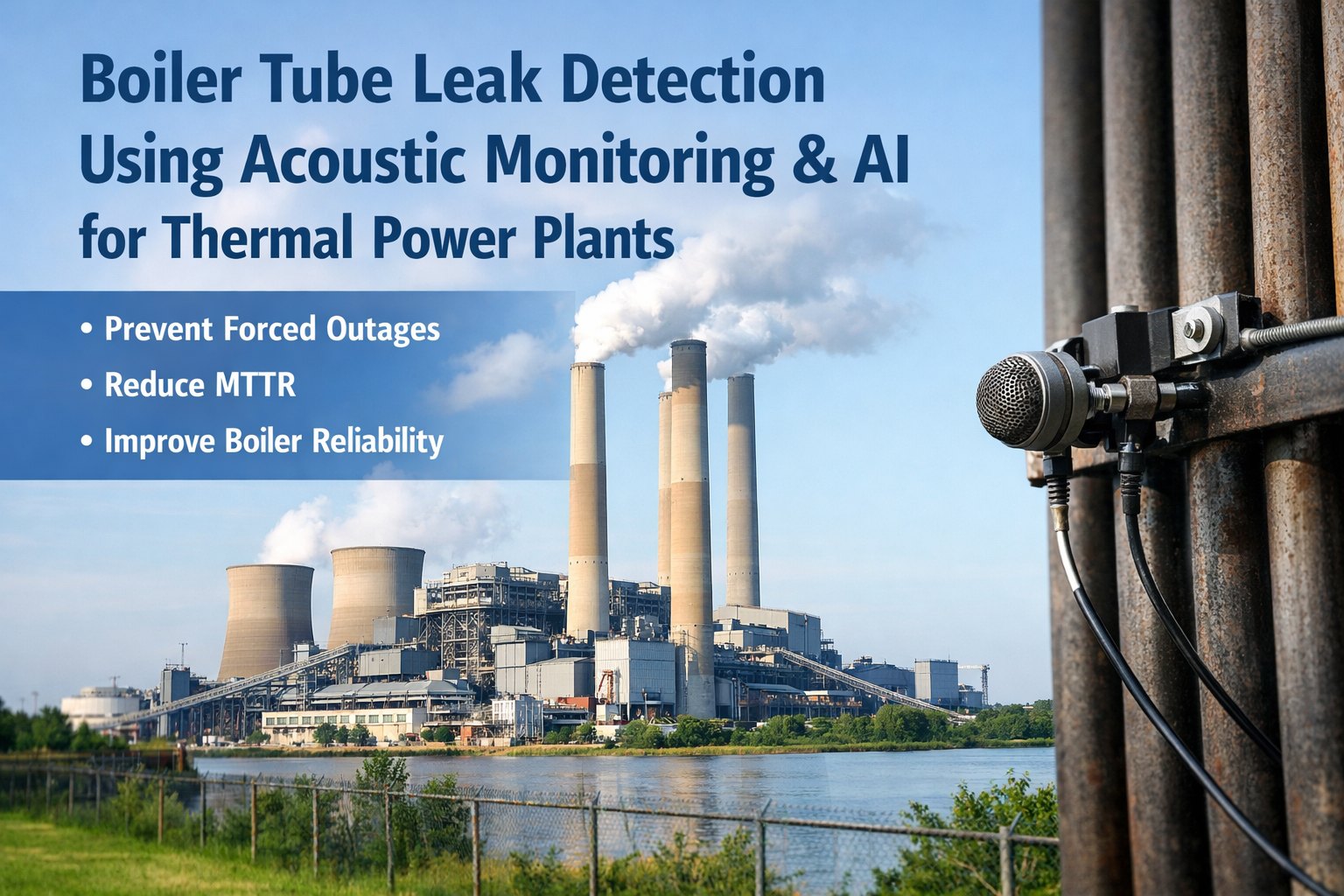
Piezo sensors on the casing pick up the ultrasonic signature of steam escaping through a pinhole. Catches leaks smaller than water balance can detect — often days to weeks earlier.
Real-time · Continuous
L2
Water & Steam Balance
Makeup water consumption, blowdown flow and drum-level trend anomalies. A rising makeup rate over a stable load profile is often the second signal a leak is developing.
DCS-derived · Trended daily
L3
Cycle Chemistry Excursions
Cation conductivity, pH, dissolved oxygen and iron/copper transport. Chemistry excursions during startup and shutdown are the mechanism behind most FAC and pitting failures.
Log-based · Reviewed per shift
L4
Tube Metal Temperature & dP
Thermocouple exceedances, superheater outlet temperature drift, and differential pressure across each circuit. Slow trends here point at oxide scaling, fouling and creep long before rupture.
DCS · Circuit-level trending
L5
Outage Inspection — UT, PA, Boroscope
Phased-array UT for axial cracks that single-angle UT misses, thickness grid readings, headers boroscoped, weld MT/PT. Every finding logged against a tube ID, not just a section.
Outage window · Ground truth

Where HRSGs Actually Leak — A Circuit-by-Circuit Map

HRSG leaks cluster in signature zones — HP superheater bends, LP evaporator bends, attemperator sleeves, economiser inlets. OXMAINT AI's circuit-level view separates HP, IP and LP so a signal doesn't get averaged into a meaningless "health score." Book a demo to see the circuit-level view on an HRSG like yours.

Failure Hot-Spots by HRSG Circuit
HP
High Pressure
SH Bends near HeadersThermal fatigue · creep
Attemperator SleevesThermal shock cracking
HP Evap Header LigamentsLow-cycle fatigue
IP
Intermediate Pressure
Reheater Inlet BendsSteam-side oxide exfoliation
IP Superheater TubesLong-term overheating
Cold Reheat PipingFAC at elbows and tees
LP
Low Pressure
LP Evaporator BendsFlow-accelerated corrosion
Economiser InletsDew-point acid corrosion
Feedwater PipingSingle-phase FAC · O₂ pitting

The Signal-to-Work-Order Path

Detection without action is just noise — most HRSG programs leak value at the handoff. OXMAINT AI closes the loop: every alert becomes a timestamped defect, defects roll into scheduled work orders, and every WO carries the signal history that raised it. Start free — turn your first HRSG alert into a scheduled WO in OXMAINT AI.

SIGNAL LAYER
Acoustic sensor
HP SH panel 3 — 47 dB rise over baseline, 04:22
DEFECT LAYER
Defect auto-opened
Classified: suspected pinhole leak · zone HP-SH-3 · severity high
WORK ORDER
WO issued
Boroscope + PA-UT scoped for next 4-hr window · welder qual + N-stamp attached

Every Signal That Doesn't Become a Work Order Is a Missed Warning.

OXMAINT AI wires acoustic alerts, chemistry excursions, dP shifts and inspection findings into one defect stream — and one defect stream into one work-order pipeline your outage team can actually plan around.

Cycling Kills HRSGs — Chemistry Discipline Keeps Them Alive

Daily cycling drives 3–5× the thermal fatigue of a baseload unit, and most damage happens in the transient windows — startup, shutdown, layup. OXMAINT AI logs chemistry excursions against unit state so you can see which transients cost you the most tube life. Book a demo to see chemistry-vs-unit-state trending in OXMAINT AI.

Unit State Chemistry Risk Dominant Damage Where to Watch
Cold start High O₂ ingress, low pH excursion Oxygen pitting, FAC initiation LP evap, economiser inlets
Load-following Cation conductivity swings Under-deposit corrosion HP evap tubes, drum internals
Shutdown Attemperator overspray, thermal shock Thermal fatigue cracking Attemperator sleeves, SH outlet
Wet layup Air ingress, stagnant water Oxygen pitting, MIC Downcomers, feedwater lines
Steady load Steady-state carryover Steam-side oxidation SH / RH tube inner surface

Planned Corrective Maintenance — Turning Detected Leaks Into Scheduled Repairs

The real win isn't detecting the leak — it's holding the unit to the next planned outage instead of forcing a shutdown now. OXMAINT AI bundles the tube history, failure mechanism, repair spec and parts availability into one work-order package ready for outage scheduling. Sign up free and package your next detected defect into a scheduled WO in OXMAINT AI.

Detect
Signal from any layer opens a defect · severity + circuit + suspected mechanism tagged
Confirm
Cross-check against adjacent layers (acoustic + water balance, dP + chemistry) · confidence scored
Decide
Run-repair vs bridge-to-outage decision · matrix uses tube criticality, leak size and next window
Package
WO drafted with repair spec, welder qual, filler metal, hydro-test, N-stamp docs pre-attached
Close
Post-repair baseline UT captured · defect closed with evidence chain · circuit history updated

What OXMAINT AI Gives an HRSG Reliability Team

OXMAINT AI is built for the combined-cycle reality — three pressure circuits, five detection layers, thousands of thermal cycles a year, one outage window to act on what you've learned. Below are the capabilities that make HRSG leak detection and failure prevention operational. Start free and put your HRSG asset register on OXMAINT AI today.

Circuit-Level Asset Register
HP, IP and LP tracked separately — per-tube thickness, chemistry and inspection history under each circuit.
Multi-Layer Alert Ingestion
Acoustic, water balance, chemistry, tube metal temperature and dP signals converge on one defect stream.
Signal-to-WO Automation
Every alert becomes a timestamped defect; every defect becomes a scheduled work order with the signal history attached.
Unit-State-Aware Chemistry
Chemistry excursions logged against startup, load-following, shutdown or layup — so patterns tie back to real transients.
Outage Scope Builder
Detected defects roll into the next outage scope with parts, welder qual and NDT vendor pre-booked.
Repair Evidence Chain
Weld records, filler metal certs, post-repair UT baseline and hydro-test all attached to the closed WO.
"

The acoustic system caught the first hint at 3am — a low-grade signal from HP superheater panel 4 that would have been dismissed as background noise on its own. Because the platform pulled that alert alongside a slow makeup-water rise from the previous week and a UT trend from the last outage that already had that panel on the watch list, the defect opened itself. We rode the unit to the planned outage 11 days later and repaired the tube in the scheduled window instead of on a forced outage.

Operations Manager · 2×1 Combined Cycle, Triple-Pressure HRSG

Frequently Asked Questions

Do we need acoustic monitoring installed before OXMAINT AI is useful for HRSG leak detection?
No. Water-balance trending, chemistry logs, tube-metal-temp exceedances and past UT data all feed the same defect stream — acoustic just adds another layer when it's available. Start with what your DCS and lab already produce. Sign up free and connect your first two detection layers this week.
How does the platform separate signal from noise across so many streams?
Signals are correlated against unit state and circuit context — an acoustic anomaly during a cold start is treated differently than the same reading at steady load. Multi-layer confirmation raises the confidence score before a defect is opened. Book a demo to walk through the correlation rules live.
Can we run this on a single-pressure HRSG or an industrial cogen unit?
Yes — the register scales down to a single circuit as easily as it handles three. The detection layers, defect workflow and WO packaging are the same regardless of pressure levels. Start free and configure your unit — single or triple pressure — in OXMAINT AI.
What if a leak is detected mid-run — does the platform tell us whether to shut down?
The run-vs-shutdown call stays with your engineering team, but OXMAINT AI surfaces the inputs that decision needs: tube criticality, estimated leak size trend, days to next planned outage, and repair readiness — on one screen. Book a demo to see the run-vs-outage decision panel.
How long does it take to see value after loading historical data?
Most teams start spotting trend patterns from prior outage UT data within the first week of loading it. Full multi-layer detection value builds through the first cycling season on the platform. Sign up free and load your last two outages' data to start.

Detect the Leak Once. Repair It on Your Schedule, Not the Unit's.

Move your HRSG leak-detection layers onto OXMAINT AI — acoustic, water balance, chemistry, thermal and inspection signals converging into one defect stream, one work-order pipeline and one repair evidence chain.

Share This Story, Choose Your Platform!