Power plants run on aging control systems — PLCs, DCS historians, and SCADA networks that were never designed to talk to modern maintenance software. The result is a costly gap: your sensors detect a bearing anomaly at 2 AM, but that data never reaches a technician until a breakdown forces an unplanned outage. IIoT edge gateways bridge this gap by translating plant-floor signals into actionable CMMS work orders — automatically, in real time, without ripping out your existing infrastructure. Facilities that deploy IIoT-connected CMMS platforms like OxMaint report up to 40% reduction in unplanned downtime and maintenance cost savings exceeding 25% in the first year.
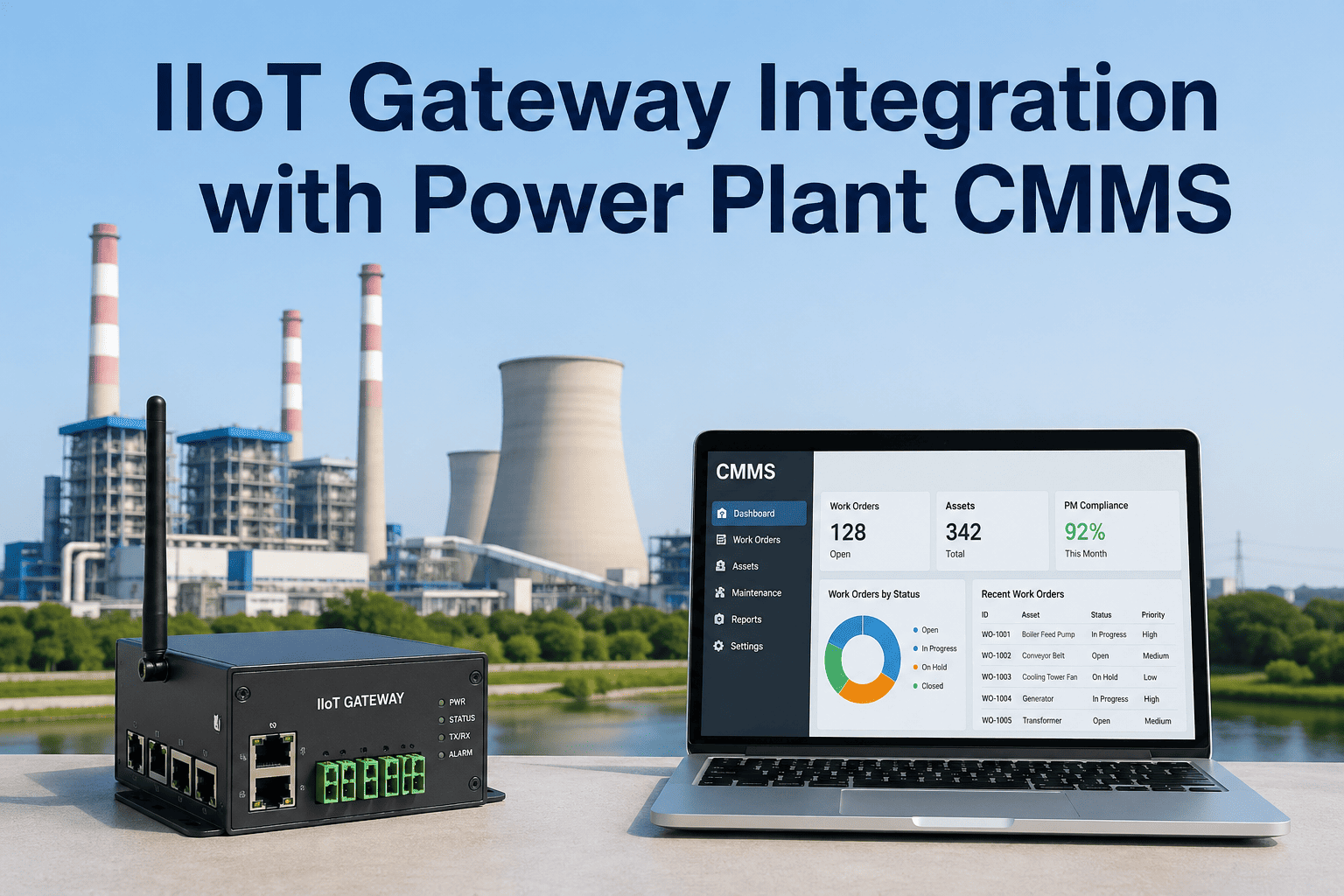
IIoT Gateway Integration with Power Plant CMMS
How edge gateways bridge PLCs, DCS historians, and plant-floor sensors with your CMMS — triggering condition-based work orders automatically, without replacing your control infrastructure.
The Data Gap That Costs Power Plants Millions
Modern power plants generate enormous volumes of sensor data — vibration, temperature, pressure, current draw — but most of this data never reaches the maintenance team in time to prevent failures. It sits locked inside SCADA screens and DCS historian archives, visible only to control room operators who are not empowered to trigger maintenance workflows.
PLCs and DCS systems collect thousands of data points per second. Without an integration layer, maintenance planners have no access to this data stream — they rely on operator verbal reports or manual rounds.
Weekly vibration rounds and monthly thermal inspections leave enormous windows where degradation goes undetected. Equipment fails between rounds — and the failure always comes at peak load.
Even when an operator notices an anomaly, translating that observation into a CMMS work order requires manual entry — introducing delays and transcription errors that affect repair prioritization.
Control rooms with hundreds of active alarms produce noise that masks the specific threshold breaches that predict imminent failure. IIoT gateways with intelligent filtering change this dynamic.
How IIoT Gateway Architecture Works
An IIoT edge gateway sits between your plant control network and your CMMS. It does not replace PLCs or SCADA — it reads their outputs, applies configurable logic, and produces structured maintenance events that the CMMS acts on automatically.
Protocols the Gateway Speaks — And What Each Unlocks
Protocol support determines which assets you can monitor. Most power plant environments run a mix of legacy and modern protocols. A capable IIoT gateway handles all of them simultaneously.
| Protocol | Common Use | What It Enables | CMMS Trigger Type |
|---|---|---|---|
| OPC-UA | Modern DCS, new PLCs | Real-time process variable streaming | Threshold-based auto work order |
| Modbus TCP/RTU | Legacy PLCs, drives, meters | Register polling for status flags | State-change work order trigger |
| DNP3 | Substations, SCADA RTUs | Event-driven data with timestamps | Fault event work order |
| MQTT / AMQP | IIoT sensors, smart devices | Lightweight pub/sub streaming | Continuous condition monitoring |
| ODBC / SQL | DCS historians (OSIsoft PI) | Historical trend retrieval | Trend-deviation PM adjustment |
| REST API | Cloud instruments, EAM/ERP | Bidirectional data exchange | Two-way status sync |
OxMaint's IIoT integration connects to your existing plant data infrastructure and starts generating condition-based work orders without a months-long implementation. See a live walkthrough of gateway-to-CMMS data flow in 30 minutes.
Condition-Based vs. Scheduled Maintenance: What Changes
Traditional preventive maintenance runs on calendar intervals — change bearings every 6 months regardless of actual condition. IIoT-triggered condition-based maintenance acts on real equipment state, reducing unnecessary work and catching failures that calendar-based PM would miss entirely.
- PM intervals set by OEM manual, not actual wear
- Equipment replaced too early or too late
- Failures between rounds go undetected
- Technician dispatched based on schedule, not need
- No early warning before catastrophic failure
- Maintenance backlog grows unpredictably
- Work orders triggered by real vibration or temperature drift
- Replace parts when condition warrants — not the calendar
- 24/7 monitoring catches anomalies at 3 AM
- Right technician, right time, right tools
- 7–21 day warning window before failure events
- Predictable maintenance load and budget forecasting
Critical Assets Monitored in Power Plant IIoT Deployments
These are the asset classes where IIoT gateway integration delivers the highest return — ranked by typical unplanned failure cost and monitoring ROI.
Vibration envelope monitoring on bearing housings, exhaust temperature differentials, and lube oil pressure trends. Early warning prevents catastrophic rotor events.
Avg. failure cost avoided: $2M+Differential pressure trending, motor current signature analysis, and cavitation detection via vibration frequency spectrum. Early alerts prevent forced derates.
Avg. failure cost avoided: $400KFlow rate monitoring, heat exchanger fouling index calculation, and pump efficiency degradation curves. Prevents summer peak load capacity losses.
Avg. failure cost avoided: $180KDissolved gas analysis trending, load tap changer operation counts, and thermal imaging anomaly flagging. Prevents catastrophic insulation failures.
Avg. failure cost avoided: $650KPrecipitator efficiency index, absorber slurry pH drift, and fan motor load trending for environmental compliance continuity.
Avg. penalty avoided: $120K+Current imbalance detection, bearing temperature rise rate, and run-hour accumulation for belt and coupling inspection scheduling.
Avg. failure cost avoided: $35KWhat the Gateway Sends to OxMaint — Exactly
Understanding the data payload from gateway to CMMS demystifies the integration. Each event carries enough context to create a complete, actionable work order with zero manual data entry.
Frequently Asked Questions
Your Plant Floor Data Is Already There. Connect It to Maintenance.
OxMaint integrates with IIoT edge gateways to turn your existing sensor infrastructure into an automated maintenance engine — without capital expenditure on new control systems. Book a 30-minute demo to see how a power plant like yours maps plant data to condition-based work orders.