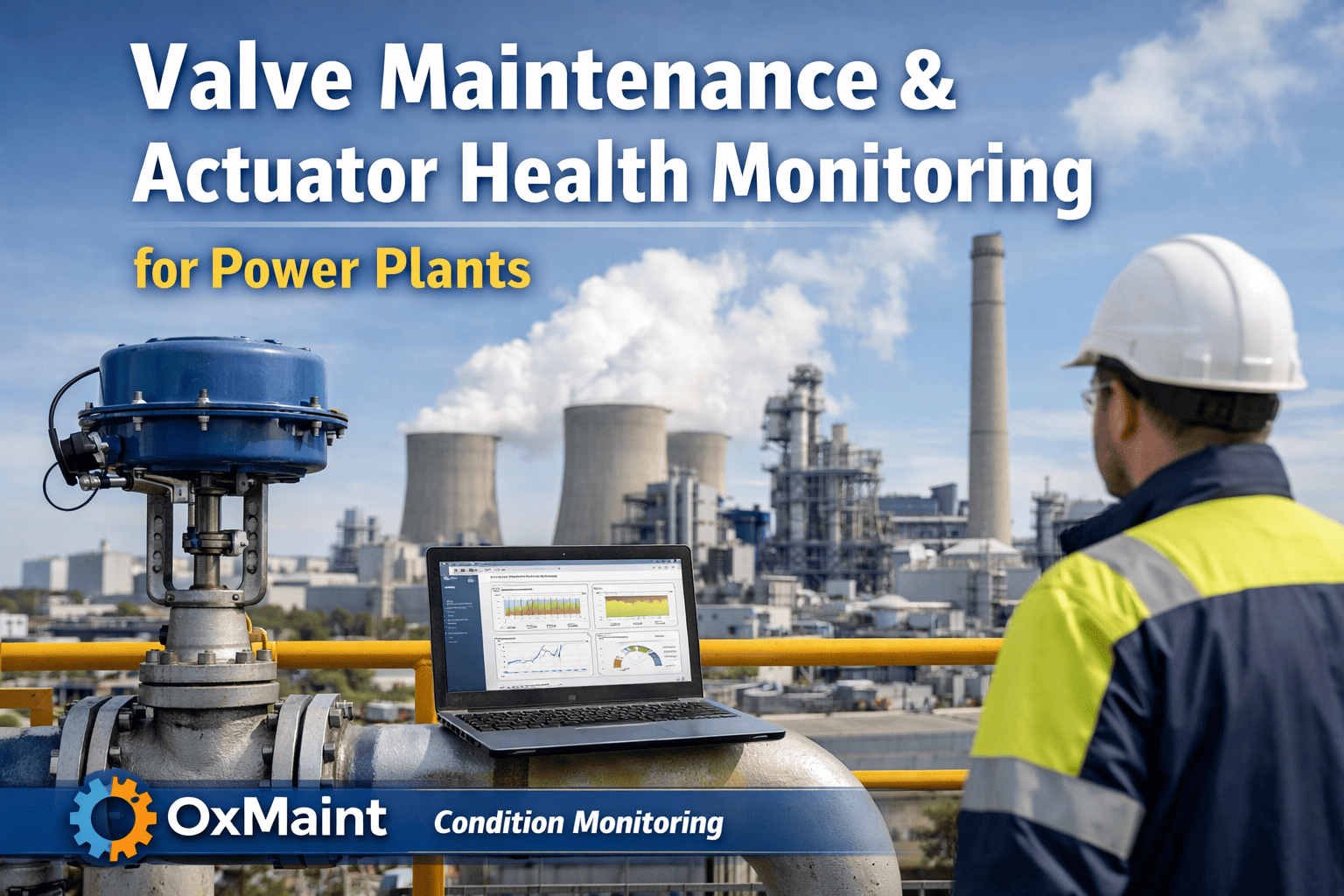
A single stuck control valve can throttle a unit's ability to follow load, and a single leaking isolation valve can quietly waste steam or bleed efficiency for months before anyone notices the pattern in the utility bill. Thermal power plants routinely operate with thousands of valves across steam, water, air, and chemical systems, yet most maintenance teams can name only a fraction of them from memory — the rest live in an as-built drawing nobody has opened in years. Valve reliability tends to be reactive by default, discovered through a stroke test failure or a leak report rather than a planned inspection. OxMaint's valve asset management platform turns that reactive pattern into a tracked, prioritized maintenance program.
Intelligent Valve Asset Management for Thermal Power Plants
Thousands of valves, one shared blind spot. Here is how to bring digital inspection, leak tracking, and lifecycle management to every valve in the plant — not just the ones that fail loudly.
Every Valve Type Fails Differently
Treating every valve the same way in a maintenance program misses the specific failure pattern each type is actually prone to.
Control Valves
Stroke time drift, positioner calibration loss, and seat wear affect load-following capability directly.
Isolation Valves
Seat leakage during shutdown or isolation is the most common and most costly failure mode.
Safety & Relief Valves
Set pressure drift and seat degradation require certified testing on a fixed regulatory interval.
Check Valves
Disc wear and reverse flow leakage often go undetected until a downstream system is affected.
Motor-Operated Valves
Actuator torque switch drift and thrust degradation are the leading causes of failure to stroke.
Pressure Reducing Valves
Diaphragm wear and pilot fouling cause downstream pressure instability over time.
The Valve Lifecycle — From Installation to Replacement
A valve's maintenance needs change across its service life. Lifecycle-based management tracks where each valve sits on this curve rather than applying one fixed schedule for the life of the asset.
Stop Finding Out a Valve Leaks During a Shutdown
OxMaint tracks stroke test results, leak classifications, and repair history for every valve so degraded performance shows up as a scheduled work order, not a surprise during isolation.
Classifying Leak Severity
Not every leak needs the same urgency. A consistent classification system prevents both over-reaction to minor seepage and under-reaction to a valve that is failing to isolate properly.
What the Platform Delivers
What Structured Valve Management Delivers
Frequently Asked Questions
How many valves in a typical thermal plant actually need active monitoring?
While a plant may have thousands of valves in total, active monitoring typically focuses on the subset classified as critical or high-priority based on their role in isolation, safety, or load control functions. This usually represents a meaningful fraction of the total population, and the remaining lower-priority valves can follow a lighter inspection schedule. The key is having every valve at least registered in the system, even if only the critical subset gets frequent active monitoring. Book a demo to see how OxMaint helps prioritize this population.
What is the difference between stroke time drift and seat leakage as failure indicators?
Stroke time drift reflects how long a valve takes to move from one position to another and typically indicates actuator wear, positioner calibration issues, or mechanical binding, which primarily affects control response and load-following ability. Seat leakage, by contrast, indicates the valve is not sealing properly when closed, which is a containment or isolation failure with different safety and efficiency implications. Both need tracking, but they point to different root causes and require different repair approaches.
How do we decide whether to repair a valve again or replace it?
The decision generally comes down to tracking the cumulative repair cost and repair frequency for that specific valve over time — a valve requiring the same type of repair every outage cycle is usually a candidate for replacement rather than continued patching, even if each individual repair seems affordable. Comparing the total cost of repeated repairs against a full replacement, alongside the criticality of the valve to plant operation, gives a clearer picture than evaluating each repair decision in isolation. Start free in OxMaint to track repeat repair costs per valve automatically.
Do safety and relief valves need to be tracked differently from other valve types?
Yes, safety and relief valves are typically subject to certified testing requirements on a fixed regulatory interval, and missing that interval carries compliance consequences beyond just a reliability risk. These valves need their test due dates tracked with the same rigor as a compliance deadline, along with certified test results and the technician or lab credentials that performed the test, since this documentation is often requested during regulatory or insurance audits. Sign in to OxMaint to set up certified test tracking for your safety valve population.
Our valve records exist mostly as physical tags and old drawings. How do we start digitizing them?
Start with a physical walkdown of the highest-criticality systems, capturing valve tag number, type, and location, then cross-reference against existing as-built drawings to fill in specification details. This initial pass does not need to be exhaustive — registering the critical and high-priority valves first delivers most of the reliability benefit, and lower-priority valves can be added incrementally as time allows.
Give Every Valve in the Plant a Record, Not Just the Ones That Failed.
OxMaint brings digital inspection, leak classification, and lifecycle tracking to your entire valve population, from safety relief valves to the smallest isolation point.