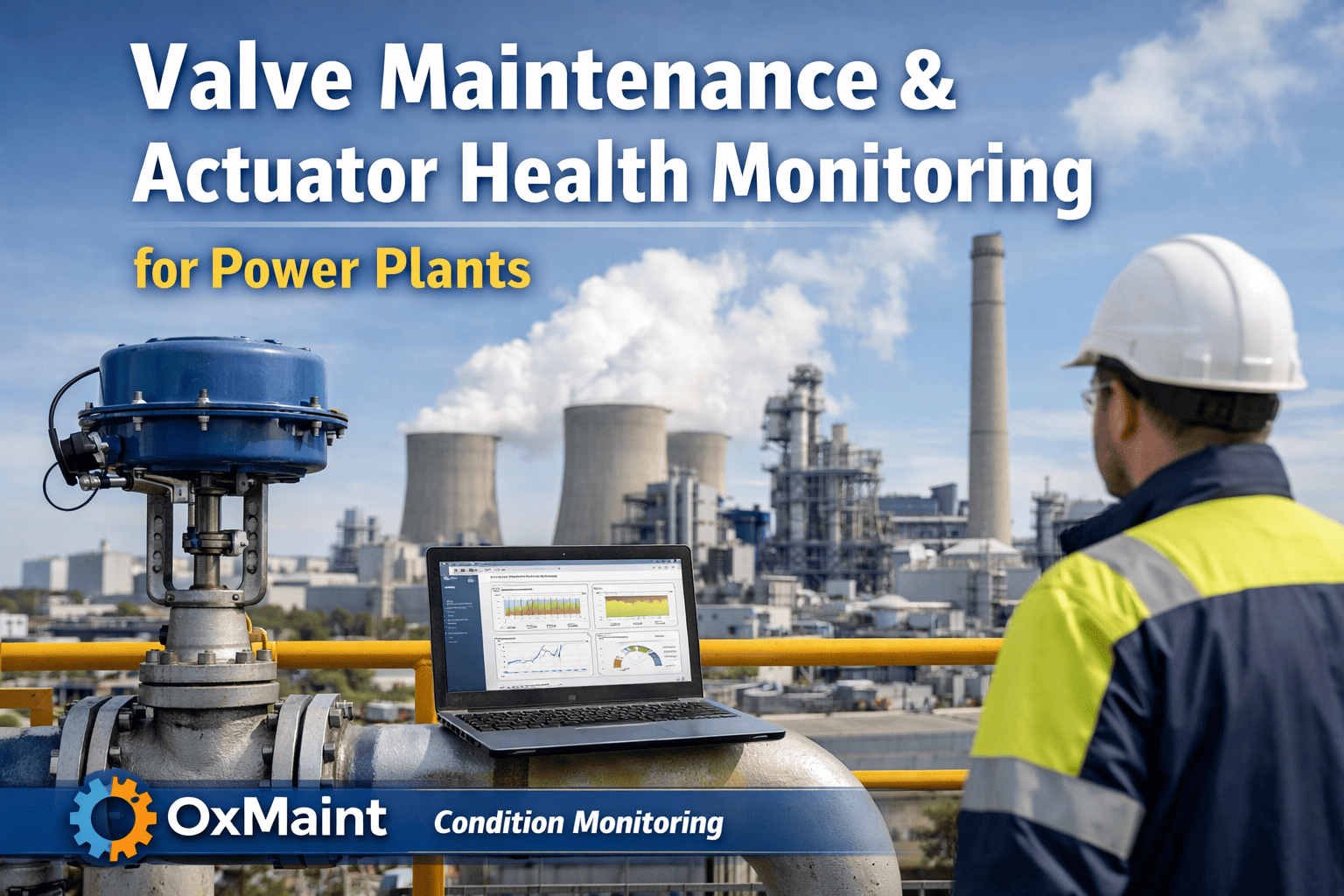
In a power plant, valves and actuators are the nervous system — controlling flow, pressure, and isolation across hundreds of critical pathways. A control valve that sticks, a safety valve that leaks, or an actuator that slows down by just 15% can cascade into forced shutdowns worth hundreds of thousands of dollars per hour. Yet most plants still rely on scheduled walkarounds and reactive repairs. OxMaint's CMMS changes that by connecting valve health data directly to maintenance action — before the process suffers. Ready to stop guessing about your valve fleet? Sign up free or book a demo with our team.
Your Valves Are Degrading Right Now. Are You Tracking It?
Stroke time drift, torque anomalies, packing wear, and seat leakage — OxMaint tracks every leading indicator across your MOV, AOV, and control valve fleet, turning raw diagnostics into scheduled maintenance before a valve becomes a crisis.
4 Ways Valves Fail — And What the Data Shows First
Every valve failure leaves a data trail weeks before it causes a shutdown. These are the four most common failure modes in power plant valve fleets and the measurable indicators that precede each one.
Packing overtightened or corroded trim causes rising actuator thrust demand. Valve begins hunting or sticking at partial stroke positions before failing to move entirely.
Seat erosion from cavitation or particulates causes exponential leakage growth. Downstream flow anomalies appear while valve is nominally "closed" — wasting fuel and skewing process control.
Pneumatic supply degradation, actuator spring fatigue, or positioner drift causes stroke time to creep beyond design limits. Critical for fast-acting safety and trip valves where response time is contractual.
Stem packing wears down with cycle count and temperature cycling. Rising fugitive emissions signal both a compliance risk and an imminent stem seal failure that forces emergency shutdown.
Every Valve Type. Every Critical Metric.
Power plants operate four primary valve categories, each with distinct failure patterns and monitoring priorities. OxMaint tracks them all under one asset registry.
Motor-Operated Valves
High-torque isolation valves on main steam, feedwater, and cooling circuits. Failures often trace to motor winding degradation or drive train wear.
Air-Operated Valves
Fast-acting valves on pneumatic circuits, trip systems, and emission control. Diaphragm fatigue and air supply degradation are leading failure causes.
Control Valves
Throttling valves on steam flow, temperature, and pressure regulation. Positioner drift and trim erosion directly impact process efficiency and output.
Safety & Relief Valves
Pressure relief valves and trip valves protecting against overpressure events. Must open at exact set-point — drift in either direction is a compliance and safety failure.
From Valve Diagnostic Signal to Closed Work Order
OxMaint bridges the gap between valve health data and maintenance execution — automatically, without a technician manually checking dashboards or writing up work orders.
Data Ingestion
OxMaint connects to SCADA historians, digital valve controllers, positioner diagnostic outputs, and smart sensor feeds via API or OPC-UA. Stroke time, torque signature, travel position, and supply pressure stream continuously into the asset register.
Baseline Health Scoring
Each valve gets a health score derived from deviation from its commissioning baseline — not a generic threshold. A stroke time 18% above baseline on a trip valve fires a different alert than the same deviation on a throttling valve in a non-critical circuit.
Tiered Alert Generation
Warning alerts schedule the valve for the next planned outage window. Alarm alerts trigger immediate inspection work orders. Critical alerts route to shift supervisors for potential isolation decisions — before the process forces the decision on you.
Automated Work Order Creation
Work orders are pre-populated with valve tag, fault type, recommended procedure, spare parts list, and estimated labor hours — routed directly to the assigned technician's mobile device. No manual transcription, no lost alerts.
Outage Planning Integration
OxMaint projects which valves will breach health thresholds before the next scheduled outage window, letting engineering order parts and allocate specialist labor weeks in advance — converting emergency repairs into budgeted planned work.
What Proactive Valve Monitoring Delivers
Valve defects detected before any process impact using continuous diagnostic monitoring
Reduction in unplanned valve-related outages reported by plants using CBM programs
Reduction in emergency maintenance labor costs by shifting to planned repair windows
Maintenance interval extension when valve health data replaces fixed-schedule replacement
Valve Monitoring — What Maintenance Teams Ask
How does OxMaint track stroke time without a dedicated stroke test system?
OxMaint can derive stroke time from positioner feedback signals already present in most DCS and SCADA systems. As long as the valve controller outputs a travel position signal, OxMaint timestamps the start and end of each stroke cycle and trends deviation from the commissioning baseline automatically — no additional hardware required for most modern valve installations.
What is the difference between a warning alert and an alarm alert in valve monitoring?
A warning alert means a health parameter has drifted 10–15% from baseline — the valve is still functional but trending toward a problem. This flags the valve for the next scheduled outage work scope. An alarm alert means deviation has reached 25–30% or a safety-critical parameter (like set pressure on a relief valve) has exceeded tolerance — triggering an immediate inspection work order and supervisor notification.
How often should power plant control valves undergo partial stroke testing?
For safety-critical valves such as main steam trip valves and emergency isolation valves, partial stroke testing every 3 months is standard practice under IEC 61511 (functional safety) requirements. For general service control valves, annual full stroke testing combined with continuous online diagnostics from positioner data provides adequate coverage without requiring process interruption.
Can OxMaint manage both MOV and AOV valves in the same asset register?
Yes. OxMaint's asset registry supports multiple valve types with type-specific health parameters — torque and current for MOVs, supply pressure and stroke time for AOVs, travel deviation and positioner data for control valves. Each asset class gets its own alarm thresholds and maintenance task templates, while the dashboard gives plant managers a unified view across the entire valve fleet.
What data sources does OxMaint connect to for valve health data?
OxMaint integrates with OSIsoft PI, Ignition, Wonderware SCADA historians, HART-enabled digital valve controllers, Foundation Fieldbus devices, and direct API connections to valve diagnostic platforms such as Emerson AMS and Metso Neles. For older analog valves without digital controllers, OxMaint can ingest data from add-on IIoT sensors or manual inspection records to maintain a complete health history.
How long before actual valve failure can OxMaint detect developing issues?
Lead time varies by failure mode. Seat leakage and packing wear are detectable 4–8 weeks before process impact. Actuator degradation such as spring fatigue and diaphragm wear shows in stroke time trends 6–12 weeks before failure. Positioner drift on control valves is detectable within days of onset. In documented cases, early valve diagnostics have provided teams with enough lead time to plan outage repairs rather than forcing emergency shutdowns.
Stop Running Blind on Your Valve Fleet
OxMaint connects your valve health data directly to maintenance work orders — so your team acts on torque trends, stroke time drift, and leakage signals weeks before they become shutdowns. Typical valve CMMS integration takes under two weeks. First prevented failure ROI: often within 90 days.