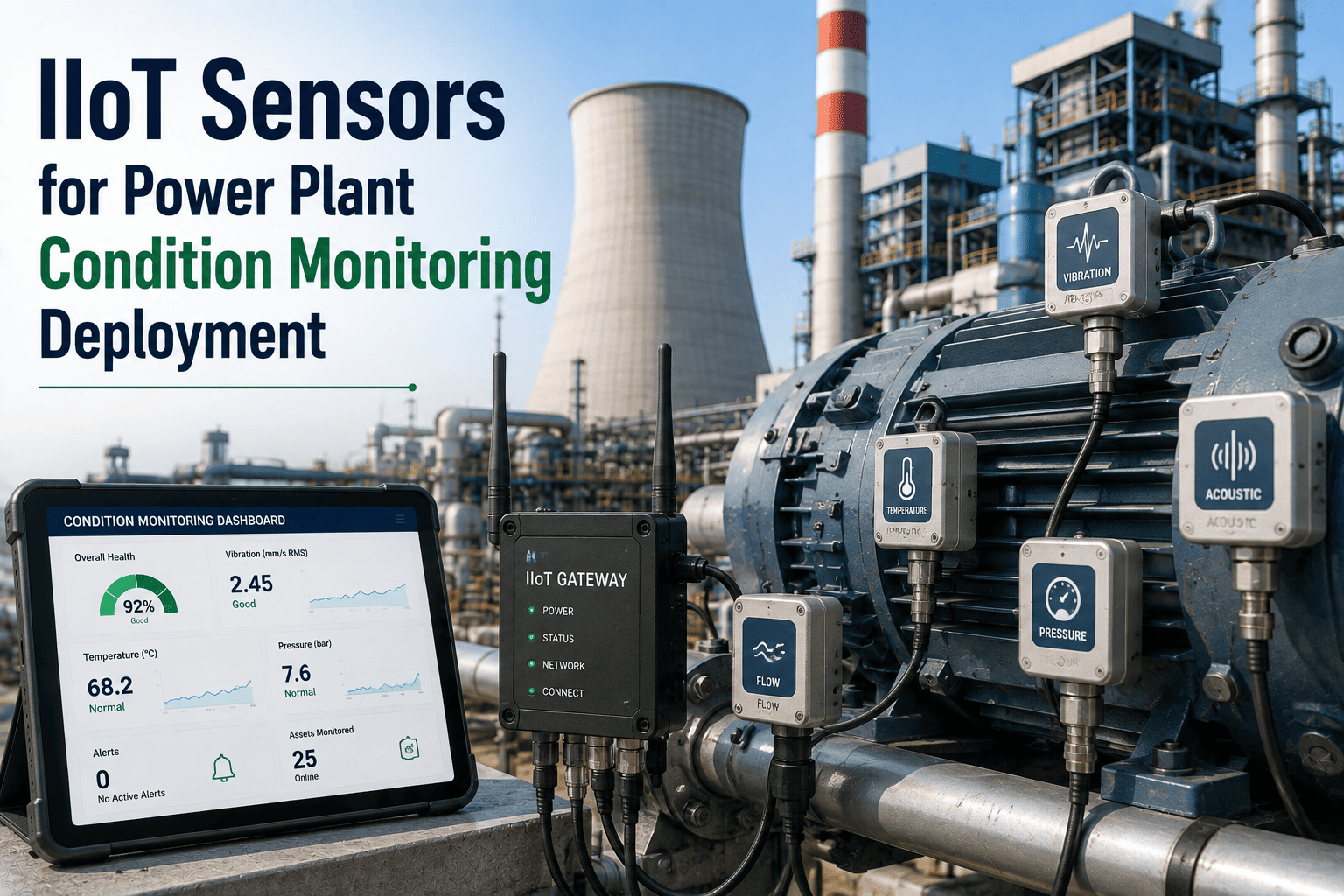
A power plant running blind on vibration, temperature, and pressure data is not managing risk — it is accumulating it. Across global energy operators, plants that deploy structured IIoT sensor networks and connect them to a CMMS report a 40–50% drop in unplanned failures within the first operating year. Connect your plant's IoT sensor data to OxMaint's CMMS and transform raw field readings into scheduled maintenance actions — automatically, in real time, with no manual data routing. Book a 30-minute OxMaint demo to see sensor-to-work-order integration live, at no cost.
IIoT · Condition Monitoring · Power Generation · OxMaint
IoT Sensor Deployment for Power Plant Condition Monitoring
Vibration, temperature, pressure, and acoustic sensors — deployed on turbines, boilers, and generators — stream live asset health data into OxMaint's CMMS, triggering predictive maintenance work orders before failures reach production impact.
4 Types
Core sensor categories covering 95% of power plant failure modes
50kHz
Maximum vibration sampling rate for high-speed rotating machinery
<2 sec
Sensor anomaly to OxMaint work order creation latency
40%
Reduction in unplanned failures after full sensor network deployment
Why Sensors First
Maintenance Intelligence Starts With Real-Time Field Data
Predictive analytics, AI models, and CMMS platforms are only as accurate as the sensor data feeding them. Power plants that invest in comprehensive IIoT sensor networks gain a permanent data foundation — one that every future maintenance improvement compounds on top of.
Without Sensors
Maintenance decisions based on operator reports, vibration felt by hand, or fixed calendar intervals — all structurally blind to early-stage degradation.
Equipment failure events arrive without warning, forcing emergency repairs at 3–5× planned maintenance cost.
Asset health is a guess. CMMS records capture what broke, not what was about to break.
With IIoT Sensors
Continuous parameter streams from every critical asset — vibration spectra, thermal profiles, pressure trends — visible in your CMMS in real time.
Anomaly patterns detected weeks before physical failure, converting emergency events into planned maintenance windows.
Every OxMaint work order carries full sensor context — readings, anomaly score, trend direction — so crews arrive prepared.
Sensor Reference Guide
The 4 Core Sensor Types for Power Plant Condition Monitoring
Each sensor type addresses a distinct class of failure modes. Deploying all four across critical assets gives your CMMS the data coverage to detect 95% of foreseeable equipment failures at the earliest observable stage.
What it detects
Bearing wear, rotor imbalance, misalignment, mechanical looseness, gear mesh defects
Mounted on
Turbine housings, generator bearing caps, pump motor end shields, gearbox casings
Sample rate
1Hz (trend logging) to 50kHz (high-speed rotating machinery FFT analysis)
Lead time
Detects developing bearing failures 4–12 weeks before breakdown
Protocol: OPC-UA · Modbus · 4-20mA analog
What it detects
Lubrication failure, electrical hotspots, cooling system degradation, insulation breakdown
Mounted on
Bearing housings, transformer windings, boiler tubes, motor stator slots, control panels
Sample rate
0.1Hz to 10Hz continuous — thermal imaging at configurable scan intervals
Lead time
Bearing overtemperature warns 1–3 weeks before lubrication failure; winding faults 2–6 weeks
Protocol: OPC-UA · MQTT · PT100 · K-type TC
What it detects
Pump cavitation, valve leakage, steam seal deterioration, flow restriction, pipe fouling
Mounted on
Coolant lines, steam headers, lubrication supply lines, condensate systems, fuel manifolds
Sample rate
1Hz steady-state monitoring; up to 1kHz for dynamic pressure surge capture
Lead time
Gradual pressure drop trends visible weeks before pump performance falls below threshold
Protocol: HART · 4-20mA · IO-Link · Modbus
What it detects
Early-stage bearing surface cracking, valve seat leakage, steam trap failure, partial discharge in switchgear
Mounted on
High-pressure valve bodies, rotating equipment bearing regions, electrical switchgear enclosures
Sample rate
100kHz to 1MHz ultrasonic band — captures sub-surface crack propagation before mechanical vibration appears
Lead time
Earliest failure indicator available — detects surface fatigue 6–16 weeks before vibration sensors trigger
Protocol: OPC-UA · Proprietary AE interface · USB industrial
Data Pipeline
How Sensor Data Reaches Your CMMS in Under 2 Seconds
Raw sensor readings are worthless without the pipeline that cleans, analyzes, and routes them to the right maintenance action. This is the five-stage IIoT-to-CMMS data flow that transforms a sensor reading into a scheduled OxMaint work order.
S1
Sense
Vibration, temperature, pressure, and acoustic sensors sample asset parameters continuously at configured intervals.
Raw analog or digital signal output
S2
Transmit
Industrial protocols — OPC-UA, Modbus TCP, MQTT — carry time-stamped readings to the edge gateway or cloud collector.
OPC-UA · Modbus · MQTT · HART
S3
Analyze
AI models compare live readings against asset-specific baselines — scoring anomaly severity and estimating remaining useful life.
ML anomaly scoring · RUL estimation
S4
Trigger
When anomaly score crosses the configured threshold, an API event fires — with full sensor context, asset ID, and action recommendation.
Webhook · REST API · Threshold alert
S5
Work Order
OxMaint creates a CMMS work order — asset linked, sensor readings attached, technician assigned — ready for planned action.
OxMaint CMMS · Full context attached
Your sensors are generating data right now. Is your CMMS receiving it?
OxMaint integrates with all major IIoT sensor protocols. Every reading becomes a maintenance insight — every anomaly becomes a scheduled repair.
Deployment Phases
Sensor Deployment Roadmap — From Zero to Full Coverage
Sensor network projects fail most often when teams skip the baseline data phase or attempt to connect raw sensor feeds directly to CMMS without an analytics layer. This four-phase structure prevents both failure points.
Asset Criticality Mapping
Rank plant assets by failure impact on generation capacity and safety. Prioritize sensor placement on Tier-1 assets — turbines, generators, boilers — where failure cost exceeds $500K per event. Sensor investment follows financial risk, not convenience.
Output: Prioritized asset list · Sensor placement drawing · Protocol specification
Sensor Installation & Protocol Integration
Mount sensors at identified measurement points. Configure OPC-UA, Modbus, or MQTT protocol gateways. Validate signal quality — check sampling rates, verify timestamp accuracy, and test data continuity under normal operating conditions before proceeding to analysis setup.
Output: Installed sensors · Protocol gateway live · Signal quality validated
Baseline Learning & CMMS Connection
Allow AI models to learn each asset's normal operating signature over 2–3 weeks across full load cycles — startup, steady-state, and shutdown. Simultaneously configure OxMaint CMMS webhook integration so anomaly events auto-generate work orders with sensor data attached.
Output: Trained baselines · OxMaint integration live · First AI alerts reviewed
Expand Coverage & Refine Models
Roll sensor deployment to Tier-2 assets using validated methodology from Tier-1 deployment. Review OxMaint work order outcomes monthly to identify false positives and missed events — feeding both back into model retraining for progressively higher prediction precision.
Output: Expanded coverage · Improving accuracy · Growing asset health dataset
Protocol & Integration Reference
OPC-UA, Modbus, MQTT — Which Protocol for Which Sensor
Protocol selection affects latency, data bandwidth, security, and CMMS integration complexity. This comparison covers the three protocols used across the vast majority of power plant IIoT deployments — and where each delivers its strongest performance.
| Protocol |
Best For |
Latency |
Security |
OxMaint Integration |
| OPC-UA |
Turbines, generators, complex multi-sensor assets with structured data models |
10–100ms |
Encrypted, cert-based auth |
Native via OPC-UA gateway |
| Modbus TCP |
Legacy PLCs, pumps, motor control centers, pressure transmitters |
50–500ms |
No built-in — add VPN layer |
Native via Modbus collector |
| MQTT |
Wireless sensors, remote monitoring points, high-volume low-bandwidth streams |
<50ms |
TLS encryption supported |
Native MQTT broker support |
| HART |
Pressure and flow transmitters on existing 4-20mA loops — retrofit installations |
250–500ms |
Physical layer only |
Via HART multiplexer bridge |
| IO-Link |
Smart sensors on assembly lines, valve positioners, point-level diagnostics |
<10ms |
Point-to-point physical |
Via IO-Link master gateway |
Measured Results
What Changes After a Full Sensor Network Goes Live
These outcome ranges reflect power plant deployments where IIoT sensor networks were connected to OxMaint CMMS and AI analytics — measured across the first 12 months of full operation, compared to pre-deployment reactive maintenance baselines.
85%
of unplanned failures detected in advance — up from near zero on reactive programs
72%
reduction in emergency repair events in year one after full sensor coverage deployed
60%
faster maintenance response time — crews arrive with sensor data, not just a breakdown report
40%
lower total maintenance cost — elimination of over-servicing and emergency parts premiums
2.3%
plant availability gain — each 1% gain equals approximately $4.4M additional annual revenue at a 500MW plant
Ready to connect your sensor network to OxMaint CMMS?
OxMaint supports OPC-UA, Modbus, MQTT, and HART out of the box. No custom development. Sensor-to-work-order integration in under 6 weeks.
Questions Answered
IoT Sensor Deployment — What Maintenance Teams Ask
How many sensors does a power plant typically need for full condition monitoring?
A 500MW combined-cycle gas turbine plant typically requires 80–200 sensor measurement points to achieve meaningful condition coverage across turbines, generators, boilers, cooling pumps, and transformers. Sensor count is driven by asset criticality ranking, not asset count — a single turbine may have 12–20 measurement points while a standard auxiliary pump needs only three.
OxMaint's free asset register tool helps you map measurement points before any hardware purchase. Most plants achieve 80% failure mode coverage with far fewer sensors than initially estimated when placement is optimized by failure mode analysis rather than blanket coverage.
Do existing plant sensors integrate with OxMaint without replacing hardware?
Yes — OxMaint connects to existing sensor infrastructure through standard industrial protocols including OPC-UA, Modbus TCP, MQTT, and HART, meaning most plants can begin streaming live data into the CMMS without replacing a single transmitter. Protocol gateway devices bridge legacy 4-20mA loops and Modbus RTU networks where needed.
Book a protocol compatibility review to confirm your current sensor network's integration path before committing to any hardware changes. The majority of deployments leverage existing sensor investment fully, with new sensors added only for identified coverage gaps.
What happens to sensor data when internet connectivity is lost at a remote plant?
OxMaint supports edge-first deployment where sensor data is collected and analyzed locally at the plant — AI anomaly scoring, work order creation, and alert dispatch all continue without internet connectivity. Data is buffered locally and synced to the cloud dashboard when connectivity is restored, with no data loss and no gap in asset monitoring coverage.
Explore OxMaint's offline-capable deployment for remote generation sites. This architecture is specifically designed for power plants in locations where reliable internet access cannot be guaranteed 24/7.
How long before AI models start producing useful predictions after sensors go live?
Anomaly detection models based on autoencoder or statistical baseline approaches begin producing reliable alerts within 2–3 weeks of sensor data collection — as soon as the model has observed a complete operating cycle including startup, steady-state, and shutdown. Classification models that predict specific failure types require 3–6 months of live data.
Sign up to start baseline data collection today — the learning period begins the moment sensors connect to OxMaint, so earlier deployment translates directly to earlier predictive capability for your maintenance team.
IIoT · CMMS Integration · Power Plant Reliability · OxMaint
Your Sensors See It. OxMaint Acts On It. Failures Stop Before They Start.
Every vibration spike, temperature rise, and pressure drop your sensors capture becomes a maintenance work order in OxMaint — with the right data, the right asset, and the right technician assigned, automatically. No manual routing. No missed signals. No unplanned outage that could have been a scheduled repair.