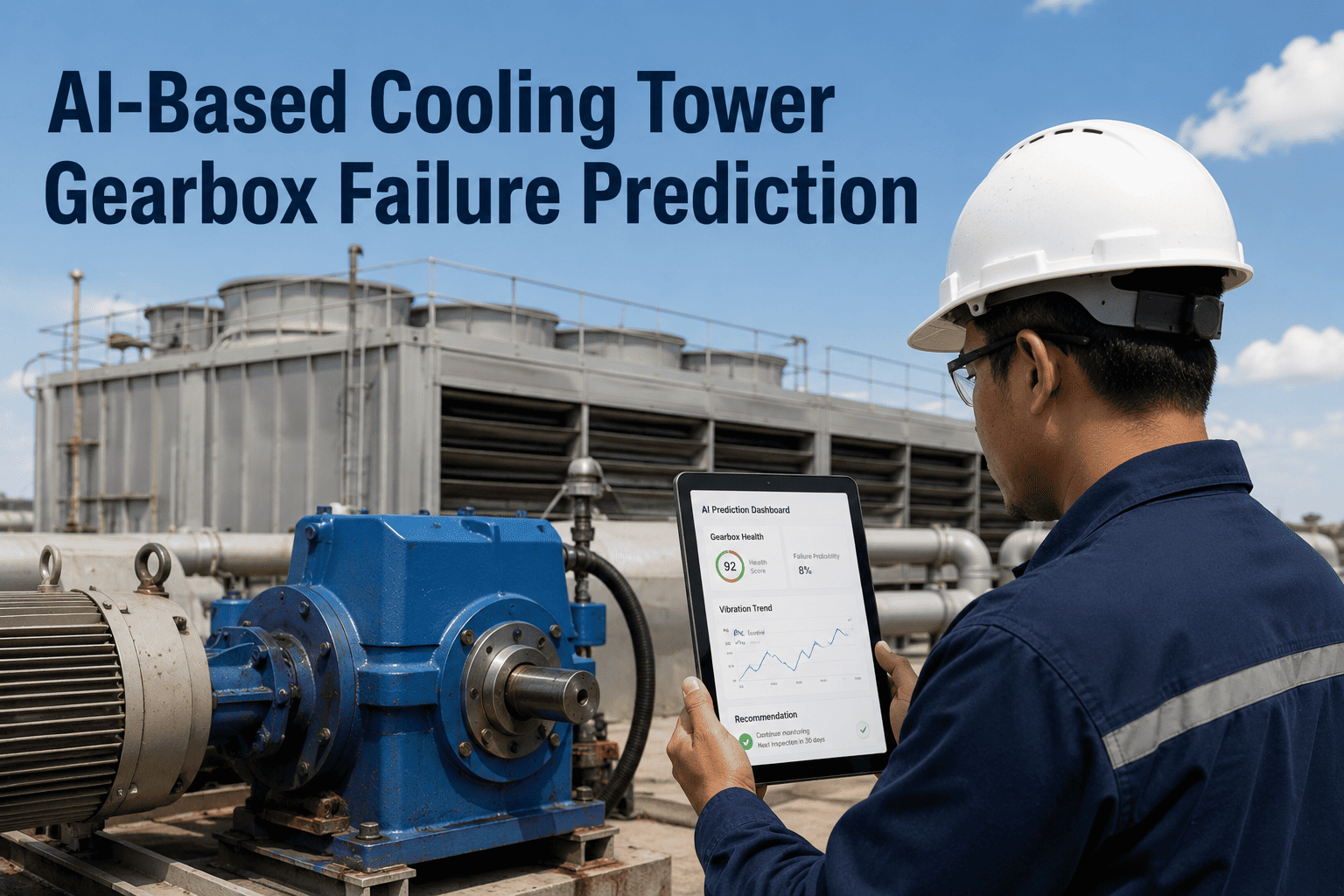
A wind turbine gearbox failure is rarely a sudden event — it is a slow story written in microscopic metal particles weeks or months before the catastrophic moment. Oil analysis is how operators read that story early, while damage is still measured in dollars instead of hundreds of thousands. With repair costs running $200,000 to $300,000 per failure event and gearboxes representing 13 to 15 percent of total turbine value, the difference between a $10,000 up-tower fix and a $300,000 down-tower replacement comes down to one thing: how early you saw the wear coming. See how OxMaint turns oil sample reports into prioritized work orders in minutes.
Wind O&M · Oil Analysis Playbook · Updated 2026
Wind Turbine Gearbox Oil Analysis & Up-Tower Maintenance
Particle counts, ferrography, and damage-mode mapping — turned into work orders your techs actually close. The complete operator playbook for catching gearbox failures 2.5 years before they cost you $250,000.
1 in 145
Turbines fail per year — gearboxes top the major replacement list
76%
Of gearbox failures originate in bearings, not gears
$250K
Average savings when faults are caught early enough for up-tower repair
2.5 yrs
Lead time online oil monitoring has demonstrated before derate
Why oil analysis is non-negotiable
The 250-foot cost penalty
A 15-ton gearbox suspended 250 feet in the air does not behave like any other industrial gearbox. The crane, the weather window, the lost generation revenue, and the limited supply of replacement units all stack into a single brutal equation: every day of unplanned downtime costs more than a year of proactive condition monitoring. Wind gearboxes routinely fail before their 20-year design life — and the gap between a planned 15-day outage and an emergency 60-day shutdown is almost always determined by what your oil samples told you three months earlier.
Up-tower bearing replacement
Particle count trend caught wear > 3 months out
$10K – $45K
Up-tower planetary stage repair
Ferrography flagged severe wear before macro damage
$80K – $150K
Full down-tower gearbox replacement
Crane mobilization, weeks of lost generation, new unit
$250K – $300K+
The oil analysis stack
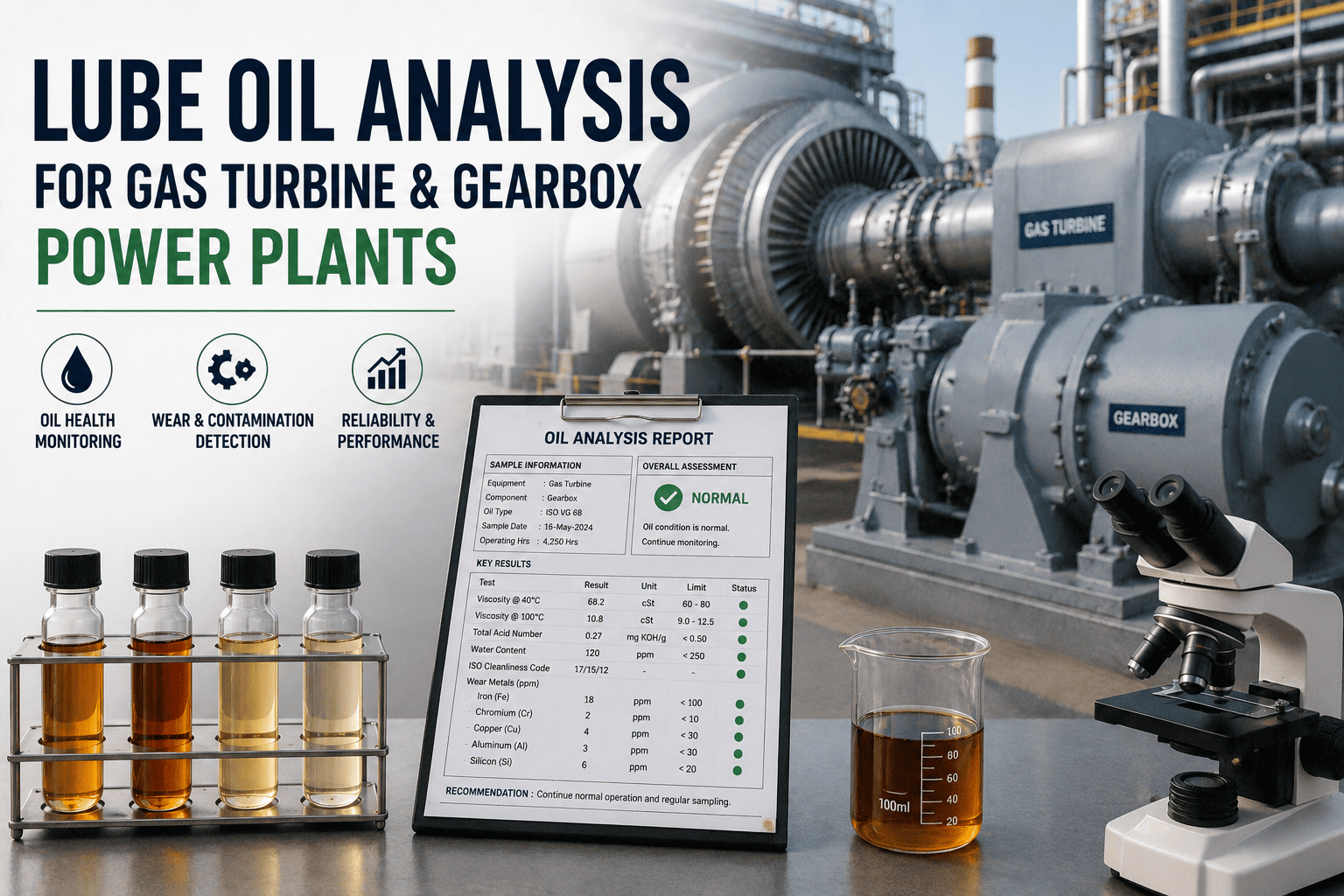
Five tests that turn a 100ml oil sample into a gearbox health report
No single test tells the whole story. Particle count tells you how dirty the oil is. Spectroscopy tells you which metals are wearing. Ferrography tells you how they are wearing. FTIR tells you whether the oil itself is breaking down. Together, the five-test stack converts what looks like a routine quarterly sample into the most reliable early-warning signal in your wind O&M program.
01
Particle Count (ISO 4406)
Cleanliness & Filter Health
Optical laser sensor counts particles in size bins from 4µm up to 100µm. AWEA/AGMA 6006-A01 sets the maximum allowable count at ISO 18/16/13. Crossing this code is the first measurable signal that filters are losing the battle.
Normal: ≤18/16/13
Caution: 19/17/14
Alarm: ≥20/18/15
02
ICP Spectroscopy
Wear Metals & Contaminants
Inductively-coupled plasma quantifies dissolved and small-particle metals. Rising iron, copper, tin, aluminium or chromium signals wear in specific gearbox zones. Sodium, calcium or potassium signals water or grease ingression — the precursor to corrosion.
Captures particles < 8µm only
Best as a trending tool, not absolute
Sharp Fe spike = immediate review
03
Analytical Ferrography
Wear Mode Identification
Magnetic separation of ferrous particles onto a glass ferrogram, examined under microscope. The only test that distinguishes how wear is happening — cutting, rubbing, fatigue, scuffing, or erosion. Each pattern points to a different root cause and a different repair scope.
Rubbing wear: normal break-in
Cutting wear: abrasive contamination
Fatigue chunks: bearing spall imminent
04
FTIR Infrared
Oil Chemistry & Degradation
Fourier-transform infrared spectroscopy identifies oxidation, nitration, sulfation, water content, and additive depletion. When base oil begins to break down, wear rates accelerate exponentially — FTIR catches the chemistry shift before the metal counts react.
Oxidation stable
Additive package depleting
Water ingress detected
05
Online Wear Debris Sensor
Continuous Monitoring
Inductive sensors mounted on the gearbox return line count and size ferrous and non-ferrous particles in real time. Research has shown online debris monitoring detecting planetary bearing faults 2.5 years before vibration systems triggered a derate — the gold standard for early warning.
24/7 streaming data
Differentiates ferrous vs non-ferrous
Catches what offline samples miss
Every sample → a work order
OxMaint ingests oil lab reports, flags out-of-spec parameters, and auto-generates inspection or repair work orders against the exact gearbox asset.
Stop reading lab PDFs. Start closing work orders.
Your oil samples are already telling you which turbines need attention. OxMaint makes sure the work actually gets done.
Connect your lab feed, set your alarm thresholds against AGMA limits, and let OxMaint route every alarm directly to the right tech with the right parts kit.
Gear & bearing damage modes
Six failure signatures every wind O&M engineer should recognize
NREL's Gearbox Reliability Database shows 76% of gearbox failures originate in bearings, with another 17% in gears. Most failures start in the intermediate and high-speed stages, often within the first five years of operation. Knowing which failure mode is present is what determines whether the answer is an oil change, an up-tower bearing swap, or a full nacelle craning operation.
A
Axial Cracking
High-speed shaft bearings (most common)
Signature: White-etched cracks running parallel to the bearing axis. Often invisible to vibration sensors until macro-pitting begins.
Oil tell: Sharp Fe spike in ICP, fatigue chunks under ferrography
B
Micro-Pitting
Gear tooth flanks, all stages
Signature: Frosted, matte surface on gear teeth where lubricant film has thinned. Progressive — accelerates if uncaught.
Oil tell: Gradual particle count drift, fine ferrous fines in ferrography
C
Macro-Pitting / Spalling
Planetary & intermediate bearings
Signature: Large craters on rolling element raceways. Generates loud, distinct vibration; often terminal for up-tower repair option.
Oil tell: Large fatigue chunks > 100µm, particle count alarm
D
Scuffing / Adhesive Wear
Helical & planetary gear teeth
Signature: Welded-then-torn metal surface from lubricant film collapse under shock load or thermal event.
Oil tell: Heat-tinted particles, FTIR oxidation jump
E
Abrasive Wear
Any contact surface with contamination
Signature: Parallel scoring from hard particles. Usually root-caused to filter bypass, breather failure, or water-induced rust.
Oil tell: Cutting-wear particles, high silicon in ICP
F
Corrosion / Water Etch
Idle bearings, low-load components
Signature: Reddish-brown staining, etching pits arranged in raceway pattern. Common after extended idle periods.
Oil tell: Water content > 500ppm in FTIR, sodium spike
Up-tower vs down-tower
The decision tree that saves $200,000 per repair
Modern modular gearbox designs and mobile workshop tooling have made it possible to swap helical sections, intermediate shafts, and even some planetary components without removing the gearbox from the nacelle. The catch: the up-tower repair window only stays open if the damage is caught early. Once macro-spalling reaches the planetary stage, the crane is on its way.
1
Oil sample / online sensor flag
2
Borescope & vibration confirm
3
Severity & location triage
Up-Tower Repair
When damage is in HSS bearings, helical stage, IMS, or accessible planetary components
| Parameter | Typical Range |
| Repair duration |
5 – 15 days |
| Crane requirement |
Small hydraulic or none |
| Cost range |
$10K – $150K |
| Lost generation |
1 – 3 weeks |
| Mobile workshop |
Often on-site |
| Weather sensitivity |
Moderate |
Down-Tower Replacement
When planetary stage is severely spalled, gearbox structure is compromised, or multi-stage damage is confirmed
| Parameter | Typical Range |
| Repair duration |
30 – 60 days |
| Crane requirement |
Large boom + secondary crane |
| Cost range |
$250K – $300K+ |
| Lost generation |
4 – 8 weeks |
| Mobile workshop |
Full off-site overhaul |
| Weather sensitivity |
Critical — high crane needs calm winds |
From sample report to closed work order
How OxMaint turns oil analysis into a fleet-wide PM program
A binder full of quarterly oil lab PDFs has never prevented a single gearbox failure. The lab report only creates value when it triggers the right work, against the right asset, with the right parts, before the failure curve goes vertical. OxMaint is the connective tissue that turns lab data into action across your entire wind fleet.
Step 1
Lab Feed Ingestion
Import oil sample results from any lab provider — Bureau Veritas, Intertek, Eurofins, or internal — directly into the asset record. Every parameter mapped to AGMA 6006-A01 thresholds.
Step 2
Automatic Alarm Routing
Out-of-spec particle counts, FTIR water alarms, or ferrography severity flags auto-generate prioritized work orders. Critical alarms escalate to the asset owner inside the same hour.
Step 3
Asset-Level Trend Lines
Every turbine gets a rolling 24-month oil trend chart — iron, copper, ISO codes, oxidation. Spot the wear curve months before any single sample reads "alarm."
Step 4
Up-Tower Kit Generation
When a repair is triggered, OxMaint builds the parts kit, checks stock across all warehouses, flags long-lead bearings, and pre-stages the crew schedule against weather windows.
Step 5
Mobile Closeout
Techs close the work order from the nacelle on a phone or tablet — photos, torque values, replaced part serials, all logged against the gearbox asset history for the next sample cycle.
Step 6
Fleet Roll-Up
Portfolio-level dashboards show which turbines, which OEMs, and which gearbox models trend worst — feeding warranty claims, contract negotiations, and repower decisions.
Outcomes operators report
What a connected oil-analysis-to-work-order program actually delivers
2.5x
Earlier fault detection vs vibration-only monitoring, per online wear-debris case studies
15 days
Average planned outage when damage is caught early — vs 45–60 days for reactive replacement
$250K
Validated savings per fault when up-tower repair replaces emergency gearbox swap
25%
Of turbines fail prematurely due to inadequate lubrication management — preventable with structured oil PM
Frequently Asked Questions
Oil analysis & up-tower maintenance — what wind O&M teams ask most
How often should we pull gearbox oil samples on a 2 MW onshore turbine?
What ISO 4406 cleanliness code should trigger an alarm?
AWEA/AGMA 6006-A01 sets the maximum at 18/16/13. A reading of 19/17/14 or higher warrants filter inspection and a follow-up sample within 30 days. 20/18/15 or above triggers immediate maintenance.
Can offline oil sampling alone replace vibration monitoring?
No. Offline samples and vibration monitoring are complementary — research shows offline-only programs miss many early-stage bearing faults. Online wear debris sensors plus quarterly lab samples plus vibration CMS together form the most reliable detection stack.
Set up a multi-source asset health view in OxMaint.
Is up-tower repair always cheaper than down-tower replacement?
Yes when the damage is caught early enough that the planetary stage is still intact. Once planetary spalling reaches a certain severity, a full down-tower swap becomes the only safe option — which is why early oil analysis is the cost lever, not the repair technique itself.
How does OxMaint connect to our existing CMS and lab providers?
OxMaint accepts oil lab reports via CSV, API, or direct lab portal integration, and ingests vibration CMS alarms via standard webhooks. No rip-and-replace of your existing monitoring stack is required.
Free Trial · Live in Under 60 Minutes · No Credit Card Required
Your next gearbox failure is already being written in oil. Read it early.
Stop chasing PDF lab reports across a binder library. Connect your oil data, your vibration alarms, and your field crews into one platform built for wind O&M — and turn every sample into a closed work order before the damage compounds.