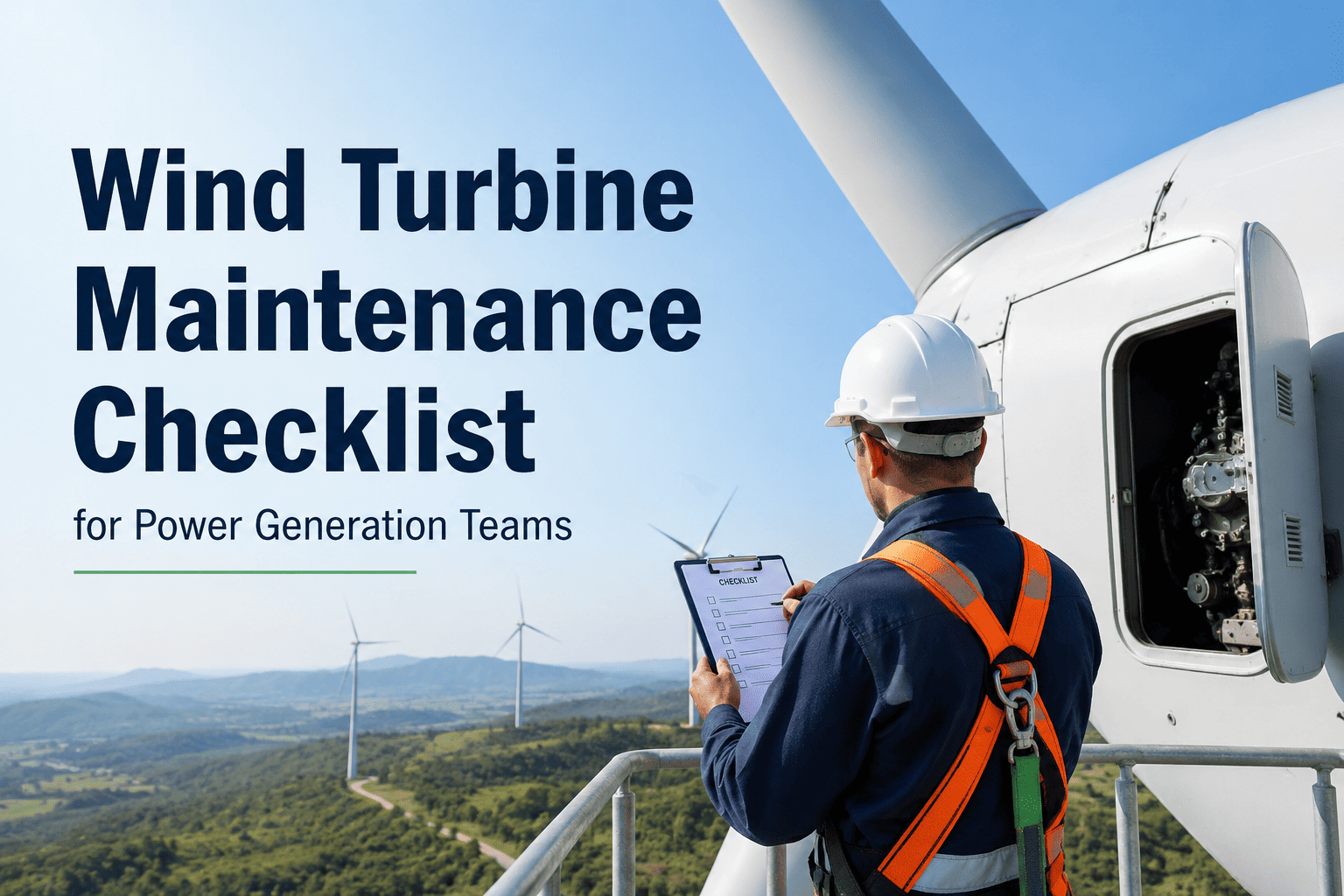
The pre-climb inspection is the last line of defence between a wind technician and a 90-metre fall. It does not exist to satisfy a clipboard. Every check on the daily card is there because somewhere, sometime, a technician died from skipping it: a harness D-ring with a hairline crack, a cable grab that did not lock, a rescue kit nobody verified, a wind speed reading nobody questioned. GWO Basic Safety Training, OSHA 29 CFR 1910 Subpart D, and ANSI Z359 all converge on the same operational truth — the climb only happens if every line of the pre-climb sheet clears. This page is the working pre-climb checklist your technicians carry every shift, structured around weather, PPE, fall arrest, ladder and rescue readiness, tower bolt verification, and the CMMS sign-off that closes the loop before boots leave the ground.
15 m/s
Maximum wind speed for safe tower climb
100 %
PPE pre-use inspection — no exceptions
2 climbers
Minimum team size for tower work
6 mo
Maximum interval for documented harness inspection
Why the Pre-Climb Sheet Cannot Be Skipped
Wind technicians work at heights that allow zero margin for the small mistakes that other industries tolerate. A loose harness buckle in a warehouse is an inconvenience; on a turbine ladder it is the moment of the fall. A radio that lost charge at ground level is a missed message; in the nacelle it is a rescue that cannot be coordinated. The pre-climb checklist exists because every single failure mode that has killed a wind technician was, by definition, present and unaddressed when the climb began.
Fall Risk
Falls from height are the leading cause of fatal injuries in wind energy. Most are traceable to PPE or anchor failures that a pre-climb inspection would have caught.
Weather Window
Wind speed, lightning risk, and visibility change faster than technicians can descend. The pre-climb forecast review is the only chance to call the climb before commitment.
Rescue Readiness
A suspended worker has minutes before suspension trauma. Rescue equipment and the rescue plan must be verified before the first rung, not improvised after a fall.
Audit Trail
OSHA, GWO, and insurance investigations all start with the pre-climb record. A missing signature on the day of an incident is the difference between a defended claim and an indefensible one.
The Six Pre-Climb Gates
Every safe tower entry passes through the same six sequential gates. Skip one and the rest are compromised. The order matters: weather and team readiness clear first because they govern whether the climb happens at all; PPE and fall arrest next because they are non-negotiable; then ladder and rescue verification; and finally CMMS sign-off that records the readiness state. This is the working structure of the daily card.
01
Weather & Site Conditions
Wind speed, lightning, visibility, ice — call the climb or stand down
02
Team & Communication
Minimum two climbers, GWO certs current, radios tested, ground contact briefed
03
PPE Pre-Use Inspection
Harness, helmet, gloves, boots — every item checked by the user who will wear it
04
Fall Arrest System
SRL, cable grab, lanyards, energy absorbers — function-checked and load-rated
05
Ladder & Rescue
Tower ladder condition, fall arrest rail, service lift, rescue kit staged
06
CMMS Sign-Off
Card signed, work order linked, base supervisor authorisation logged
Gate 1 — Weather & Site Conditions
The weather decision is binary. If any one of the four conditions below fails, the climb does not happen. There is no negotiation, no "we'll try and see," no operator pressure that overrides the limit. The pre-climb sheet captures the actual measured values, not estimates — verified at the tower base with a calibrated anemometer and confirmed against the regional forecast.
Wind Speed
Maximum 15 m/s sustained at hub height
Verified at tower base anemometer and against turbine nacelle wind reading. Forecast must show wind below limit for full duration of planned work plus 1 hour reserve.
Lightning Risk
No storm activity within 20 km / 8 km/h approach
Check radar before climb. Descend immediately if storms approach. Lightning has killed wind technicians inside nacelles — even partial-strike side flash is fatal.
Visibility
Hub visible from ground at all times
Fog, heavy rain, or snow that obscures the tower top compromises ground rescue coordination. If the ground team cannot see the nacelle, the climb stands down.
Ice on Structure
Zero ice on blades, tower, ladder, platforms
Ice shedding from blades is potentially lethal in the exclusion zone. Visible ice on any part of the structure means no climb until thaw is verified.
Gate 2 — Team, Communication & Permits
Working alone on a wind turbine is not a planning compromise — it is a violation. GWO Basic Safety Training, the rescue plan, the radio chain, and the lockout-tagout chain all assume a minimum two-person climb team with active ground support. The pre-climb sheet verifies that the team is qualified, communicating, and authorised before anyone touches the ladder.
Minimum two climbers on team — both GWO BST certified and current
Verify GWO Basic Safety Training certificate dates. Refresher required every 24 months. Expired certification stands the climber down. Working at Heights, First Aid, Manual Handling, Fire Awareness modules all current.
Ground contact identified, briefed, and reachable for full shift
Named ground person stays at site or in radio range, with emergency numbers and rescue protocol in hand. Not a phone-on-mute supervisor 50 km away.
Two-way radios tested ground-to-nacelle range with charged spares
Radio check at base before climb. Each climber carries one with spare battery. Cell phones are not a substitute — coverage in nacelles is frequently zero.
Work permit issued and LOTO sequence agreed with control room
Turbine stop confirmed, yaw locked, rotor lock engaged where required. Lockout devices and personal padlocks signed out per OSHA 29 CFR 1910.147.
Job hazard analysis reviewed and signed by every climber on team
JHA covers the specific work scope for that day — not a generic template. Each climber initials acknowledgment. Changes in scope mid-shift require a new JHA.
Gate 3 — Personal Protective Equipment
PPE inspection is performed by the technician who will wear the equipment that day. No exceptions, no second-hand sign-offs, no "I checked it last shift." Every component is inspected against the manufacturer's pre-use criteria and the ANSI Z359 stitching, hardware, and label requirements. A single failed item stands the technician down — the kit does not get patched in the field.
Full-Body Harness
Stitching intact, no fraying, no UV degradation, D-rings undeformed, labels legible. Documented six-monthly inspection within validity.
Climb Helmet
Shell free of cracks or impact marks, chin strap fully functional, no expired manufacture date, suspension intact.
Gloves & Hand PPE
Climb-rated gloves, no holes or worn fingertips. Arc-rated gloves on hand if electrical work planned in nacelle.
Climbing Boots
Lugged sole condition, ankle support intact, laces in good shape, no oil contamination on tread, slip resistance verified.
Flame-Resistant Coverall
No tears, all zips and closures functional, FR rating still within manufacturer wash-cycle life.
Tool Tethers & Bags
Every tool tethered to harness or stored in closed bag. Drop test ratings within limit. No untethered items leave the ground.
Stop Running Pre-Climb Cards on Paper
OxMaint captures every pre-climb sign-off against the turbine, the climber, the harness serial, the wind reading, and the supervisor authorisation — and locks the work order until the card is closed. The audit trail is automatic, the rescue plan is attached to the work order, and gaps in PPE inspection dates flag before the climb begins.
Gate 4 — Fall Arrest System
The fall arrest system is the equipment that catches the climber when the worst happens. Inspection is functional, not just visual — the cable grab must lock when shocked, the SRL must arrest under sudden load, the energy absorber must show no signs of deployment from a previous incident. ANSI Z359.9 and Z359.16 govern descent controllers and ladder fall arrest systems respectively, and both demand pre-use verification by the user.
Cable grab / carrier sleeve locks instantly when shock-tested at base
Pull-test before climbing. A grab that does not lock on sharp downward load is unserviceable — no second chances. Replace before climb.
Self-retracting lifeline retracts smoothly and arrests under sudden load
Pull web out fully and let retract — must wind back evenly. Sudden jerk test arrests within manufacturer spec. Damaged web or sluggish retract grounds the unit.
Energy absorber shows no signs of previous deployment
Inspect for any visible tear-out of the absorber pack. A deployed absorber means the unit took a fall — it is single-use and must be replaced before the next climb.
Lanyards and connectors free of corrosion, gates lock and unlock cleanly
Snap hooks open and close fully with no binding. Salt-air sites need extra attention — corrosion at the gate is a known offshore failure mode.
Serial numbers and last documented inspection dates logged in CMMS
Every fall-arrest item carries an asset tag. CMMS holds serial, last inspection date, next due date. Out-of-date inspection stand the unit down automatically.
Gate 5 — Ladder, Service Lift & Rescue Readiness
The tower internal ladder is the climber's path up and down — and in a fall, the rail or cable along that ladder is the only thing between the climber and 90 metres of empty tower. The service lift is faster and safer when available, but it has its own pre-use inspection. And the rescue kit is the gear that brings a suspended worker safely down — it is checked before the climb because no one wants to be opening the bag for the first time during an actual rescue.
Tower Ladder & Rest Platforms
Rungs clean and free of oil, water, or debris
No deformed, cracked, or missing rungs anywhere on climb path
Rest platforms unobstructed and structurally sound
Internal tower lighting functional at every platform
Fall arrest rail or cable continuous, no gaps, no damage
Service Lift (Where Fitted)
Daily function test from base before first climb
Emergency lower system tested and accessible
Annual statutory inspection certificate within validity
Load rating displayed and respected — no overload
Fall arrest still worn when using lift, not as substitute
Rescue Kit & Plan
Rescue descender, sling, and rope verified at base before climb
Site rescue plan reviewed by every climber on the team
Nearest hospital and emergency response time documented
First-aid kit, AED, and trauma kit at site and in nacelle
Rescue practice within last 6 months — drill record on file
Gate 6 — CMMS Sign-Off & Authorisation
The card is not closed when the technician initials it. It is closed when the supervisor authorises the climb in the CMMS, the work order links to the pre-climb record, and the gate-six status updates the turbine to "climb in progress." This is what separates a safety programme from a clipboard exercise — every climb has a digital signature trail that survives the day, the technician, and the inspector who asks for it three years later.
Step 1
Climber Completion
Each climber completes their personal section of the card on mobile device — PPE inspected, harness serial confirmed, JHA acknowledged, ready to climb.
Step 2
Site Lead Verification
Site lead reviews team certifications, weather log, and tower-specific checks. Confirms two-climber minimum and ground contact in place.
Step 3
Supervisor Authorisation
Supervisor signs the climb authorisation in CMMS. Card is locked to the work order. Turbine status updates automatically to indicate climb in progress.
Step 4
Climb Closure
On safe descent, climber confirms all PPE recovered, all tools accounted for, and any defects flagged for follow-up. Card closes; turbine returns to operational status.
Paper Card vs. CMMS-Tracked Pre-Climb
Paper pre-climb cards have been the wind industry standard for two decades. They also produce most of the audit findings, most of the disputed insurance claims, and most of the "we couldn't find it" responses after incidents. A CMMS-tracked pre-climb workflow turns the daily card into a permanent, queryable record that links every climb to its turbine, its team, its weather, and its outcome.
Frequently Asked Questions
What is the maximum safe wind speed for a turbine climb?
15 m/s sustained at hub height is the standard industry maximum, with some operators setting stricter limits at 12 m/s for less experienced teams. The forecast must show wind below the limit for the full planned work duration plus a 1-hour reserve. Wind speeds change rapidly at altitude — what is calm at the base may exceed limits at the nacelle. Configure site-specific limits in
OxMaint pre-climb settings.
How often does fall arrest equipment need formal inspection?
Pre-use inspection by the wearer every climb. Documented competent-person inspection every six months at minimum, recorded against the serial number. Annual or biennial recertification per manufacturer spec for harnesses, SRLs, and descent controllers. Any equipment that has arrested a fall is single-use and must be retired immediately.
Can a wind technician climb alone if the work is short?
No. Minimum two-climber teams are the GWO and OSHA-aligned standard for tower climbing work. A suspended worker has minutes before suspension trauma sets in — a partner climber and an active ground contact are the only realistic rescue chain. "Quick jobs" account for a disproportionate share of wind-industry fatalities.
What is the difference between a JHA and the pre-climb checklist?
The Job Hazard Analysis identifies the specific risks of the day's planned work — what could go wrong, what controls are in place. The pre-climb checklist verifies that the standing safety conditions are met before any tower access. Both are required: JHA first to plan the work, pre-climb sheet at the tower base to authorise the climb.
How does OxMaint handle failed pre-climb checks?
Any failed item — expired PPE, wind over limit, missing GWO certification, ungrounded rescue kit — automatically blocks the climb authorisation in OxMaint and generates a corrective task at matching priority. The supervisor cannot sign off until the failure is resolved or the climb is formally stood down with documented reason. To see the workflow live,
book a 30-minute walkthrough.
Run Your Pre-Climb Programme on a CMMS Built for Wind O&M
OxMaint ships with pre-built daily pre-climb templates aligned to GWO Basic Safety Training, OSHA 29 CFR 1910 Subpart D, and ANSI Z359 fall protection standards. Each card binds to the turbine, the climber, the harness serial, the weather log, and the supervisor signature. Expired certifications and PPE inspection dates auto-flag. Your pre-climb programme becomes a living safety record — not a stack of paper that nobody can find when the auditor calls.