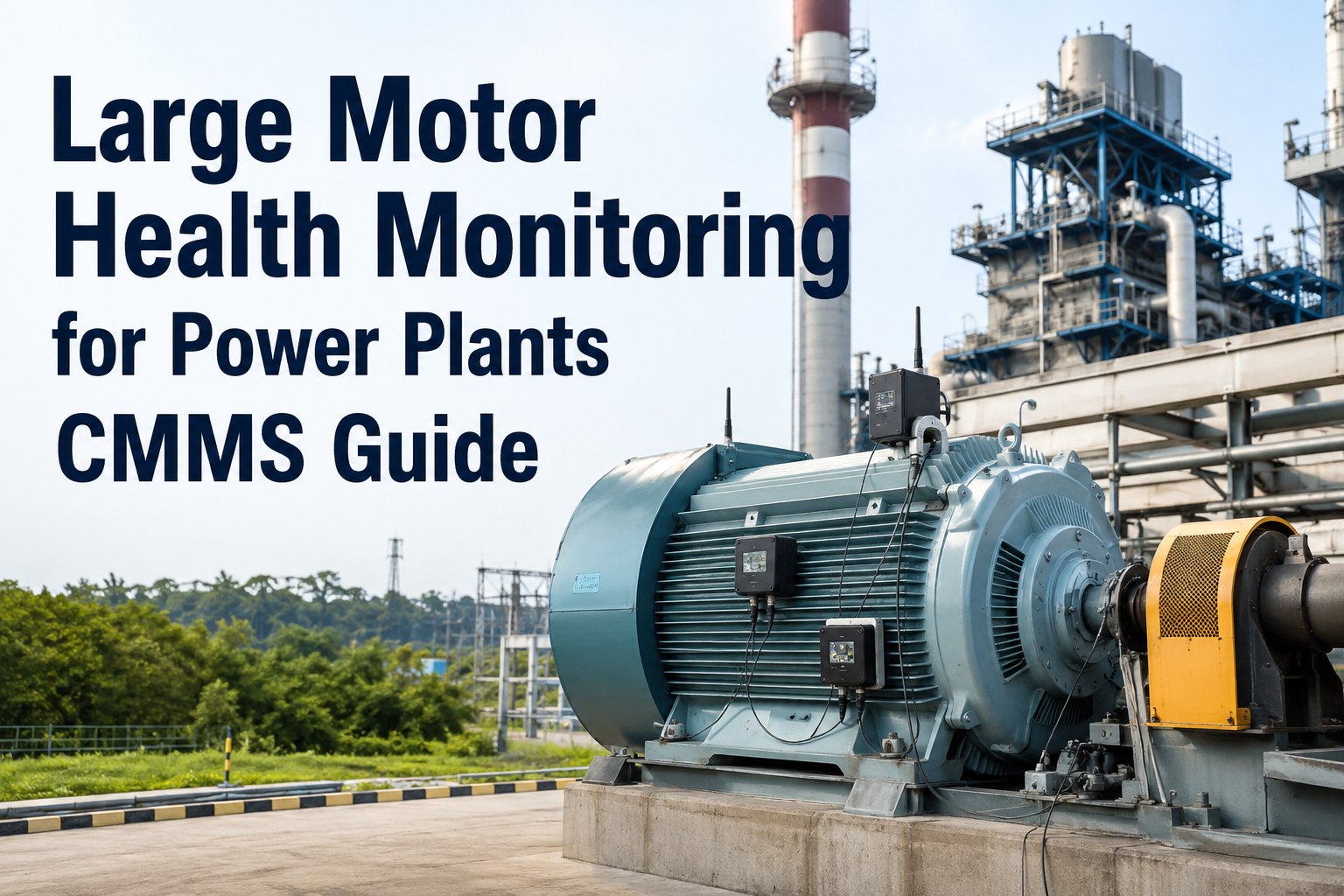
Electric motors are the most numerous rotating assets in any thermal or hydro power plant — driving feedwater pumps, ID/FD/PA fans, coal mills, condensate extraction pumps, and auxiliary cooling systems that are collectively as critical to generation continuity as the turbine itself. Motor Current Signature Analysis (MCSA) detects electrical and mechanical faults in these motors without physical contact, using the motor's own current waveform as a diagnostic signal. When MCSA data is integrated with a CMMS, each fault signature becomes a structured diagnostic alert, a condition-based work order, and a documented maintenance decision — rather than a spectrogram on a technician's laptop that reaches a work order only after a manual review cycle. OxMaint connects MCSA diagnostic outputs to predictive maintenance workflows, asset health trending, and outage scheduling — giving power plant maintenance engineers the actionable layer that transforms motor diagnostics into documented, defensible maintenance decisions. Book a demo to see MCSA integration with OxMaint in action.
Motor Current Signature Analysis for Power Plant Equipment
Detect motor electrical and mechanical faults early using MCSA current spectrum diagnostics — integrated with OxMaint predictive maintenance workflows for structured work orders, asset health trending, and forced outage prevention.
What Motor Current Signature Analysis Detects and How
MCSA works on the principle that motor current waveforms contain frequency components modulated by mechanical and electrical anomalies in the motor system. A healthy motor draws a current at the supply frequency with harmonics determined by its design. When faults develop — broken rotor bars, bearing defects, air gap eccentricity, or stator winding faults — they introduce characteristic sidebands and harmonics into the current spectrum that are absent in a healthy machine. Current sensors on the motor supply cables capture the raw waveform; FFT analysis extracts the spectrum; and diagnostic algorithms identify fault-specific frequency signatures against baseline.
Broken or cracked rotor bars in squirrel cage induction motors produce characteristic sidebands at (1±2s)f₁ in the current spectrum, where s is slip and f₁ is supply frequency. MCSA identifies the number of broken bars from sideband amplitude and progression. Power plant applications: ID fans, FD fans, large cooling water pumps.
Bearing outer race, inner race, and rolling element defects modulate motor current at characteristic frequencies derived from bearing geometry (BPFO, BPFI, BSF). MCSA bearing detection is less sensitive than vibration analysis for early-stage bearing faults but provides a non-contact complement for motors where vibration sensor installation is impractical.
Inter-turn short circuits in stator windings produce negative sequence current components and harmonic distortion detectable in the MCSA spectrum before the fault progresses to phase-to-ground failure. MCSA phase imbalance analysis also detects supply voltage asymmetry contributing to winding thermal stress — a common root cause of winding failure in plants with poor power quality on auxiliary systems.
Static and dynamic eccentricity between rotor and stator produces eccentricity-related harmonics in the current spectrum. Dynamic eccentricity (rotating non-uniformity) is detectable at specific harmonic frequencies dependent on pole pair count. Power plant relevance: large induced draft fan motors and coal mill motors are particularly susceptible due to bearing wear patterns from variable load operation under SLDC dispatch schedules.
Pulsating load torque from misaligned couplings, gear defects, or driven equipment problems produces current modulation at the rotation frequency and its harmonics. MCSA identifies coupling and driven-end mechanical faults through load torque spectral analysis — enabling diagnosis of pump cavitation, fan blade issues, or mill liner wear from the motor electrical supply alone.
MCSA measures the actual current waveform at the motor terminals, capturing supply quality issues — voltage unbalance, harmonic distortion from VFDs, and inter-harmonic content — that cause motor overheating even when load and speed appear normal. This supply quality monitoring capability is particularly valuable for VFD-driven auxiliary motors in modern plants.
Critical Motors in Power Plants Where MCSA Delivers the Highest Value
| Motor / Driven Equipment | Typical Rating (MW range) | Primary MCSA Fault Target | Operational Risk if Missed |
|---|---|---|---|
| Induced Draft (ID) Fan Motor | 1–8 MW | Rotor bar fracture, bearing fault, eccentricity | Unit load reduction, forced outage if fan trips |
| Forced Draft (FD) Fan Motor | 0.5–4 MW | Rotor bar, coupling misalignment, voltage unbalance | Combustion disruption, boiler pressure drop |
| Primary Air (PA) Fan Motor | 0.5–3 MW | Bearing fault, eccentricity, inter-turn short | Coal transport interruption, mill capacity reduction |
| Boiler Feed Pump Motor | 5–20 MW | Rotor bar, bearing fault, torque pulsation (cavitation) | Feed system disruption, boiler drum level instability |
| Coal Mill (Bowl Mill) Motor | 0.5–2 MW | Load torque variation, coupling, bearing | Mill trip, load derating, coal quality excursion |
| Condensate Extraction Pump Motor | 0.3–1.5 MW | Bearing, cavitation signature, inter-turn fault | Heat rate impact, LP heater level instability |
| Circulating Water Pump Motor | 1–5 MW | Rotor bar, bearing, eccentricity | Condenser vacuum loss, turbine back pressure increase |
How MCSA Data Flows Into OxMaint Predictive Maintenance
Each motor is registered in OxMaint with nameplate data, rated power, connection type, driven equipment, and MCSA baseline spectrum recorded at commissioning or last overhaul. MCSA baseline files are stored against the motor asset record.
MCSA measurements are conducted at scheduled intervals (quarterly to semi-annual for critical motors) using portable or permanently installed sensors. Results are uploaded to OxMaint via the mobile app or file import against the motor asset and measurement date.
OxMaint's AI analytics compare the new MCSA spectrum against the motor's baseline and configured fault frequency references. Identified fault signatures are severity-graded (advisory, alert, urgent, critical) based on sideband amplitude relative to the supply frequency fundamental.
Fault signatures above advisory threshold automatically generate a predictive maintenance work order in OxMaint with the fault type, severity grade, motor location, and MCSA report attached. The assigned electrical or mechanical engineer receives mobile notification with the diagnostic summary.
Each MCSA result is plotted on the motor's health trend in OxMaint. Accelerating fault signature amplitude across successive measurements triggers automatic escalation to senior engineer review. OxMaint tracks the time from initial fault detection to maintenance decision for each motor.
After repair or replacement, a post-maintenance MCSA measurement is conducted and uploaded to OxMaint as the new baseline. The work order is closed with the post-repair spectrum attached — providing a before-after diagnostic record and a verified new baseline for the next monitoring cycle.
MCSA Compared to Other Motor Condition Monitoring Techniques
MCSA is not a replacement for vibration analysis or thermal imaging — it complements them by covering fault types and motor locations where other techniques have limitations. The comparison below defines the complementary role of each technique in a comprehensive motor health monitoring program.
| Technique | Primary Fault Coverage | Motor Access Required | Strengths | Limitations |
|---|---|---|---|---|
| MCSA | Rotor bars, stator winding, eccentricity, supply quality | Current terminals only (no physical motor access) | Detects electrical faults invisible to vibration; no contact; works through VFDs with suitable adaptation | Less sensitive for early bearing faults vs vibration; requires load >30% for accurate results |
| Vibration Analysis | Bearings, imbalance, misalignment, looseness, gears | Accelerometer access to bearing housings | Best technique for early bearing fault detection; wide fault coverage | Does not detect electrical faults (rotor bar, stator winding); requires physical access to motor body |
| Thermal Imaging (IR) | Overheating, hot spots, connection faults, cooling failure | Line-of-sight to motor body or terminal box | Fast screening of multiple assets; detects connection and cooling faults not visible to other techniques | Snapshot only (no real-time trend); requires safe access; cannot detect rotor internal faults |
| Insulation Resistance (IR Test) | Winding insulation condition to ground | Motor must be de-energized | Directly measures insulation condition to ground; IBR and CEA accepted method | Requires motor shutdown; does not detect inter-turn faults; point-in-time measurement only |
What Power Plant Engineers Report From MCSA Programs
We had an ID fan motor on Unit 3 that was vibrating within alarm limits but not tripping. MCSA showed a clear rotor bar sideband at the third broken bar harmonic level. Vibration hadn't indicated anything beyond the stage-1 alert threshold. We planned a rotor inspection during the next scheduled maintenance window — three weeks later — and found four cracked bars. A full bar failure on a running 4.5 MW motor in that location would have forced a unit trip and potential core damage. MCSA bought us the window to act.
Electrical Maintenance Manager · 2x500 MW Thermal Plant · Eastern IndiaWe started using MCSA for our BFP motors after a second bearing failure in 18 months on the same motor. The pattern only became visible when we trended the MCSA data against operating hours and load profile — OxMaint showed us the fault was developing faster than our quarterly measurement interval would catch. We moved to monthly monitoring for that motor and adjusted the bearing PM interval based on the actual rate-of-change data. No failures since in over two years.
Predictive Maintenance Lead · Central Sector GENCO · Supercritical UnitFrequently Asked Questions
Can MCSA be performed on VFD-driven motors in power plant auxiliary systems?
Yes, with adaptation. Standard MCSA algorithms require modification for VFD-driven motors because the supply frequency varies with speed setting. Specialized MCSA analysis techniques applied in the VFD intermediate frequency domain or using encoder-referenced analysis can detect rotor bar and other electrical faults in VFD-driven motors including variable-speed BFP motors and modern variable-speed ID fans. OxMaint stores VFD-specific MCSA baseline data and flags VFD motor diagnostic records separately for the appropriate analysis method. Start free to configure your VFD motor monitoring program.
How does OxMaint manage MCSA baselines when a motor is rewound or replaced?
When a motor rewind or replacement is completed, OxMaint closes the existing asset history record with the final maintenance record and creates a new baseline measurement period beginning from the post-repair MCSA test. The pre-repair fault history is retained in the original asset record for trend analysis, while the new baseline drives all subsequent MCSA comparison alerts. Work order templates for motor rewind completion include a mandatory post-repair MCSA measurement as a sign-off requirement. Book a demo to review motor lifecycle record management.
What is the recommended MCSA measurement frequency for critical power plant motors?
Measurement frequency is risk-graded in OxMaint based on motor criticality and current fault status. Critical single-stream motors (single ID fan, sole BFP) are typically measured quarterly as a baseline, with monthly frequency when any fault signature is in advisory or alert status. Non-critical redundant motors may be measured semi-annually. When OxMaint trending shows accelerating fault signature amplitude, the system automatically recommends shortening the measurement interval and can generate the corresponding PM schedule adjustment in the work order queue for engineering approval.
How does MCSA diagnostic data in OxMaint support CEA equipment health compliance?
CEA's Operation and Maintenance Standards for Generating Stations require that auxiliary equipment health be monitored, documented, and acted upon systematically. OxMaint's MCSA records — including measurement date, fault signatures identified, severity grade, and maintenance decisions triggered — constitute the documented condition monitoring evidence required for CEA O&M compliance audits. The complete motor health record from OxMaint, including trend charts and work order closure history, is exportable as a compliance report for CEA inspection submissions. Start free to configure your motor health compliance record structure.
Can OxMaint integrate MCSA data with vibration monitoring data for the same motor?
Yes — OxMaint supports multi-technique condition monitoring data against the same motor asset record. MCSA spectral findings, vibration analysis reports, thermal imaging results, and insulation resistance test records are all linked to the individual motor asset and displayed on a unified motor health dashboard. This multi-technique view enables engineers to assess overall motor health across all diagnostic dimensions simultaneously, identify fault types that only appear in one technique versus multiple, and make maintenance decisions based on the complete diagnostic picture rather than single-parameter alerts.
Your Motors Are Telling You Their Condition Through the Current They Draw. Are You Listening?
OxMaint integrates MCSA diagnostic outputs into condition-based work orders, motor health trending, and outage-aligned maintenance decisions — converting fault signatures from technician reports into documented, actionable maintenance records before failures reach operations.