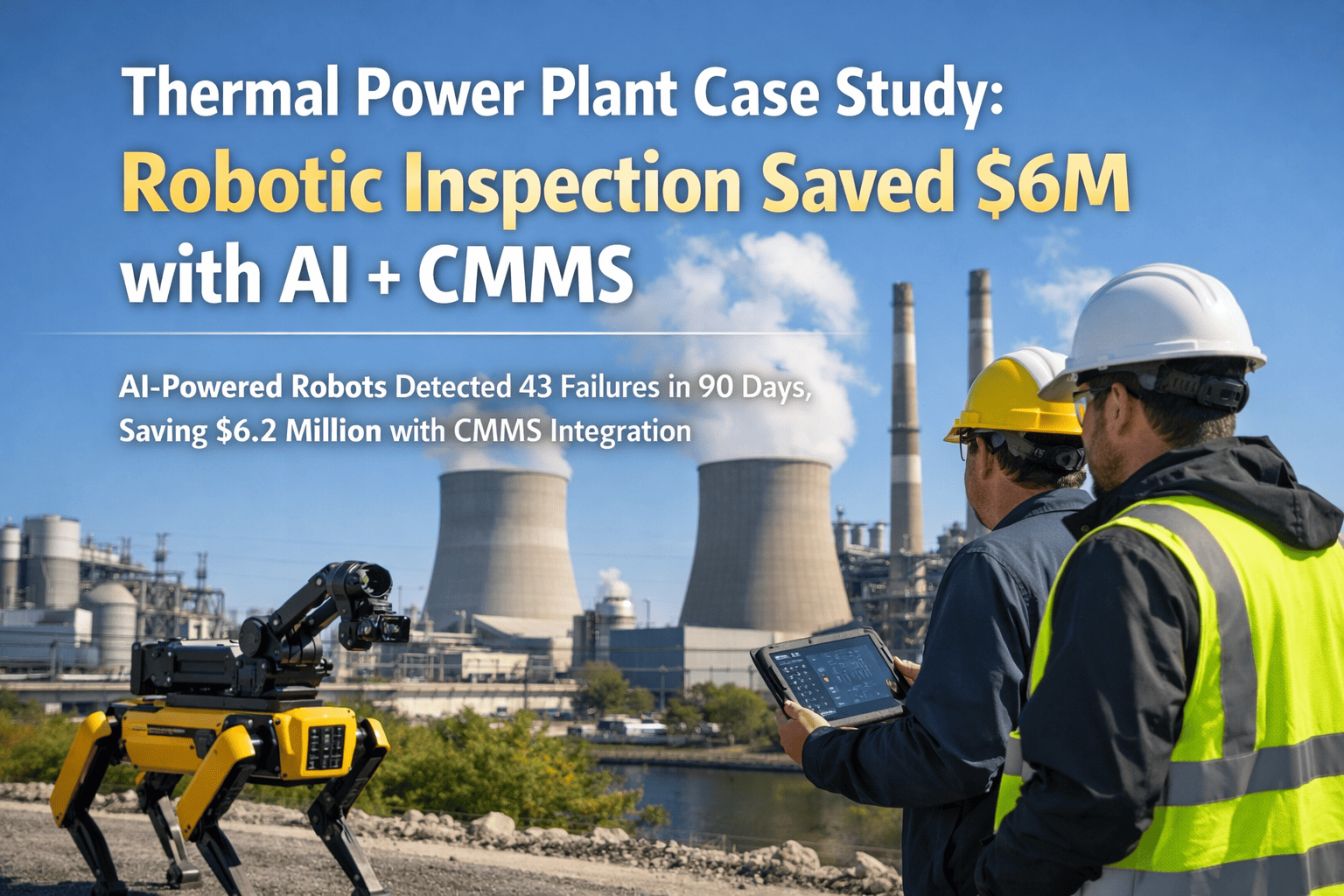
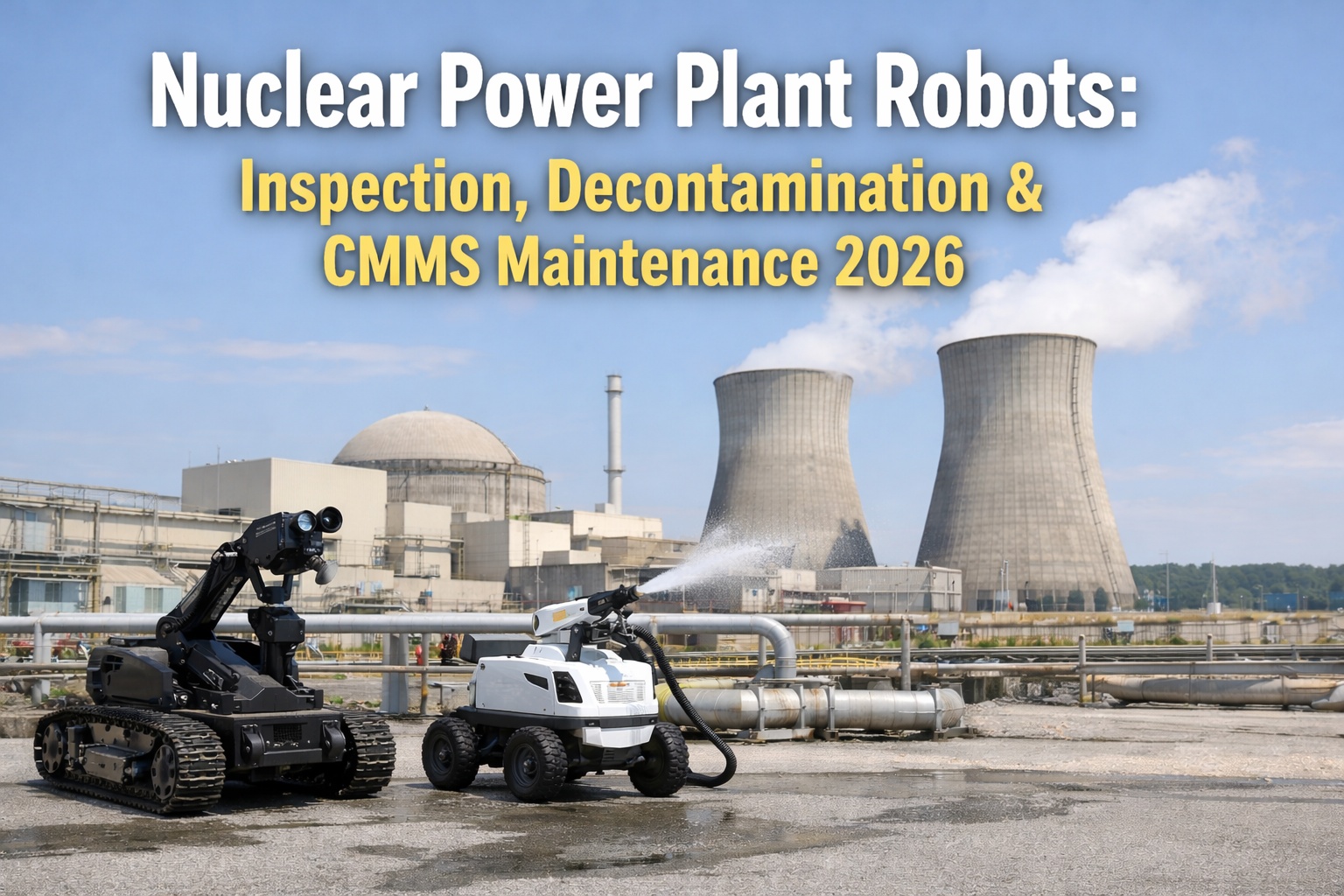
A 500 MW combined-cycle power plant covers 40+ acres, spans 6 stories of turbine halls, runs underground cable tunnels, supports cooling towers 30 meters tall, and contains thousands of assets that never sleep. No single robot covers all of it. The plants reporting the highest inspection ROI in 2025 aren't deploying one robot — they're deploying coordinated fleets where quadrupeds, drones, and crawlers each own the terrain they're built for. And when every robot in that fleet reports to OXmaint, one operator sees everything, and every anomaly becomes a work order before the shift ends. Sign up free on OXmaint to connect your entire robot fleet to a single maintenance intelligence platform.
40%
Operating cost reduction documented by fleet-based autonomous inspection platforms across energy and industrial facilities
50%
Reduction in manual inspections reported by utility operators deploying multi-robot inspection programs
1M+
Inspections completed by heterogeneous robot fleets across five continents in oil, gas, chemical, and utility sectors
32,000+
Hours of hazardous human labor eliminated by coordinated robot and drone deployments at Shell, BP, E.ON, and BASF
Why One Robot Is Never Enough
Every Zone in Your Plant Demands a Different Robot
The hard truth about single-robot deployments: they leave blind spots. A quadruped that excels on equipment floors can't inspect cooling tower shells 30 meters up. A drone that surveys rooftops can't navigate indoor boiler tunnels with limited clearance. A pipe crawler sees inside condenser tubes — and nothing else. Large power plants have four distinct inspection environments, and each one has a robot type that was purpose-built for it.
The breakthrough happening at facilities like Shell Energy Park Rheinland and E.ON substations isn't any single robot. It's the shift to heterogeneous fleets — where each robot type covers its terrain, all data flows to one platform, and the CMMS generates work orders regardless of which robot found the anomaly.
The Four-Robot Fleet: What Each Type Covers
Ground Level
Quadruped Robot
Boston Dynamics Spot · ANYmal · Ghost Robotics
Best For
Equipment halls and turbine floors
Switchyard patrol routes
Staircase and multi-level navigation
Radiation-restricted zones
Overnight autonomous patrol
Thermal + Acoustic + Gas + Visual + LiDAR
Aerial
Inspection Drone
DJI Industrial · Flyability Elios · Percepto
Best For
Cooling tower shell and basin inspection
Chimney and stack interior surveys
Roof and structural perimeter checks
Confined spaces — tanks, boiler chambers
Rapid large-area coverage mapping
Thermal IR + RGB + LiDAR + Ultrasonic
Tracked / Confined
Crawler Robot
Gecko Systems · Inuktun · GE Mentor
Best For
Boiler tube and furnace interior walls
High-heat confined space navigation
Vertical surface and tank wall inspection
Weld seam and coating integrity checks
Areas inaccessible to legged robots
Visual + Ultrasonic UT + Thermal + Eddy Current
Pipe / Tube
Pipe Inspection Robot
RedZone Robotics · GE PII · Eddyfi
Best For
Condenser tube internal inspection
Underground utility pipeline surveys
Feedwater and steam line integrity
Erosion and corrosion wall thickness
Post-outage verification inspection
CCTV + Sonar + MFL + Ultrasonic UT
One Platform. Every Robot. All Your Work Orders.
OXmaint receives anomaly alerts from any robot platform via API — quadrupeds, drones, crawlers, pipe inspection units — and converts them into prioritized, asset-linked work orders your team acts on immediately.
Coverage Matrix: Which Robot Inspects What
Not every robot type is optimal for every asset. This matrix shows how a coordinated four-robot fleet eliminates inspection blind spots across a 500 MW combined-cycle facility.
Gas Turbine Hall
Primary
Support
—
—
Cooling Tower
—
Primary
Support
—
HRSG / Boiler
Support
Support
Primary
—
Condenser Tubes
—
—
—
Primary
Switchyard
Primary
Support
—
—
Electrical Panels
Primary
—
—
—
Stack / Chimney
—
Primary
—
—
Underground Pipelines
—
—
—
Primary
Rooftop / Perimeter
Support
Primary
—
—
Primary — optimal robot type for this zone
Support — supplemental coverage capability
Not applicable for this asset type
How Multi-Robot Coordination Actually Works
Deploying multiple robots is straightforward. Coordinating them — so data from each feeds a single decision layer without duplication, conflict, or lost alerts — is the engineering problem that OXmaint solves at the CMMS layer.
Zone Assignment and Route Planning
Each robot type is assigned to the plant zones where it performs best. Quadruped routes cover equipment floors and switchyard on autonomous patrol cycles. Drones are scheduled for cooling tower and stack inspection on periodic mission plans. Crawlers and pipe robots deploy on condition-triggered or outage-window schedules. No two robots duplicate the same coverage — every inspection hour is productive.
Real-Time Sensor Fusion Per Robot
Each robot processes its own sensor stack independently — thermal, acoustic, visual, or ultrasonic — and flags deviations from established baselines. The alert carries asset ID, sensor reading, deviation magnitude, and the robot's GPS or indoor positioning coordinates. Data is structured the same way regardless of which robot generated it, enabling unified analysis downstream.
Fleet-Level Aggregation in OXmaint
OXmaint receives structured anomaly alerts from all active robots via API — hardware agnostic, vendor agnostic. The platform deduplicates alerts from overlapping inspection zones, prioritizes by severity and asset criticality, and routes each finding to the qualified technician for that asset type. One maintenance planner manages the full fleet's output from a single dashboard.
Automated Work Orders and Compliance Records
Every fleet-generated anomaly creates a timestamped, asset-linked work order in OXmaint with the robot type, sensor evidence, and recommended action pre-populated. Inspection history from all robots builds automatically into the asset record — creating the continuous, traceable maintenance log that satisfies NERC, NRC, EPA, and insurance documentation requirements without any manual compilation.
Real-World Deployment
Shell Energy Park Rheinland: Mixed Fleet in Production
Shell's Energy and Chemicals Park Rheinland deployed a mixed fleet of autonomous inspection robots and a drone using a hardware-agnostic fleet orchestration platform — one of the first large-scale multi-robot inspection programs at a major European energy facility. The deployment covered ATEX Zone 1 explosive environments, perimeter monitoring, and continuous equipment inspection across the plant.
Thomas Klein, Digital Innovation Lead at Shell Energy and Chemicals Park Rheinland, confirmed the facility put the mixed fleet into production as part of its broader innovation and digitalization program — citing the ability to operate different robot types under a single platform as the critical enabler.
ATEX
Zone 1 explosive environments covered by robot fleet — eliminating human entry requirements
24/7
Continuous autonomous inspection coverage across the facility without shift limitations
Single
Platform managing all robots and drones — no fragmented dashboards or disconnected data silos
40%
Operating cost reduction potential documented for fleet-based autonomous inspection programs
Deployment Roadmap: From First Robot to Full Fleet
Most plants don't deploy four robot types simultaneously. The highest-ROI path is phased — starting with the zone that has the highest failure cost and expanding from there as the data and the team build confidence.
Phase 1 — Months 1–3
Anchor Robot Deployment
Deploy one quadruped on the highest-risk inspection route — typically the turbine hall or switchyard. Operate in supervised mode while building operator familiarity. Connect findings to OXmaint for automated work order creation and baseline trend building. First avoided failures begin accumulating within 60–90 days.
Phase 2 — Months 4–8
Aerial Coverage Added
Add drone inspection for cooling towers, stacks, and roof structure. Both robot types report to OXmaint under the same asset hierarchy. Inspection coverage now includes terrain the quadruped cannot reach. ROI breakeven typically occurs in this phase — two to three prevented failures typically cover program cost.
Phase 3 — Months 9–18
Full Fleet Coverage
Crawler deployed for boiler and confined space inspection. Pipe robot added for condenser tube and underground pipeline surveys during outage windows. All four robot types feed OXmaint. One maintenance planner manages fleet-wide output. Compliance documentation is fully automated across all robot types and inspection zones.
What Multi-Robot Fleets Deliver: Documented Outcomes
50%
Reduction in manual inspection hours for utility operators deploying coordinated robot fleets across equipment zones
Deloitte, 2024
40%
Operating cost reduction achievable through fleet-based autonomous inspection at energy and industrial facilities
Energy Robotics, 2025
35–50%
Faster troubleshooting when robot pre-diagnosis delivers failure mode context before technicians reach the asset
Industry deployment benchmarks, 2024
$2M+
Annual savings documented by infrastructure operators combining robot inspection with predictive maintenance programs
ASCE case studies, 2023
How OXmaint Turns a Robot Fleet Into a Maintenance Machine
01
Hardware-Agnostic Fleet Integration
OXmaint receives condition alerts via API from any robot platform — Boston Dynamics, ANYbotics, DJI, Flyability, and custom IIoT deployments. No vendor lock-in. If your fleet grows or changes hardware, the CMMS integration doesn't break. Every robot speaks the same language into OXmaint regardless of manufacturer.
02
Single-Pane Fleet Dashboard
One maintenance planner can monitor the full output of a four-robot fleet from a single OXmaint dashboard. Anomalies from all robots are ranked by severity and asset criticality in one queue. No switching between four different robot dashboards, no risk of a critical alert being missed in a vendor-specific interface nobody checks at midnight.
03
Skill-Matched Work Order Routing
A drone finding a cooling tower delamination requires different skills than a quadruped flagging compressor bearing degradation. OXmaint routes each robot-generated work order to the certified technician qualified for that specific asset and failure type — preventing warranty voids, ensuring safety, and eliminating the wasted dispatch of the wrong person to the wrong job.
04
Cross-Robot Trend Analytics
OXmaint builds asset performance trend charts from multi-robot data — correlating a quadruped's thermal readings from the turbine hall with a pipe robot's wall thickness measurements from the connected feedwater line. Failure patterns that no single robot could detect become visible when their data is unified in one analytics layer over time.
Frequently Asked Questions
Do all robots in a multi-robot fleet need to be from the same vendor?
No — and this is one of the most important decisions in fleet architecture. The highest-performing multi-robot deployments, including Shell's program at Rheinland and E.ON's substation fleet, use hardware-agnostic orchestration platforms that integrate robots from different manufacturers. OXmaint operates the same way at the CMMS layer: it receives structured anomaly alerts via API from any robot platform, regardless of vendor. Your quadruped can be Boston Dynamics Spot, your drone can be DJI or Flyability, and your crawler can be from Gecko Systems — all feeding the same OXmaint work order queue.
Book a demo to see how multi-vendor integration works in practice.
How many operators does it take to manage a four-robot fleet?
At full autonomous deployment, a four-robot fleet covering a 500 MW plant can typically be managed by one to two operators per shift — significantly fewer than the inspection team it replaces. During initial deployment phases, each robot platform may require dedicated supervision. As autonomous patrol modes are validated and confidence builds, operators shift from active piloting to exception-based monitoring: reviewing anomalies flagged by robots and managing the OXmaint work order queue rather than conducting inspections themselves. Deployment time for missions has shrunk from minutes to seconds with modern LLM-driven mission planning platforms.
What happens when two robots detect the same anomaly in overlapping zones?
This is a known challenge in heterogeneous fleet management — addressed at the platform layer, not the robot layer. OXmaint deduplicates anomaly alerts from overlapping inspection zones by matching asset ID, timestamp, and sensor type. If a quadruped's thermal camera and a drone's IR camera both flag an overheating transformer, OXmaint creates one work order with both sensor readings attached as corroborating evidence — not two duplicate work orders that confuse the maintenance queue. The multi-source confirmation actually increases the confidence score of the finding and can affect prioritization of the response.
Can the fleet operate in ATEX hazardous zones?
Yes. ATEX Zone 1 and IECEx-rated robot deployments are commercially available and have been deployed at facilities including Shell's Rheinland refinery complex. Specific robots and payload configurations must carry the relevant ATEX certifications for the zone classification. The operational benefit is significant: ATEX environments are precisely the zones where human inspection is most costly, most dangerous, and most restricted. Deploying an ATEX-rated robot eliminates the PPE overhead, two-person entry rules, and dose/exposure tracking that makes manual inspection of these zones so expensive. OXmaint manages ATEX zone inspection records the same way it handles any other asset — compliance documentation is automatic.
How long before a multi-robot fleet pays back its investment?
Based on documented fleet deployments in energy and utility sectors, most programs reach ROI breakeven within 6–14 months of full deployment. The primary driver is prevented forced outages — at $850K–$1.5M per event on a 500 MW plant, two or three prevented failures per year covers a substantial portion of the fleet program cost alone. Secondary returns come from the 40–50% reduction in manual inspection labor, compliance documentation time savings, and insurance premium reductions for facilities with structured, digitally documented maintenance programs. Phase 1 single-robot deployments typically cross breakeven faster, making them the recommended starting point for building the business case before expanding to a full fleet.
Sign up for OXmaint to start building your baseline today.
Deploy Your Fleet
Every Robot Type. One Platform. Zero Blind Spots.
OXmaint connects your entire robot inspection fleet — quadrupeds, drones, crawlers, pipe robots — to a single work order system, asset trend dashboard, and compliance record engine. Deploy the fleet. Let OXmaint make it productive.