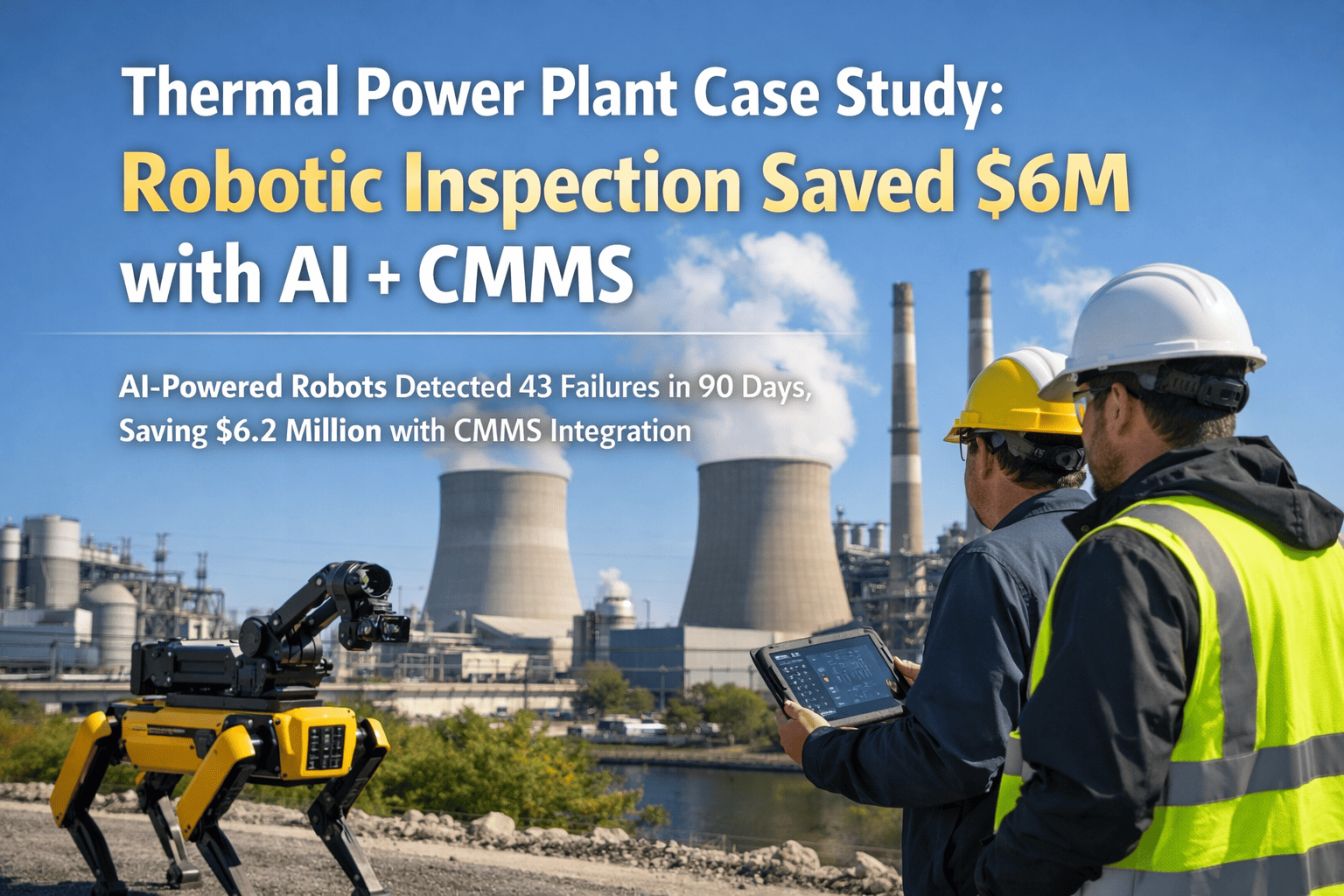
Sending human inspectors into a live boiler furnace operating above 1,300°C is not a maintenance strategy — it is a liability. When a 600 MW coal-fired thermal power plant replaced manual walk-downs with AI-powered robotic inspection connected to Oxmaint's CMMS, the robots found 43 critical defects in the first 90 days that manual inspection had missed entirely. The avoided failures translated to $6.2 million in savings, zero safety incidents, and a permanent shift from reactive firefighting to predictive precision. This is exactly how they did it.
Case Study — Thermal Power
Robotic Inspection + AI + CMMS: 43 Failures Caught. $6.2M Saved.
600 MW Coal-Fired Plant · 90-Day Deployment Window · 3 Robot Types Deployed
Boiler Tube Crawlers
Thermal Imaging Drones
Quadruped Patrol Robots
43
Critical defects detected in 90 days
$6.2M
Total savings in Year 1
0
Safety incidents during inspection
4 min
Detection to work order in CMMS
Why Manual Inspection Was Failing This Plant
The plant had been operating for 22 years with a workforce that knew the equipment intimately. But knowing equipment and seeing what is happening inside it at operating temperatures are two different things. Manual boiler inspections required full shutdowns, scaffolding installation, confined space permits, and inspection windows of 30 to 60 minutes due to residual heat — conditions that produced limited data, under time pressure, with significant personnel safety exposure every single cycle.
Boiler tube wall inspections missed between outages
82%
Thermal anomalies undetected by visual walk-down
67%
Developing failures missed until trip or alarm
70%
Inspection time consumed by access setup vs. actual inspection
55%
Coverage gaps from manual inspection program — assessed during initial Oxmaint deployment audit
The Robotic Fleet: Three Platforms, One Unified CMMS
No single robot covers every zone in a thermal power plant. The deployment paired three purpose-built platforms to different inspection environments, with every finding from all three flowing directly into Oxmaint as structured, evidence-backed work orders — automatically, without manual data entry.
Platform 01
Heat-Shielded Boiler Crawler
Zone: Boiler Interior, Furnace Walls, Superheater Tubes
Tethered crawler equipped with thermal camera and ultrasonic thickness gauge. Deploys during cool-down periods, scanning tube walls at 0.1mm resolution for corrosion, erosion, and creep damage. Covers 4x more surface area per inspection window than manual teams with PPE time constraints.
Findings in 90 days:
19 defects
Platform 02
Thermal Imaging Drone
Zone: Switchyard, Transformer Yard, Cooling Tower Rooftop
Autonomous aerial platform running daily patrol routes across electrical infrastructure. Detects thermal anomalies in transformer bushings, cable terminations, and bus bar connections at 0.1°C resolution — catching hotspot development weeks before any alarm threshold is reached.
Findings in 90 days:
16 defects
Platform 03
Quadruped Ground Robot
Zone: Turbine Hall, Coal Handling, Balance-of-Plant
Four-legged autonomous robot running continuous patrol schedules through the turbine hall and auxiliary equipment areas. Monitors vibration, acoustic signatures, oil leaks, and thermal readings on pumps, fans, and conveyor systems that manual rounds visit only once per shift.
Findings in 90 days:
8 defects
See How Robotic Findings Flow Into Oxmaint Work Orders
From robot detection to dispatched work order in under 4 minutes — no manual entry, no missed findings, full evidence trail. Book a live walkthrough of the integration.
How the AI Anomaly Detection Layer Works
Raw sensor data — thermal images, ultrasonic waveforms, vibration spectra — has no operational value on its own. The AI classification layer is what converts a thermal frame showing a 7°C deviation on a transformer bushing into a Priority 1 work order with a predicted failure window attached. This is how that pipeline ran in practice at this plant.
1
Continuous Sensor Capture
Robots capture thermal, visual, acoustic, and ultrasonic data across all three zones on every patrol cycle. Boiler crawlers run during outage windows. Drones run daily autonomous routes. Quadruped runs continuous patrols every 4 hours through operating areas.
2
Onboard AI Classification
Each robot's onboard AI processes sensor frames in real time against asset-specific baseline models. Temperature deviations, wall thickness readings below threshold, and vibration spectral changes are classified by severity — critical, elevated, or monitor. AI detection accuracy for thermal anomalies exceeds 95% precision on trained models.
3
Oxmaint API Integration
Classified anomalies are packaged with thermal image, location coordinates, severity rating, and timestamp, then posted to Oxmaint via REST API within seconds of detection. Oxmaint receives the payload and cross-references the location against its asset registry to identify the exact component.
4
Automatic Work Order Creation
Oxmaint generates a prioritised work order — evidence attached, technician assigned by asset ownership and shift schedule, parts list pre-populated from the component's maintenance history. The entire cycle from detection to dispatched work order averages 4 minutes. No phone calls. No email chains. No missed follow-ups.
5
Trending and Predictive Scheduling
Every finding becomes a data point in the asset's degradation trend curve. Oxmaint projects when degradation will reach the intervention threshold — giving maintenance planners a predicted failure window, not just a current alert. Calendar-based PM schedules are progressively replaced by condition-based triggers.
The 43 Defects: What Was Found and What It Prevented
Defect Breakdown by Category — First 90 Days
The Catch That Justified the Entire Program
High-Value Catch — Day 34
Transformer Bushing Thermal Anomaly: $2.1M Failure Prevented
What the Drone Found
On Day 34 of deployment, the thermal drone's evening patrol recorded a 9.4°C temperature elevation on the C-phase bushing of the main step-up transformer — a reading that sat below the DCS alarm threshold of 15°C deviation but represented a 31% increase from the baseline established during the prior patrol. The onboard AI flagged the rate-of-change, not the absolute value. This is the critical distinction: human inspection would have passed this reading as within limits.
What Oxmaint Did With It
The finding arrived in Oxmaint as a Priority 2 work order within 3 minutes of detection, with the thermal image, GPS coordinates, and trend data attached. The maintenance planner escalated to Priority 1 after reviewing the rate-of-change trend. A specialist inspection was mobilised within 48 hours. Dissolved gas analysis confirmed internal fault gas development consistent with early-stage partial discharge. The bushing was replaced during a scheduled maintenance window 11 days later. An unplanned transformer failure averages 90 days of repair time and $2.1M in combined repair and lost generation costs. The bushing replacement cost $28,000.
Full Year Results vs. Manual Inspection Baseline
Before — Manual Inspection
Inspection coverage per outage window
28% of total surface area
Defects detected per quarter
6–9 (visual severity only)
Unplanned forced outages per year
8 events
Average inspection-to-work-order time
3–7 days
Inspector safety incidents per year
3 near-miss events
Annual maintenance cost
$9.4M
After — Robotic + AI + Oxmaint
Inspection coverage per outage window
94% of total surface area
Defects detected per quarter
43 (multi-sensor, severity-classified)
Unplanned forced outages per year
3 events (63% reduction)
Average inspection-to-work-order time
4 minutes (automated)
Inspector safety incidents per year
0 incidents
Annual maintenance cost
$7.1M (24% reduction)
Your Plant's Blind Spots Are Costing You. Find Them First.
Oxmaint connects robotic inspection platforms to automated work orders — so every anomaly becomes a scheduled intervention before it becomes a forced trip. Sign up free or talk to our power generation team today.
Frequently Asked Questions
Do we need to buy robots from Oxmaint to use this integration?
No.
Oxmaint integrates with third-party robotic platforms through a standard REST API and does not require proprietary hardware. Whether you deploy quadruped robots, inspection drones, or crawler systems from any commercial vendor, inspection findings can be routed into Oxmaint for automated work order creation. The integration is handled via API configuration during onboarding, typically completed within one to two weeks of deployment. You choose the robot; Oxmaint closes the loop between detection and corrective action.
How does Oxmaint handle AI anomaly findings that turn out to be false positives?
Every robotic finding that generates a work order is reviewed by a technician before corrective action begins — Oxmaint does not auto-execute repairs. When a technician inspects and finds no defect, they mark the work order as false positive, which feeds back into the AI model's calibration for that specific asset and sensor type. Over time, false positive rates decrease significantly as the model learns the operating fingerprint of each asset.
Book a demo to see how the feedback loop works for your asset classes.
Can robotic inspection run during live plant operations, or only during shutdowns?
External inspection zones — switchyards, transformer yards, turbine halls, balance-of-plant, and coal handling — run continuously during normal operations with no production impact. Internal boiler inspections using crawlers require the unit to be offline and cooled, but robotic deployment covers significantly more surface area in the same outage window, meaning the time saved on scaffolding and personnel safety setup translates directly into earlier unit restart. Explore Oxmaint's power plant features to see zone-by-zone inspection scheduling in practice.
What is a realistic deployment timeline from contract to first robot findings?
For most thermal power plants, the deployment runs in three stages: Oxmaint CMMS setup and asset hierarchy configuration in weeks 1 through 3, robot API integration and baseline data capture in weeks 3 through 8, and first AI anomaly detections generating live work orders by week 8 to 10. The plant in this case study received its first automated work order from a robotic finding on Day 18.
Schedule a call to build a deployment plan specific to your plant's inspection zones and robot hardware.
How does this approach affect inspector headcount and workforce planning?
Plants typically redeploy existing inspection staff to higher-value tasks rather than reducing headcount. Manual inspectors shift from routine walk-downs to specialist verification of robot-flagged anomalies, outage scope planning, and corrective maintenance execution. The result is that skilled technicians spend their time acting on findings rather than searching for them.
Start a free trial to see how Oxmaint structures work order assignment across both robotic findings and human inspection tasks in the same workflow.