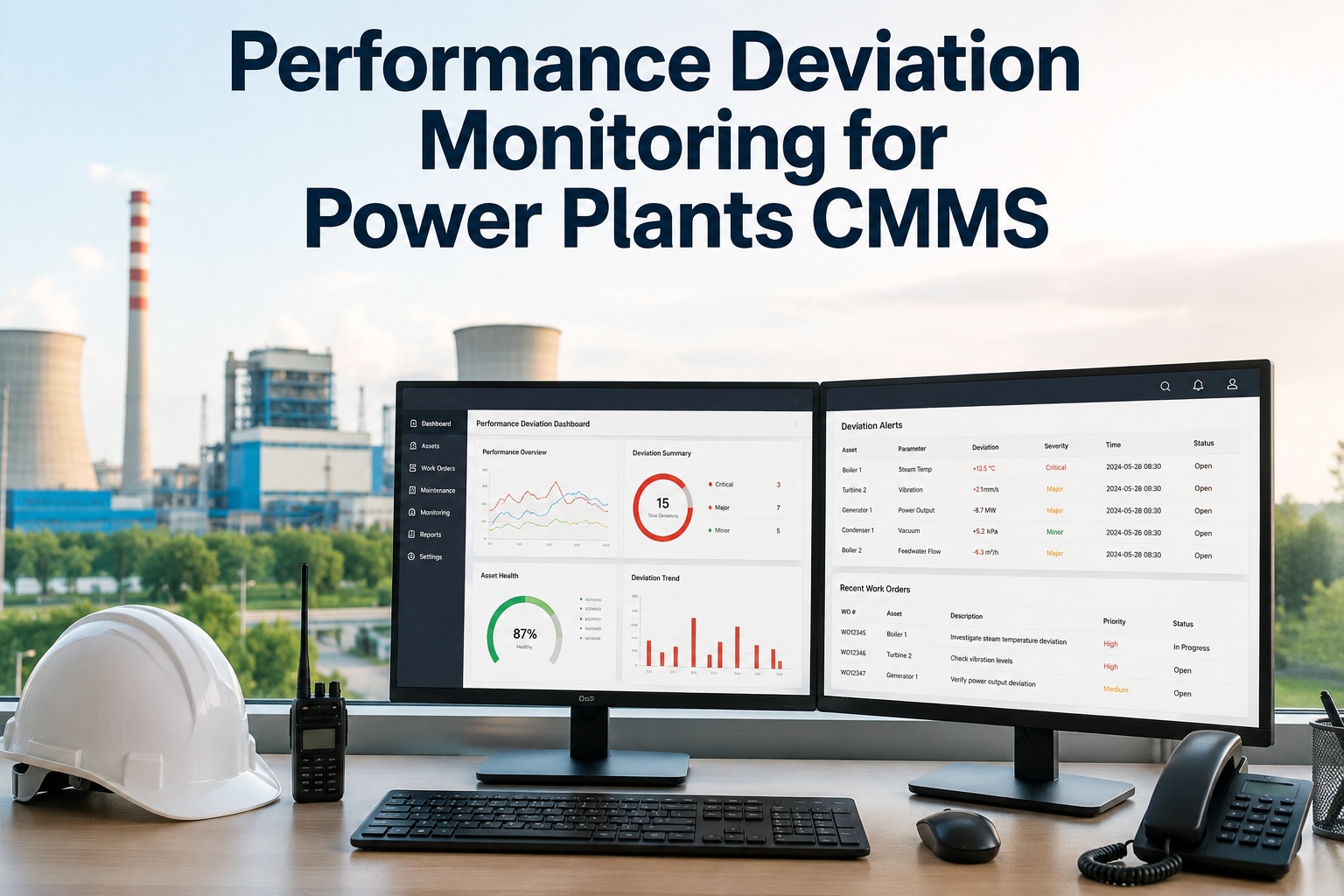
Overall Equipment Effectiveness was built for manufacturing lines where a stopped machine means zero output — but power plant operations demand a different lens. A gas turbine running at 85 percent of rated capacity due to a compressor fouling issue, a coal unit derated by 40 MW because of a forced outage that maintenance could not prevent, or a combined-cycle plant cycling off peak because its heat rate has drifted 3 percent above dispatch economics — these are OEE failures hiding behind operational labels. The International Electrotechnical Commission and NERC have developed power-generation-specific equivalents — Equivalent Availability Factor, Equivalent Forced Outage Rate, and Net Capacity Factor — that map directly to OEE's three pillars of Availability, Performance, and Quality. The plants that improve fastest are not the ones that track the most metrics — they are the ones that link every KPI back to a specific maintenance action in their CMMS and close the loop between data and decision. Start a free OxMaint trial to see how a CMMS-driven OEE dashboard works for power generation, or book a 30-minute demo with a specialist.
OxMaint · Power Plant OEE Intelligence
OEE for Power Plants: Availability, Performance, and Quality KPIs That Actually Drive Decisions
From EAF and EFOR to net capacity factor — every KPI your plant needs, tracked in one CMMS dashboard with maintenance actions linked to every metric.
The Framework
How OEE Maps to Power Generation — The Three Pillars
Manufacturing OEE uses Availability × Performance × Quality. Power plants use the same logic under different names — but the cause-and-effect chain is identical. A failure in any pillar reduces the MWh your plant actually delivers versus what it was capable of delivering.
Pillar 1
Availability
Manufacturing: % time equipment is not down for maintenance or failure
Power Plant Equivalent
Equivalent Availability Factor (EAF) — percentage of period hours the unit was available to generate at any capacity, accounting for planned and unplanned outages
EAF
EFOR
Forced Outage Hours
Planned Outage Factor
World ClassEAF above 92%
Industry AvgEAF 85–91%
UnderperformingEAF below 82%
Pillar 2
Performance
Manufacturing: actual output rate vs rated output rate during operating time
Power Plant Equivalent
Net Capacity Factor and Derating Hours — actual MWh generated versus what the unit was capable of generating at full rated output during available hours
Net Capacity Factor
Derating Hours
Heat Rate Deviation
Load Factor
World ClassLess than 2% capacity derating
Industry Avg3–6% derating loss
UnderperformingAbove 8% derating loss
Pillar 3
Quality
Manufacturing: % of output that meets specification vs total output produced
Power Plant Equivalent
Emission Compliance Rate and Grid Code Conformance — percentage of operating hours the plant met all permit, grid code, and performance guarantee requirements
NOx / SO₂ Compliance %
Grid Code Conformance
Heat Rate vs Guarantee
Power Quality Factor
World Class99.5%+ emission compliance
Industry Avg97–99% compliance rate
UnderperformingBelow 96% — penalty exposure
Key Metrics Explained
EAF, EFOR, and NERC Reliability Metrics — What Each One Measures
NERC's Generating Availability Data System defines the reliability metrics that utilities and independent power producers report. Each metric isolates a different dimension of plant performance — and each one points to a specific category of maintenance action when it deteriorates.
EAF
Equivalent Availability Factor
= (Available Hours − Equivalent Derated Hours) ÷ Period Hours × 100
The primary availability metric. Accounts for both full and partial outages by converting derated capacity periods into equivalent full-outage hours. A unit running at 80% capacity for 10 hours counts as 2 hours of equivalent forced outage.
Target: Above 90% for baseload units
Drops when: Forced outages, extended planned maintenance, hot starts that damage equipment
EFOR
Equivalent Forced Outage Rate
= (Forced Outage Hours + Equivalent Forced Derated Hours) ÷ (Service Hours + Forced Outage Hours) × 100
The single most important reliability metric in most power purchase agreements and capacity market performance requirements. Directly measures unplanned failure rate. High EFOR is the clearest signal that preventive maintenance is failing.
Target: Below 3% for combined-cycle, below 5% for coal
Drops when: PM compliance falls, aging equipment lacks condition monitoring, spare parts are unavailable
POF
Planned Outage Factor
= Planned Outage Hours ÷ Period Hours × 100
Measures the fraction of total time consumed by scheduled maintenance. A high POF is not automatically bad — but a POF that grows year-over-year signals that planned maintenance scope is expanding due to deferred work or equipment condition deterioration.
Target: 6–10% for annual maintenance cycle plants
Drops when: Work scope expands due to deferred PM, outage execution extends beyond plan
NCF
Net Capacity Factor
= Actual Net MWh Generated ÷ (Nameplate Capacity × Period Hours) × 100
Measures how much of the plant's theoretical maximum energy the unit actually delivered. Captures both availability losses and performance degradation in a single revenue-linked number. Declining NCF without a corresponding availability change signals performance degradation.
Target: Varies by plant type and dispatch profile
Drops when: Heat rate degrades, compressor or turbine fouling, emissions limit generation
SAIDI
System Average Interruption Duration
= Sum of (Customer Interruption Durations) ÷ Total Customers Served
Used by regulated utilities and grid operators to measure the impact of generation failures on end-user service reliability. Generation plants that feed directly into constrained transmission nodes carry SAIDI penalties when they fail unexpectedly — making plant EFOR a grid reliability metric, not just an internal KPI.
Target: Varies by regulatory jurisdiction
Drops when: Unexpected outages at constrained grid nodes during peak demand periods
HR Dev
Heat Rate Deviation
= (Actual Heat Rate − Design Heat Rate) ÷ Design Heat Rate × 100
The performance KPI that maps most directly to fuel cost. A 3% heat rate degradation on a 500 MW gas plant burning $8/MMBtu fuel costs approximately $2.1M per year in additional fuel spend. Heat rate deviation is OEE's performance pillar translated directly into dollars.
Target: Less than 2% deviation from design baseline
Drops when: Compressor fouling, turbine blade erosion, HRSG fouling, condenser tube scaling
Revenue Impact
What Each 1% OEE Improvement Is Worth — In Actual Revenue
Abstract percentages become compelling when translated to dollars. The table below shows the annual revenue impact of a 1-percentage-point improvement in each OEE pillar, calculated for three common plant types at current market prices. These are the numbers your CFO needs to approve a CMMS investment.
Combined-Cycle Gas (500 MW)
+1% EAF (Availability)
~$1.75M/yr
−1% Heat Rate Deviation
~$2.1M/yr
+1% Emission Compliance
~$180K/yr
Coal Steam Unit (600 MW)
+1% EAF (Availability)
~$1.95M/yr
−1% Heat Rate Deviation
~$2.6M/yr
+1% Emission Compliance
~$220K/yr
Simple Cycle Peaker (150 MW)
+1% EAF (Availability)
~$380K/yr
−1% Heat Rate Deviation
~$460K/yr
+1% Emission Compliance
~$55K/yr
Values calculated using $55/MWh average power price, $8/MMBtu gas fuel cost, 8,000 operating hours per year. Actual values vary with market conditions, dispatch profile, and plant-specific contracts.
OxMaint CMMS Dashboard
Your OEE KPIs Should Drive Maintenance Work Orders — Not Just Reports
OxMaint links EAF, EFOR, heat rate deviation, and PM compliance into a single dashboard — and turns every deteriorating KPI into an automatic maintenance action before it becomes a forced outage.
EFOR Deep Dive
Why EFOR Is the Most Important Number in Your Maintenance Program
EFOR tells you exactly how much of your plant's failure risk is unplanned and uncontrolled. It is the metric that capacity market operators, off-takers, and insurance underwriters use to assess plant reliability — and it is the one most directly controlled by maintenance quality.
What Drives EFOR Higher
01
Missed or Deferred Preventive Maintenance
Every deferred PM shifts a manageable degradation into an unpredictable failure. EFOR rises as PM compliance falls — the correlation is consistent across NERC reliability data spanning decades.
02
No Condition-Based Monitoring
Plants without vibration analysis, oil sampling, or thermographic inspection programs are flying blind. Rotating equipment failures that condition monitoring catches weeks early show up as forced outages when the data is not being collected.
03
Spare Parts Not Staged for Critical Assets
A forced outage that could be repaired in 8 hours extends to 72 hours because the replacement part is on a six-week lead time. EFOR is not just a maintenance planning failure — it is a supply chain failure that a CMMS-linked inventory system prevents.
04
Repeat Failures Without Root Cause Closure
The same bearing, seal, or control component failing every 8 months is not bad luck — it is an unclosed failure mode. Without a CMMS that tracks failure history and triggers root cause analysis work orders, EFOR contributions recycle indefinitely.
EFOR Performance Zones
0 – 2%
World Class
Best-in-class combined-cycle and nuclear fleet performance. Achieved through rigorous PM compliance and real-time condition monitoring.
2 – 4%
Good
Above industry average. Consistent PM program in place but likely gaps in condition-based monitoring or spare parts readiness.
4 – 7%
Industry Average
Most NERC-reporting thermal units fall in this band. Represents significant revenue and reliability improvement opportunity.
Above 7%
Underperforming
Capacity market penalty exposure. Off-taker contract breach risk. Insurance premium impact. Maintenance program restructuring required.
OxMaint EFOR Tracking
OxMaint calculates your rolling EFOR automatically from work order timestamps — forced outage start, return to service, derated capacity period, and root cause code — and projects your EFOR trajectory against your capacity market compliance threshold 90 days out.
See EFOR tracking live in a demo
CMMS Connection
How OxMaint Connects OEE KPIs to Maintenance Actions
The gap between knowing your EAF is 87% and actually improving it is a maintenance workflow problem. OxMaint closes that gap by linking every KPI threshold breach to a specific work order — so the system acts on deteriorating OEE, not just reports it.
1
KPI Threshold Configured
Plant sets target and alert threshold for each OEE metric — EAF, EFOR, heat rate deviation, PM compliance rate, mean time between failures. Thresholds can be set by unit, by asset class, or plant-wide.
2
Live Data Feeds CMMS
OxMaint ingests operating data from DCS, SCADA, PI historian, and manual technician entries. Every forced outage, derating event, and PM completion updates the OEE scorecard in real time — not at month-end.
3
Threshold Breach Triggers Action
When EFOR crosses 4% or heat rate deviation exceeds 2%, OxMaint automatically creates a corrective work order — pre-assigned to the correct maintenance team with the relevant asset history, failure mode library, and spare parts checklist attached.
4
Root Cause Captured at Closure
Every work order closure requires a root cause code and corrective action summary. This data feeds the EFOR calculation directly — turning repair history into trend analysis that predicts the next failure before it happens.
5
OEE Dashboard Updates Automatically
Plant manager, reliability engineer, and CFO all see the same live OEE scorecard. Monthly NERC GADS reporting data exports directly from OxMaint — no separate manual compilation step required.
Benchmark Data
Power Plant OEE Benchmarks by Technology Type
OEE targets are not universal — a peaking unit that runs 1,200 hours per year has very different availability economics than a baseload combined-cycle plant dispatched for 7,500 hours. The benchmarks below are derived from NERC GADS data and EPRI reliability surveys and should be used as reference targets for your maintenance planning process.
| Plant Technology |
Target EAF |
Target EFOR |
Target Heat Rate Dev. |
Typical Annual Hours |
Key OEE Risk |
| Combined-Cycle Gas |
Above 91% |
Below 3% |
Below 1.5% |
6,000–8,000 hrs |
Compressor fouling, HRSG tube failure |
| Coal Steam (PC) |
Above 88% |
Below 5% |
Below 2.0% |
5,000–8,000 hrs |
Boiler tube leaks, FGD system failures |
| Simple Cycle Gas (Peaker) |
Above 94% |
Below 4% |
Below 2.5% |
800–2,500 hrs |
Hot section inspection intervals, starts-based maintenance |
| Nuclear (PWR / BWR) |
Above 93% |
Below 1.5% |
Below 0.5% |
7,500–8,600 hrs |
Refueling outage scope, RCP and valve maintenance |
| Hydro (Conventional) |
Above 95% |
Below 2% |
N/A |
Dispatch-dependent |
Runner cavitation, generator winding degradation |
| Biomass / Waste-to-Energy |
Above 82% |
Below 8% |
Below 3.5% |
7,000–8,000 hrs |
Boiler fouling, grate and feed system maintenance |
FAQ
Frequently Asked Questions
Is OEE the same as EAF, or are they different metrics?
OEE is a three-factor composite — Availability × Performance × Quality. EAF is the power-generation-specific measure of the Availability factor only. EAF does not capture performance degradation (heat rate drift, derating) or quality losses (emission non-compliance). A plant can have high EAF but poor overall OEE if it is running at derated capacity with deteriorating heat rate.
Book a demo to see how OxMaint tracks all three OEE factors simultaneously.
How does OxMaint calculate EFOR automatically from work order data?
When a forced outage work order is created, OxMaint records the exact timestamp of the outage start and the return-to-service confirmation. Derating events are logged with capacity reduction percentage and duration. The EFOR formula applies automatically — so your rolling EFOR is always current without manual calculation. Work order root cause codes feed the EFOR analysis by failure mode, showing you which systems contribute most to your forced outage rate.
Start a free trial to configure EFOR tracking for your unit.
What data does OxMaint need to build an OEE dashboard for a power plant?
At minimum: unit nameplate capacity, period hours, forced and planned outage timestamps, derated capacity events, and PM work order completion records. Optional but high-value additions include DCS heat rate data, CEMS emission readings, and PI historian integration for real-time KPI feeds. OxMaint can build a meaningful OEE baseline from work order history alone while richer integrations are configured in parallel.
Book a demo to discuss your plant's data environment.
How does improving PM compliance directly improve EFOR?
NERC reliability studies show that plants with PM compliance above 95% run EFOR rates 30 to 50 percent lower than plants with PM compliance below 80%. Each deferred PM extends the window during which an equipment failure can occur unexpectedly. OxMaint tracks PM compliance rate as a leading indicator — showing you the EFOR risk building in your backlog before a forced outage occurs.
Start free to track PM compliance and project its EFOR impact.
Can OxMaint export OEE and EFOR data for NERC GADS reporting?
Yes. OxMaint structures outage and derating event records in alignment with NERC GADS event types and cause codes. Monthly and annual GADS report data exports directly from the platform in the required format, eliminating the separate spreadsheet-building step that most reliability engineers currently spend 2 to 4 days on each reporting cycle.
Book a demo to see the GADS export workflow.
OxMaint OEE Intelligence
Every Percentage Point of EAF You Are Missing Is Revenue Already Lost. Start Recovering It.
OxMaint gives your plant a live OEE dashboard — EAF, EFOR, heat rate deviation, and PM compliance tracked automatically from your maintenance data, with NERC GADS reporting built in and KPI-triggered work orders that act on deteriorating performance before it becomes a forced outage.