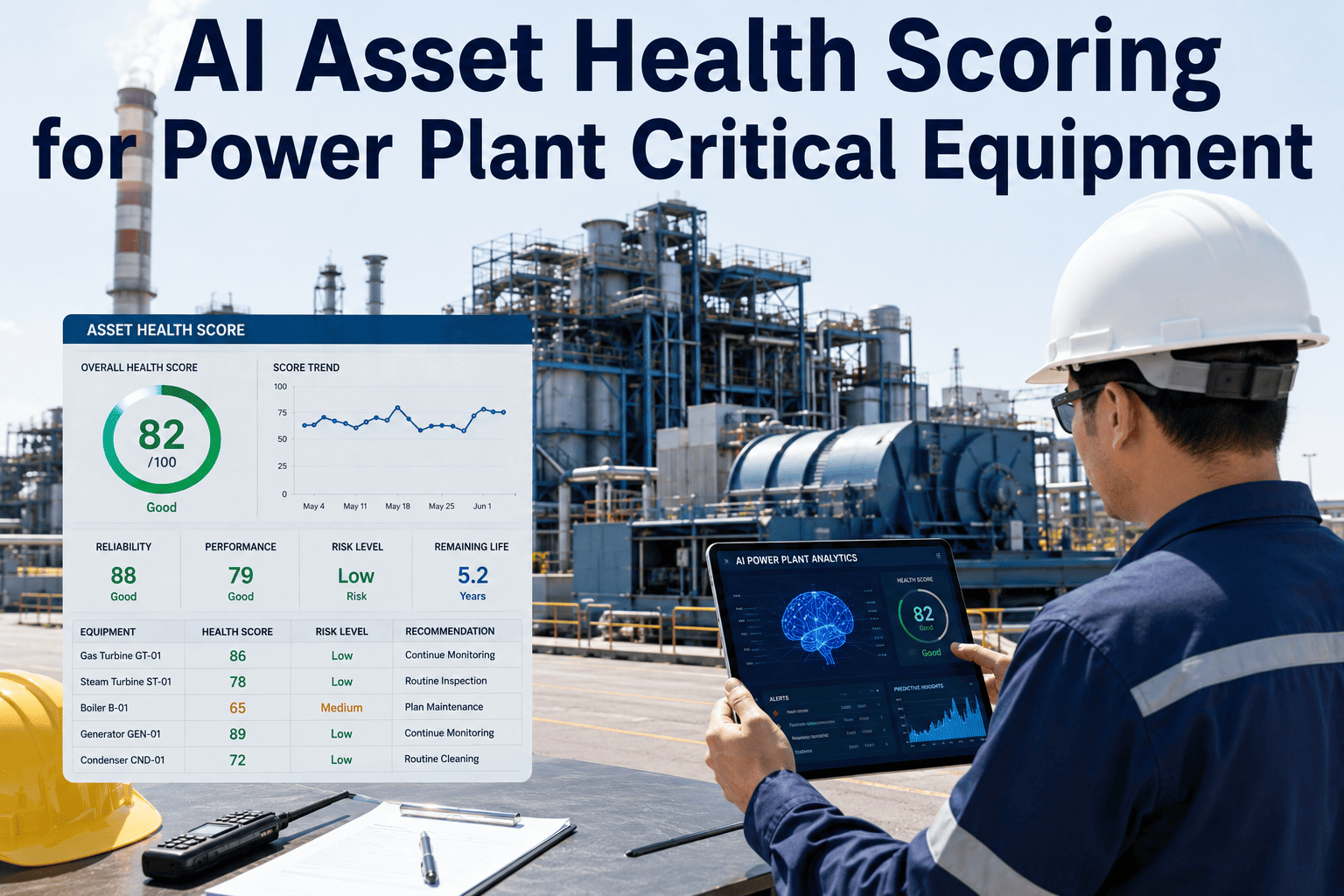
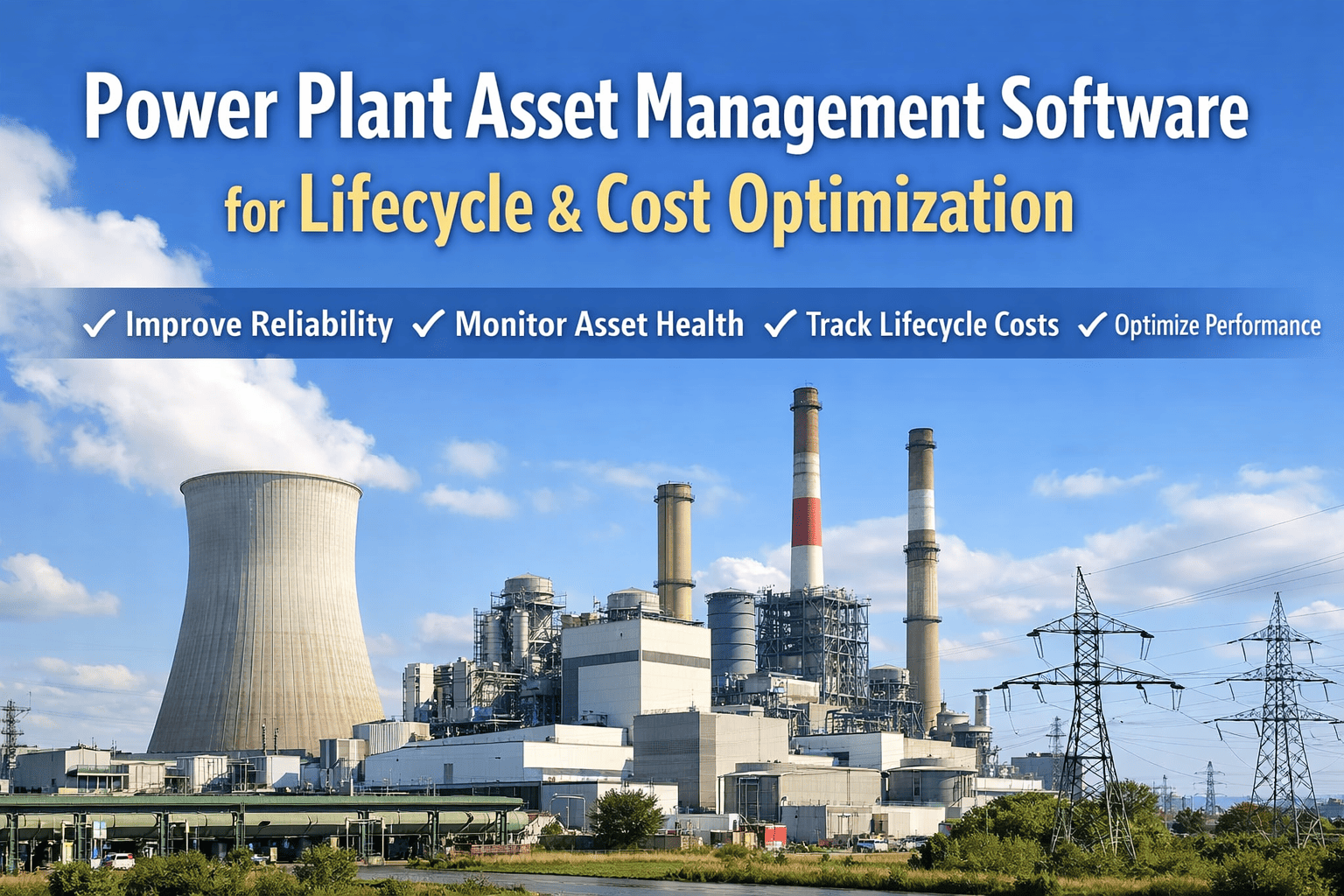
Power plants run on margins measured in milliseconds and megawatts — a single unplanned turbine trip costs an average of $1.4 million in lost generation revenue, emergency labor, and expedited parts. Asset performance management (APM) software closes the gap between what your maintenance teams know and what your assets are actually telling you, giving operations leaders real-time health scores, predicted failure windows, and audit-ready documentation across every generator, transformer, boiler, and cooling system in the plant. Book a demo to see how Oxmaint delivers full lifecycle APM for power generation operations.
$1.4M
Average cost of a single unplanned turbine outage
62%
Of power plant failures are predictable with condition monitoring
3.2x
Typical ROI on APM investment within first 18 months
78%
Reduction in reactive work orders after APM deployment
The Core Problem
Why Power Plants Operate Blind Without APM
Most power generation facilities carry thousands of critical assets — rotating equipment, electrical infrastructure, civil structures, and control systems — each with its own inspection schedule, failure mode profile, and compliance requirement. Without a unified APM layer, that data lives in siloed CMMS exports, paper inspection sheets, and the tacit knowledge of engineers who have been with the plant for twenty years. When those engineers retire, the institutional memory goes with them.
01
Reactive Maintenance Spiral
Plants without structured APM spend 60–75% of their maintenance budget reacting to failures rather than preventing them. Every reactive repair displaces a planned activity, creating a compounding backlog that erodes plant availability quarter over quarter.
02
Fragmented Asset Health Data
Vibration data sits in one system, thermal imaging in another, work order history in a third. Without integration, engineers spend more time compiling reports than analyzing trends — and the analysis that matters most happens too late to prevent the failure it would have predicted.
03
Compliance Exposure at Audit
NERC CIP, OSHA Process Safety Management, and state environmental permits all demand traceable inspection records. Plants relying on spreadsheets routinely enter audits with incomplete documentation, resulting in findings, corrective action plans, and in some cases, consent orders with financial penalties.
04
Accelerating Asset Age
The average U.S. thermal power plant is 31 years old. Legacy assets demand more frequent condition assessments, tighter failure mode libraries, and proactive life extension planning — capabilities that reactive, calendar-based maintenance programs cannot deliver at the required resolution.
Full Lifecycle View
The APM Lifecycle for Power Generation Assets
Effective APM is not a maintenance tool — it is an asset decision engine that spans commissioning, steady-state operation, condition-based intervention, and end-of-life planning. Each phase produces data that feeds the next, creating a continuous improvement loop that lowers cost and extends asset life simultaneously.
Phase 01
Asset Registry and Baseline Establishment
Every asset is catalogued with nameplate data, original equipment manufacturer (OEM) specifications, criticality classification, and baseline health scores. Failure mode and effects analysis (FMEA) templates are assigned by asset class — turbines, transformers, pumps, valves, and heat exchangers each carry a distinct risk profile that drives inspection frequency and alert thresholds.
Phase 02
Condition Monitoring and Real-Time Health Scoring
Sensor feeds, manual inspection findings, and predictive diagnostics are aggregated into a live health score for each asset. Engineers see which assets are degrading faster than expected, which are approaching maintenance thresholds, and which carry elevated failure risk — all on a single dashboard without switching between systems.
Phase 03 — Critical Window
Predictive Intervention and Failure Prevention
When an asset's health score drops below a configurable threshold or when a condition parameter crosses a defined limit, the APM system automatically generates a prioritized work order, assigns it to the appropriate crew, and escalates if acknowledgment is not received within the defined response window. The difference between a scheduled repair and an emergency replacement is typically measured in weeks — not hours.
Phase 04
Lifecycle Cost Analysis and Capital Planning
APM data feeds directly into capital investment decisions. Replacement vs. refurbishment analysis, risk-adjusted maintenance cost projections, and asset remaining useful life estimates are all generated from operational data — giving plant managers and CFOs the evidence base they need to justify capital budget requests to boards and regulators.
See Full Lifecycle APM in Action for Your Plant
From turbine health scoring to audit-ready compliance exports — Oxmaint gives power plant operations teams complete asset visibility from a single mobile-first platform. Deployments are live in 8–12 weeks.
Platform Capabilities
What Oxmaint APM Delivers for Power Plant Operations
Purpose-built for high-criticality industrial environments, Oxmaint APM combines automated scheduling, mobile field documentation, predictive health scoring, and compliance export in a single platform that field crews and control room engineers both use daily.
Automated PM Scheduling
Work orders are auto-generated by asset class, criticality tier, and operating hours — not calendar date. Escalating alerts at 30, 14, and 7 days ensure no inspection window is missed. High-criticality assets like main power transformers and hydrogen-cooled generators carry mandatory supervisor sign-off before closure.
Mobile Offline Field App
Field engineers capture findings, photos, meter readings, and GPS confirmation with full offline capability — critical in substation environments and plant areas with signal interference. Records sync automatically on reconnection, with timestamp and inspector attribution preserved for audit purposes.
Asset Health Dashboard
A real-time view of health scores, open work orders, and approaching thresholds across every asset in the plant hierarchy — from individual pump seals to complete unit trains. Plant managers can drill from fleet-level compliance to individual asset history in three clicks.
Failure Mode Libraries
Pre-configured FMEA templates for power generation asset classes — turbines, generators, boilers, condensers, cooling towers, transformers, and switchgear — with editable failure codes, consequence severity ratings, and recommended inspection tasks aligned to OEM specifications and industry standards.
Compliance Documentation Export
Audit-ready reports with timestamped findings, inspector attribution, photo attachments, and digital sign-off — exportable for NERC, OSHA PSM, ISO 55001, and state environmental compliance reviews. Documentation that previously required 18 staff-days of compilation is produced in under 4 hours.
Cross-Unit Maintenance Analytics
Maintenance cost per megawatt-hour, mean time between failure by asset class, planned vs reactive work order ratio, and labor utilization by crew — all calculated from operational data without manual reporting. Analytics that give plant managers the evidence to defend maintenance budget decisions at every level.
Performance Comparison
Before and After APM: What the Numbers Look Like
The following benchmarks are drawn from power generation facilities that transitioned from calendar-based, paper-documented maintenance programs to structured APM operations using Oxmaint over a 12–18 month period.
| Performance Metric |
Without APM |
With Oxmaint APM |
| Unplanned downtime per year |
12–18 days per unit |
3–5 days per unit |
| Mean time to detect failure |
4–6 hours post-event |
Under 20 minutes, pre-event |
| Maintenance cost as % of RAV |
4.5–6% annually |
2.1–2.8% annually |
| Asset utilization rate |
68–74% |
88–94% |
| Compliance audit preparation |
18 staff-days per audit |
4 staff-days per audit |
| Reactive vs planned work ratio |
65% reactive / 35% planned |
18% reactive / 82% planned |
| Average asset lifespan extension |
Baseline (no extension program) |
+15–22% through condition-based care |
| PM compliance rate |
58–67% across asset classes |
96–99% at 14 months |
$284K
Typical deployment investment including training
→
$1.7M
Annual operational savings in year one
→
2.1 months
Payback period from first prevented failure event alone
Ready to Move from Reactive to Predictive Maintenance?
Oxmaint APM deploys across your full asset inventory in 8–12 weeks — no rip-and-replace of your existing CMMS, no heavy IT implementation. Full compliance documentation and real-time health dashboards from day one.
Standards and Frameworks
APM Compliance Coverage for Power Generation
Power generation facilities operate under overlapping compliance frameworks from federal regulators, grid operators, and environmental agencies. Oxmaint APM is designed to produce documentation that satisfies each framework from the same field data capture — without separate reporting workflows for each authority.
NERC CIP
Critical Infrastructure Protection standards require traceable maintenance records for cyber-physical assets including control systems and protection relays. Oxmaint provides timestamped, inspector-attributed records with mandatory sign-off for CIP-scoped assets.
OSHA PSM (29 CFR 1910.119)
Process Safety Management requires mechanical integrity documentation for pressure vessels, boilers, piping, and relief systems. Oxmaint automates inspection scheduling, captures findings at element level, and produces the audit trail PSM compliance reviews require.
ISO 55001
The international asset management standard requires documented lifecycle planning, performance monitoring, and continual improvement processes. Oxmaint's analytics and maintenance history records map directly to ISO 55001 clause requirements without additional reporting.
EPA / State Environmental
Environmental compliance inspections for cooling water systems, stack emission controls, ash handling equipment, and wastewater treatment assets require documented maintenance records. Oxmaint's compliance export supports state permit conditions and EPA consent agreement documentation.
"Our State Bridge Engineer had no real-time visibility before deployment. The first automated alert caught active section loss seven days before deadline. That single event made clear exactly what the prior system had cost us in risk exposure for years."
Director of Maintenance Operations
Mid-Atlantic State Infrastructure Agency
Frequently Asked Questions
APM for Power Plants: Common Questions
QHow does APM software differ from a standard CMMS for power plant use?
QWhat asset types does Oxmaint APM support in a power generation environment?
Oxmaint supports all major power generation asset classes including steam turbines, gas turbines, generators, main and auxiliary transformers, boilers, heat exchangers, condensers, cooling towers, pumps, compressors, switchgear, control and protection systems, and civil infrastructure. Each asset class carries configurable FMEA templates, inspection frequencies, and failure consequence ratings aligned to OEM and industry standards.
Start a free trial to explore asset templates for your plant configuration.
QHow long does deployment take for a plant with thousands of assets?
Most power generation deployments are live across all units and asset classes within 8–12 weeks, including asset registry import from existing NBI or CMMS data, inspection template configuration, crew training, and compliance dashboard activation. The deployment does not require replacing existing plant systems — Oxmaint integrates alongside SCADA, historian, and CMMS platforms already in place.
Book a demo to build a deployment timeline for your facility.
QHow does Oxmaint APM handle compliance documentation for multiple regulatory frameworks simultaneously?
Field data captured once in Oxmaint — findings, photos, meter readings, inspector attribution, and GPS confirmation — is automatically structured to meet the documentation requirements of NERC CIP, OSHA PSM, ISO 55001, and state environmental compliance frameworks without separate data entry for each. Export formats are configured per regulatory authority, and audit packages for 100+ assets are produced in under 4 hours.
Start a free trial to see the compliance export configuration for your regulatory obligations.
QWhat does the ROI case look like for a mid-size power plant?
For a 500–1,000 MW facility, preventing one major unplanned turbine trip — typically costing $1.2–$1.8 million in lost generation and emergency repair — recovers the full annual APM platform investment in a single event. Beyond failure prevention, plants consistently report 60–75% reductions in audit preparation labor and 15–22% extension of asset service life through condition-based maintenance, both of which compound year over year.
Book a demo to model the APM ROI for your plant's specific asset base and capacity profile.
Full Asset Visibility. Zero Missed Inspections. One Platform for Every Compliance Framework.
Power plant operations teams using Oxmaint APM reach 96–99% PM compliance within 14 months, cut audit preparation time by 74%, and produce the documentation trail that keeps federal and state regulatory relationships clean. Your asset inventory is the starting point — deployment is live in under 12 weeks.