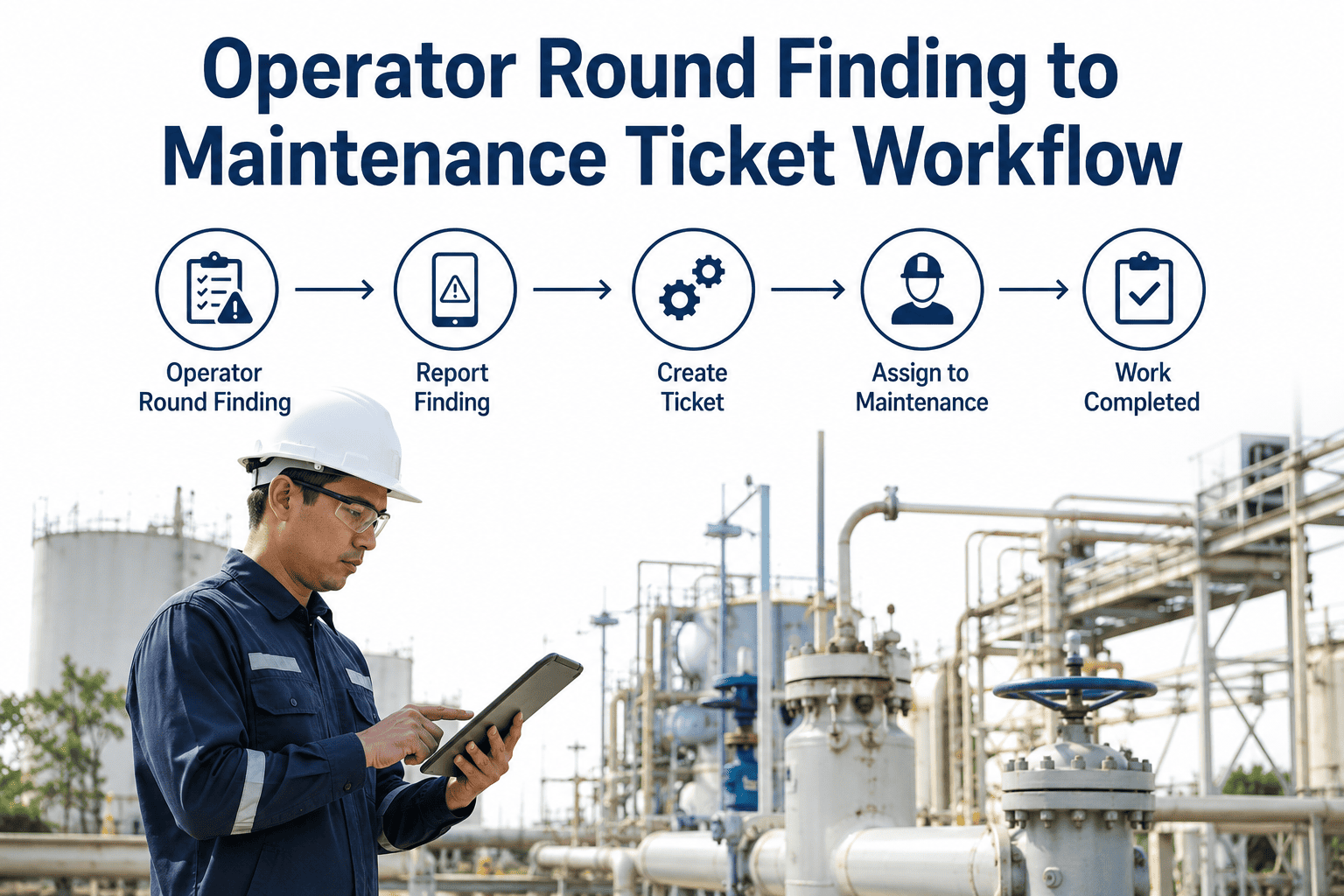
Operator rounds are the earliest warning system in any power plant — a trained eye walking the equipment corridor at 06:00 will detect a bearing running warm, a seal weeping, or a vibration developing long before any DCS alarm fires. The problem is not that operators miss findings; it is that findings captured on paper rounds sheets, radio calls, or shift handover notes take 4 to 48 hours to become maintenance tickets — and in that window, a manageable repair becomes an emergency. Oxmaint's Work Order Management closes this gap by converting a mobile round observation directly into a structured maintenance ticket in under 60 seconds, with asset context, priority classification, and photographic evidence already attached.
Work Order Management
Operator Rounds
Power Plant CMMS
Operator Round Finding to Maintenance Ticket Workflow
Every round finding deserves a ticket. Oxmaint turns a mobile field observation into a structured, routed maintenance work order in under 60 seconds — before the shift ends.
48 hrs
Average delay from paper round finding to maintenance ticket in plants without digital rounds
60 sec
Time to create a structured, routed maintenance ticket from a mobile round observation in Oxmaint
35%
Of paper round findings never become maintenance tickets — they are lost at shift handover
2.8x
More findings captured per shift when operators use mobile round apps vs. paper
The Gap
Where Round Findings Go Missing — The Paper-to-Ticket Problem
The operational gap between field observation and maintenance action is well documented in power generation. A 2022 survey of thermal plant operations teams across India found that 35% of all paper round findings never generated a maintenance ticket. The reasons are predictable.
06:00
Round Finding Captured
Operator notes bearing temperature 8°C above normal on BFP-2 in the paper round log
14:00
Shift Handover
Finding mentioned verbally — incoming operator does not create a ticket, intends to monitor
22:00
Second Handover
Paper log not reviewed, verbal finding lost — no ticket exists in the CMMS
Next Day
Bearing Failure
BFP-2 trips on high bearing temperature — forced outage, emergency repair, 14 hours lost
With Oxmaint Mobile Rounds — the same scenario
06:04 — Operator logs bearing temperature anomaly in Oxmaint mobile app with photo and reading. A P2 maintenance ticket is auto-generated, assigned to the mechanical team, and visible to the day shift maintenance supervisor before the operator's shift ends. By 08:30 the bearing is greased and temperature confirmed normal. No outage. No emergency repair.
Workflow Architecture
The 5-Step Round Finding to Maintenance Ticket Workflow
Oxmaint's operator round module is purpose-built for power plant field conditions — offline-capable, QR-code asset tagging, and direct ticket generation without returning to the control room or accessing a desktop system.
1
Route Loaded on Mobile
The operator's assigned round route is pre-loaded on their mobile device at shift start — including all equipment checkpoints, required readings, and alert thresholds specific to that unit. No paper, no printed checklist, no login queue at a shared terminal.
2
Asset Tagged at Checkpoint
At each checkpoint, the operator scans the equipment QR code or NFC tag — confirming physical presence at the asset and loading the current reading history, last PM date, and any open work orders for that specific piece of equipment into the round checklist view.
3
Observation Recorded with Evidence
Readings are entered directly; abnormal conditions trigger a finding flag. The operator adds a photo, voice note, or typed description. Oxmaint compares the reading against the asset's alert band — flagging findings that are outside normal range for automatic priority escalation at ticket creation.
4
Maintenance Ticket Auto-Generated
A finding that meets ticket-creation criteria generates a structured maintenance ticket automatically — pre-populated with the asset ID, finding description, operator photo, reading vs. threshold, and a suggested priority based on deviation magnitude. The ticket is routed to the correct maintenance discipline before the operator moves to the next checkpoint.
5
Supervisor Notified — Ticket Visible Immediately
The maintenance supervisor receives the ticket on their mobile device with full context — no follow-up call required, no shift handover gap. P1 findings trigger an immediate push notification to the on-call crew. The operator's round is completed and the finding is in the system before they leave the area.
Finding Classification
How Round Findings Are Prioritized Into Tickets
Not every observation requires an emergency response. Oxmaint classifies round findings into four ticket priorities based on deviation magnitude, equipment criticality, and time-sensitivity — ensuring the right response without over-escalating routine observations.
| Finding Type |
Example |
Ticket Priority |
Response Window |
Notification |
| Safety / Trip Risk |
Rotating equipment guard missing; smoke or burning smell |
P1 — Emergency |
Immediate |
On-call crew paged |
| Operational Limit Breach |
Bearing temp 15°C above normal; seal water flow lost |
P2 — Urgent |
Within 4 hours |
Shift supervisor notified |
| Developing Abnormality |
Vibration trending up; minor oil seep; noise change |
P3 — Scheduled |
Within 48 hours |
Day shift maintenance queue |
| Routine Observation |
Housekeeping; label damaged; reading outside advisory range |
P4 — Planned |
Next PM window |
Maintenance backlog added |
Stop losing round findings at shift handover
Oxmaint converts every field observation into a structured maintenance ticket before the operator leaves the equipment area — with photo evidence, priority, and routing already attached.
Expert Review
What Operations Leaders Say About Digital Round Workflows
The most underrated maintenance intervention in a power plant is not a better PM program or a new predictive sensor — it is the time from field observation to maintenance ticket. Every hour that gap exists, a finding that could have been a planned repair has a chance to become a forced outage. Digital round workflows that create the ticket at the point of observation, with evidence and priority pre-assigned, eliminate that gap entirely. In our operational experience across thermal plants in India, the switch from paper rounds to mobile round apps with direct CMMS ticket creation reduced breakdown-from-missed-finding events by over 60% in the first six months.
60%
Reduction in breakdown-from-missed-finding events reported by plants after digital round deployment
2.8x
More findings captured per shift on mobile vs. paper — operators record what they would otherwise not bother to write
INR 12–35L
Estimated annual avoided emergency repair cost per 100 MW unit from faster finding-to-ticket conversion
FAQ
Frequently Asked Questions
Can operators use Oxmaint mobile rounds without a smartphone — on shared plant devices or ruggedized tablets?
Yes. Oxmaint's mobile round module runs on Android and iOS smartphones as well as ruggedized tablets used in plant environments. The app is also accessible via browser on shared control room terminals for operators who prefer to complete the round digitally at a fixed station. QR code scanning for asset tagging works on any device with a rear camera.
Start free and install the app on your team's existing devices today.
What happens to round findings if the operator loses mobile signal in the plant?
Oxmaint mobile rounds support full offline operation. The round route, asset checkpoints, reading history, and alert thresholds all sync to the device before the operator enters the field. All observations, photos, and readings recorded without connectivity sync automatically when the device reconnects — which typically happens when the operator returns to the control room area. No findings are lost to connectivity gaps.
Book a demo to test the offline mode in a simulated plant environment.
How are round route completeness and operator compliance tracked?
Oxmaint tracks round completion at three levels: checkpoint level (was each asset scanned and reading entered), route level (percentage of checkpoints completed per round), and shift level (how many rounds were completed on schedule vs. late or missed). Supervisors see this data in real time on the maintenance dashboard. Incomplete rounds generate an automatic flag to the shift supervisor — not a punitive escalation, but a prompt to identify whether the operator encountered a finding that interrupted the round.
Explore the round compliance dashboard in Oxmaint.
Can operators add unplanned checkpoints — equipment not on the pre-loaded route?
Yes. Operators can scan any QR-tagged asset in the plant and record an ad-hoc observation, even if that asset is not on their current round route. The finding is logged as an off-route observation and generates a maintenance ticket through the same classification and routing logic as a route-based finding. This ensures that equipment noticed incidentally during a round — not just the formal route assets — also generates tickets when warranted.
Book a demo to see how ad-hoc observations are tracked separately from route compliance metrics.
How long does it take to configure Oxmaint round routes for a new plant?
A standard thermal plant round configuration — equipment import, checkpoint setup, alert threshold definition, and QR tag printing — takes 3 to 5 working days with Oxmaint's onboarding support. If the plant already has an equipment list in spreadsheet or CMMS format, asset import is automated and the configuration timeline is typically under 3 days.
Start free and use the guided onboarding wizard to configure your first round route without specialist support.
Every finding. Every shift. Every ticket — before the shift ends.
Oxmaint's operator round module converts field observations to structured maintenance tickets in under 60 seconds — with evidence, priority, and routing already attached, accessible to the maintenance team before the operator moves to the next checkpoint.