In 1992, OSHA created 29 CFR 1910.119 — the Process Safety Management standard — after a series of catastrophic industrial incidents that shared one common failure: equipment was started up before it was verified as safe. The Pre-Startup Safety Review (PSSR) is the mandatory gate this standard placed between construction completion and first startup. For power plants, a PSSR is not optional paperwork. It is the final structured checkpoint that confirms every system — mechanical, electrical, instrumentation, procedural, and human — is ready before energy is introduced. A missed interlock, an untrained operator, or a relief valve not yet calibrated can each cause the kind of incident that ends careers and shuts plants. This template library gives power plant reliability engineers, HSE managers, and operations leads a complete, OSHA-compliant PSSR framework for every major modification and new installation scenario — stored, tracked, and closed in Oxmaint CMMS with full audit trail, or book a 30-minute walkthrough with our process safety team.
PSSR Fundamentals
What a PSSR Is — And What It Is Not
A PSSR IS
The final field verification that construction matches approved design
A mandatory gate before hazardous energy or substances are introduced
A check that procedures are written, current, and operator-trained
A confirmation that all PHA and MOC action items are closed
A documented, signed record retained as part of the PSM programme
The only authorised path to startup sign-off — no exceptions
A PSSR IS NOT
A HAZOP — HAZOP identifies risks during design; PSSR confirms controls are installed
A commissioning test — commissioning proves functionality; PSSR proves safety readiness
A formality or rubber stamp — unresolved items must block startup, not be waived
A one-person review — it requires a multi-disciplinary team sign-off
Optional for modifications — any MOC-triggering change requires its own PSSR
Retrospective — it cannot be completed after startup has already occurred
When PSSR Is Required
Trigger Events — What Makes a PSSR Mandatory at a Power Plant
Under OSHA 29 CFR 1910.119(i), a PSSR is mandatory in two scenarios: new facilities, and modified facilities where the modification is significant enough to require a change in process safety information. At a power plant, "significant" covers more than most engineers initially assume.
Always Triggers a PSSR
New unit or facility — initial startup
Turbine major overhaul — rotor, blades, or casing replaced
Boiler tube replacement — more than spot repairs
HV switchgear replacement or addition
DCS upgrade or controller replacement
Safety instrumented system (SIS) modification
Relief valve resizing or setpoint change
New fuel system or fuel type introduction
Heat exchanger replacement — different rating or material
Generator rewinding or excitation system change
Requires Assessment — May Trigger
Like-for-like pump or motor replacement — same rating and spec
Gasket or seal replacement — same material and spec
Instrument calibration — no setpoint change
Lubrication system maintenance — no design change
Minor piping repair — same diameter, material, rating
Software patch — no logic change or setpoint modification
Insulation replacement — same material class
Valve packing replacement — like-for-like
Typically Does Not Trigger
Routine PM tasks within approved procedures
Filter changes — standard consumables
Routine lubrication — no component change
Instrument loop check — no modification
Visual inspections — no intervention
Temporary repairs within existing design limits
Cleaning of heat exchanger surfaces — no change
Track Every PSSR From Trigger to Sign-Off in Oxmaint
Oxmaint CMMS links MOC trigger events to automatic PSSR creation, tracks checklist completion by discipline, and stores signed records against the asset — so your PSM audit trail is complete and retrievable in seconds.
The PSSR Checklist
Power Plant PSSR Checklist — Four OSHA-Mandated Verification Areas
OSHA 29 CFR 1910.119(i) requires PSSR to confirm four specific areas before startup. The checklist below is structured around these four areas, expanded with power plant-specific checks. Every item requires a Yes / No / N/A response with a responsible reviewer signature. Items answered No must be resolved and re-verified before startup authorisation is granted.
Area 1
Construction and Equipment — Per Design Specifications
OSHA 1910.119(i)(1)(i)
All equipment installed per approved P&IDs and isometric drawings
Project Engineer
Pressure relief devices installed, sized, and set per design — ASME documentation complete
Mechanical Eng.
Pressure testing of all piping and vessels completed — hydro test records filed
Project Engineer
All instruments calibrated — loop check records signed and filed
I&C Engineer
Safety interlocks and shutdowns tested and proven functional — test records available
I&C / Safety Eng.
Electrical systems installed, tested, and energised per approved drawings — NFPA 70E verified
Electrical Engineer
Mechanical completion punch list — Category A items (safety-critical) fully closed
Commissioning Mgr.
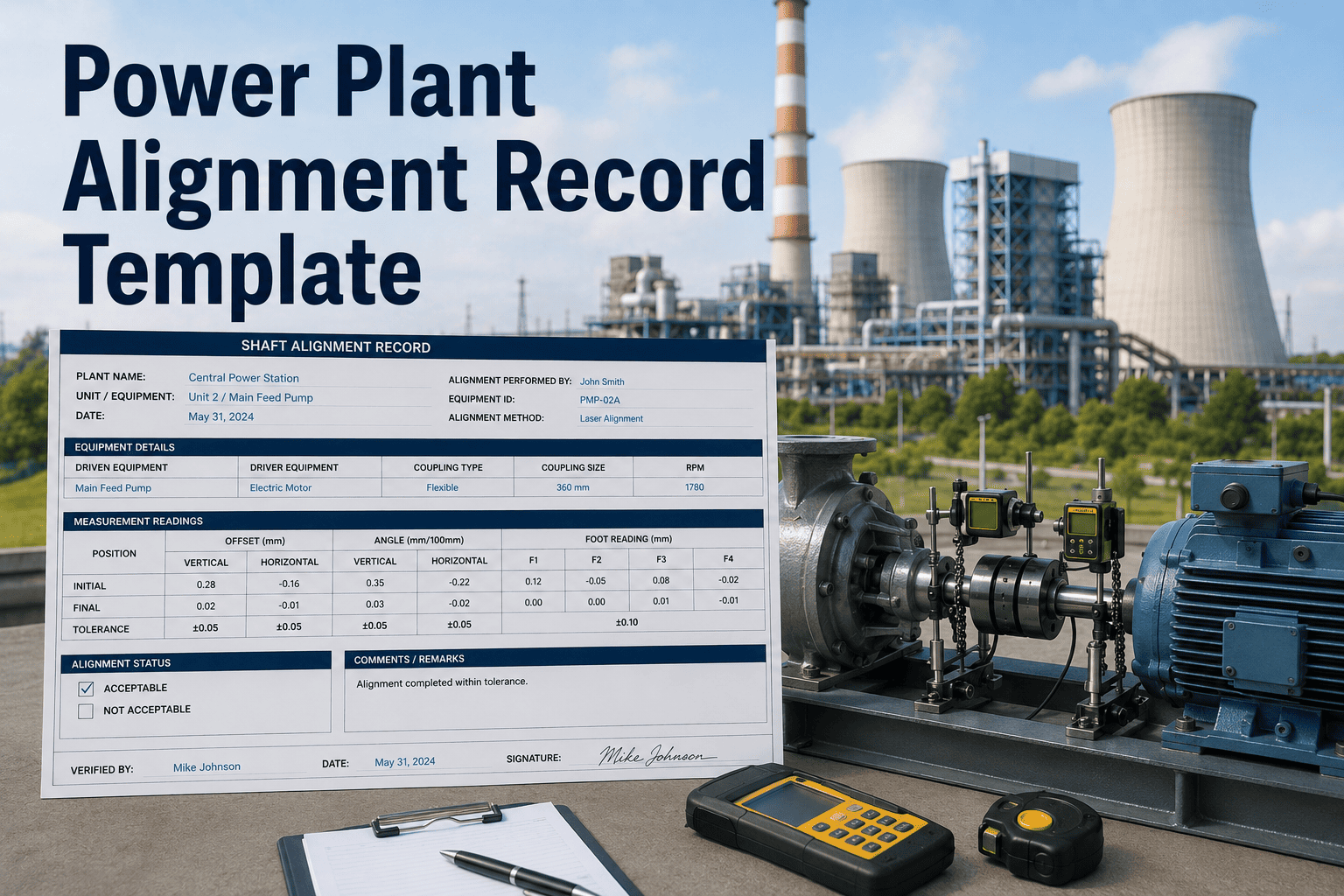
Rotating equipment alignment verified — shaft alignment records on file
Mechanical Eng.
Thermal insulation complete on all high-temperature surfaces — burn risk eliminated
Site Safety Officer
All temporary construction equipment, materials, and scaffolding removed from area
Site Supervisor
Area 2
Safety, Operating, Maintenance and Emergency Procedures
OSHA 1910.119(i)(1)(ii)
Normal startup procedure — written, reviewed, and approved by operations lead
Operations Lead
Normal shutdown procedure — written, reviewed, and approved
Operations Lead
Emergency shutdown procedure — confirmed current and accessible at control room
Shift Supervisor
LOTO (Lockout Tagout) procedure updated to reflect new or modified equipment
Maintenance Lead
Confined space entry procedures reviewed if any confined spaces created or modified
HSE Officer
Permit-to-work procedures updated for new energy sources or isolation points
HSE Officer
Safety Data Sheets (SDS) for all new or changed chemicals — available at point of use
Chemical Safety
Area 3
Employee Training — Operators and Affected Personnel
OSHA 1910.119(i)(1)(iii)
All operations personnel trained on new or revised startup procedure — rosters signed
Training Manager
Maintenance personnel trained on revised LOTO and isolation procedures
Maintenance Lead
Emergency response team briefed on new hazard scenarios introduced by modification
HSE Officer
Control room operators completed simulator or tabletop exercise on modified system
Operations Lead
Contractor personnel on site during first startup briefed on site emergency procedures
Site Safety Officer
Training records filed in CMMS — linked to asset and PSSR record for audit purposes
Training Manager
Area 4
PHA and MOC Action Items — Confirmed Closed
OSHA 1910.119(i)(1)(iv)
HAZOP / PHA study completed for this modification — report available and reviewed
Process Safety Eng.
All HAZOP / PHA action items — Priority 1 (safety-critical) confirmed closed before startup
Process Safety Eng.
MOC documentation for this modification — approved, signed, and filed in CMMS
Engineering Lead
Process safety information updated — P&IDs, equipment data sheets, and cause-and-effect charts revised
Engineering Lead
Outstanding MOC action items deferred to post-startup — formally documented with responsible owner and deadline
Process Safety Eng.
Previous PSSR findings (if restart) — all outstanding items verified closed
PSSR Leader
Sign-Off Block
PSSR Sign-Off — Required Signatories and Startup Decision
A PSSR sign-off is not a single signature. It is a multi-disciplinary approval that documents who reviewed what, and confirms the startup decision. The three possible outcomes — Ready, Conditional, or Blocked — must be recorded explicitly. No verbal approvals are acceptable under OSHA PSM.
PSSR Leader
Overall PSSR coordination and decision
Operations Lead
Area 2 (Procedures) + Area 3 (Training)
Maintenance / Engineering Lead
Area 1 (Construction and Equipment)
Process Safety Engineer
Area 4 (PHA / MOC Closure)
HSE Officer
Safety systems, PPE, emergency procedures
Plant / Site Manager
Final startup authorisation — management sign-off
Startup Decision
Ready to Start — All items verified. No outstanding safety items.
Conditional Start — Minor items deferred. Documented with owner, deadline, and risk acceptance sign-off.
Startup Blocked — Open safety items must be resolved. New PSSR required before authorisation.
CMMS Integration
How Oxmaint Manages PSSR From MOC Trigger to Closed Record
01
MOC Work Order Triggers PSSR Creation
When a Management of Change work order is raised in Oxmaint for a qualifying modification, the system automatically creates a linked PSSR record — pre-populated with asset details, modification scope, and the required checklist template for that asset class.
02
Checklist Assigned to Multi-Discipline Reviewers
Each checklist area is assigned to the responsible reviewer role in Oxmaint. Engineers, operations leads, and HSE officers each see only their section — and cannot mark the overall PSSR complete until all assigned areas are signed off individually.
03
Open Items Create Tracked Action Records
Any checklist item answered No generates an action record with responsible owner, due date, and priority classification (safety-critical vs. post-startup acceptable). The PSSR cannot be closed until all safety-critical actions are verified closed by the PSSR Leader.
04
Startup Authorisation Locked Until PSSR Is Closed
The associated work order for the modification cannot be closed — and startup permit cannot be issued — until the PSSR record shows full sign-off. The system enforces the gate, removing the dependency on individual discipline or memory.
05
Signed PSSR Retained Against Asset Record for Audit
The completed PSSR — with all signatures, timestamps, action items, and the startup decision — is stored permanently against the asset record in Oxmaint. OSHA regulators requesting PSM documentation receive the full audit trail in minutes, not days.
06
Post-Startup Deferred Items Auto-Scheduled as Work Orders
Any items deferred to post-startup under a Conditional Start decision are automatically converted to scheduled work orders in Oxmaint with the agreed completion deadline — ensuring deferred items are never forgotten after the pressure of first startup passes.
Frequently Asked Questions
Power Plant PSSR — Common Questions
Who should lead the PSSR for a power plant modification?
The PSSR Leader should typically be a representative of the operations group — because operations is the ultimate owner of the facility and the team that assumes responsibility for safety after startup. The leader is not the project manager or contractor, as they have a vested interest in reaching startup. An independent operations or reliability lead provides the right level of scrutiny.
Oxmaint assigns PSSR leader in the system and routes all review tasks through their approval before the record closes.
Can a PSSR be completed remotely or does the team need to be on site?
Area 1 (Construction and Equipment) requires physical field verification — it cannot be completed by document review alone. The P&ID walkdown, interlock testing observation, and punch list review must be conducted in the field. Areas 2, 3, and 4 can be partially completed through document review but should be validated with on-site discussions with the personnel involved.
Book a session to see how Oxmaint structures mobile PSSR completion with photo evidence capture for field checks.
How long must PSSR records be retained under OSHA PSM?
OSHA 29 CFR 1910.119 does not specify a minimum retention period for PSSR records specifically, but the programme requires PSM documentation to be maintained and available throughout the life of the process. Industry best practice is to retain PSSR records for the life of the asset plus five years.
Oxmaint stores PSSR records permanently against the asset record — never purged unless the asset is formally decommissioned.
What is the difference between a PSSR for a new facility and one for a modification?
New facility PSSRs confirm that the full design has been built as specified — PHA completion, full procedure set, all training, and complete mechanical readiness. Modification PSSRs focus narrowly on what changed: only the modified system, the updated procedures, and the personnel trained on the change require verification. Area 4 for modifications specifically confirms that the MOC process was completed correctly.
Oxmaint uses separate PSSR templates for new facilities and modifications — automatically selected based on the triggering MOC type.
Can startup proceed if there are open PSSR action items?
Only if the open items are explicitly classified as non-safety-critical and are formally deferred under a Conditional Start decision — documented with responsible owner, completion deadline, and risk acceptance signature from the Plant Manager. Safety-critical items (interlock failures, uncalibrated relief valves, untrained operators on critical procedures) must be resolved before startup. There is no acceptable workaround for these.
Oxmaint enforces this classification — conditional items remain as tracked work orders with deadlines that cannot be quietly ignored.
Replace Paper PSSR Checklists With an Auditable, CMMS-Tracked Safety Gate
Oxmaint links every PSSR to its triggering MOC, assigns checklist sections to the right reviewers, tracks open action items to closure, and stores the signed record permanently against the asset. Your OSHA PSM audit trail is complete — from trigger event to startup authorisation — in one system. Deployed in under 10 weeks.