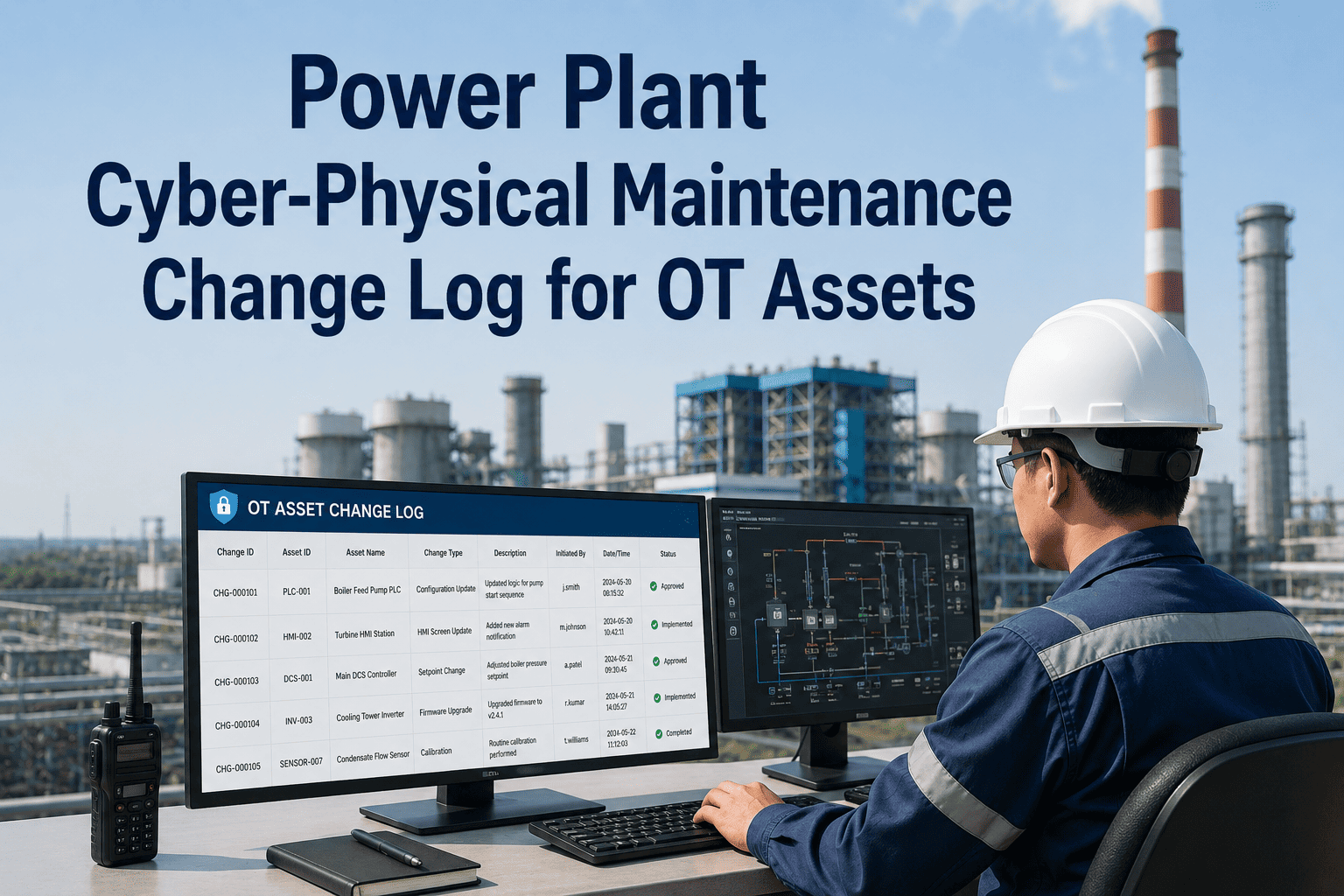
Operational technology assets in power plants — PLCs, RTUs, SCADA systems, protective relays, and field controllers — sit at the intersection of physical wear and cyber exposure. Every firmware update, configuration change, and patch applied to these systems must be documented with the same rigor as a physical overhaul, yet most plants still track OT changes in disconnected spreadsheets or informal logbooks that collapse under regulatory scrutiny. A structured cyber-physical maintenance change log captures who changed what, when, and why — creating the audit trail that NERC CIP, IEC 62443, and internal governance programs demand. OxMaint's CMMS brings OT change documentation into a single compliance-ready platform where digital work orders, revision histories, and approval workflows replace fragmented paper trails. Start your free trial and bring every OT asset change log into one auditable system.
OT Maintenance · Compliance Tracking · 2025
Cyber-Physical Maintenance Change Log for Power Plant OT Assets
Every firmware push, relay setting change, and configuration update on your OT network must be traceable. Build the audit trail that regulators expect and cyber incidents demand — before you need it.
78%
of OT incidents traced to undocumented configuration changes
NERC CIP
Requires documented change management for high and medium BES cyber systems
$1M+
Potential NERC CIP penalty exposure per violation per day
The Problem
Why OT Change Logs Fail in Power Plants
Cyber-physical assets in generation facilities are updated constantly — protective relay settings after a system study, PLC logic after a process modification, SCADA historian configurations after a network change. Each of these touches both the physical and the cyber layer, yet documentation practices rarely reflect that duality. The result is a change history that is incomplete, scattered, and impossible to reconstruct during a NERC CIP audit or post-incident forensic review.
Spreadsheet Fragmentation
Multiple engineers maintaining separate version-controlled files with no cross-reference, no approval chain, and no link to the physical work order that triggered the change.
Missing Cyber-Physical Link
Physical maintenance records and OT configuration logs exist in separate systems with no linkage — making it impossible to correlate a relay calibration with a firmware update done the same day.
No Rollback Evidence
When a configuration change causes a trip or anomaly, there is no documented pre-change baseline to compare against — delaying diagnosis and extending forced outages.
Approval Gap
Changes made verbally or informally without documented review and authorization — violating NERC CIP-010 change management requirements for high and medium impact BES cyber systems.
Change Log Structure
Anatomy of a Complete OT Maintenance Change Log Entry
A defensible OT change log entry captures the full context of the change — not just what was done, but the asset affected, the cyber and physical scope, the approvals obtained, and the post-change verification. This structure satisfies NERC CIP-010 documentation requirements and provides the forensic foundation needed for incident response.
01
Asset Identification
Asset ID and equipment tag
BES Cyber System classification
Physical location and substation/unit
Vendor, model, firmware baseline
→
02
Change Definition
Change type: firmware / config / physical / software
Scope: cyber layer, physical layer, or both
Reason for change and initiating work order
Expected impact on system operation
→
03
Approval Chain
Initiating engineer and timestamp
OT cybersecurity review sign-off
Operations supervisor authorization
Change window and outage coordination
→
04
Execution and Verification
Actual change performed with technician ID
Post-change functional test results
Configuration backup confirmation
Return-to-service sign-off
OT Asset Categories
OT Assets That Require Cyber-Physical Change Documentation
Not every asset in a power plant touches the OT layer, but for those that do, change documentation must address both dimensions. The following asset categories carry the highest compliance exposure when change logs are incomplete or missing during regulatory inspection.
| Asset Category |
Physical Change Examples |
Cyber Change Examples |
NERC CIP Relevance |
| Protective Relays |
Wiring modifications, CT/PT replacement |
Setting file updates, firmware upgrades |
CIP-007, CIP-010 |
| PLCs and RTUs |
I/O card replacement, chassis work |
Logic program changes, parameter edits |
CIP-010 R1 |
| SCADA Servers |
Hardware replacements, rack upgrades |
OS patches, historian config, user access |
CIP-007 R2, CIP-010 |
| DCS Controllers |
Module swaps, cable replacement |
Control strategy changes, tuning parameter edits |
CIP-010 R1 |
| Network Equipment |
Switch replacement, cabling |
VLAN changes, firewall rule updates |
CIP-005, CIP-010 |
| HMI Workstations |
Monitor/peripheral replacement |
Application updates, screen configuration |
CIP-007 R3 |
OxMaint Solution
How OxMaint Unifies Physical and Cyber Change Documentation
OxMaint connects the physical maintenance work order to the OT configuration change record in a single, auditable platform. When a technician closes a work order for relay testing, the system prompts for any associated configuration changes — ensuring the cyber layer is never documented separately from the physical work that triggered it.
Linked Work Order and Change Records
Every OT configuration change is linked to the originating work order. Physical maintenance history and cyber change history are viewable together on a single asset timeline.
Multi-Stage Approval Workflows
Changes requiring OT cybersecurity review route automatically through configurable approval chains. No change proceeds to execution without all required sign-offs captured and timestamped.
Firmware and Configuration Baseline Tracking
Maintain a documented baseline for every cyber asset. Each change creates a new version record with pre-change and post-change state captured for rollback and forensic comparison.
NERC CIP Audit Report Generation
Generate change management evidence packages for CIP-010 compliance audits in minutes. Filter by asset, date range, change type, or BES Cyber System classification.
Mobile Field Documentation
Technicians document changes in the field from any mobile device. Photos, test results, and digital signatures captured at the point of work — not reconstructed later at a desk.
Change Frequency Analytics
Dashboards show change velocity by asset, system, or team. Unusual change patterns that may indicate unauthorized activity or maintenance drift surface automatically.
Free Trial · No Credit Card · OT Compliance Module
One Platform for Every OT Change. Zero Documentation Gaps for NERC CIP Audits.
OxMaint links physical maintenance work orders to OT configuration change records — giving your compliance team the complete, auditable history that NERC CIP-010 demands and your operations team the rollback baseline they need when something goes wrong.
Frequently Asked Questions
OT Maintenance Change Log Questions Power Plant Teams Ask
What does NERC CIP-010 require for OT change management documentation?
NERC CIP-010 R1 requires documented change management for high and medium impact BES Cyber Systems, including a list of planned changes, security impact assessment, pre-change approval, and post-change verification. Records must identify who authorized the change, when it occurred, and what was modified.
OxMaint templates are built around these requirements.
How is a cyber-physical change log different from a standard maintenance work order?
A standard work order captures physical maintenance activities. A cyber-physical change log additionally documents the OT configuration layer — firmware versions, setting file changes, software modifications — and links these to the physical work. This dual-layer record is essential for both reliability analysis and NERC CIP compliance.
Can OxMaint integrate with existing OT asset inventory or CMDB systems?
Yes. OxMaint supports asset data import via CSV and structured API connections for organizations with existing OT asset inventories or configuration management databases. This allows existing asset records to be enriched with maintenance history without starting from scratch.
Discuss your integration requirements in a demo.
How long must OT change records be retained for NERC CIP compliance?
NERC CIP-010 requires change management records to be retained for at least three years. OxMaint stores all records indefinitely with role-based access controls, and can export complete audit evidence packages filtered by any date range or asset category.
What happens during a NERC CIP audit if OT change records are missing or incomplete?
Incomplete or missing CIP-010 change management records can result in violations with penalties exceeding $1 million per violation per day. Auditors specifically examine change approval records, security impact assessments, and post-change verification documentation. Gaps in any of these areas trigger findings that require remediation evidence.
Eliminate documentation gaps with OxMaint.
Power Plant CMMS · OT Compliance · NERC CIP Ready
Your OT Assets Are Changing Every Week. Your Change Log Should Show Every One.
Stop reconstructing OT change history from memory and email threads before audits. OxMaint creates a living, auditable cyber-physical change log for every OT asset in your plant — linked to work orders, backed by approvals, and ready for NERC CIP review at any time.