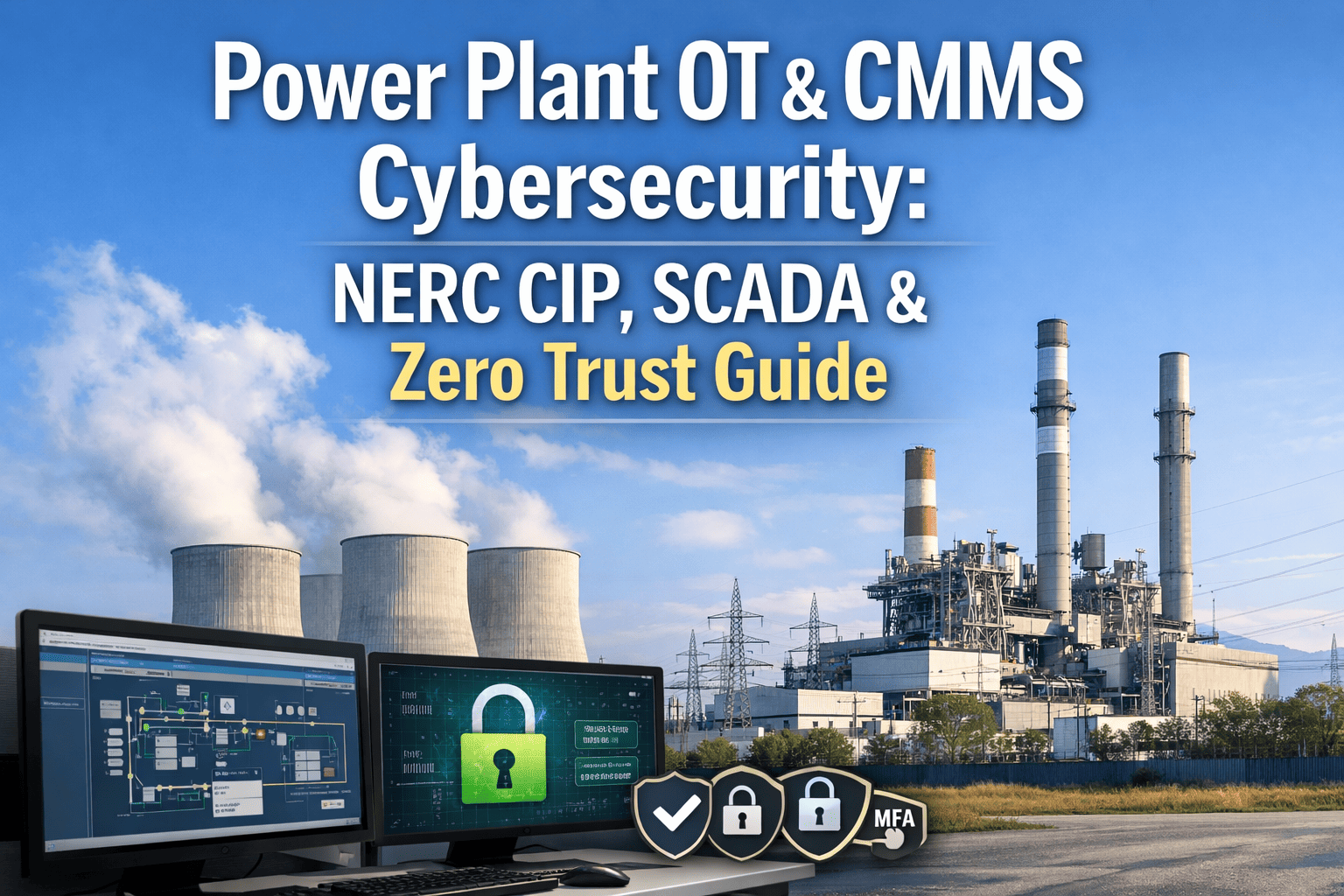
In 2024, CISA documented over 500 known exploited vulnerabilities affecting ICS and OT components — and the energy sector ranked as the fourth most attacked industry globally. A power plant DCS, turbine control system, or SCADA network connected to a corporate IT environment without properly enforced zone boundaries is not a compliance risk in the future tense — it is an active exposure today. The three frameworks that govern power plant OT cybersecurity each serve a distinct role: NIST CSF 2.0 provides strategic direction and risk governance, IEC 62443 provides the engineering blueprint for zones, conduits, and security levels, and NERC CIP provides mandatory minimum controls for North American bulk electric system operators with enforceable penalties. Running all three in parallel is not redundant — each layer fills gaps the others leave open. OxMaint helps plant teams track OT asset inventories, manage cybersecurity-linked maintenance records, and keep patch compliance and access control evidence audit-ready at all times. Start your free trial to connect your OT asset records to a CMMS-integrated compliance programme, or book a demo to see how OxMaint supports NERC CIP and IEC 62443 documentation workflows.
OT Cybersecurity · Power Generation
One Unpatched PLC.
One Grid Event. One $40M Breach.
Power plant OT environments face nation-state actors, ransomware operators, and supply chain threats simultaneously. NIST CSF, IEC 62443, and NERC CIP exist for exactly this reason — and each one demands documented, verifiable evidence.
4th
Most attacked industry globally
500+
ICS/OT CVEs documented in 2024
$40M
Average OT breach cost in 2024
35 days
NERC CIP patch review window
Three Frameworks, One Programme: How NIST CSF, IEC 62443, and NERC CIP Fit Together
The most common mistake in power plant cybersecurity is treating these three frameworks as alternatives. They are complementary layers — each answers a different question, covers a different scope, and creates a different type of accountability. Implementing all three in sequence produces a programme that is strategically sound, technically rigorous, and regulatorily defensible.
Strategic Layer
NIST CSF 2.0
What should our cybersecurity programme achieve and how do we govern it?
All organisations, all sectors. Six functions: Govern, Identify, Protect, Detect, Respond, Recover.
What it leaves open: How to technically implement OT-specific controls (zones, conduits, security levels)
Voluntary — widely adopted
▼
Engineering Layer
IEC 62443
How do we design and operate secure OT zones, conduits, and system components?
Any IACS operator, integrator, or vendor. Defines Security Levels (SL 1–4), zones and conduits, and secure development lifecycle.
What it leaves open: Sector-specific mandatory minimum controls and enforcement timelines
Voluntary — increasingly contractual
▼
Compliance Layer
NERC CIP
What minimum controls must North American BES operators prove they have implemented?
North American bulk electric system operators only. 14 standards (CIP-002 to CIP-015) with mandatory timelines, audit evidence, and financial penalties.
What it leaves open: Engineering depth for OT-specific implementation (deferred to IEC 62443)
Mandatory — enforceable fines
NERC CIP Standards: What Each One Requires
NERC CIP comprises 14 active standards. The most frequently violated — and most operationally consequential for power plant maintenance teams — are the ones that require recurring documentation, patch tracking, and asset inventory upkeep. CIP-007 alone has accumulated more violations than any other standard, driven primarily by the 35-day patch review cycle.
| Standard |
Subject |
Key Requirement for Plant Teams |
Recurring Interval |
Most Common Violation |
| CIP-002 |
BES Cyber System Categorisation |
Identify and categorise all BES cyber assets as High, Medium, or Low impact. Reassess after any BES change. |
Review after every change |
Incomplete re-categorisation after asset additions |
| CIP-003 |
Security Management Controls |
Document a cybersecurity policy with defined roles, responsibilities, and exception processes. |
Annual review |
Policy not reviewed within required period |
| CIP-004 |
Personnel and Training |
Background checks and cybersecurity training for all personnel with BES cyber system access. Records retained. |
Annual training cycle |
Training record gaps for contractors |
| CIP-005 |
Electronic Security Perimeters |
Define and enforce ESP boundaries. Control and log all inbound/outbound access. Manage vendor remote access sessions. |
Continuous monitoring |
Undocumented vendor remote access sessions |
| CIP-007 |
Systems Security Management |
Patch review every 35 days. Apply, document, or create a mitigation plan within a further 35 days. Port and service management. Malware prevention. |
Every 35 days |
Most violated standard — patch cycle lapse |
| CIP-008 |
Incident Response |
Documented incident response plan tested at least once per calendar year. Roles, escalation, and reporting timelines defined. |
Annual test |
Plan not tested within 15-month window |
| CIP-010 |
Configuration Change Management |
Baseline all authorised software, OS, firmware, and connections. Verify baseline every 35 days. Full vulnerability scan every 15 months. |
Every 35 days / 15 months |
Baseline not updated after configuration change |
| CIP-013 |
Supply Chain Risk Management |
Documented supply chain risk management plan. Vendor software integrity verification. Controls for vendor remote access (CIP-005 linkage). |
18-month review cycle |
No software integrity verification process |
CMMS-Integrated Compliance Tracking
NERC CIP Patch Cycles and Asset Inventories — Tracked Where Maintenance Actually Happens
OxMaint connects your OT asset register, patch compliance records, and access control logs to the same platform your maintenance team uses every day — so compliance evidence is built continuously, not assembled in a panic before an audit.
IEC 62443 Zones, Conduits, and Security Levels Explained
IEC 62443 organises an industrial control system into Security Zones — logical groupings of assets with similar security requirements — connected by Conduits, which are the controlled pathways between zones. Each zone is assigned a Security Level (SL 1–4) based on the sophistication of attacker it must resist. The Purdue Model maps these zones to plant network layers.
Purdue Model — Power Plant OT Security Zones
Level 4–5
Enterprise / IT Network
Corporate ERP, email, business systems. Must be separated from OT by a DMZ with enforced data diodes or firewalls. No direct connectivity to Level 0–2.
SL target: SL 1
DMZ / Demilitarised Zone — Enforced firewall, data historian, jump server with MFA and session recording
Level 3
Operations / SCADA / EMS
Plant historians, SCADA servers, OT network management, engineering workstations. Primary target for ransomware and lateral movement from IT.
SL target: SL 2
Conduit — Role-based access control, unidirectional data flow enforcement where possible
Level 2
Control / DCS / HMI
Distributed control systems, HMIs, turbine control, boiler management systems. Compromise here has direct operational and safety consequences.
SL target: SL 2–3
Conduit — Strict zone enforcement, no unauthorised devices, media scanning on all removable media
Level 1
Field Controllers / PLCs / RTUs
Programmable logic controllers, remote terminal units, smart sensors. Firmware patching windows are operationally constrained — planned outage dependency.
SL target: SL 2–3
Conduit — Physical port lockdown, serial communication monitoring, no wireless unless explicitly secured
Level 0
Physical Process — Sensors, Actuators, Drives
Instruments, valve actuators, variable speed drives. Cyber risk here is typically through compromised Level 1 controllers issuing incorrect process commands.
SL target: SL 1 — physical controls primary defence
OT Asset Inventory: The Foundation Every Framework Requires
You cannot protect what you cannot see. NIST CSF 2.0's Identify function, IEC 62443's zone modelling, and NERC CIP-002 categorisation all begin at exactly the same point: a complete, accurate, continuously maintained inventory of every cyber asset in the OT environment. In practice, most power plants have significant blind spots — undocumented legacy PLCs, unmanaged engineering laptops with ICS software, and vendor-installed devices whose network presence is unknown to the operations team.
01
Active Discovery (Carefully)
Active network scanning in OT environments can crash legacy PLCs and disrupt process control. Passive discovery using network taps and span ports is the standard approach. Active discovery, if used at all, must be scoped and approved for each zone.
Required by: NERC CIP-002, IEC 62443-2-1, NIST CSF Identify
02
Asset Attributes to Capture
Manufacturer, model, firmware version, IP and MAC address, communication protocols, zone assignment, criticality category (High/Medium/Low), patch status, and last reviewed date. These fields directly map to NERC CIP-002 categorisation evidence.
Required by: NERC CIP-002 / CIP-010, IEC 62443-2-1
03
Change Control Integration
Any new device added to an OT zone must trigger an inventory update, a zone impact assessment, and a CIP-002 re-categorisation review. NERC CIP-010 requires baseline verification every 35 days — this only works if the baseline was accurate to begin with.
Required by: NERC CIP-010, IEC 62443-2-1
04
CMMS Linkage for Patch Records
Each asset in the inventory needs a linked patch history — review date, patch applied or deferred, mitigation plan if deferred, and evidence of approval. OxMaint maintains this record against each asset and flags when the 35-day CIP-007 review window is approaching.
Required by: NERC CIP-007 — 35-day patch cycle
Frequently Asked Questions
Is NERC CIP mandatory for all power plants, or only large generators?
NERC CIP applies to operators of the North American Bulk Electric System (BES). Generation assets below 20 MVA threshold, smaller renewable sites, and behind-the-meter assets are generally excluded from the full CIP standards, though some Low-impact BES cyber system requirements still apply. Any facility connected to the transmission grid at BES thresholds should complete a formal CIP applicability assessment.
Book a demo to discuss applicability for your facility.
What is the difference between IEC 62443 Security Level 2 and Security Level 3?
Security Level 2 (SL2) requires protection against intentional violation using simple means with low resources — opportunistic attackers, script kiddies, and unsophisticated insiders. Security Level 3 requires protection against intentional violation using sophisticated means with moderate resources — organised attackers using publicly available tools. Most power plant DCS and turbine control zones should target SL2 as a minimum, with safety-critical systems (SIS) targeting SL3 or above.
How does OxMaint support NERC CIP patch compliance tracking?
OxMaint maintains an OT asset register with firmware version, last patch review date, and patch application status for each cyber asset. When the 35-day CIP-007 review window approaches, a scheduled task is triggered automatically. If a patch is deferred, the mitigation plan is recorded and linked to the asset record. All evidence is retained and exportable for NERC CIP audit submissions.
Start your free trial to set up patch tracking.
What is the most commonly violated NERC CIP standard and how do we avoid it?
CIP-007 (Systems Security Management) has accumulated more violations than any other standard, primarily because the 35-day patch review cycle is operationally demanding and easy to miss without automated tracking. The solution is systematic: build the 35-day review cycle into your CMMS as a recurring work order against each affected asset class, with evidence capture built into the close-out form. Manual calendar reminders fail at scale.
How do we segment OT from IT without disrupting plant operations?
The standard approach is a DMZ architecture with a data historian and a hardened jump server as the only pathways between IT and OT. Unidirectional security gateways (data diodes) on the SCADA-to-historian data path prevent any inbound traffic reaching Level 3. Remote vendor access must be session-based, MFA-authenticated, and recorded. Changes to zone boundaries are managed through a formal change control process approved by both OT engineering and the cybersecurity team.
OxMaint OT Compliance Platform
NIST CSF · IEC 62443 · NERC CIP — All Three Supported, One Platform
35 days
CIP-007 patch cycle — auto-tracked in CMMS
14
NERC CIP standards — evidence captured
100%
Audit-ready asset inventory at all times
No credit card required. Trusted by plant operations, OT engineering, and compliance teams across power generation and critical infrastructure.