When a power plant unit trips unexpectedly, the ability to execute a safe, controlled emergency load transfer separates a managed event from a cascading grid emergency. The gap between a 12-minute load transfer and a 90-minute one is almost always a maintenance gap — untested switchgear, breakers with missed service intervals, manual procedures that haven't been walked through in two years, and SCADA alarm setpoints that haven't been validated since the last major outage. Grid operators and reliability engineers across NERC regions consistently find that emergency load transfer performance correlates directly with the quality of the underlying maintenance program, not with crew experience or dispatcher speed. If your emergency transfer procedures, switchgear PMs, and tie-line readiness checks are tracked on paper or across disconnected systems, start a free Oxmaint trial and build the maintenance foundation that makes emergency load transfers predictable and fast.
Grid Reliability Maintenance Guide — 2026
Power Plant Emergency Load Transfer Maintenance Workflow
Switchgear readiness, transfer scheme validation, interlock testing, and mobile CMMS coordination — the maintenance workflow that keeps emergency transfers controlled and fast.
12 min
Target transfer time for a maintained emergency switchover vs 90+ min for degraded systems
NERC
EOP-005 standard governs emergency operations procedures for generation facilities
38%
Of unplanned generation trips involve switchgear that had missed a scheduled PM
Switchgear That Won't Open or Close on Command
High-voltage breakers and disconnect switches that sit unused for months accumulate mechanical stiffness, contact oxidation, and spring mechanism degradation that only reveals itself during an emergency operation. A breaker that tested at 95ms operating time two years ago may now take 300ms or fail to close at all. Scheduled CMMS work orders for breaker operation tests, contact resistance measurement, and spring mechanism lubrication prevent this failure mode from appearing during the worst possible moment.
Protection Relay Coordination That Drifted from Design
Emergency load transfer schemes depend on relay coordination settings that define which breakers open in what sequence, at what current threshold, and with what time delay. Relay settings that drift from the coordination study — through unauthorized changes, firmware updates that reset to defaults, or relay replacements that weren't re-commissioned — can cause sequential tripping that extends the transfer time or, worse, creates an uncontrolled island or voltage collapse during what should have been a managed event.
Tie-Line and Transfer Interlock Untested Since Last Outage
Transfer interlocks — the logic circuits that prevent unsafe parallel operations, back-feed conditions, or out-of-phase closures — require periodic injection testing to verify their actual function. Documentation-only verification (checking that the programming is still present) is not sufficient. An interlock that exists in logic but fails to actuate under real current and voltage conditions is discovered during the emergency it was designed to prevent. CMMS-managed interlock testing at defined intervals with test data attached is the only defensible maintenance approach.
Auxiliary Power Availability Assumptions That Aren't Validated
Emergency load transfer depends on auxiliary power — station service transformers, battery-backed DC buses, and UPS systems — remaining available through the transfer event. A station service transformer with degraded insulation, a DC battery with reduced capacity, or a UPS that switches to bypass under load can interrupt the control power that the transfer scheme relies on mid-sequence. Each of these auxiliary systems requires its own CMMS PM schedule with results tracked and alarms followed up before they become single points of failure during transfer execution.
Quarterly — Transfer Scheme Functional Test
Execute a controlled functional test of the automatic transfer switching sequence using secondary injection methods. Verify timing from trip initiation to source re-energization. Record results in CMMS against the asset's transfer scheme record. Compare against previous results and design specification. Any degradation in transfer time initiates a corrective investigation work order with root cause requirement.
CMMS: Auto-schedule · Test data attachment · Trend comparison
Semi-Annual — Switchgear Mechanical Inspection and Operation Test
Operate every breaker and disconnect switch in the transfer path through a complete open-close cycle. Measure operating time, contact resistance, and spring charge status. Inspect arc chute condition, contact wear, and control wiring integrity. CMMS work order carries the full inspection checklist; technician completes on mobile device from the switchgear cubicle without returning to the control room for sign-off.
CMMS: Mobile checklist · Photo attachment · Contact wear trending
Annual — Protection Relay Setting Audit and Injection Test
Compare all relay settings in the emergency transfer path against the current approved coordination study. Any deviation triggers a corrective work order before the audit is closed. Perform secondary injection testing on over-current, under-voltage, and frequency relays that initiate or control the transfer sequence. Document pickup values, timing, and reset levels against design specification in CMMS with engineering sign-off required for closure.
CMMS: Relay register · Setting comparison · Engineer approval gate
Annual — DC Battery Capacity Discharge Test
Perform a full capacity discharge test on every DC battery string that supports emergency transfer control circuits. Verify that actual capacity meets or exceeds the design requirement for transfer scheme operation duration. CMMS records cell voltage profiles, total discharge capacity, and temperature during the test. Cells falling below 80% of rated capacity trigger individual cell replacement work orders with expedited procurement routing.
CMMS: Capacity trend · Cell-level data · Auto-procurement trigger
After Every Actual Emergency Transfer — Post-Event Review Work Order
Every actual emergency load transfer, regardless of outcome, generates a mandatory post-event review work order in CMMS within 24 hours. The work order captures transfer time, any deviations from the expected sequence, equipment that did not operate as designed, and corrective actions required. This feedback loop is the most valuable data input to the emergency transfer maintenance program — real event performance versus designed performance.
CMMS: Auto-generate on event · 24-hr completion requirement · Lessons-learned record
Mobile CMMS for Emergency Readiness
Know Every Transfer Path Is Ready Before the Emergency Arrives
Oxmaint tracks every switchgear operation test, relay setting, battery capacity result, and transfer scheme functional test across your entire plant — with overdue PM alerts that ensure nothing in the emergency transfer path is silently degraded.
NERC EOP-005 requires that generating facilities have documented, tested, and rehearsed operating procedures for emergency conditions including load transfers. The maintenance program that supports EOP-005 compliance must demonstrate three things:
R1
Procedures Are Current and Tested
Emergency operating procedures for load transfer must reflect the current plant configuration, including any equipment changes, relay updates, or topology modifications made since the last revision. CMMS provides the change history that proves procedures are current.
R2
Equipment Is Capable of Performing the Transfer
Switchgear, relays, and auxiliary power systems must be maintained in a condition that allows them to perform as the procedure assumes. CMMS maintenance history is the documentary evidence that equipment capability has been verified and sustained.
R3
Staff Are Trained and Records Demonstrate It
Operator training on emergency transfer procedures requires documented completion records. CMMS tracks training task completion, simulation exercise dates, and personnel qualification status — making NERC compliance evidence a report, not a reconstruction.
At the Switchgear Cabinet
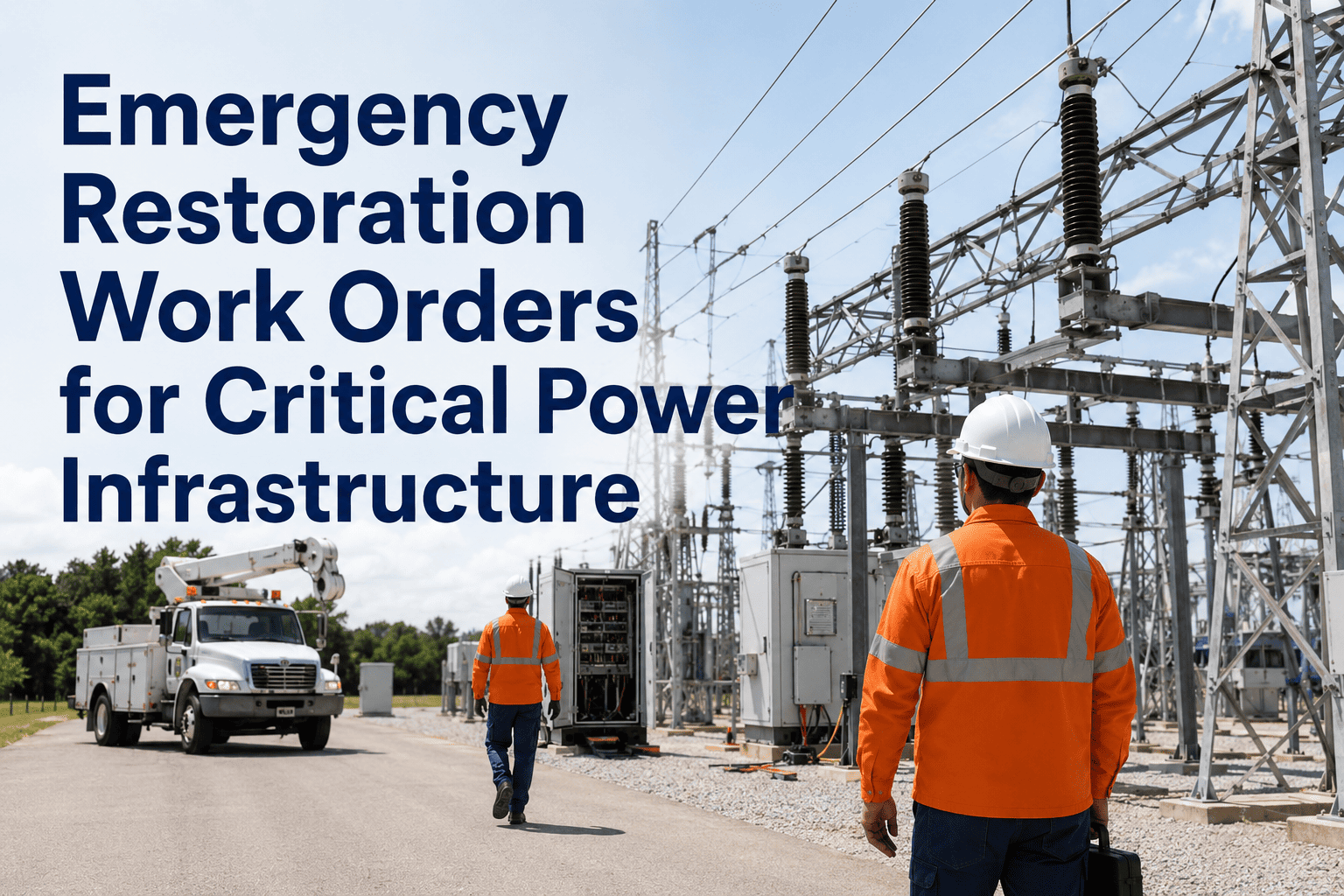
Technicians scan the QR code on the switchgear panel, receive the active work order with the full inspection checklist, record operating times, contact resistance readings, and photos directly on a mobile device — with or without network connection in the switchyard.
In the Relay Room
Relay technicians access the current approved setting file from the work order, compare against live relay programming via CMMS-linked documentation, record injection test results including pickup values and timing, and flag any deviations for engineering review before the work order closes.
In the Battery Room
Battery technicians record cell voltage, temperature, and capacity test data directly into structured fields on the mobile work order. CMMS calculates capacity as a percentage of nameplate and automatically generates replacement work orders for any cell below the threshold — no post-inspection data entry required.
In the Control Room
Supervisors see real-time completion status of all emergency transfer maintenance work orders, pending overdue items, and upcoming scheduled PMs — prioritized by the plant's criticality ranking so transfer path assets are always visible at the top of the dashboard.
How often should emergency load transfer schemes be functionally tested?
Industry best practice and most NERC regional standards call for functional testing of automatic transfer switching schemes at least annually, with key component tests (breaker operations, relay injections) on a semi-annual or quarterly basis. CMMS scheduling ensures testing frequency is determined by engineering-based intervals rather than calendar convenience. Oxmaint automates PM scheduling for every asset in the transfer path with configurable frequency rules.
What maintenance records does NERC EOP-005 require for emergency transfer equipment?
EOP-005 requires evidence that emergency operating procedures are current, tested, and that equipment is maintained in a capable condition. CMMS work order records, test data attachments, relay setting audit trails, and training completion records collectively satisfy the documentation requirements for NERC audits. Post-event review work orders from actual emergency transfers are also valuable evidence of program effectiveness.
Can Oxmaint work offline in switchyard environments with poor network coverage?
Yes. The Oxmaint mobile application supports full offline operation — technicians can access work orders, complete inspection checklists, attach photos, and record test data without network connectivity. All data syncs automatically when connection is restored. This capability is specifically designed for switchyard, substation, and remote generation asset environments. Book a demo to see the offline workflow.
How does CMMS improve emergency transfer response time compared to paper-based maintenance?
CMMS eliminates the two biggest contributors to extended transfer times: equipment degradation that went undetected (caught by scheduled PMs with tracked results) and operator uncertainty about current system configuration (resolved by CMMS-maintained single-line diagrams and procedure revision history). Plants using mobile CMMS for emergency equipment maintenance consistently report faster, more predictable transfer execution because the equipment behaves as expected when it matters most.
What data does Oxmaint capture for post-emergency transfer reviews?
Oxmaint auto-generates a post-event review work order within 24 hours of a logged emergency transfer event. The work order captures: actual vs expected transfer time, equipment deviations, breaker operation anomalies, relay behavior, and corrective action items — all linked to the specific assets involved. This creates an auditable lessons-learned record that feeds back into the PM program to address any gaps the real event exposed. Start a free trial to configure your emergency event workflow.
Grid Reliability CMMS
Emergency Transfers Are Only as Fast as the Maintenance Program Behind Them
Oxmaint schedules, tracks, and records every switchgear PM, relay test, battery capacity check, and interlock verification — with mobile execution from the field and real-time supervisor visibility in the control room. Be ready for the transfer before the grid demands it.
5 asset classes
tracked in every transfer path maintenance program
100% offline
mobile capability in switchyard and substation environments
Auto WO
generated within 24 hrs of every actual emergency transfer event