Power plant energy efficiency is no longer just an operational metric — in 2026, it is the single biggest lever for profitability, emissions compliance and grid competitiveness. Every 1% improvement in power plant heat rate can save a mid-size facility $500K–$2M annually in fuel costs alone, yet most plants lose 3–7% of their generating capacity to poorly maintained turbines, fouled boilers and degraded condenser performance. This guide breaks down the specific maintenance activities — from turbine compressor washing to boiler tuning and condenser performance optimization — that directly move the efficiency needle, and shows how an AI-powered CMMS like OxMaint can schedule, track and automate those tasks to recover lost megawatts. Ready to stop wasting fuel and start tracking every BTU? Start Free Trial and digitize your energy efficiency maintenance program today.
Energy Efficiency Maintenance · 2026
Is Your Power Plant Burning 5% More Fuel Than It Should?
Heat rate drift doesn't happen overnight — it accumulates through skipped cleanings, overdue boiler tunes and untracked condenser fouling. A structured maintenance program powered by an AI-driven CMMS can recover 2–5% in plant efficiency within the first year, turning routine work orders into measurable fuel savings.
The Math of Efficiency Loss
Why Heat Rate Optimization Starts in the Maintenance Department
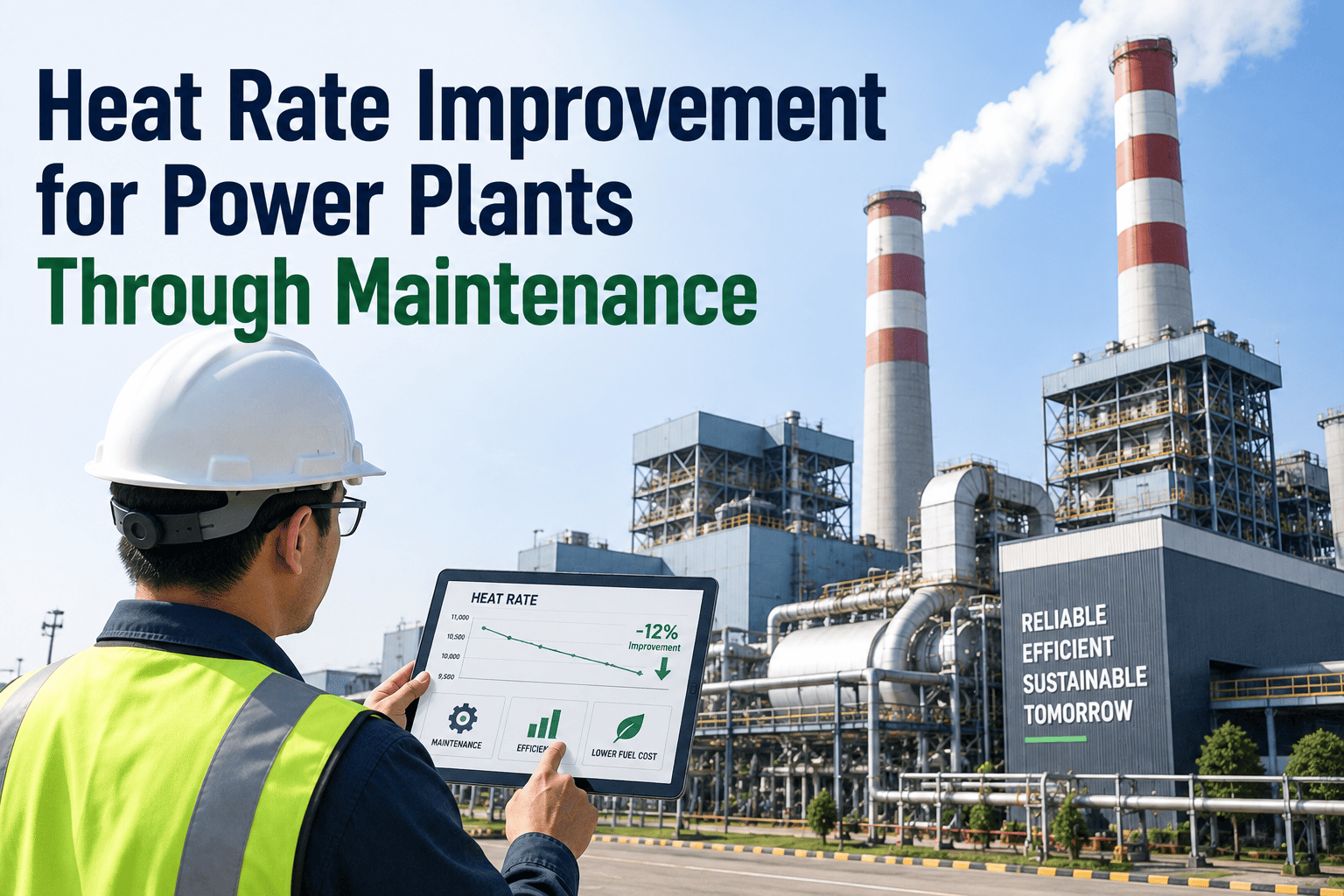
Power plant heat rate — the amount of fuel energy (BTU) required to generate one net kilowatt-hour of electricity — is the master metric of power generation efficiency. A baseline combined-cycle plant operates near 7,000 BTU/kWh; a coal-fired steam plant may run at 9,500–10,500 BTU/kWh. When maintenance slips, these numbers creep upward. A 100 BTU/kWh increase in heat rate on a 500 MW unit running at 80% capacity factor translates to roughly $1.2M in additional annual fuel costs at $4/MMBTU. Heat rate optimization is therefore not an engineering project — it is a disciplined, recurring maintenance execution problem.
High-Impact Maintenance Activities
Four Maintenance Levers That Directly Improve Power Plant Energy Efficiency
Not every work order moves the efficiency needle equally. Reliability teams that prioritize the following four maintenance lever groups consistently report the fastest heat rate improvement and the strongest ROI on their CMMS investment.
Online and offline turbine compressor washing removes fouling deposits that degrade compressor aerodynamics and increase heat rate. A typical 500 MW gas turbine loses 0.5–1.5% output per month of operation between washes. Scheduled compressor washing — triggered by trending compressor discharge pressure and exhaust temperature deviation in OxMaint — restores isentropic efficiency and can recover 1–2% of lost generation capacity within hours.
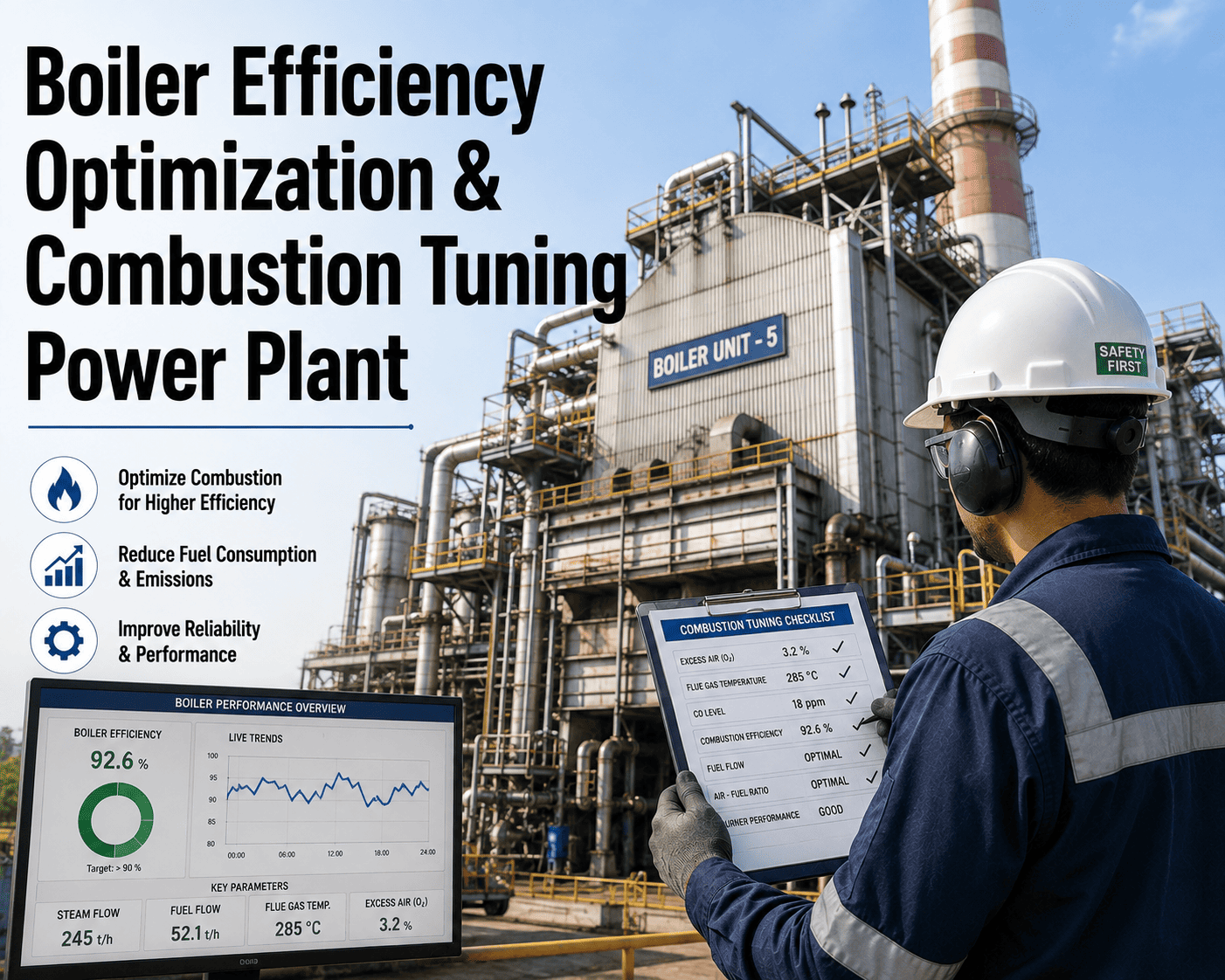
Boiler tuning — including excess oxygen trim, sootblower optimization and air-heater leakage repair — directly impacts boiler efficiency. Every 1% reduction in excess oxygen above optimal can improve boiler efficiency by roughly 0.5%. OxMaint schedules boiler tune-ups, tracks flue-gas analyser readings as asset parameters, and auto-generates work orders when O₂ deviation exceeds configurable thresholds, ensuring your boiler always operates within the manufacturer's efficiency envelope.
A 0.5 inch Hg increase in condenser back-pressure can reduce steam turbine output by 1–3%. Tube fouling, air in-leakage and cooling-tower fill degradation are the primary culprits. OxMaint tracks condenser cleanliness factor, terminal temperature difference and dissolved oxygen trends, then triggers predictive work orders for tube cleaning, leak detection and vacuum-pump maintenance before heat rate penalties accumulate.
Pumps, fans and motors consume 4–8% of gross generation as auxiliary (parasitic) load. A worn pump impeller, misaligned fan or clogged filter forces the plant to draw more power internally. OxMaint's predictive maintenance module uses vibration and current-signature data to flag degrading auxiliaries early, scheduling repairs during low-load periods so parasitic consumption — and therefore net plant heat rate — stays minimized.
Worked Example
Real-World Scenario: A 500 MW Combined-Cycle Plant Recovers $1.8M in Fuel Costs
Consider a 500 MW combined-cycle power plant spending $42M annually on natural gas. After implementing OxMaint as their CMMS for energy efficiency, the reliability team identified and corrected three long-standing issues within the first six months: a fouled compressor (restored 1.4% output), an out-of-tune boiler excess-O₂ loop (0.4% boiler efficiency gain) and a leaking condenser air-ejector (0.7 inHg back-pressure reduction). The combined effect was a 2.3% net heat rate improvement — worth $1.8M per year in fuel savings, plus 9,200 tons of avoided CO₂ emissions. The CMMS deployment paid for itself in under three months.
Savings Breakdown
Where the Dollars Come From: Energy Efficiency Maintenance ROI
The table below maps the four primary maintenance levers to their typical efficiency gain, annual fuel savings on a 500 MW unit and the OxMaint module that automates the workflow. These ranges are based on industry benchmarks from EPRI, ASME PTC 46 performance codes and field data from combined-cycle and coal-fired plants.
| Maintenance Lever | Efficiency Gain | Annual Fuel Saved (500 MW) | OxMaint Module |
|---|---|---|---|
| Turbine compressor washing | 1.0–2.0% | $600K–$1.2M | Predictive Maintenance |
| Boiler tuning & excess O₂ trim | 0.3–0.8% | $180K–$480K | Preventive Maintenance |
| Condenser tube cleaning & leak repair | 0.5–1.5% | $300K–$900K | Asset Condition Tracking |
| Auxiliary equipment optimization | 0.2–0.5% | $120K–$300K | Vibration & Condition Monitoring |
| Combined potential | 2.0–4.8% | $1.2M–$2.88M | Full OxMaint CMMS Suite |
How OxMaint Helps
From Heat Rate Drift to Measurable Recovery — Powered by OxMaint
OxMaint is an AI-powered CMMS and EAM platform built for maintenance and reliability teams who need to connect every work order to plant performance. Instead of reacting to efficiency losses after the monthly performance test, OxMaint helps you predict, schedule and execute the maintenance activities that keep your heat rate at design baseline.
Predictive Heat Rate Monitoring
OxMaint ingests real-time sensor data — compressor discharge pressure, exhaust temperature, condenser back-pressure, flue-gas O₂ — and uses AI models to detect deviation from the performance baseline. When a trend crosses your configurable threshold, a predictive work order auto-generates so the fix happens before fuel waste accumulates.
Automated PM Scheduling for Efficiency Tasks
Create recurring preventive maintenance schedules for compressor washes, boiler tune-ups, sootblower optimization and condenser tube cleaning. OxMaint assigns work orders to the right technician, attaches OEM procedures and tracks completion — ensuring no efficiency-critical task is ever skipped or delayed.
Asset & Equipment Performance Tracking
Every turbine, boiler, condenser and auxiliary has a digital twin in OxMaint — complete with performance parameters, maintenance history, failure codes and spare-parts availability. When a component degrades, you see the full asset context in one dashboard, enabling faster root-cause analysis and better capital decisions.
Maintenance Analytics & Heat Rate Dashboards
OxMaint's analytics engine ties work-order completion to plant performance metrics, giving reliability managers a live dashboard of heat rate trend, PM compliance, MTBF and fuel-cost impact. Audit-ready reports satisfy ISO 55000 asset-management requirements and internal management reviews — no spreadsheets required.
See OxMaint Recover Efficiency on Your Assets
Book a 30-minute demo and we'll show you exactly how OxMaint maps to your plant's turbines, boilers and condensers — and how much fuel you could recover in year one.
Frequently Asked Questions
Power Plant Energy Efficiency & Maintenance — Answered
How does maintenance affect power plant energy efficiency?
Maintenance directly impacts heat rate — the fuel energy needed per kWh generated. Fouled turbine compressors, out-of-tune boilers, leaking condensers and degraded auxiliaries all force the plant to burn more fuel for the same output. A disciplined preventive and predictive maintenance program can recover 2–5% of lost plant efficiency, translating to $1–3M in annual fuel savings for a typical 500 MW unit.
What is heat rate optimization and how often should it be performed?
Heat rate optimization is the process of identifying and correcting the equipment-level issues that degrade thermal performance — compressor fouling, boiler excess-air drift, condenser back-pressure rise and auxiliary parasitic load increase. Key activities like turbine compressor washing should occur monthly or based on performance deviation triggers, while boiler tuning and condenser tube cleaning are typically scheduled semi-annually or annually. OxMaint automates these schedules based on real-time condition data rather than fixed calendar intervals.
Can a CMMS improve power generation efficiency?
Yes. A CMMS like OxMaint improves power generation efficiency by ensuring that every efficiency-critical maintenance task — compressor washes, boiler tunes, condenser cleans, pump alignments — is scheduled, assigned, executed and verified on time. It also tracks asset performance parameters over time so reliability teams can detect heat rate drift early and trigger corrective work orders before fuel losses accumulate. You can Start Free Trial to see how OxMaint maps to your plant's assets.
How much can a power plant save through energy efficiency maintenance?
A 500 MW combined-cycle plant can typically save $1.2M–$2.88M per year by recovering 2–4.8% of lost efficiency through targeted maintenance. The largest single contributor is usually turbine compressor washing (up to $1.2M), followed by condenser performance restoration ($300K–$900K) and boiler tuning ($180K–$480K). Most CMMS-led efficiency programs pay for themselves within 6–18 months.
What are the best maintenance practices for power plant efficiency in 2026?
The best practices are: (1) trend-based compressor washing triggered by performance deviation rather than fixed intervals, (2) continuous boiler excess-O₂ monitoring with automated tuning work orders, (3) condenser cleanliness factor tracking with predictive tube-cleaning schedules, (4) vibration-based predictive maintenance on critical auxiliaries, and (5) a CMMS that ties all of this together with audit-ready records and real-time heat rate dashboards. Book a demo at calendly.com/oxmaintapp/30min to see these workflows in action.
Stop Burning Fuel to Compensate for Poor Maintenance
Every day without a structured energy efficiency maintenance program, your plant is losing megawatts and dollars to preventable heat rate drift. Deploy OxMaint in days, not months — and start recovering fuel savings in your very first PM cycle.
Free 14-day trial · No credit card