Every maintenance backlog is a queue of competing claims — and "who shouts loudest" is a terrible way to decide what gets fixed first. A risk-based priority matrix replaces the noise with a rule: rank each work order by the consequence if the asset fails and the likelihood it will. The two together give a risk score, and the score decides the queue — so a leaking gauge on a critical feed pump beats a cosmetic fix on a spare, every time. OxMaint AI maintenance management software builds this scoring into every work order, so priority is calculated, not argued.
Power Generation · Reliability Engineering · Risk-Based Work Orders
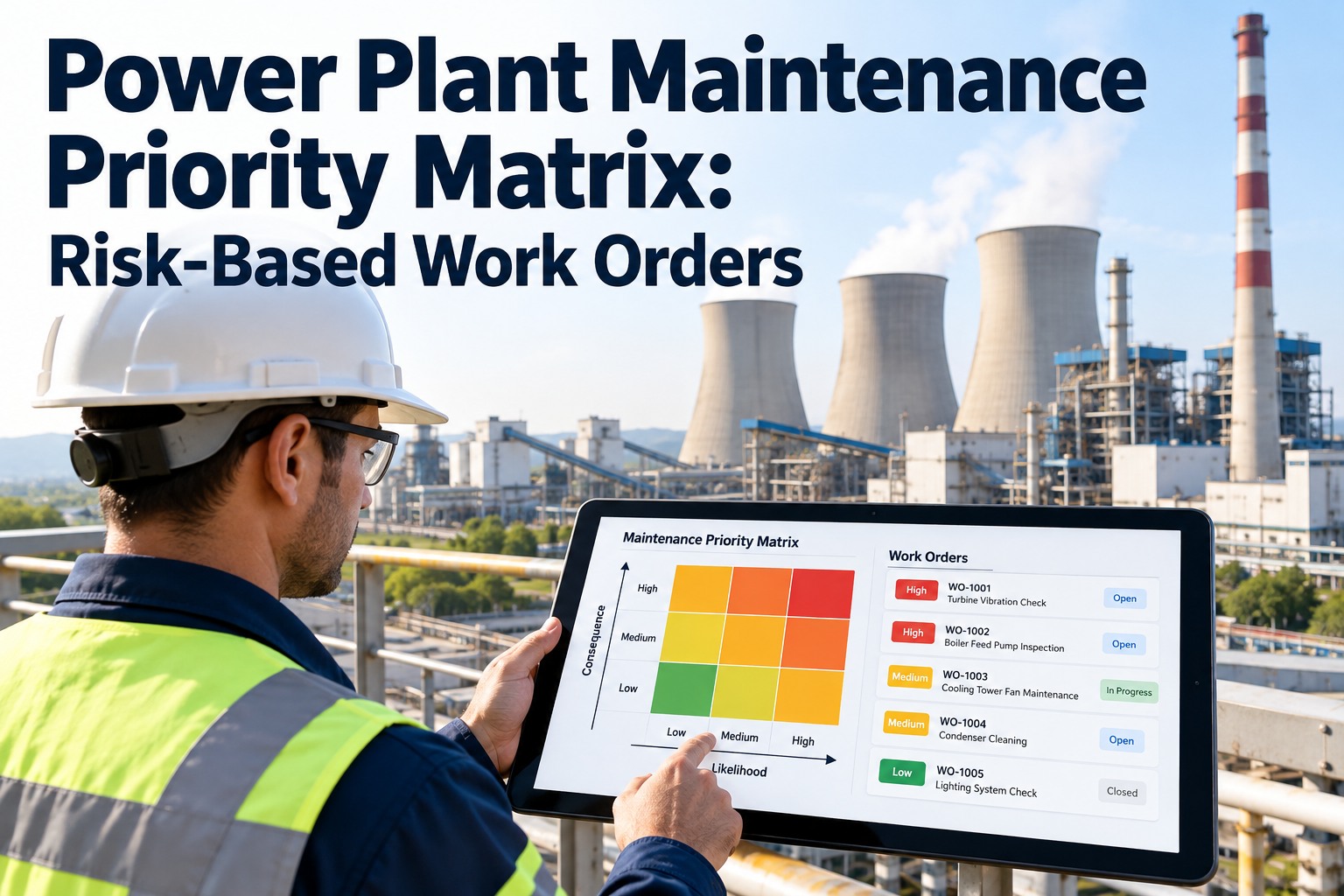
Power Plant Maintenance Priority Matrix: Risk-Based Work Orders
Stop prioritizing by whoever asked last. A priority matrix scores every job on consequence and likelihood — safety, production impact, asset criticality, urgency and failure probability — and lets the risk score run the queue. OxMaint AI applies the matrix automatically, so the highest-risk work rises to the top and PM capacity is protected from reactive noise.
1 Rate consequence
2 Rate likelihood
3 Read the risk score
4 Assign the priority
Risk =
consequence × likelihood, scored per work order
5 factors
safety · production · criticality · urgency · probability
P1–P4
four priority tiers, each with a response window
40–50%
of technician time protected for planned PM
The Risk Matrix at the Center of It
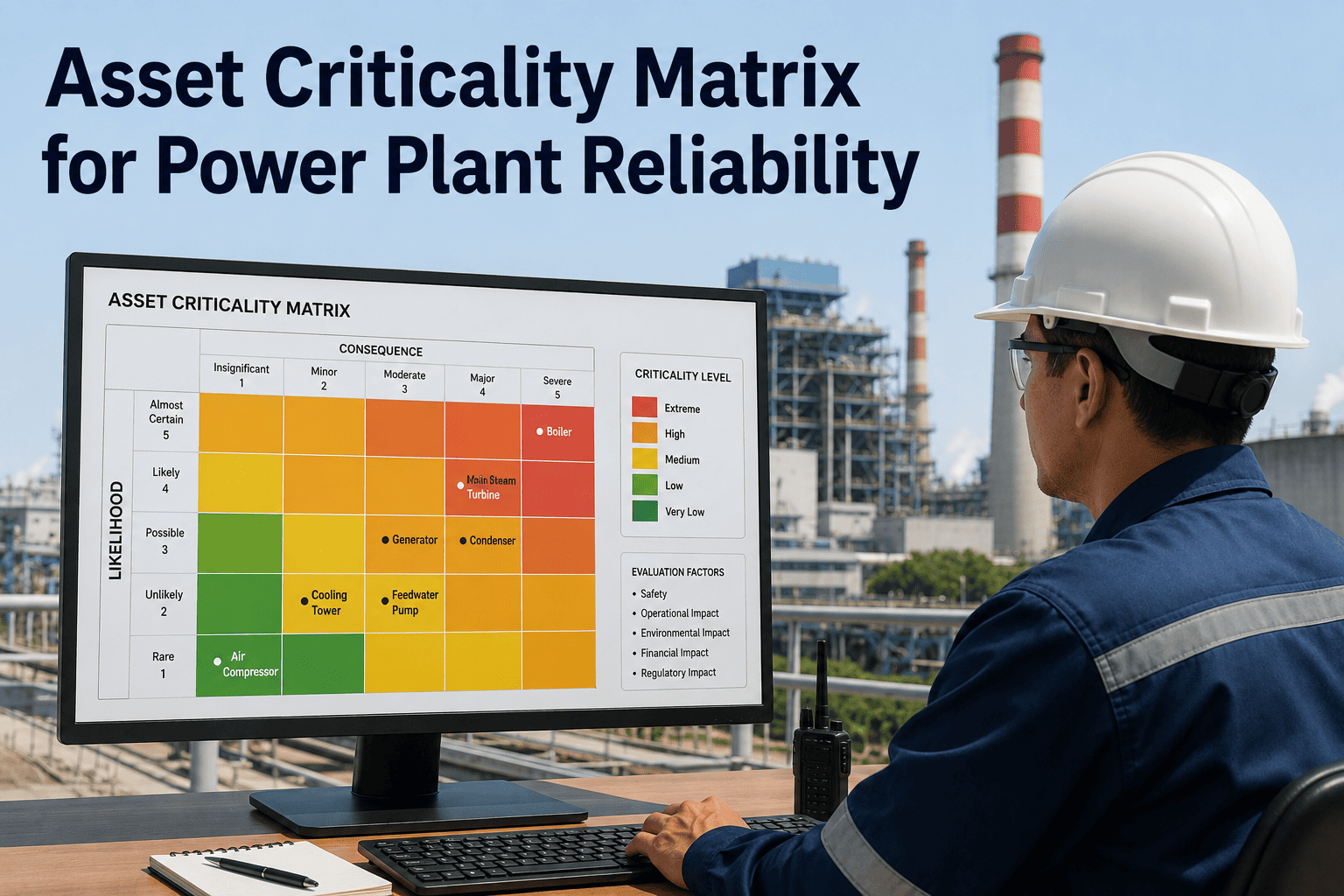
The matrix is simple to read and hard to argue with. Consequence runs up one axis, likelihood across the other. Where a work order lands decides its risk zone — and its zone decides its priority. Low-consequence, low-likelihood work waits; high-consequence, high-likelihood work jumps the queue. Start free and put your work orders on this matrix in OxMaint AI.
Consequence ↑ / Likelihood →
Rare
Unlikely
Possible
Likely
Almost certain
Catastrophic
M
H
C
C
C
Major
M
M
H
C
C
Moderate
L
M
M
H
H
Minor
L
L
M
M
H
Negligible
L
L
L
M
M
C — Critical (P1)
H — High (P2)
M — Medium (P3)
L — Low (P4)
The Five Factors That Set Priority
Consequence and likelihood aren't single guesses — each is built from factors a plant already knows. These five turn a subjective "it feels urgent" into a defensible score. Book a demo to weight these factors for your plant.
01Safety Impact
Could failure hurt someone or breach a safety limit? This is a hard constraint — high safety risk bypasses the queue entirely.
Axis: Consequence
02Production Impact
Does the failure cut MW, force a derate, or risk a trip? Lost generation is the clearest cost of getting the queue wrong.
Axis: Consequence
03Asset Criticality
How essential is the asset itself? Class A (mission-critical), B (important) or C (general) sets a baseline score before anything else.
Axis: Consequence
04Urgency
How fast is it degrading, and is a compliance or outage deadline attached? Urgency compresses the response window.
Axis: Likelihood / time
05Failure Probability
How likely is failure soon — from condition, age and history? This is the likelihood axis, informed by real asset data.
Axis: Likelihood
Weights are yours to set
A plant might weight safety and production heaviest; another leans on criticality. The matrix is the same — the weighting reflects your mission.
Safety and Compliance Aren't Scored. They're Non-Negotiable.
A true risk matrix treats safety and regulatory work as hard constraints that jump the queue — not variables to be out-weighed by cost. OxMaint AI enforces that rule automatically, so the critical few never sit behind the trivial many.
From Risk Zone to Response Window
A risk score is only useful if it maps to an action deadline. Each priority tier carries a response window, so "critical" means a defined clock, not a vague sense of hurry. Sign up free and auto-assign these tiers from the score.
P1
Critical — Immediate
Safety, trip risk or major production loss. Respond now; mobilize before other work.
P2
High — 24–48 hours
Serious consequence or high likelihood. Schedule ahead of routine work, tight window.
P3
Medium — 1–2 weeks
Moderate risk. Planned into the normal maintenance schedule with the right parts and people.
P4
Low — Backlog / fill capacity
Minor, low-likelihood work. Done when capacity allows, batched for efficiency.
Scoring a Work Order, Step by Step
Turning the matrix into a live priority is a short, repeatable loop — the same one OxMaint AI runs on every incoming job. Book a demo to run this scoring on your backlog.
Step 1
Rate consequence — score safety, production impact and asset criticality to place the job on the consequence axis.
Step 2
Rate likelihood — use failure probability and urgency, drawn from condition, age and history, for the likelihood axis.
Step 3
Read the risk zone — the intersection lands in a Critical, High, Medium or Low cell — the composite risk score.
Step 4
Assign the priority — the zone maps to a P1–P4 tier with its response window, and the work order takes its place in the queue.
Step 5
Review & re-rank — as condition changes, the score updates and the queue re-orders itself — priority stays current, not frozen at intake.
Why a Matrix Beats Gut Feel
The difference between scoring risk and reacting to noise shows up in the backlog every week. Start free and replace the shouting match with a score.
GUT-FEEL PRIORITIZATION
What It Costs
- The loudest requester wins, not the biggest risk
- Critical assets wait behind convenient jobs
- PM capacity gets eaten by reactive firefighting
- No defensible reason for any given order
- Priority frozen at intake, never revisited
RISK-BASED MATRIX IN OXMAINT AI
What It Gives
- The highest-risk work rises to the top by rule
- Safety and compliance bypass the queue
- Reserved PM time protected from reactive load
- Every priority is scored and explainable
- Scores update as condition changes
What OxMaint AI Adds
A matrix on a whiteboard is a good idea; a matrix wired into every work order is a working system. Start free and see risk-based prioritization end to end.
Automatic Risk Scoring
Every work order scored on consequence and likelihood the moment it's raised — no manual triage.
Custom Factor Weights
Set how heavily safety, production, criticality, urgency and probability count for your plant.
Criticality-Class Inheritance
Class A/B/C assets pass a baseline score to their work orders automatically.
Hard Safety Constraints
Safety and compliance jobs escalate to the top regardless of other scores.
Protected PM Capacity
Reserve technician time for planned work so reactive jobs can't consume the schedule.
Live Re-Ranking
Scores refresh as condition and urgency change, keeping the queue in true risk order.
Frequently Asked Questions
What is a maintenance priority matrix?
A tool that ranks each work order by the consequence of failure against its likelihood, placing it in a risk zone that sets its priority — so the queue follows risk, not volume or volume of complaint.
Start free and build yours in OxMaint AI.
How is the risk score calculated?
Consequence factors (safety, production, criticality) and likelihood factors (failure probability, urgency) are scored and combined — often as weighted values summed into one number that maps to a priority tier.
Book a demo of the scoring model.
Where do safety and compliance fit?
What do the P1–P4 tiers mean?
They map risk zones to response windows: P1 immediate, P2 within 24–48 hours, P3 within 1–2 weeks, P4 into backlog — so "priority" carries a real deadline.
Book a demo of tiered response windows.
Does the priority change over time?
It should. As condition degrades or a deadline nears, the score rises and the queue re-orders. OxMaint AI keeps priorities live instead of frozen at intake.
Start free and keep your queue current.
Let Risk Run the Queue — Not the Loudest Voice.
A priority matrix turns a contested backlog into a ranked, defensible plan: score consequence and likelihood, read the risk zone, assign the tier, act on the deadline. OxMaint AI maintenance management software builds it into every work order — so your critical few never wait behind the trivial many.