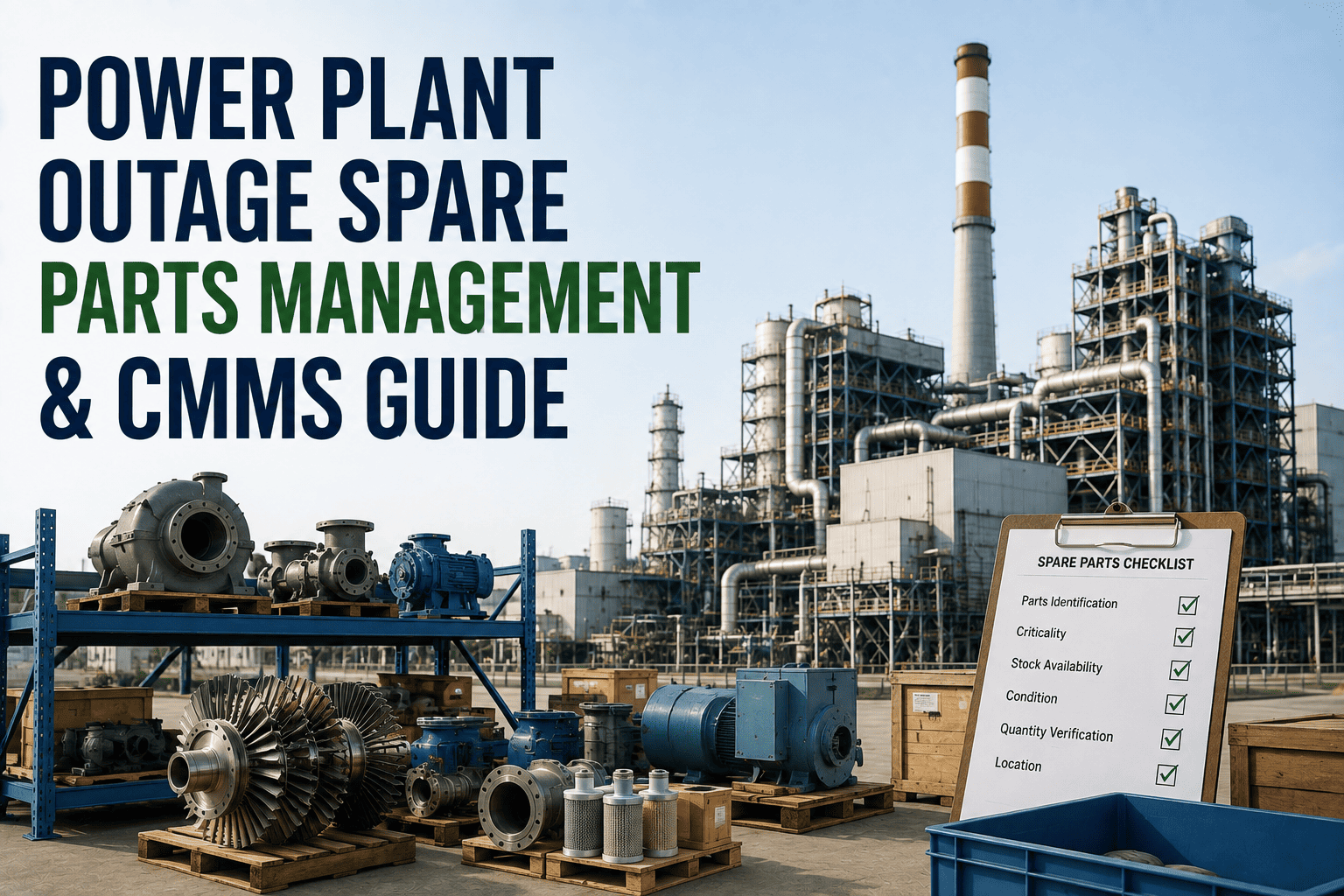
Power plant outage planning requires a structured 12-month lead time to secure long-lead parts, lock in specialty contractors, and satisfy regulatory notification deadlines without derailing generation schedules. A well-executed outage planning timeline reduces unplanned downtime by up to 40% and keeps multi-million-dollar maintenance budgets on track. By integrating a CMMS outage timeline early in the process, reliability teams can automate milestone tracking, streamline outage parts procurement, and ensure no critical path task slips through the cracks. See how OxMaint transforms your next turnaround by taking 60 seconds to Start Free Trial today.
12-MONTH OUTAGE PLANNING LEAD TIME GUIDE
Is your 12-month outage planning timeline leaving critical path tasks to chance?
Most power plant overruns trace back to missed procurement deadlines and untracked scope changes in the first 90 days of planning. A CMMS outage timeline eliminates the blind spots—giving you total control over milestone tracking, contractor scheduling, and long-lead parts management.
OUTAGE PLANNING SCHEDULE
The 12-Month Power Plant Outage Planning Timeline
A successful plant outage planning schedule breaks down into four distinct phases. Missing the regulatory notification window or delaying scope freeze by even a few weeks can cascade into $250K+ in expedited freight and extended downtime.
Phase 1: Scope Definition & Long-Lead Parts
Identify critical path assets, finalize the equipment list, and submit purchase requests for long-lead parts power plants require—such as turbine rotors, valve internals, and main transformers. Establish the baseline CMMS outage planning framework.
Phase 2: Regulatory Notification & Scope Freeze
Issue regulatory notification for outage to grid operators, environmental agencies, and regional reliability councils. Execute a hard scope freeze to prevent late additions that inflate contractor costs by 20–30%.
Phase 3: Contractor Staging & Procurement
Finalize outage parts procurement for standard spares. Lock in specialty contractor schedules (NDE, turbine overhaul, generator rewind). Pre-stage kitted parts in the warehouse using CMMS inventory tracking.
Phase 4: Execution Readiness & Lockout
Conduct pre-outage safety briefings, verify LOTO procedures, and confirm all work orders are loaded into the CMMS outage timeline. Validate spare parts availability down to 99% fulfillment for critical path tasks.
OUTAGE PARTS PROCUREMENT GUIDE
Critical Parts & Regulatory Deadlines Checklist
Missing a 90-day regulatory notification outage deadline can result in six-figure fines and delayed grid synchronization. Use this outage procurement guide to verify every long-lead item and compliance milestone is locked in.
- Turbine rotor forgings (12–18 mo)
- Main generator step-up transformer (14–24 mo)
- HP/LP valve internals and seats (6–10 mo)
- Specialized heat exchanger bundles (4–8 mo)
- Grid operator outage request (M-9 minimum)
- EPA emissions testing schedule (M-6)
- State environmental agency filings (M-6)
- NRC/Regional reliability council updates (M-3)
- OEM turbine specialist crew (M-8)
- Scaffold access contract (M-6)
- NDE/inspection vendors (M-5)
- Insulation & abatement teams (M-4)
- Pre-load all work orders into CMMS (M-2)
- Verify LOTO isolation points per asset (M-1)
- Map spare parts kits to work order PMs (M-2)
- Generate daily execution dashboard (M-1)
| Milestone | Lead Time | Cost Impact if Missed | Owner |
|---|---|---|---|
| Scope Freeze | M-9 | 20–30% increase in contractor rates | Outage Manager |
| Regulatory Notification | M-9 to M-6 | $50K–$250K fines, delayed sync | Compliance Lead |
| Long-Lead Parts PO | M-12 to M-9 | $200K+ expedited freight & downtime | Supply Chain |
| Contractor Scheduling | M-8 to M-5 | Crew unavailability, 2-week delay | Outage Manager |
| CMMS Work Order Load | M-2 | Execution chaos, lost LOTO tracking | Reliability Eng. |
THE COST OF DELAY
How much does poor outage lead time planning cost?
A single day of unplanned downtime at a 500 MW coal or gas-fired facility can cost $150,000 to $500,000 in lost generation revenue. Poor 12-month planning power directly impacts your bottom line through expedited freight, premium contractor labor, and extended outages.
Example: A 5-day outage overrun at 500 MW ($45/MWh) adds $2.7M in lost revenue alone—before adding $120K in expedited parts and $80K in premium contractor overtime.
CMMS OUTAGE PLANNING SOLUTION
How OxMaint streamlines your 12-month outage timeline
OxMaint is a purpose-built, AI-powered CMMS and EAM platform that transforms reactive outage planning into a proactive, data-driven process. By centralizing work orders, spare-parts inventory, and milestone tracking, reliability teams gain total visibility into their outage schedule power.
Automated Outage Milestone Tracking
Map your entire 12-month outage planning timeline with automated alerts for scope freezes, regulatory notifications, and procurement deadlines—reducing manual tracking time by 70%.
Long-Lead Parts Procurement Integration
Link long-lead parts power items directly to work orders and track POs from requisition to staging. Achieve 99% spare parts fulfillment for critical path tasks and cut expedited freight costs by 40%.
Compliance & Regulatory Audit Trails
Generate automatic documentation for regulatory notification outage filings, LOTO procedures, and safety briefings—ensuring 100% audit readiness for NERC, EPA, and internal compliance reviews.
AI-Powered Predictive Analytics
Use historical outage data and asset health scores to predict scope additions and failure modes before scope freeze—eliminating 30% of unplanned additions and keeping your budget on track.
STOP LEAVING MILESTONES TO CHANCE
See OxMaint on your assets — book a 30-min demo
Discover how a centralized CMMS outage timeline can cut your planning hours by 70% and secure your long-lead procurement before it's too late.
FAQ
Power Plant Outage Lead Time Planning Questions
How much lead time is needed for a power plant outage?
A major power plant outage requires a minimum 12-month lead time. This window is driven by long-lead parts power procurement (turbine rotors and transformers can take 12–18 months), regulatory notification outage deadlines (often 6–9 months prior), and specialty contractor scheduling. A structured 12-month outage planning timeline ensures scope freeze, procurement, and execution readiness happen in the correct sequence.
What is a scope freeze milestone in outage planning?
Scope freeze is the hard deadline—typically at the 9-month mark (M-9)—after which no new work orders or asset interventions can be added to the outage plan without executive approval. It prevents scope creep, which typically inflates outage budgets by 20–30% and disrupts the critical path. Using a CMMS outage timeline helps enforce this by locking work order generation after the milestone.
How does a CMMS help with 12-month outage planning?
A CMMS like OxMaint centralizes the outage planning schedule by tracking milestones, linking long-lead parts to specific work orders, and automating regulatory deadline alerts. It replaces spreadsheets and manual checklists, cutting planning hours by up to 70% and ensuring 99% spare parts fulfillment for critical path tasks. You can Start Free Trial to test the workflow on your assets.
When should regulatory notifications be submitted for a plant outage?
Regulatory notifications must typically be submitted 6 to 9 months before the outage start date, depending on the grid operator, environmental agency, and regional reliability council. Missing this outage milestone power deadline can result in fines from $50K to $250K and forced rescheduling. Your outage procurement guide should map these notifications to the M-9 and M-6 milestones automatically.
What are the most common long-lead parts for power plant outages?
The most critical long-lead parts include turbine rotors (12–18 months), main step-up transformers (14–24 months), HP/LP valve internals (6–10 months), and large heat exchanger bundles (4–8 months). Outage parts procurement for these items must begin at the M-12 mark. Delaying these POs is the leading cause of expedited freight costs and extended downtime during execution.
READY TO OPTIMIZE YOUR OUTAGE?
Transform your 12-month outage planning timeline today
Join the reliability teams using OxMaint to cut planning hours, secure long-lead parts, and execute flawless outages. Book a personalized demo or start your free trial now.
Free 14-day trial · No credit card