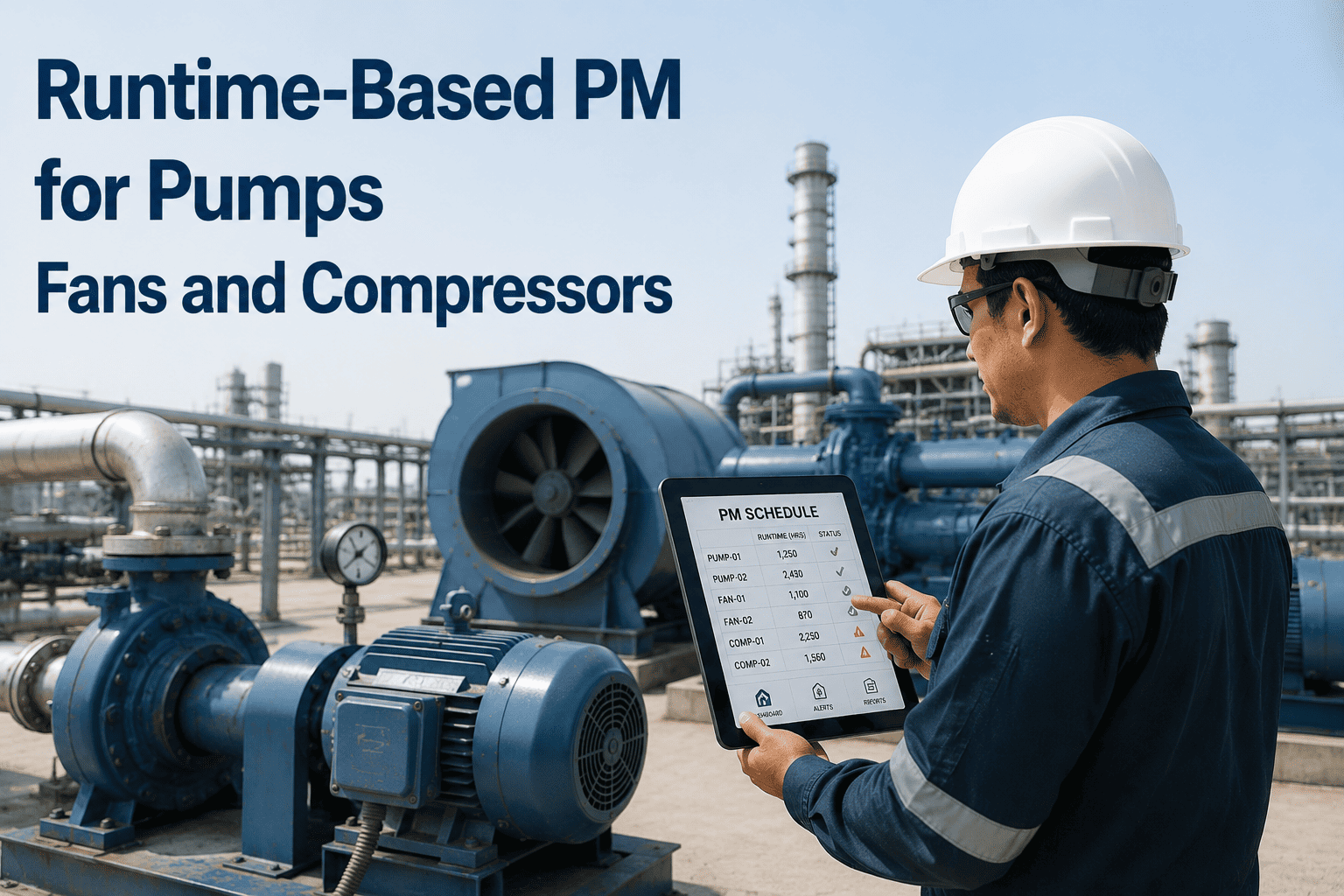
Power plant pumps operate continuously under extreme conditions, yet most facilities still maintain them on fixed calendar schedules that ignore actual wear patterns. A boiler feedwater pump running 8,000 hours annually experiences dramatically different stress than one operating only 3,000 hours, but calendar-based maintenance treats both identically. This mismatch results in either premature service that wastes resources or delayed intervention that risks catastrophic failure. Runtime-based maintenance transforms this approach by triggering inspections and overhauls based on actual operating hours, ensuring pumps receive attention exactly when they need it. Oxmaint's runtime tracking platform automates hour monitoring across your entire pump fleet, eliminating manual tracking errors and scheduling maintenance at precisely the right intervals.
Critical Pump Systems in Power Plant Operations
Power plants rely on interconnected pump systems that must operate continuously at peak efficiency. Understanding each pump type's unique operating characteristics and failure modes is essential for implementing effective runtime-based maintenance programs. Here are the four critical pump categories that demand the closest attention:
Boiler Feedwater Pumps
The most critical pumps in any thermal plant, BFPs operate under extreme pressure (up to 400 bar) and temperature conditions. They deliver water to the steam generator at rates up to 2,500 tons per hour. Failure causes immediate unit trip and potential boiler damage.
Condensate Extraction Pumps
Operating at extremely low suction pressures near vacuum conditions, these pumps collect saturated water from the condenser hot well. They run continuously when the unit is online and are highly susceptible to cavitation damage if not properly maintained.
Circulating Water Pumps
These high-volume, low-head pumps move enormous quantities of cooling water through the condenser. A 500 MW unit may require 50,000+ GPM of cooling water flow. Failures degrade condenser vacuum and force load reductions or unit trips.
Auxiliary Pump Systems
Includes lube oil pumps, seal water pumps, chemical feed pumps, and service water pumps. While individually less critical, collective failures of auxiliary pumps account for 40% of forced outage events due to their quantity and interconnected nature.
The 6 Common Pump Failure Modes and Their Runtime Triggers
Understanding when failures occur relative to operating hours enables precise maintenance scheduling. These six failure modes account for over 85% of power plant pump failures, and each has predictable runtime-based patterns that Oxmaint's maintenance scheduling can track:
Bearing Degradation
Sleeve and rolling element bearings degrade predictably with runtime. Vibration signatures change detectably 500-1,000 hours before catastrophic failure, providing ample warning when properly monitored.
Mechanical Seal Failure
Seal faces wear at consistent rates based on operating hours and fluid conditions. Leakage rates increase predictably, allowing scheduled replacement during planned outages rather than emergency shutdowns.
Impeller Erosion
Cavitation and particle erosion gradually reduce impeller efficiency. Performance degradation is measurable through head-flow curves, enabling condition-based replacement timed with runtime milestones.
Coupling Wear
Flexible coupling elements fatigue with start-stop cycles and continuous operation. Grid, disc, and gear couplings each have characteristic wear patterns that correlate strongly with accumulated runtime.
Wear Ring Clearance
Internal wear ring clearances increase with runtime, reducing pump efficiency by 5-15%. This silent efficiency loss often goes undetected until performance drops become operationally significant.
Motor Insulation Degradation
Motor winding insulation degrades with thermal cycling and continuous operation. Megger readings trend downward predictably with runtime, enabling scheduled rewinding before catastrophic motor failure.
Runtime-Based Maintenance Schedule for Power Plant Pumps
This comprehensive schedule represents industry best practices for pump maintenance intervals based on actual operating hours. Implementing these intervals through Oxmaint's automated scheduling ensures no critical task is missed while avoiding unnecessary premature maintenance:
Automate Your Pump Runtime Tracking
Stop relying on spreadsheets and manual logs. Oxmaint automatically tracks operating hours for every pump in your fleet and triggers work orders at exactly the right intervals.
How Oxmaint Enables Runtime-Based Pump Maintenance
Manual runtime tracking using spreadsheets and paper logs introduces errors, delays reporting, and makes it nearly impossible to coordinate maintenance across a fleet of 40-60 pumps. Oxmaint's CMMS platform eliminates these challenges with purpose-built features for power plant operations:
Automated Hour Meter Tracking
Connect directly to SCADA systems or manually log runtime hours. Oxmaint calculates cumulative operating hours for every pump and automatically tracks progress toward maintenance thresholds without manual intervention.
Multi-Trigger PM Scheduling
Configure preventive maintenance to trigger based on runtime hours, calendar intervals, or whichever comes first. Different maintenance tasks can have independent triggers on the same pump for maximum flexibility.
Automatic Work Order Generation
When a pump reaches its runtime threshold, Oxmaint automatically generates a work order with complete task details, required parts, and estimated labor hours. No more missed maintenance windows due to tracking failures.
Fleet-Wide Runtime Dashboards
View runtime status for your entire pump fleet on a single dashboard. Color-coded indicators show which pumps are approaching maintenance thresholds, enabling proactive planning and resource allocation.
Maintenance History Analytics
Track actual vs. planned runtime intervals for every maintenance event. Identify pumps that consistently fail before expected intervals, enabling targeted root cause analysis and specification adjustments.
Mobile Inspection Checklists
Technicians complete runtime-triggered inspections on mobile devices with mandatory data fields for vibration readings, temperature measurements, and oil sample results. Photo documentation ensures thorough condition assessment.
Implementation Roadmap: 4 Weeks to Runtime-Based Scheduling
Transitioning from calendar-based to runtime-based pump maintenance requires systematic implementation. This proven roadmap delivers measurable results within 30 days through Oxmaint's structured onboarding process:
Pump Asset Inventory and Baseline
Catalog every pump in your plant with specifications, current runtime hours, and maintenance history. Establish baseline operating hours from existing records or hour meter readings. Identify critical pumps that require the most rigorous tracking.
Configure Runtime-Based PM Tasks
Build PM schedules in Oxmaint with runtime triggers for each pump type. Define inspection checklists, required parts, and labor estimates. Set up notification thresholds to alert maintenance planners before intervals are reached.
Establish Hour Tracking Workflow
Implement daily or shift-based runtime logging procedures. Configure SCADA integration if available, or establish manual logging protocols. Train operators on accurate hour recording and verification processes.
Launch and Monitor Performance
Activate runtime-based scheduling for all pump assets. Monitor work order generation, PM compliance rates, and technician feedback. Refine intervals based on actual equipment condition findings during first maintenance cycles.
Power Plant Pump Performance Benchmarks
Use these industry benchmarks to evaluate your pump maintenance program performance. Top-quartile plants achieve these metrics through disciplined runtime-based maintenance programs:
Transform Your Pump Maintenance Program
Join power plants that have reduced pump-related outages by 70% through runtime-based maintenance scheduling. Start your transition today.
Frequently Asked Questions
How do I track runtime hours if my pumps don't have hour meters?
Oxmaint supports multiple hour tracking methods. If your pumps lack dedicated hour meters, you can calculate runtime from motor starter auxiliary contacts, SCADA run signals, or daily operator logs. Many plants estimate runtime from unit load factors when detailed pump-specific data isn't available. The key is establishing a consistent tracking method and maintaining discipline in logging. Even estimated runtime tracking delivers significantly better results than pure calendar-based scheduling.
What's the typical payback period for implementing runtime-based maintenance?
Most power plants see payback within 3-6 months of implementing runtime-based pump maintenance. The primary savings come from eliminating one or two unplanned pump failures per year, which typically cost $50,000-$500,000 each in emergency repairs and lost generation. Secondary savings include reduced spare parts inventory from better planning and lower overtime costs from scheduling maintenance during regular hours rather than emergency callouts.
Should I use runtime-based or condition-based maintenance for critical pumps?
The best approach combines both strategies. Runtime-based maintenance establishes maximum intervals between inspections and component replacements, while condition monitoring (vibration analysis, oil analysis, thermography) enables extending those intervals when equipment condition warrants it. Oxmaint supports both approaches, allowing you to trigger maintenance based on runtime OR condition thresholds, whichever comes first. For critical boiler feedwater pumps, most plants use runtime triggers with condition monitoring as a secondary check.
How does Oxmaint integrate with our existing SCADA or DCS system?
Oxmaint offers multiple integration pathways depending on your control system architecture. Direct API integration captures runtime data automatically from SCADA historians or real-time databases. For systems without direct integration capability, Oxmaint can import runtime data from CSV exports on scheduled intervals. Our implementation team works with your I&C department to establish the most reliable data flow for your specific infrastructure.
What happens when a pump exceeds its runtime interval before we can perform maintenance?
Oxmaint provides escalating notifications as pumps approach runtime thresholds: typically at 80%, 90%, and 100% of interval. When a pump exceeds its interval, the system flags it as overdue with red status indicators on dashboards and reports. You can configure automatic escalation to maintenance supervisors and plant management. The system also tracks overdue hours to identify chronic scheduling problems and support root cause analysis of why maintenance windows were missed.