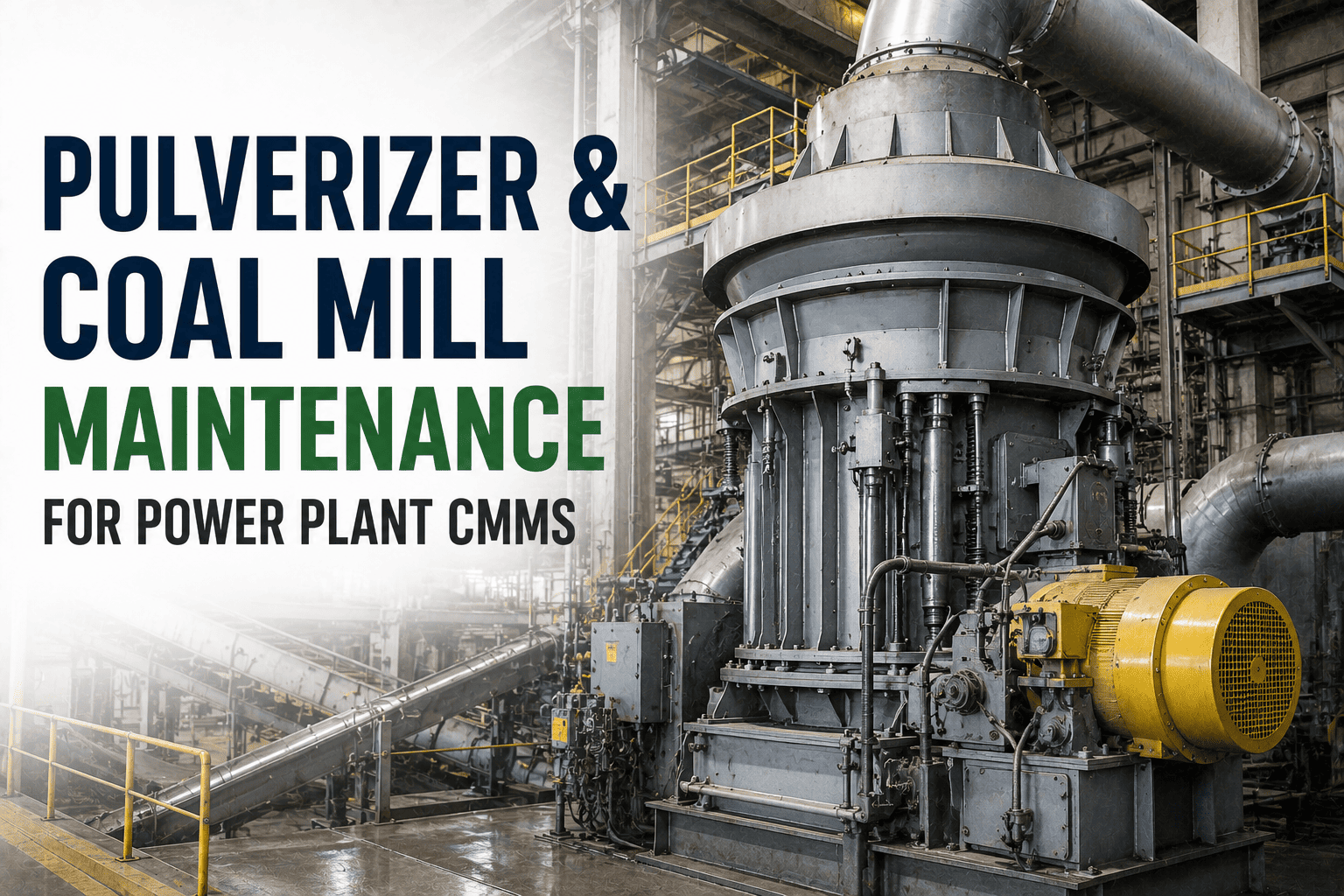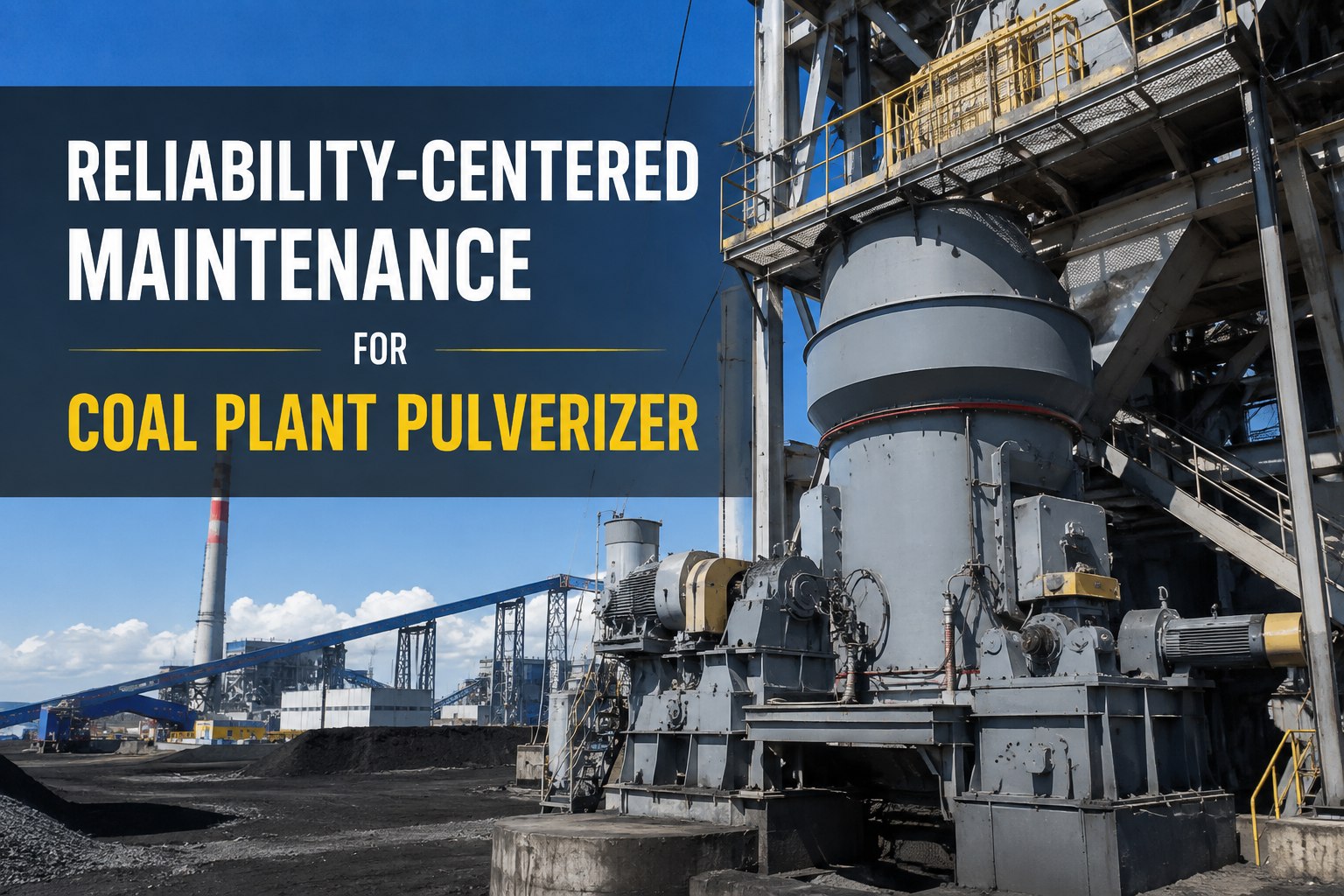
Reliability-centered maintenance (RCM) for coal plant pulverizers is a structured methodology that identifies critical failure modes—such as grinding ring wear, journal bearing degradation, and gearbox oil contamination—and assigns targeted condition-based or preventive tasks to each. For a typical 500 MW unit running multiple bowl mills or ball mills, pulverizer unavailability can force load derates costing $40,000–$120,000 per day in lost generation margin, making pulverizer reliability a primary driver of coal plant RCM success. Implementing pulverizer RCM maintenance through an AI-powered CMMS like OxMaint reduces unplanned mill outages by 30–50%, extends grinding element life, and ensures your maintenance team is executing the right task at the right interval. You can Start Free Trial today to map your pulverizer assets and failure modes, or book a guided demo to see the full RCM workflow in action.
Is One Failed Pulverizer Derating Your Entire Unit?
When a single coal mill drops offline, you lose 15–20% of unit capacity instantly. A disciplined RCM program built in OxMaint catches bearing vibration, oil degradation, and grinding wear weeks before they cause a forced outage — keeping every mill available when dispatch demands it.
Critical Pulverizer Failure Modes & RCM Task Selection
A coal plant pulverizer RCM program begins with FMEA: cataloging every way each mill can fail, the consequence of that failure, and the earliest detectable warning signal. Below are the six highest-impact failure modes for bowl mills and ball mills, mapped to the recommended RCM task type and monitoring interval.
| Failure Mode | Component | Warning Signal | RCM Task Type | Interval | Consequence if Ignored |
|---|---|---|---|---|---|
| Grinding ring wear | Bowl / ring | Fineness drop, amp rise | Scheduled restoration | 4,000–6,000 hrs | Coal fineness <70% thru 200 mesh; unburned carbon |
| Journal bearing failure | Journal assembly | Vibration, temp rise | Condition-based (CBM) | Continuous / weekly | Seized journal; 5-day mill outage |
| Gearbox oil degradation | Reduction gearbox | Particle count, viscosity | Oil analysis ( predictive ) | Monthly sample | Gear pitting, shaft failure; $80K+ rebuild |
| Classifier blade erosion | Classifier cage | Fineness imbalance | Time-directed PM | 12 months | Poor fineness; boiler slagging |
| Primary air leakage | Seal air system | Seal air DP drop | Inspection / calibration | Quarterly | Coal dust ingress; fire risk |
| Motor winding degradation | Mill motor | IRIS / partial discharge | Predictive ( electrical ) | 6 months | Motor failure; forced derate |
How to Implement Pulverizer RCM in 6 Months
A phased rollout prevents analysis paralysis. The timeline below shows how a typical 500 MW coal plant moves from reactive pulverizer maintenance to a fully condition-based RCM program within 26 weeks — using OxMaint to automate work order generation at every stage.
Asset Criticality & Data Baseline
Import all pulverizer assets, hierarchies, and nameplate data into OxMaint. Rank mills by criticality. Pull 24 months of work order history to establish baseline MTBF, MTTR, and forced-outage frequency.
FMEA Workshop
Conduct a cross-functional FMEA with operations, maintenance, and engineering. Document failure modes for grinding elements, journals, gearboxes, classifiers, and seal air. Assign consequence severity scores in OxMaint.
Task Selection & PM Build
Apply the RCM decision logic: run-to-failure, time-directed PM, condition-based, or predictive. Build every task into OxMaint as an auto-triggered work order with checklists, parts kits, and labor estimates attached.
Condition Monitoring Integration
Connect vibration sensors, oil analysis lab feeds, and motor testing results to OxMaint. Configure AI threshold alerts so that a bearing vibration spike auto-generates a corrective work order before failure occurs.
Measure, Refine, Scale
Review first-cycle KPIs: unplanned pulverizer downtime, PM compliance rate, and derate hours. Adjust intervals based on actual condition data. Scale the RCM framework to fans, pumps, and boiler feedwater systems.
Pulverizer RCM Cost Savings & Payback Formula
The financial case for coal plant reliability centered maintenance is straightforward: compare the annualized cost of forced pulverizer outages against the cost of the RCM program (software + labor + sensors). Most plants achieve full payback within 4–9 months.
Worked Example: 500 MW Plant with 6 Bowl Mills
A 500 MW coal plant running six bowl mills experiences 14 forced pulverizer outages per year, averaging 22 hours each. At $50,000 per derate-day, that is $640,000 in lost margin annually. By implementing RCM in OxMaint — adding vibration monitoring, oil analysis, and auto-triggered PMs — the plant cuts forced outages by 40% (down to ~8 per year) and reduces average repair time from 22 to 14 hours. Annual savings: $310,000 in avoided derates plus $45,000 in reduced emergency repair labor. Total program cost (software + sensors + labor): $62,000. Payback: under 3 months.
How OxMaint Powers Your Pulverizer RCM Program
OxMaint turns your RCM analysis from a static spreadsheet into a living, automated maintenance system. Every failure mode you identify becomes a monitored condition, a triggered work order, and a tracked KPI — without manual data entry or paper chasing.
AI-Driven Predictive Alerts
Connect vibration, temperature, and oil-analysis sensors to OxMaint. AI threshold detection auto-generates a corrective work order the moment a journal bearing or gearbox trends out of spec — cutting unplanned pulverizer downtime 30–50%.
Automated RCM Work Orders
Every PM, condition-based task, and inspection from your FMEA is scheduled and dispatched automatically. Technicians get mobile checklists, parts kits, and photos — eliminating paper work orders and boosting PM compliance above 95%.
Spare-Parts Inventory Sync
Link each pulverizer PM to its parts kit — grinding rings, journals, gearbox oil, classifier blades. OxMaint tracks stock levels, auto-reorders at min, and ensures critical spares are pre-staged before every scheduled mill outage.
Reliability Analytics Dashboard
Track MTBF, MTTR, OEE, and forced-outage hours per mill in real time. Identify which pulverizers are trending toward failure and which RCM tasks are actually reducing risk — so you can refine intervals and justify every maintenance dollar.
See OxMaint on Your Pulverizers — Book a 30-Min Demo
We will load your mill hierarchy, map your top failure modes, and show you exactly how auto-triggered work orders and AI predictive alerts will cut your unplanned downtime — live, on your asset data.
Pulverizer RCM & CMMS: What Reliability Teams Ask
What is reliability-centered maintenance for a coal plant pulverizer?
RCM for a coal plant pulverizer is a systematic process of identifying each mill's critical failure modes — grinding wear, bearing degradation, gearbox oil contamination, classifier erosion — and assigning the optimal maintenance task (predictive, condition-based, time-directed, or run-to-failure) based on consequence and detectability. The goal is to prevent forced derates and extend component life at the lowest cost.
How does a CMMS support pulverizer RCM maintenance?
A CMMS like OxMaint automates the execution layer of RCM: it schedules every PM and inspection, triggers work orders from condition-monitoring data, tracks spare-parts inventory, and records failure history for continuous FMEA refinement. Without a CMMS, RCM decisions stay trapped in spreadsheets and rarely get executed consistently. You can Start Free Trial to see the full workflow.
What are the most common pulverizer failure modes in coal power plants?
The six highest-impact failure modes are grinding ring or ball wear, journal bearing failure, gearbox oil degradation, classifier blade erosion, primary air / seal air leakage, and mill motor winding degradation. Each has a distinct warning signal — vibration, oil particle count, fineness drop, temperature rise — that an RCM program monitors to catch problems weeks before a forced outage.
How much does pulverizer RCM reduce downtime in a coal plant?
Plants that implement a disciplined RCM program with condition monitoring and automated CMMS work orders typically reduce unplanned pulverizer downtime by 30–50%. For a 500 MW unit with six mills, that translates to $250,000–$400,000 in avoided annual derate costs, with full program payback in 3–9 months.
How long does it take to implement RCM for coal plant pulverizers?
A focused pulverizer RCM rollout takes 4–6 months: Month 1 for asset baseline, Month 2 for FMEA workshops, Months 3–4 for task selection and PM build in the CMMS, Month 5 for sensor integration, and Month 6 for KPI review and interval refinement. Book a demo to get a customized implementation plan for your plant.
Stop Reacting to Pulverizer Failures. Start Preventing Them.
Join the coal plant reliability teams using OxMaint to cut unplanned downtime 30–50%, extend grinding element life, and keep every mill online when dispatch calls. Your RCM program starts with one demo.
Free 14-day trial · No credit card