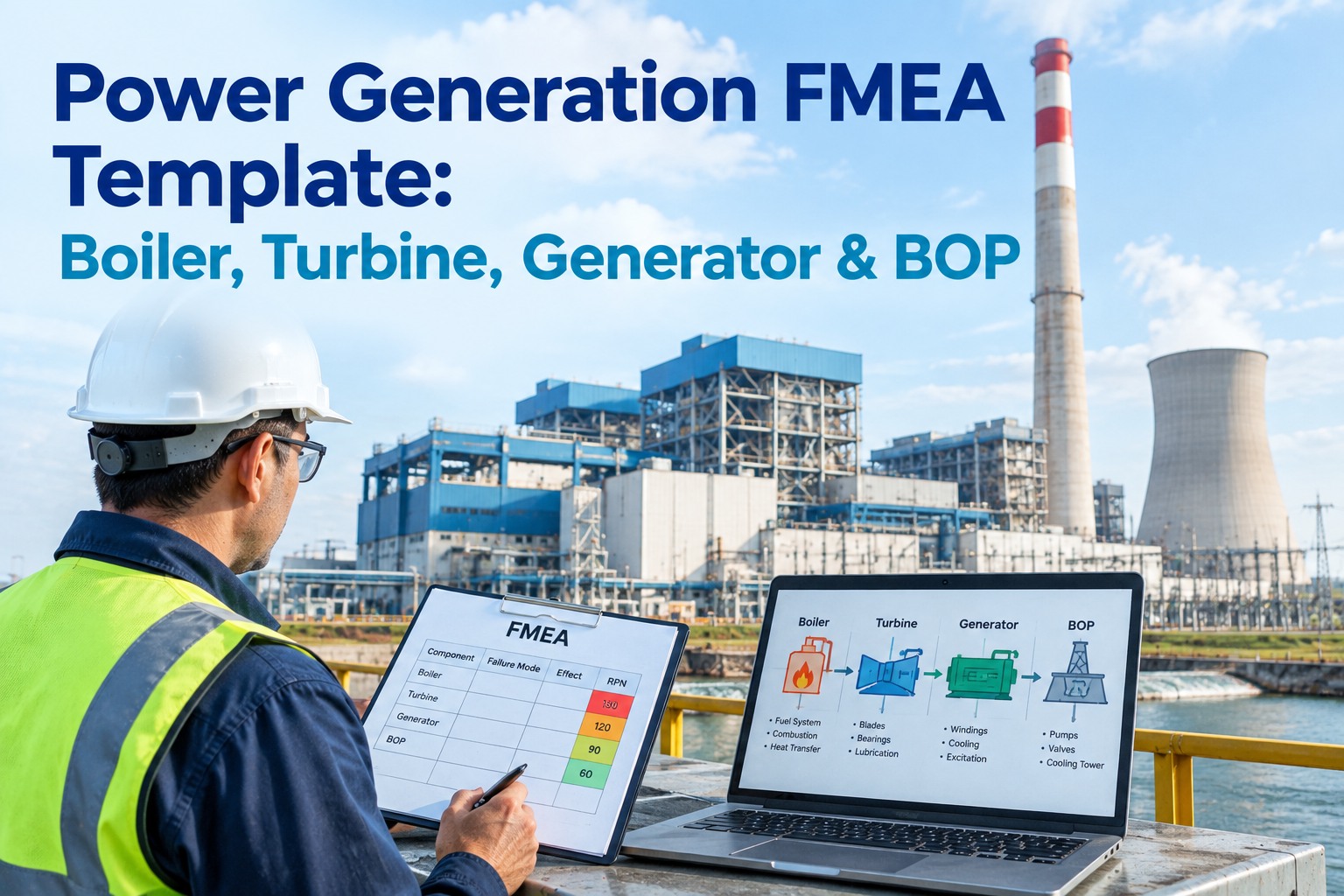
A maintenance plan that treats every asset the same quietly wastes effort on low-risk kit while under-protecting the one failure that takes the whole unit down. FMEA fixes that by ranking every way your plant can fail by real risk — so attention and budget follow consequence, not habit. The OXMAINT AI — the AI-powered maintenance management software — turns that ranking into the actual PM and PdM plan, so the highest-risk failure modes get the right task first.
Reliability Engineering · FMEA / RCM · Power Generation · Maintenance Prioritization · 2026
Power Plant FMEA: Failure Modes, Risk Analysis & Maintenance
Turbines, boilers, generators and balance-of-plant equipment each fail in their own ways, with wildly different consequences. FMEA scores every failure mode by how bad, how likely and how hard to catch — then OXMAINT AI turns that score into the maintenance task that actually lowers the risk.
1Find the mode
→
2Score S × O × D
→
3Rank by RPN
→
4Assign the task
S × O × D
RPN scores severity, occurrence and detection together
1–1000
Each factor runs 1–10, giving a priority number for every mode
4 domains
Turbines, boilers, generators and balance-of-plant
Risk-ranked
Effort follows consequence, not a uniform calendar
Why a Uniform Maintenance Plan Fails
When every asset is on the same PM cadence, the plan is wrong in two directions at once — over-serving the equipment that barely matters and under-serving the one that will trip the unit. FMEA is how you tell the difference before a failure does it for you, and OXMAINT AI keeps that judgment living in your work-order plan; start free and build your risk-ranked maintenance plan in OXMAINT AI.
Hidden high-risk modes
The failure that takes the unit down is often on no special watch — because nobody scored its consequence.
Flat PM everywhere
One cadence for all assets over-maintains the trivial and starves the critical of attention.
Budget by habit
Spend lands where it always has, not where the risk is — so money and downtime leak together.
Hard-to-catch faults
A mode you cannot detect early needs a different strategy — but only a detection score tells you which.
The RPN Engine: Severity × Occurrence × Detection
FMEA turns a vague sense of risk into a number by scoring three things and multiplying them. Each factor runs from 1 to 10, so the Risk Priority Number lands between 1 and 1000 — and the plant sorts itself by what deserves attention first; book a demo to see RPN scoring built into the asset record in OXMAINT AI.
S
Severity
1 – 10
How bad is the effect — from a minor nuisance to a safety event or total loss of the unit.
×
O
Occurrence
1 – 10
How likely is the mode — from a remote chance to a fault that recurs on a known cycle.
×
D
Detection
1 – 10
How hard to catch early — from sure to spot on a trend to effectively invisible until it fails.
=
RPN
Risk Priority
1 – 1000
The score that ranks the whole plant, so the task plan starts at the top of the list.
FMEA Across the Plant
Every major system carries its own signature failure modes — the ones worth scoring first. These are the usual high-risk candidates FMEA surfaces in a thermal plant; start free and hold an FMEA for every asset class in OXMAINT AI.
Steam Turbines
Bearing wearBlade erosionGovernor / control faultOverspeed
Boilers
Tube failureOverheating / creepFireside corrosionRefractory loss
Generators
Winding insulationStator / rotor faultCooling lossExcitation fault
Balance of Plant
Pump & fan wearValve failureHeat-exchanger foulingTransformer insulation
The FMEA Worksheet in Practice
An FMEA is only useful when it is written down the same way every time — mode, effect, three scores, the RPN and the task it drives. Here is what that looks like for a handful of power-plant modes, with example scores to show the shape; book a demo to see the worksheet built against your own assets in OXMAINT AI.
Equipment
Failure mode
Effect
S
O
D
RPN
Task
Boiler
Tube leak
Unplanned shutdown
9
6
6
324
UT + chemistry monitoring
Generator
Winding insulation breakdown
Catastrophic failure
10
3
7
210
Partial-discharge testing
Steam turbine
Bearing wear
Vibration trip, forced outage
9
4
5
180
Vibration PdM
Boiler feed pump
Seal failure
Loss of feedwater, trip
8
5
4
160
Seal inspection PM
Condenser
Tube fouling
Efficiency fall, derate
5
7
4
140
Cleaning schedule
Transformer
Insulation degradation
Fault, fire risk
10
2
6
120
DGA oil analysis
From RPN to the Right Task
The number is not the point — the task it drives is. A high RPN earns a predictive or design response, a middle score earns a scheduled task, and a low one can be left to run and simply watched. OXMAINT AI carries each mode to its matching strategy; start free and map every RPN to its maintenance task in OXMAINT AI.
High RPN
Predictive monitoring or a design fix — act now, before the mode matures.
Medium RPN
A scheduled PM or condition task on a defined interval holds the risk down.
Low RPN
Run-to-failure is acceptable — logged, watched and reviewed, not actively serviced.
An FMEA in a Spreadsheet Ages the Day It Is Finished.
Risk is not static — a mode that failed twice this year is not as rare as its old score says. Run your FMEA inside the OXMAINT AI maintenance management software and every real failure feeds the scores, so the ranking and the task plan move with the plant instead of gathering dust.
How OXMAINT AI Runs FMEA-Driven Maintenance
FMEA only pays back when the scores live with the assets and drive the actual plan — and that is the job the software does. Here is what the OXMAINT AI maintenance management software brings to reliability prioritization; book a demo to see FMEA-driven planning in OXMAINT AI.
Asset FMEA records
Every failure mode scored for severity, occurrence and detection and stored against its asset.
Plant-wide RPN ranking
The whole plant sorted by risk, so the riskiest modes sit at the top of the plan, not the bottom.
Risk-to-task mapping
High RPN becomes a PdM or redesign action, medium a scheduled PM, low a watched item.
Auto PM / PdM scheduling
The chosen task becomes a recurring work order on the right interval, with no manual re-entry.
Live risk refresh
As failures are logged, occurrence and detection move with reality and the ranking re-sorts.
One reliability record
FMEA scores, tasks, work-order history and cost sit together, so the next review starts with evidence.
Frequently Asked Questions
What is FMEA in a power plant?
FMEA — Failure Modes and Effects Analysis — is a structured way to list how each major asset can fail, judge how serious each failure is, and rank them by risk so maintenance effort goes where it matters most.
How is the RPN calculated?
RPN is Severity × Occurrence × Detection, each scored 1 to 10, giving a Risk Priority Number from 1 to 1000. The higher the number, the higher the maintenance priority for that failure mode.
What is the difference between FMEA and RCM?
FMEA ranks failure modes by risk; RCM uses that ranking to decide the maintenance strategy for each one. FMEA is a step inside the broader RCM process, not a rival to it.
Is RPN still the accepted standard?
RPN is still widely used, but the 2019 AIAG-VDA handbook moved to an Action Priority rating (high, medium, low) because two modes with the same RPN do not always carry the same real risk.
How does a CMMS support FMEA?
It stores the scores against each asset, ranks the plant by risk, turns each priority into the right scheduled task, and refreshes the ranking as real failures come in — so the analysis stays current;
OXMAINT AI runs the full FMEA-to-task loop.
Put Your Maintenance Effort Where the Risk Actually Is.
Run FMEA inside the OXMAINT AI maintenance management software — asset failure-mode records, plant-wide RPN ranking, risk-to-task mapping, automatic PM and PdM scheduling and a live risk refresh — so turbines, boilers, generators and balance-of-plant equipment all get the attention their risk earns, no more and no less.