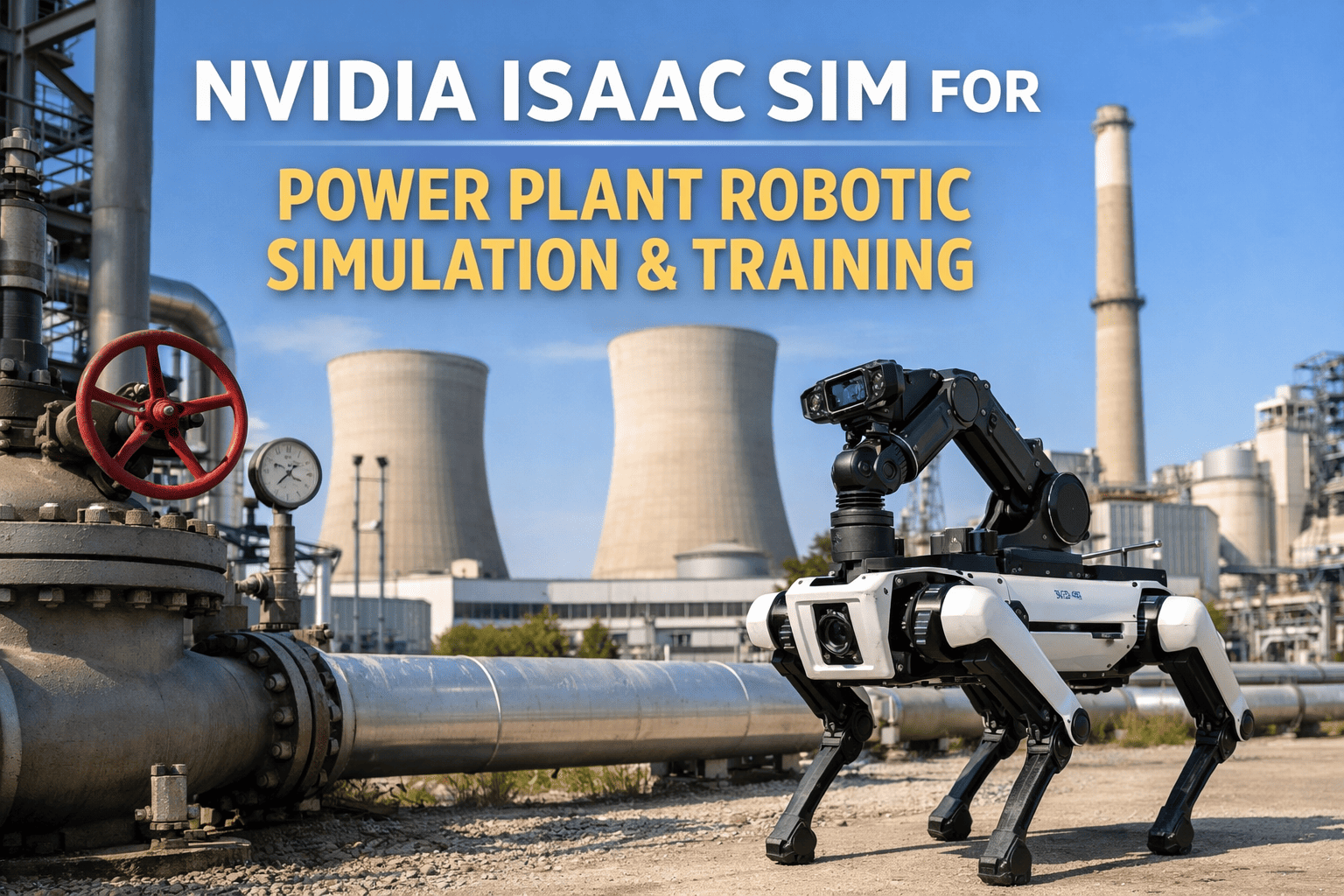
Autonomous inspection robots are no longer a research project — the global market reached $2.8 billion in 2024 and is accelerating toward $6.07 billion by 2033. The technology stack making this possible in power plants is not proprietary or opaque: it is ROS2 as the robot middleware layer, NVIDIA Isaac Sim as the physics-accurate training and simulation environment, and Isaac ROS as the GPU-accelerated perception and navigation runtime that bridges virtual training to physical deployment. This guide covers exactly how these three layers fit together — and how OxMaint connects the inspection robot to the maintenance management system that acts on what it finds. Sign up free to explore OxMaint's robotics integration, or book a demo to see it in action.
Technical Guide · Robotics
ROS2 · NVIDIA Isaac · Inspection AI
ROS2 & NVIDIA Isaac for Autonomous Power Plant Inspection Robots
From Isaac Sim training to Jetson-powered real-world deployment — the complete integration architecture for building inspection robots that detect, log, and trigger maintenance automatically.
$6.07B
Autonomous inspection robot market by 2033
18.4%
CAGR of power inspection robotics through 2033
99%+
Defect detection accuracy with modern AI vision systems
Integration Stack
CMMS Layer
OxMaint — Work order generation, asset logs, maintenance scheduling
▼
ROS2 Middleware
Topic publishing · Service calls · Action servers · DDS transport
▼
Isaac ROS Packages
Visual SLAM · nvBlox · AprilTag · FoundationPose · Perceptor
▼
NVIDIA Jetson Edge
GPU inference · CUDA acceleration · Low-latency real-time control
▼
Physical Robot
LiDAR · Thermal · RGB-D cameras · Motor controllers · IMU
Why This Stack
Why Power Plants Are Choosing ROS2 + NVIDIA Isaac Over Proprietary Platforms
Power plant operators choosing a robotics platform in 2026 face a build-vs-buy decision with long-term consequences. The ROS2 + Isaac stack offers a specific combination of capabilities that closed proprietary platforms cannot match.
01
Physics-Accurate Digital Twins
Isaac Sim is built on NVIDIA Omniverse and OpenUSD — the same physics engine used in aerospace and automotive simulation. Robots trained in Isaac Sim experience gravity, sensor noise, surface friction, and lighting conditions that match real plant environments with sub-millimeter accuracy. This is what makes sim-to-real transfer viable rather than theoretical.
02
GPU-Accelerated ROS2 Pipelines
Standard ROS2 nodes run on CPU, which creates latency bottlenecks in real-time perception. Isaac ROS 4.0 replaces CPU-bound vision processing with NITROS (NVIDIA Isaac Transport for ROS) — a zero-copy GPU-to-GPU data pipeline that delivers perception outputs at 3–5x higher throughput with significantly lower latency on Jetson hardware.
03
Open Ecosystem Compatibility
ROS2 is the world's most widely adopted open robotics framework. Every sensor driver, navigation algorithm, and manipulation library in the global ROS community integrates directly with Isaac ROS. The robot you build today is not locked to a single vendor — you can swap hardware, add sensors, and deploy on multiple robot platforms from the same codebase.
04
Synthetic Data at Scale
Training a defect-detection model for a power plant boiler requires thousands of labeled images of cracks, corrosion, and thermal anomalies — data that is nearly impossible to collect safely in a real plant. Isaac Sim generates photorealistic synthetic training datasets with automatic annotation, eliminating the data scarcity problem that stops most custom vision models before they start.
Deployment Architecture
The Sim-to-Real Pipeline: Five Phases from Training to Deployment
This is the exact sequence engineering teams follow when deploying autonomous inspection robots in power generation environments using the ROS2 + Isaac stack.
Phase 01
Digital Twin Construction
Isaac Sim · OpenUSD
Reconstruct the plant environment in Isaac Sim using LiDAR point cloud data, CAD drawings, or photogrammetry scans converted to OpenUSD scene format. Model key inspection zones — boiler walls, turbine housings, transformer bays, pipe runs — with accurate material properties and lighting conditions. This digital twin becomes the training environment for all subsequent robot learning and navigation validation.
Output
Photorealistic plant simulation with physics-accurate sensor models (LiDAR, RGB-D, thermal)
Phase 02
Synthetic Data Generation
Isaac Sim · Isaac Lab
Generate annotated training datasets from the digital twin — RGB images, depth maps, thermal signatures, and semantic segmentation labels for all asset classes the robot will need to identify. Domain randomization (varied lighting, surface textures, sensor noise profiles) ensures the trained model generalizes to real-world conditions it was never explicitly trained on. This is the step that replaces months of manual data collection with hours of compute time.
Output
Labeled multi-modal dataset: corrosion patterns, thermal anomalies, equipment states, gauge readings
Phase 03
Perception Model Training
Isaac Lab · RL · TAO Toolkit
Train the robot's perception models using Isaac Lab's reinforcement learning framework and NVIDIA's TAO Toolkit for fine-tuning foundation models on plant-specific defect classes. Isaac Lab provides GPU-parallelized training environments where thousands of simultaneous simulation instances accelerate policy convergence. Models trained here are exported as TensorRT-optimized engines ready for sub-millisecond inference on Jetson hardware.
Output
TensorRT perception models: defect classification, anomaly scoring, equipment state recognition
Phase 04
ROS2 Stack Integration
Isaac ROS · Nav2 · NITROS
Integrate trained perception models into a full ROS2 navigation and inspection stack. Isaac ROS Visual SLAM provides real-time 6DoF localization from camera input without requiring pre-mapped environments. Isaac ROS nvBlox generates the 3D occupancy map for Nav2 path planning. The NITROS transport layer keeps all GPU-bound data on the GPU throughout the pipeline — from raw sensor input to classification output — eliminating the PCIe round-trips that limit standard ROS2 performance.
Output
Complete autonomy stack: SLAM localization + obstacle avoidance + inspection task execution
Phase 05
Real-World Deployment & CMMS Integration
Jetson · OxMaint API
Deploy the validated ROS2 stack on NVIDIA Jetson Thor or Orin edge compute hardware mounted on the physical robot. The robot executes inspection routes autonomously, running perception inference at edge with no cloud dependency for real-time decisions. Findings — anomalies detected, equipment states logged, thermal measurements recorded — are published as ROS2 topics that a bridge node forwards to OxMaint, automatically generating structured work orders with asset links, severity classifications, and photo evidence.
Output
Autonomous inspection with automatic CMMS work order creation — zero manual data entry required
Key Components
Isaac ROS Package Reference for Power Plant Inspection
These are the specific Isaac ROS packages that power plant inspection teams use most — what each one does and where it fits in the inspection robot stack.
Package
Function
Inspection Use Case
Hardware
Isaac ROS Visual SLAM
Real-time 6DoF pose estimation using stereo or mono camera input with GPU-accelerated feature matching
Localize the robot within the plant at centimeter precision without GPS or pre-placed markers
Jetson Orin / Thor
Isaac ROS nvBlox
GPU-accelerated 3D scene reconstruction from RGB-D or LiDAR, producing distance field maps for navigation
Build and update real-time 3D occupancy maps of boiler rooms, cable tunnels, and equipment corridors
Jetson Orin / Thor
Isaac ROS FoundationPose
Foundation model for 6D object pose estimation and tracking of novel objects from a single reference image
Track valve positions, gauge states, breaker positions, and equipment orientation during inspection rounds
Jetson Orin / Thor
Isaac ROS AprilTag
GPU-accelerated AprilTag detection for sub-centimeter pose localization at inspection checkpoints
Anchor inspection checkpoints at known positions for high-precision thermal and visual comparison imaging
Jetson Orin / AGX
Isaac Perceptor
End-to-end multi-camera 3D perception reference application combining SLAM, nvBlox, and object detection
Full-stack AMR perception for large plant floor navigation with simultaneous obstacle avoidance and mapping
Jetson Orin / Thor
The Missing Layer
What Happens After the Robot Finds Something
The most common failure point in autonomous inspection robot deployments is not the robot — it is the workflow that should begin when the robot detects an anomaly. Without a direct integration between the inspection robot and a structured CMMS, findings are exported to CSV files, emailed to supervisors, or logged in a separate system where they wait for manual transfer into a maintenance work order. The inspection gap closes. The maintenance response gap opens.
OxMaint closes this gap with a direct ROS2-to-CMMS bridge. When the inspection robot's perception stack classifies an anomaly, the ROS2 topic payload — asset ID, anomaly type, severity score, GPS/SLAM coordinates, and attached thermal or visual evidence — routes directly to OxMaint as a structured work order with zero manual data entry. The maintenance team receives a work order with a pre-populated asset link, a classified fault description, and photo evidence already attached.
Book a Robotics Integration Demo
Robot Detects Anomaly
Thermal spike · Corrosion patch · Gauge deviation · Vibration signature
▼
ROS2 Topic Published
anomaly_type · severity · asset_id · coordinates · sensor_data · timestamp
▼
OxMaint Bridge Node
Subscribes to inspection topics · Transforms payload to CMMS work order schema
▼
Work Order Created in OxMaint
Asset-linked · Photo attached · Severity classified · Assigned to technician
▼
Technician Dispatched
Arrives with pre-populated context — fault type, location, evidence already available
OxMaint connects your autonomous inspection robots to a structured maintenance workflow.
ROS2-to-CMMS integration, automatic work order creation from robot findings, asset-linked evidence photos, and full audit trail — free to evaluate at industrial scale.
Inspection Capabilities
What an Isaac-Powered Inspection Robot Can Detect in a Power Plant
AI vision models trained in Isaac Sim and deployed via Isaac ROS can classify and log these specific fault types during autonomous inspection rounds — each one triggering a structured OxMaint work order.
Thermal Camera
Thermal Anomaly Detection
Overheating bearings and motor windings above baseline temperature thresholds
Transformer hot spots indicating insulation degradation or load imbalance
Steam pipe lagging failure exposing heat loss and potential burn hazard zones
Electrical panel thermal asymmetry indicating loose connections or overloaded circuits
RGB-D Vision
Visual Defect Classification
Surface corrosion and rust progression on pressure vessels, pipes, and structural steel
Crack propagation in concrete foundations, turbine housings, and boiler supports
Oil and fluid leaks — puddle detection and stain pattern classification by severity
Equipment state recognition — valve positions, breaker states, indicator lamp readings
LiDAR + Ultrasonic
Structural & Dimensional
Pipe wall thickness change detection through ultrasonic sensor integration on robot arm
Structural deformation measurement — comparing current geometry against digital twin baseline
Clearance monitoring around rotating equipment to detect mounting drift over time
3D mapping updates for confined space access paths and emergency egress verification
Gas Sensors
Environmental Hazard
SF6 gas leak detection in switchgear rooms and GIS substations — major greenhouse gas hazard
Hydrogen concentration monitoring in battery storage areas and generator cooling systems
CO and NOx levels in boiler house and turbine hall — early combustion anomaly indicator
Oxygen deficiency monitoring in confined spaces prior to human entry authorization
Technical Q&A
Frequently Asked Questions
What is the difference between Isaac Sim, Isaac Lab, and Isaac ROS?
Isaac Sim is the physics-accurate simulation environment built on NVIDIA Omniverse — used to create digital twins, generate synthetic training data, and validate robot behavior before deployment. Isaac Lab is an open-source robot learning framework built on top of Isaac Sim, optimized for training reinforcement learning policies at scale using GPU-parallelized simulation. Isaac ROS is the collection of NVIDIA-accelerated ROS2 packages — Visual SLAM, nvBlox, AprilTag, FoundationPose, Perceptor — that run on Jetson hardware during real-world deployment. The three components form a complete end-to-end pipeline: train in Isaac Sim and Isaac Lab, deploy with Isaac ROS.
Which NVIDIA Jetson platform should a power plant inspection robot use?
For full Isaac Perceptor workloads — multi-camera 3D perception, real-time SLAM, and concurrent defect detection inference — the Jetson AGX Orin (275 TOPS) or Jetson Thor are the appropriate platforms. For lighter inspection robots running single-camera Visual SLAM with a smaller detection model, the Jetson Orin NX (100 TOPS) is sufficient. The choice depends on the number of simultaneous sensor streams, the complexity of the detection model, and whether the robot needs to run navigation and inspection inference concurrently. Isaac ROS packages have published performance benchmarks across all Jetson platforms that allow accurate sizing before hardware procurement.
How does sim-to-real transfer work and what causes it to fail?
Sim-to-real transfer works when the simulation is accurate enough that a policy or model trained virtually behaves correctly in the real world without additional re-training. The most common failure causes are domain gap (simulation physics or sensor models that do not match real conditions), insufficient domain randomization during training (models that overfit to specific simulation conditions rather than generalizing), and unmodeled environmental factors (dynamic obstacles, lighting changes, sensor calibration drift). Isaac Sim addresses domain gap through physically accurate rendering and sensor simulation. Isaac Lab's domain randomization tools address overfitting. The remaining risk — unmodeled factors — is managed through a short real-world fine-tuning phase after initial sim-trained deployment.
Can an inspection robot integrate with OxMaint without a custom ROS2 bridge?
OxMaint provides a standard API for work order creation and asset event logging that any ROS2 node can call. The simplest integration is a ROS2 node that subscribes to the robot's inspection results topic and forwards structured findings to the OxMaint API — a pattern that requires minimal custom code. For teams requiring tighter integration — real-time asset state updates, inspection route logging, or bi-directional scheduling (OxMaint PM triggers dispatching the robot) — a more complete bridge node is required. Book a demo to review the integration architecture for your specific robot platform and inspection workflow.
What robot platforms work with the ROS2 + Isaac stack in power plant environments?
Any ROS2-compatible robot can run Isaac ROS packages, since Isaac ROS is built on the standard ROS2 framework. Common platforms deployed in power plant environments include Boston Dynamics Spot (quadruped for uneven terrain, stairs, and outdoor transition), wheeled AMR platforms for flat floor industrial spaces, tracked robots for dusty or debris-covered environments, and inspection drones for elevated or confined infrastructure. NVIDIA maintains a partner ecosystem that includes AgileX Robotics and ROBOTIS, among others, with verified Isaac ROS compatibility. The key hardware requirement is an onboard NVIDIA Jetson module — all other choices (robot form factor, sensor suite, locomotion type) depend on the specific inspection environment.
How does autonomous inspection change the maintenance workflow at a power plant?
Manual inspection rounds in power plants typically happen once per shift, cover a predetermined route, and generate paper or tablet-based findings that are later transcribed into maintenance records. Autonomous inspection robots can run continuous or hourly inspection cycles, cover every registered asset consistently, and generate structured digital findings with zero transcription. When integrated with OxMaint, findings automatically become asset-linked work orders with evidence photos and severity classifications — arriving in the maintenance planner's queue before the inspection robot has completed its route. The shift is from reactive discovery to continuous, structured condition monitoring with automatic maintenance triggering.
Close the Loop
Your Robot Finds It. OxMaint Fixes It.
An autonomous inspection robot without a connected maintenance system is a very expensive data collection device. OxMaint is the CMMS layer that turns every robot finding into a structured work order — asset-linked, evidence-attached, severity-classified, and routed to the right technician automatically. Free to evaluate, built for industrial scale.