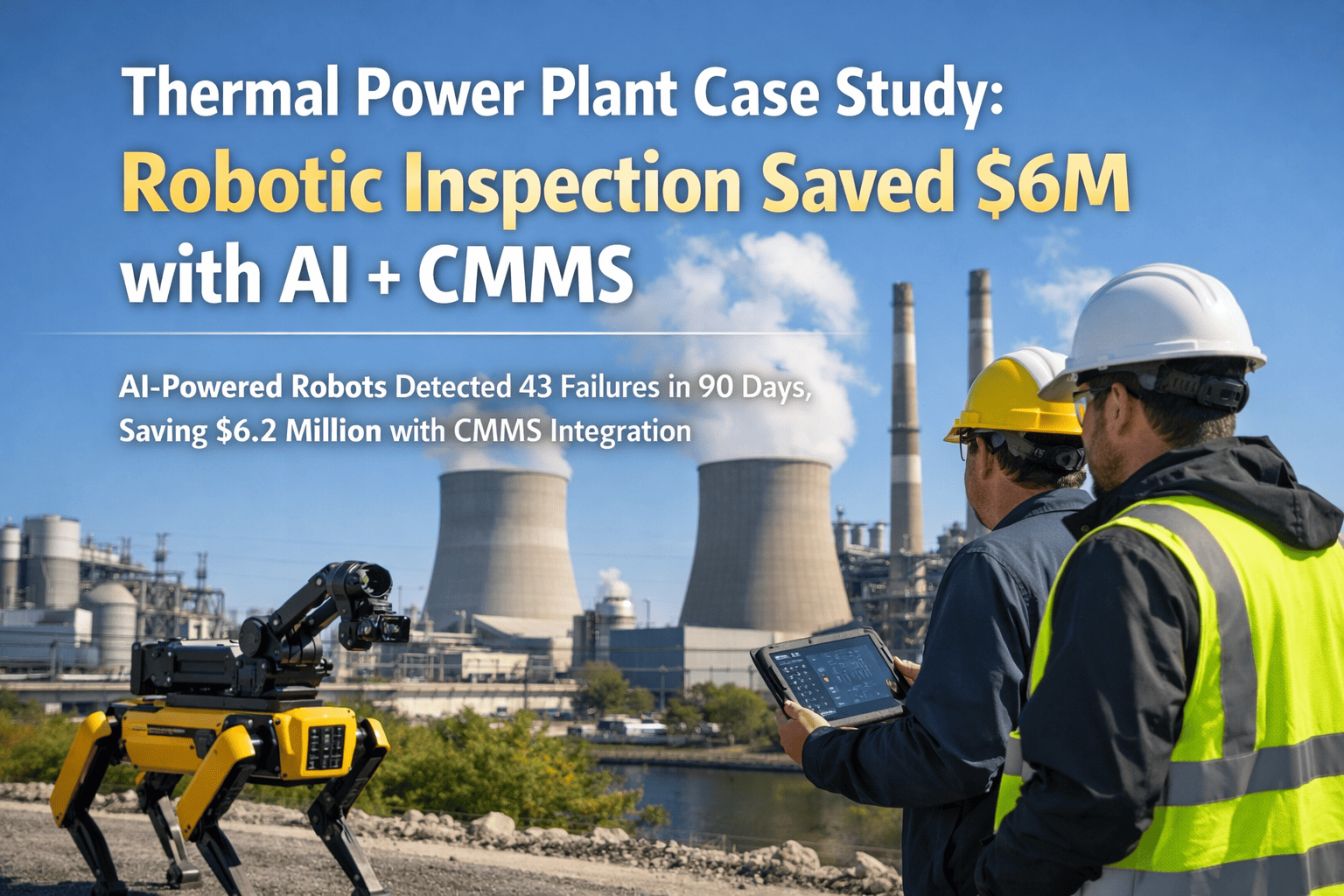
Power plants operate around the clock in conditions that punish both equipment and the people who inspect it. Turbine halls exceed 90 dB with surface temperatures above 300°C on steam headers. Boiler penthouses trap flue gas leaks that go undetected until a confined-space entry is authorised. Cooling tower basins hide structural corrosion beneath metres of humid, zero-visibility air. These are the inspection gaps that drive unplanned outages costing $500K–$2M per event. Quadruped robots close those gaps — walking through grated floors, climbing service stairways, and capturing thermal, vibration, and atmospheric data from assets that human inspectors reach only during planned shutdowns. When that data feeds directly into Oxmaint — try it free for your power plant, every patrol becomes a closed-loop maintenance action: sensor readings auto-populate asset histories, threshold breaches generate work orders, and your reliability team acts on data instead of assumptions.
Why Power Plants Are Turning to Quadruped Robots
Conventional walk-around inspections cover only the assets human inspectors can safely and conveniently reach — which excludes the very areas where failures originate. The consequences show up in every plant's maintenance records: reactive repairs on equipment that was technically "inspected" weeks earlier, confined-space permits that delay critical checks by days, and trending data that exists only in individual memory rather than in your CMMS — sign up free to centralise inspection data.
Patrol Zones: Where Quadrupeds Replace Risk
Each area of a power plant presents unique temperature, atmospheric, and terrain challenges. Effective robotic inspection maps these variables into route architectures with tailored sensor loadouts, checkpoint densities, and patrol frequencies.
Turbine Hall & Generator Floor
Hazards: High noise (100+ dB), rotating equipment proximity, hydrogen cooling system leak risk, lube oil vapour, elevated ambient temperature from turbine casings exceeding 200°C surface temperature.
Robot strategy: Quadruped patrols turbine pedestal perimeter and generator housing at 3m standoff. Tri-axial vibration sensors capture bearing signatures at each pedestal checkpoint. Thermal camera scans hydrogen seals and exciter brushes for hot spots indicating wear.
Boiler House & Penthouse
Hazards: Superheated steam leaks (invisible and lethal), CO and SO₂ accumulation in upper levels, extreme radiant heat from boiler walls, narrow catwalks between tube banks, coal dust in solid-fuel plants.
Robot strategy: Compact quadruped navigates boiler level catwalks with ultrasonic acoustic sensors detecting tube leaks through wall noise. Multi-gas detector maps flue gas concentrations at each elevation. Thermal camera captures header and tube surface profiles for thinning detection.
Cooling Towers & Condensers
Hazards: Zero visibility in saturated air, biological growth (Legionella risk zones), wet and slippery surfaces, confined spaces in condenser water boxes, fan deck height exposure above 30 metres.
Robot strategy: Quadruped with IP67 enclosure patrols basin perimeter and internal walkways. Visual AI identifies structural degradation in fill media and drift eliminators. Vibration sensors capture fan motor and gearbox signatures from accessible positions on fan deck.
Switchyard & Electrical Systems
Hazards: High-voltage arc flash zones, electromagnetic interference, SF₆ gas leaks from GIS equipment, oil spill risk from transformer leaks, outdoor exposure to weather extremes year-round.
Robot strategy: EMI-hardened quadruped patrols transformer bays and GIS buildings. Long-range thermal camera captures bushing and connection temperatures from outside arc flash boundaries. SF₆ detector maps gas concentrations around breakers and GIS compartments.
Fuel Handling & Emissions Systems
Hazards: Combustible dust atmospheres (coal, biomass), ammonia slip in SCR areas, SO₂ exposure near FGD absorbers, confined spaces in precipitator hoppers, conveyor pinch points and moving equipment.
Robot strategy: ATEX-rated quadruped patrols coal handling and emissions equipment corridors. Dust concentration sensors monitor explosion risk. Thermal camera detects bearing overheating on conveyors and identifies hot spots on precipitator shells indicating hopper buildup.
Every Robot Patrol Creates a Maintenance Decision. Automate Both.
Oxmaint receives quadruped inspection findings and automatically generates prioritised work orders with thermal images, vibration spectra, gas readings, and recommended actions — connecting robotic patrols to your maintenance workflows.
Sensor-to-Defect Pairing for Power Plant Assets
A quadruped robot delivers value only when sensor payloads match the defect modes specific to power generation equipment. The matrix below maps each sensor type to the failures it catches and the automated CMMS action it triggers — start free with Oxmaint.
| Defect Category | Primary Sensor | What Gets Detected | CMMS Action |
|---|---|---|---|
| Overheating Components | FLIR Thermal Camera | Bearing hot spots, steam leak signatures, electrical termination heat, insulation breakdown | Condition-based work order with thermal image attached to asset record |
| Mechanical Wear | Tri-axial Accelerometer | Bearing degradation, pump cavitation, fan imbalance, misalignment, gearbox wear | Predictive maintenance alert with vibration spectrum and severity trend |
| Gas & Atmosphere | Multi-gas Detector | CO, SO₂, NH₃, H₂S concentration spikes; O₂ depletion in confined areas; SF₆ leaks | Safety alert and environmental compliance log entry in Oxmaint |
| Structural Defects | HD Zoom Camera + AI | Corrosion pitting, fatigue cracks, weld defects, insulation damage, missing fasteners | Defect work order with annotated photo evidence and severity classification |
| Fluid & Steam Leaks | Ultrasonic Microphone | Steam trap failures, compressed air leaks, valve blow-by, condenser tube leaks | Leak repair order with estimated energy loss and cost justification |
| Instrument Drift | OCR Camera | Analog gauge readings outside range; pressure, temperature, and level deviations | Calibration request or out-of-range alert logged to asset trend history |
How Patrol Data Becomes a Maintenance Decision
Capturing data is straightforward. The competitive advantage comes from what happens in the seconds after a robot completes a checkpoint — how that data reaches the right people, in the right format, with the right urgency inside your CMMS.
Manual Walk-Arounds vs. Robot + CMMS Patrols
The shift from clipboard-based inspections to sensor-equipped robotic patrols integrated with Oxmaint — schedule a demo to see it in action changes every dimension of how power plant maintenance teams operate.
Replace Clipboards With Sensor Intelligence. Start With Oxmaint.
Connect your quadruped robot's checkpoint data directly to asset records. Thermal scans, vibration data, and gas readings auto-populate equipment histories and generate priority work orders — so your team acts on data, not guesswork.
From Pilot to Full Coverage: Phased Deployment
Power plants that succeed with robotic inspection follow a phased rollout — starting narrow, proving value fast, and expanding based on data. Schedule a demo to get a phased plan customised for your facility.
Measured Impact After Deployment
When quadruped robots and CMMS integration work together, the improvements are structural shifts in how maintenance teams operate. The following figures reflect documented outcomes from power plants that have completed at least six months of robotic inspection operations.
Robot Selection Criteria for Power Plant Environments
Not every quadruped robot withstands the punishment a power plant dishes out. Selecting the right platform means matching environmental tolerances, sensor modularity, and CMMS integration — sign up to explore Oxmaint's robot API capabilities to your facility's demands.
| Specification | Minimum Requirement | Why It Matters |
|---|---|---|
| IP Rating | IP67 or higher | Airborne particulate, water spray from cooling systems, and steam destroy unprotected electronics |
| Operating Temp | -20°C to +60°C ambient | Ambient temperatures near boiler and turbine areas regularly exceed 50°C during peak load |
| Stair Climbing | Standard industrial stairways (35° incline) | Multi-level facilities require vertical mobility between turbine deck, mezzanines, and basements |
| Battery Life | 90+ minutes per charge | Complete zone patrol plus 20% reserve; hot-swap batteries preferred for continuous coverage |
| Payload | 10+ kg sensor payload | Thermal camera, vibration sensor, gas detector, acoustic mic, and comms module ride simultaneously |
| API Integration | REST API with JSON export | Oxmaint requires structured data packets for automated CMMS population and work order generation |
From Hazardous Zone to Work Order in Under 5 Minutes
Oxmaint bridges the gap between robotic inspection technology and maintenance execution — ensuring every finding becomes a tracked, completed, verified repair. Your quadruped captures the data. Oxmaint turns it into action.