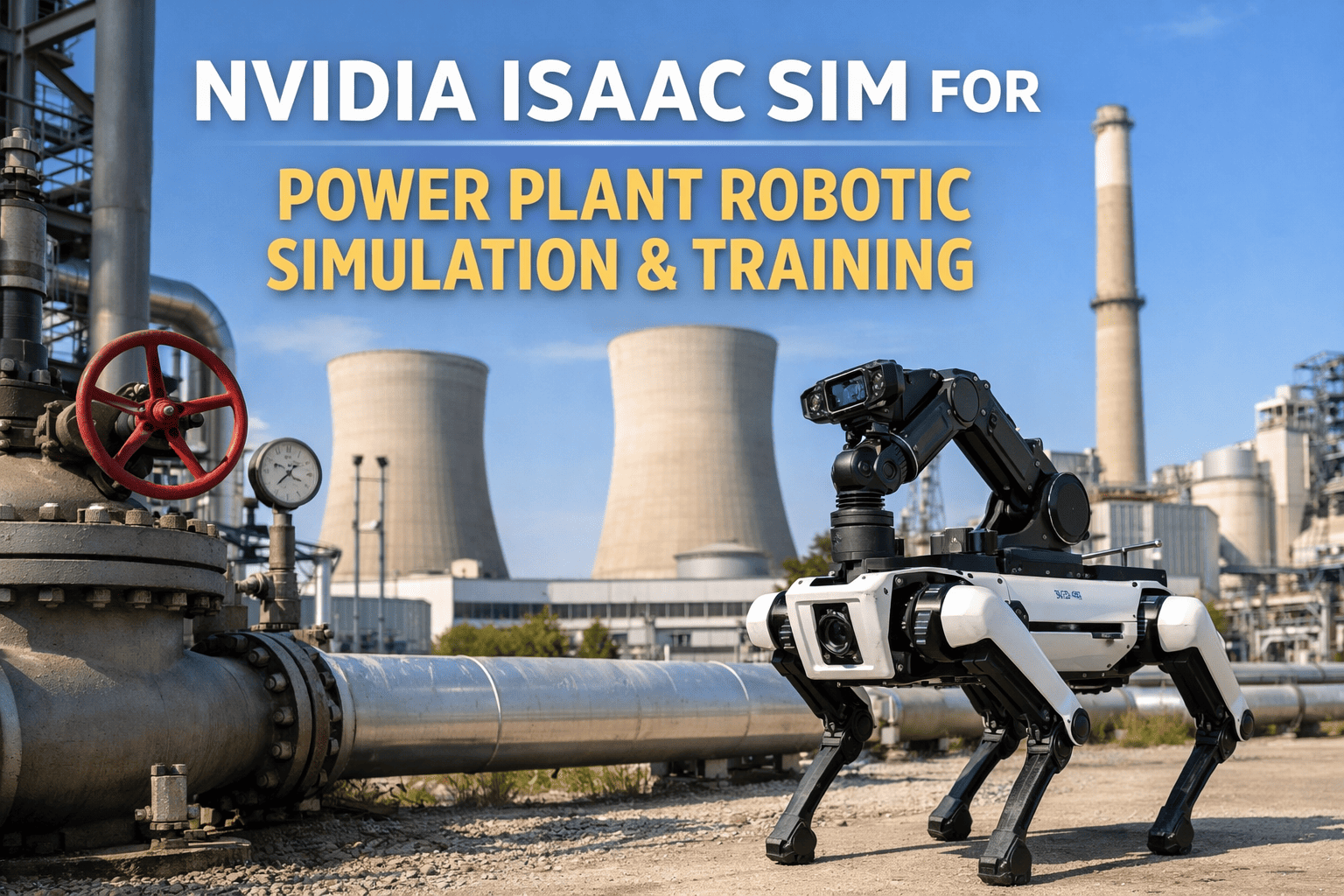
Before a robot ever steps onto a turbine deck, it needs thousands of hours of experience it cannot safely get in the real world. NVIDIA Isaac Sim gives power plant robotics teams a physically-accurate virtual environment to train, test, and validate AI inspection robots against exact replicas of their facility — failure scenarios, sensor noise, confined spaces, and all. When those robots deploy and find anomalies, OXmaint CMMS converts their findings into work orders your maintenance team acts on immediately. Sign up free on OXmaint to connect simulation-trained robot data to your plant's maintenance workflow.
Simulation Scale
4,096+
Parallel virtual environments running simultaneously on a single GPU for robot policy training
Programming Time Saved
70%
Reduction in robot programming time when using Isaac Sim digital twins vs. manual real-robot programming (Techman Robot)
Training Speed
1.6M
Simulation frames per second achieved in batched GPU training across 8 GPUs with Isaac Lab 2.2
Inspection Efficiency
20%
Reduction in inspection cycle time documented after optimizing robot programs in Isaac Sim before deployment
The Real Problem
You Cannot Train a Power Plant Robot by Crashing It Into Real Equipment
Testing an inspection robot in an actual turbine hall means scheduling access windows, halting operations, and accepting the risk that a navigation error sends a 50kg robot into live equipment. Training an AI model to detect thermal anomalies requires thousands of labeled examples of failures — failures you do not want to produce on purpose.
Isaac Sim solves this by putting the entire power plant into a GPU-accelerated virtual world. Your robot trains against physics-accurate simulations of every piece of equipment it will encounter. It fails thousands of times in simulation before it takes a single step in the real plant. And the policies it learns transfer directly to the real robot with no retraining required.
01
No Operational Disruption
Simulate every inspection route, obstacle scenario, and failure mode in a virtual plant replica. Training happens on GPU servers while your real plant runs at full capacity.
02
Synthetic Failure Data at Scale
Generate thousands of labeled sensor readings for bearing faults, thermal anomalies, and gas leaks that would take years to collect in the field. Isaac Sim's Replicator engine produces this data in hours.
03
Zero-Shot Real Deployment
Policies trained in Isaac Sim transfer to real robots without retraining. Researchers demonstrated zero-shot transfer achieving near-NAV2 performance on first deployment — the robot navigates the real plant on day one.
The Power Plant Robot Training Pipeline
From digital twin creation to live OXmaint work orders — this is how Isaac Sim transforms robot development for industrial inspection.
Phase 1
Build the Virtual Plant
Import your facility's CAD models, P&IDs, and equipment specs into Isaac Sim via URDF, MJCF, or CAD formats. USD scene description creates a photorealistic, physics-accurate digital twin of your turbine halls, switchgear rooms, and inspection corridors.
Phase 2
Simulate Sensor Conditions
Configure LiDAR, thermal cameras, acoustic microphones, and gas sensors with realistic noise models — rolling shutter, multipath artifacts, temperature drift. Your robot learns to read real-world imperfect sensor data, not idealized simulation outputs.
Phase 3
Train AI Inspection Policies
Isaac Lab runs reinforcement learning across 4,000+ parallel environments simultaneously. The robot attempts thousands of inspection routes, obstacle scenarios, and anomaly detection tasks per hour — compressing months of real-world learning into days.
Phase 4
Validate Before Deployment
Software-in-loop and hardware-in-loop testing confirm policy performance against edge cases — blocked corridors, sensor degradation, extreme temperatures. The robot must pass virtual certification before it enters the real plant.
Phase 5 — Live Deployment
Trained robot deploys into the real plant. Anomaly detections route via API into OXmaint — creating timestamped, prioritized work orders with asset context, sensor evidence, and assigned technician before the robot docks to recharge.
What Isaac Sim Simulates for Power Plant Robots
Every sensor type, every navigation challenge, every failure mode that matters in a power generation facility — Isaac Sim models them with GPU-accelerated physics.
Physics Engine
NVIDIA PhysX + Newton
High-fidelity rigid body dynamics, friction modeling, and joint physics. Robots navigate grating floors, valve actuator stairs, and tight cable trays with accurate contact simulation.
Sensor Simulation
RTX Multi-Sensor Stack
LiDAR, RGB cameras, depth cameras, thermal, IMU, and contact sensors — all simulated with realistic noise, calibration drift, and environmental interference matching real plant conditions.
Training Framework
Isaac Lab (GPU-Native RL)
Run 4,096+ parallel training environments on a single GPU. Robots learn inspection policies in hours, not months. Domain randomization ensures policies generalize across real plant variation.
Synthetic Data
Omniverse Replicator
Generate millions of labeled training images for anomaly detection — thermal hotspots, corrosion, gauge deviation, oil leaks. Eliminates the need to wait for real failures to build a training dataset.
ROS Integration
Isaac ROS 2 Bridge
Native ROS 2 integration means robots running on standard ROS stacks in the real plant use the exact same control architecture that was tested in simulation. No translation layer, no policy mismatch.
Deployment Testing
SIL + HIL Validation
Software-in-loop and hardware-in-loop testing validate robot behavior under edge cases before any physical deployment. Failure modes your plant would take years to see are tested systematically in simulation.
Closing the Sim-to-Real Gap: What This Means in Practice
The biggest historical objection to simulation-trained robots was the sim-to-real gap — behaviors that worked in simulation failed in the physical world. Isaac Sim closes this gap through three mechanisms that matter specifically for power plant environments.
Domain Randomization — During training, Isaac Sim varies surface friction, lighting conditions, sensor noise levels, and equipment positions within realistic ranges. The robot learns to handle variation, not just the ideal simulated scenario.
Physics-Level Accuracy — Mass, friction, PD gains, joint damping, and actuation limits are all configurable and match real equipment specs. A robot trained on your actual turbine hall geometry behaves the same way when it enters the real hall.
Zero-Shot Transfer Validated — Published research demonstrates RL policies trained in Isaac Sim deploying to real robots with no retraining — achieving near-NAV2-level navigation performance from the first run, and gear assembly tasks transferred with zero retraining to a UR10e robot.
Zero-Shot
Policy transfer from sim to real robot, no retraining required
16x
Training speed vs CPU-based simulation (RTX 4080, 4,096 environments)
0.06px
Calibration error for structured-light digital twin validation in Isaac Sim
30s
Per-motion robot programming time after Isaac Sim training, vs 5 minutes manually
Simulation Gets the Robot Ready. OXmaint Makes the Data Actionable.
When your Isaac Sim-trained robot detects an anomaly in the real plant, OXmaint converts that finding into a prioritized work order — asset ID, sensor evidence, failure context, and assigned technician — automatically.
Power Plant Inspection Scenarios Isaac Sim Trains For
Turbine Hall Navigation
Train robots to navigate between gas turbines, traverse grating floors, and pass under low pipe runs without contact. Simulate every maintenance configuration your team uses.
Thermal Anomaly Detection
Generate synthetic thermal imaging datasets covering bearing overheating, electrical panel hotspots, and steam leak signatures. Train detection models before any real failure occurs.
Gas Leak Localization
Simulate gas dispersion patterns across HRSG corridors and compressor stations. Train robot policy to localize source, not just detect threshold breach.
Gauge and Indicator Reading
Generate synthetic labeled images of analog gauges across the full range of readings, lighting conditions, and camera angles. Visual inspection AI trained entirely on sim data before deployment.
Confined Space Mapping
Simulate tight underground valve vaults and cable tunnels robots must navigate without visual guidance. Train locomotion policies for narrow-passage traversal in zero-light conditions.
Multi-Robot Fleet Coordination
Isaac Sim's Mega Blueprint supports multi-robot fleet simulation — train coordination logic for multiple inspection robots sharing zones without collision or task duplication.
The Isaac Ecosystem Behind It
Isaac Sim is not a standalone product — it sits at the center of a complete AI robotics development stack. Each layer adds a specific capability that matters for power plant inspection deployment.
NVIDIA Omniverse
USD Scene Foundation
Provides the photorealistic, physically-based rendering layer. Facility digital twins are built in OpenUSD — the same format used by engineering tools like Onshape and CAD pipelines.
Isaac Sim 5.0
Simulation Engine
The core simulation environment. Neural reconstruction, advanced synthetic data generation, OmniSensor USD schema for standardized sensor configuration. GA released August 2025.
Isaac Lab 2.2
Robot Learning Framework
GPU-native RL training with 4,096+ parallel environments. Supports quadrupeds, AMRs, humanoids, and manipulators. Used by Boston Dynamics, Agility Robotics, Figure AI.
NVIDIA Cosmos
World Generation
Generates diverse virtual world variations for training data expansion — different plant layouts, lighting, equipment states. Creates environments faster than manual scene authoring.
Isaac ROS 2
Real-World Bridge
Accelerated ROS 2 packages that connect simulation-trained policies to real robot hardware. The same control stack runs in sim and on the deployed robot — zero interface translation.
OXmaint CMMS
Maintenance Action Layer
Receives anomaly detections from deployed robots via API. Creates prioritized work orders, routes to certified technicians, builds compliance records, and tracks performance trends automatically.
Frequently Asked Questions
Does a robot trained in Isaac Sim actually work in a real power plant without additional training?
Yes — this is the documented zero-shot transfer capability of Isaac Sim. Published research (Salimpour et al., January 2025) demonstrated RL policies trained in Isaac Sim deploying to real robots achieving near-NAV2-level navigation performance without any fine-tuning on the real platform. NVIDIA's own industrial deployment blog documented zero-shot transfer of a gear assembly task on a UR10e robot trained entirely in Isaac Lab. The key enablers are domain randomization during training and physics-accurate simulation that closely matches real-world dynamics.
What hardware is required to run Isaac Sim for power plant robot training?
Isaac Sim runs on NVIDIA RTX-class GPUs. An RTX 4080 achieves approximately 9,200 training samples per second running 4,096 parallel environments. For larger fleet training or faster iteration cycles, Isaac Lab supports cloud distribution across multiple GPUs — accessible via NVIDIA Brev for instant GPU access. Isaac Sim 5.0 and Isaac Lab 2.2 are now generally available as open-source on GitHub, removing previous licensing barriers for development teams.
How does Isaac Sim connect to OXmaint for maintenance management?
The integration works at the deployment layer. When an Isaac Sim-trained robot runs inspection routes in your real plant and detects an anomaly — a thermal deviation, acoustic signature, or gas reading — that alert routes via API into OXmaint CMMS. OXmaint creates a prioritized work order pre-populated with the asset ID, sensor type, reading, deviation from baseline, and failure mode context. No manual dashboard review is needed.
Book a demo to see the full integration flow.
Can Isaac Sim train inspection robots for specific power plant equipment like gas turbines or HRSGs?
Yes. Isaac Sim accepts URDF, MJCF, and CAD model imports, so any equipment with available CAD data can be modeled in the virtual plant. Gas turbine casings, HRSG corridors, switchgear rooms, and underground valve vaults can all be replicated with physics-accurate geometry. Techman Robot documented a 70% reduction in robot programming time when building inspection applications in Isaac Sim digital twins versus programming directly on real equipment — applicable directly to power plant inspection route development.
How does synthetic data generation in Isaac Sim help with anomaly detection models?
Training an anomaly detection AI model on real plant data requires waiting for failures to occur — a slow, expensive, and dangerous data collection strategy. Isaac Sim's Omniverse Replicator engine generates millions of labeled synthetic sensor readings covering the full range of bearing fault signatures, thermal anomaly patterns, gauge deviations, and leak indicators. These synthetic datasets train detection models to high accuracy before any real deployment. Techman Robot documented a 20% improvement in inspection cycle time from models trained on Isaac Sim synthetic data, demonstrated at Jensen Huang's COMPUTEX keynote.
Ready to Deploy Smarter Robots?
Train Your Inspection Robots in Simulation. Deploy Them With Confidence. Connect Their Findings to OXmaint.
NVIDIA Isaac Sim prepares your robots for every scenario your plant can throw at them. OXmaint turns their real-world findings into the maintenance actions that keep your plant running.