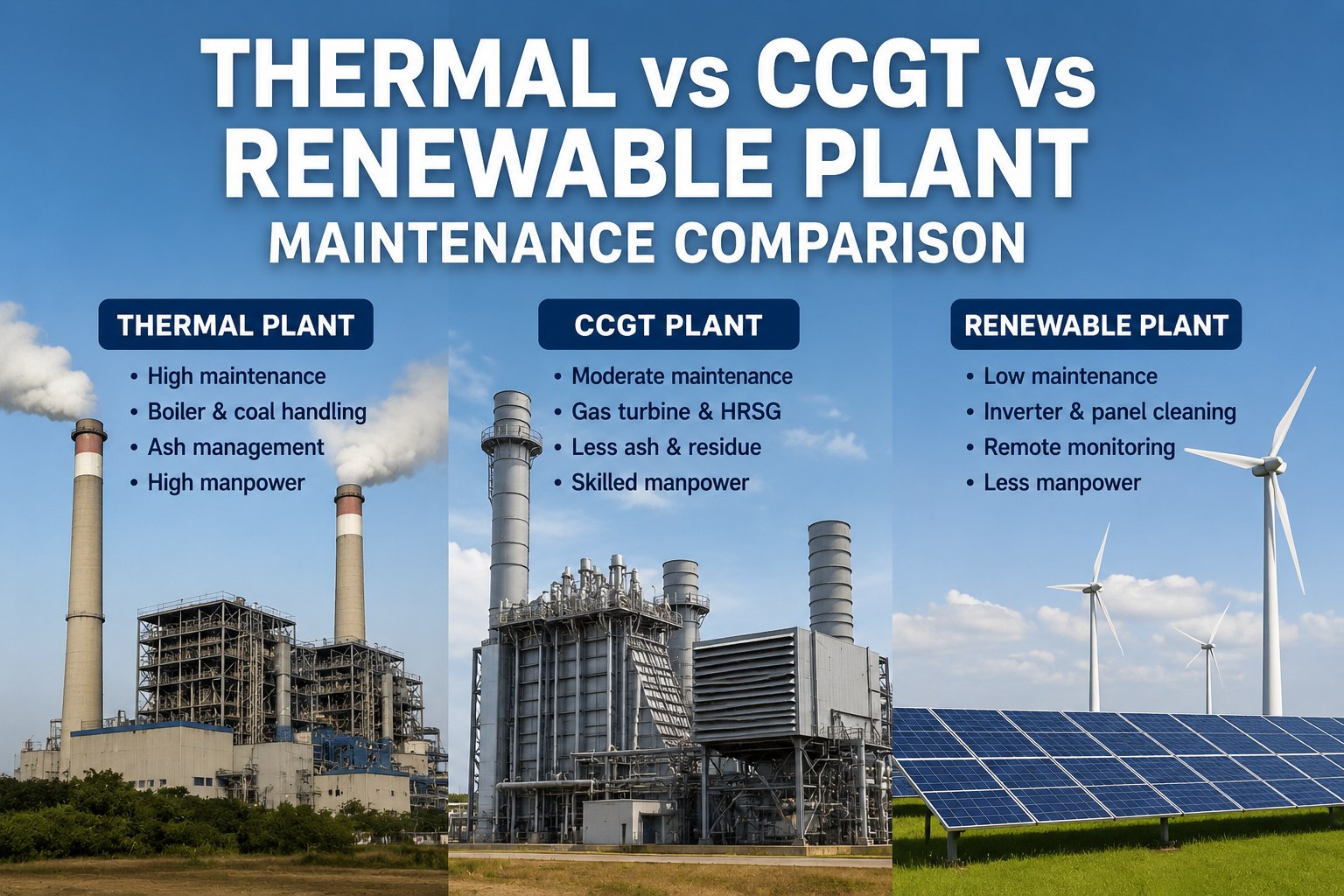
Managing maintenance across thermal, CCGT, and renewable assets means juggling vastly different failure modes, inspection triggers, and compliance regimes — often within the same fleet. This comparison breaks down how boilers, gas turbines, and inverters each demand their own upkeep strategy, and how a unified CMMS brings them under one roof. Start a free OxMaint trial or book a 30-minute demo to see mixed-fleet standardization in action.
Thermal vs CCGT vs Renewable Plant Maintenance Comparison
Boilers, gas turbines, and solar inverters don't fail the same way — and they shouldn't be maintained the same way either. Here's how inspection triggers, compliance burdens, and staffing models diverge across the three dominant generation types, and where a single CMMS closes the gap.
Asset Types: What You're Actually Maintaining
The maintenance conversation starts with the hardware. Each plant category has a different center of gravity — high-pressure steel, precision rotating aerodynamics, or power electronics — and that shapes everything from wrenches to work-order templates.
High-pressure, high-temperature steel
- Boiler tubes, drums, and headers (erosion, corrosion, creep)
- Steam turbine rotor, blades, and casing (vibration, blade fatigue)
- Coal handling: conveyors, pulverizers, feeders
- ESP / baghouse, ash handling, FD/ID fans
- Condenser, cooling tower, BOP pumps and valves
Precision rotating aerodynamics + heat recovery
- Gas turbine: combustor, hot-gas-path, rotor (fired-hour driven)
- HRSG: HP/IP/LP sections, drums, finned-tube bundles
- Steam turbine (bottoming cycle): rotor, blades, condenser
- Generator, exciter, step-up transformer
- BOP: lube-oil, fuel-gas skid, condensate system
Power electronics + distributed rotating assets
- Wind: gearbox, main bearing, blades, pitch/yaw systems
- Solar PV: inverters, DC combiner boxes, string monitoring
- BESS: cell balancing, thermal management, BMS firmware
- Transformers, switchgear, SCADA gateways
- Site: soiling, vegetation, fencing, access roads
Inspection Intervals & PM Triggers
Thermal runs on calendar cycles tied to outages. CCGT runs on fired hours and starts. Renewables run on condition. Mixing those triggers in one spreadsheet is where most maintenance plans break down.
| Dimension | Thermal (Coal / Steam) | CCGT | Renewable |
|---|---|---|---|
| Primary PM trigger | Calendar-based outage cycles | Fired hours + start/stop counts | Condition-based + OEM calendar |
| Major overhaul interval | 4–6 years (boiler + turbine) | 24,000–32,000 fired hours (HGP) | 12–24 months (inverter / blade) |
| Routine inspection cadence | Daily rounds, weekly PM, monthly oil sampling | Daily borescope, weekly lube-oil, monthly performance | Quarterly visual, semi-annual thermography |
| Condition-monitoring tech | Vibration, oil analysis, NDE on tubes | Vibration, exhaust-temp spread, borescope | SCADA alarms, drone thermography, CMS |
| Outage model | Planned annual / biennial major outage | CI, HI, MI intervals per OEM firing logic | Opportunistic + scheduled component swap |
| Spare-parts strategy | Long-lead tube sections, valve castings | HGP hardware, combustion liners, nozzles | Inverter boards, gearbox bearings, blades |
Compliance & Regulatory Pressure
Each plant type answers to a different regulator. A mixed fleet means maintaining three separate audit trails — and a single missing record can trigger a forced derate or fine.
Thermal
- NERC PRC-005 protection-system maintenance
- EPA MATS / Boiler MACT emissions limits
- OSHA 1910 Process Safety Management (PSM)
- ASME Section I & VII boiler code
- State ash-handling and water-discharge permits
CCGT
- NERC PRC-005 + TOP-002 unit-commitment records
- EPA NSPS Subpart KKKK gas-turbine NOx
- API 610 / 617 rotating-equipment standards
- NFPA 85 boiler / HRSG combustion safety
- FERC market-offer and availability reporting
Renewable
- NERC PRC-024 ride-through settings (IBR)
- IEEE 1547 inverter interconnection
- UL 1741-SB inverter certification
- FAA / aviation lighting on wind towers
- ISO 14001 environmental management for sites
Staffing & Skills: One Fleet, Three Trades
The workforce question is where mixed-portfolio maintenance gets hardest. You can't cross-train a boiler welder into an IGBT technician overnight — but you can standardize how their work is planned, scheduled, and recorded.
Thermal crew profile
Heavy on pipefitters, boilermakers, and NDE technicians. Outage seasons pull in 200–600 contractor headcount. Skills: welding, rigging, tube replacement, valve repair.
CCGT crew profile
Leaner permanent staff — typically 25–45 per plant. Combustion-turbine specialists, HRSG technicians, controls engineers. OEM reps handle major HGP work.
Renewable crew profile
Distributed technicians covering 50–200 turbines or MW of solar. Electrical and electronic skills dominate. Drone pilots and data analysts increasingly core to the team.
Three separate CMMS instances. Maintenance managers reconcile spreadsheets by hand. Contractor onboarding repeated at every outage. Skill matrices live in HR, not in the work-order system.
One CMMS with plant-type-specific asset hierarchies, PM triggers, and compliance templates. Contractor credentials, skill matrices, and work history all live on the same record. Dashboards roll up by plant, by region, or by fleet.
Where OxMaint Unifies the Three
A single platform doesn't erase the differences between a boiler and an inverter — it standardizes the workflow around them. Here's how OxMaint maps to each plant type while keeping one source of truth.
Plant-type asset hierarchies
Build thermal, CCGT, and renewable asset trees with type-specific failure codes, criticality ratings, and OEM reference data — all under one system configuration.
Mixed PM trigger engine
Calendar cycles for thermal, fired-hour counters for CCGT, condition-based thresholds for renewables. OxMaint auto-generates work orders from whichever trigger fires.
Compliance templates per regulator
Pre-built checklists for NERC PRC-005, NFPA 85, IEEE 1547, and API 610. Every completed task is time-stamped, signed, and exportable for audit defense.
Contractor & skills management
Track certifications, clearances, and skill levels for permanent staff and outage contractors alike. Assign work only to qualified personnel — the system enforces it.
Fleet-wide dashboards
Roll up availability, MTBF, backlog, and compliance status by plant type, region, or entire portfolio. Drill from a fleet-level KPI down to a single work order in three clicks.
Mobile execution for every site
Technicians on a boiler platform, inside a nacelle, or at a solar inverter all use the same mobile app — offline-capable, with photos, signatures, and barcode scans attached to the work order.
Frequently Asked Questions
Can one CMMS really handle thermal, CCGT, and renewable assets without compromise?
How does OxMaint handle CCGT fired-hour tracking?
What about NERC PRC-005 evidence across different plant types?
We run outages with 300+ contractors. Can OxMaint scale for that?
Does OxMaint integrate with SCADA and condition-monitoring systems for renewable assets?
Standardize Maintenance Across Your Entire Generation Fleet
Whether you're planning a coal-plant outage, tracking CCGT fired hours, or responding to a wind-turbine CMS alarm, OxMaint gives you one platform, one audit trail, and one source of truth across thermal, combined-cycle, and renewable assets.