A power transformer fails silently. There is no vibration to feel, no audible warning, no alarm on a SCADA screen — while gases dissolve steadily into the insulating oil, each one a precise chemical fingerprint of a fault that can escalate from detectable to catastrophic in weeks. Transformer failures account for over 30% of all power grid outages, and a single unit failure can cost between $3 million and $10 million in equipment replacement, environmental cleanup, and lost revenue. Dissolved Gas Analysis (DGA) is the industry-standard early warning system for internal transformer faults — but DGA data without a connected maintenance workflow is information without action. OxMaint's predictive maintenance platform closes that gap: every DGA threshold breach or rate-of-change anomaly automatically generates a structured, assigned work order — ensuring the gap between fault signal and technician action is measured in minutes, not days. Book a demo to see how OxMaint connects your DGA monitoring hardware to a complete maintenance action workflow.
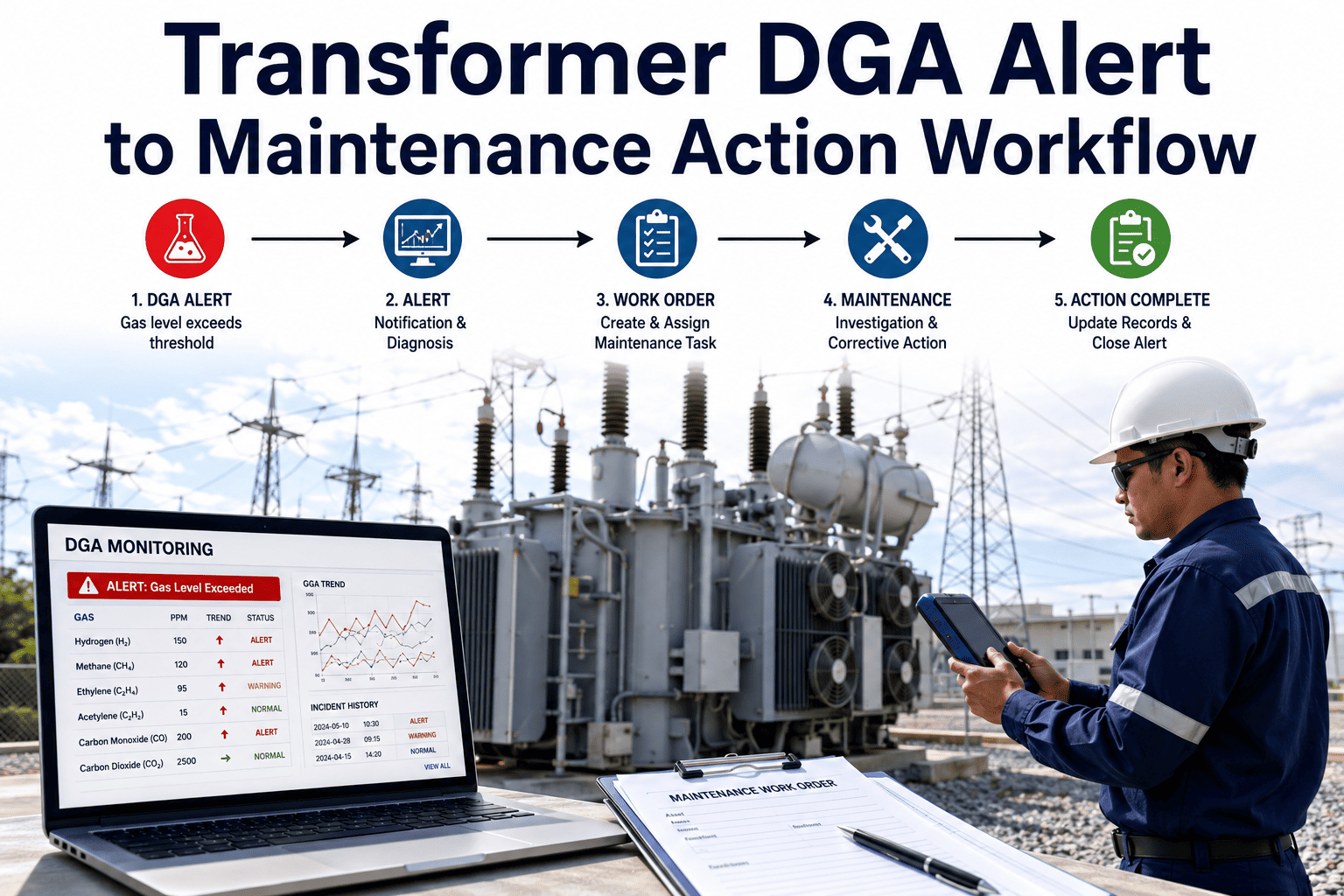
Transformer DGA Alert to Maintenance Action Workflow
From dissolved gas detection to closed-loop work order completion — a fully automated workflow that turns fault signals into documented maintenance outcomes.
The 7 Key Fault Gases and What They Signal
Each gas dissolved in transformer oil is a specific indicator of internal fault type. OxMaint's AI matches gas combinations against IEEE C57.104-2019 fault ratios and generates a fault classification with the alert.
| Gas | Chemical Symbol | Fault Indicated | Severity if Rising | OxMaint Alert Trigger |
|---|---|---|---|---|
| Hydrogen | H₂ | Partial discharge, corona | Medium | Concentration threshold or rate-of-change |
| Methane | CH₄ | Thermal fault — low temperature | Medium | Trend acceleration over 30-day window |
| Ethane | C₂H₆ | Thermal fault — moderate temperature | Medium | Ratio analysis (Duval Triangle) |
| Ethylene | C₂H₄ | Thermal fault — high temperature (>300°C) | High | Threshold breach + work order auto-create |
| Acetylene | C₂H₂ | Arcing, high-energy discharge | Critical | Any detection triggers immediate escalation |
| Carbon Monoxide | CO | Cellulose insulation degradation | High | CO/CO₂ ratio monitored continuously |
| Carbon Dioxide | CO₂ | Overheating of solid insulation | Medium | CO₂ + CO combined ratio analysis |
From DGA Alert to Closed Work Order: The 5-Step OxMaint Workflow
Most utilities have DGA monitoring installed but no connected maintenance system. The gap between alert and action is where preventable failures happen.
Connect Your DGA Monitoring to Automated Maintenance Action
Book a 30-minute demo and we will walk through the full DGA alert to closed work order workflow — including fault classification, smart dispatch, and asset health score update — using transformer data from your fleet type.
Offline vs. Online DGA: How OxMaint Supports Both
What Transformer Asset Managers Say
DGA data is only as valuable as what you do with it. I have seen utilities invest in excellent online monitoring hardware and then route the alerts to a shared inbox where they sit unread for days. The fault develops, the transformer trips, and everyone is surprised — despite having the data right there. The missing piece is always the connection between the signal and a structured maintenance response. When a DGA alert automatically generates a work order with fault classification, inspection scope, and technician assignment, the alert becomes an action. That is the difference between a monitoring program and a maintenance program. The best implementations treat DGA as an input to the CMMS, not as a standalone monitoring tool. OxMaint is one of the few platforms I have reviewed that handles this connection natively — the transformer asset record, the DGA trend, and the work order are all in one system, which means audit traceability is also automatic.
Frequently Asked Questions
Turn Fault Signals Into Maintenance Actions — Automatically
OxMaint connects your DGA monitoring data to a complete maintenance action workflow: fault classification, smart work order dispatch, field inspection, and closed-loop documentation — with zero manual steps between alert and action.