Power plants run on two things: megawatts and discipline. Every turbine blade hour, every boiler tube wall, every switchgear contact, and every cooling tower cell degrades on a schedule — and the only question is whether your maintenance program finds the degradation first, or your next forced outage does. Unplanned generation outages cost between $50,000 and $500,000 per day in lost revenue and replacement power purchases, yet industry data shows that over 70% of power plant failures are preventable through structured preventive maintenance. This library gives you 50+ ready-to-use PM checklist templates — for steam turbines, gas turbines, boilers, generators, switchgear, cooling towers, and balance-of-plant systems — built to ASME, NFPA, and NERC compliance standards. Deploy your first checklist free in OxMaint today, or book a live demo to see how leading power plants automate their entire PM program.
50+ Free PM Templates
Ultimate Power Plant Preventive Maintenance Checklist Library
Steam Turbines · Gas Turbines · Boilers · Generators · Switchgear · Cooling Towers · Balance-of-Plant
$500K
Max daily cost of forced outage
70%
Failures preventable by structured PM
3-9x
Reactive vs. planned maintenance cost
50+
PM templates in this library
Why Power Plant PM is Different from Any Other Industry
A food processing plant that goes down loses a batch run. A power plant that goes down loses grid capacity, triggers NERC reliability events, draws FERC market penalties, and burns through replacement power budgets that can exceed a year of CMMS licensing in a single forced outage event. Power plant maintenance operates at the intersection of extreme thermodynamic stress, massive rotating equipment, and real-time grid dispatch obligations.
01
Regulatory Exposure
NERC PRC standards, FERC market rules, EPA emissions permits, OSHA 29 CFR 1910.269, and ASME Boiler and Pressure Vessel Code all impose documentation requirements that paper-based PM programs cannot consistently satisfy.
02
Failure Consequence Scale
A generator winding failure requires a 4-12 week repair at $10M+ replacement cost. A single HRSG tube leak forces an immediate unit trip. Cooling tower basin failures cascade into full-unit shutdowns. The stakes are categorically different.
03
Equivalent Operating Hours
Turbine inspection intervals are measured not in calendar time but in equivalent operating hours (EOH) where cold starts, trip events, and peak-load cycles consume inspection budget faster than base-load hours. Static calendars miss this entirely.
04
Multi-System Dependencies
A cooling tower degradation affects condenser backpressure, which stresses LP turbine blades, which elevates vibration, which triggers bearing wear, all before the first alarm. Only cross-system PM visibility catches these cascade chains early.
The 6 Critical Systems and Their Failure Cost Map
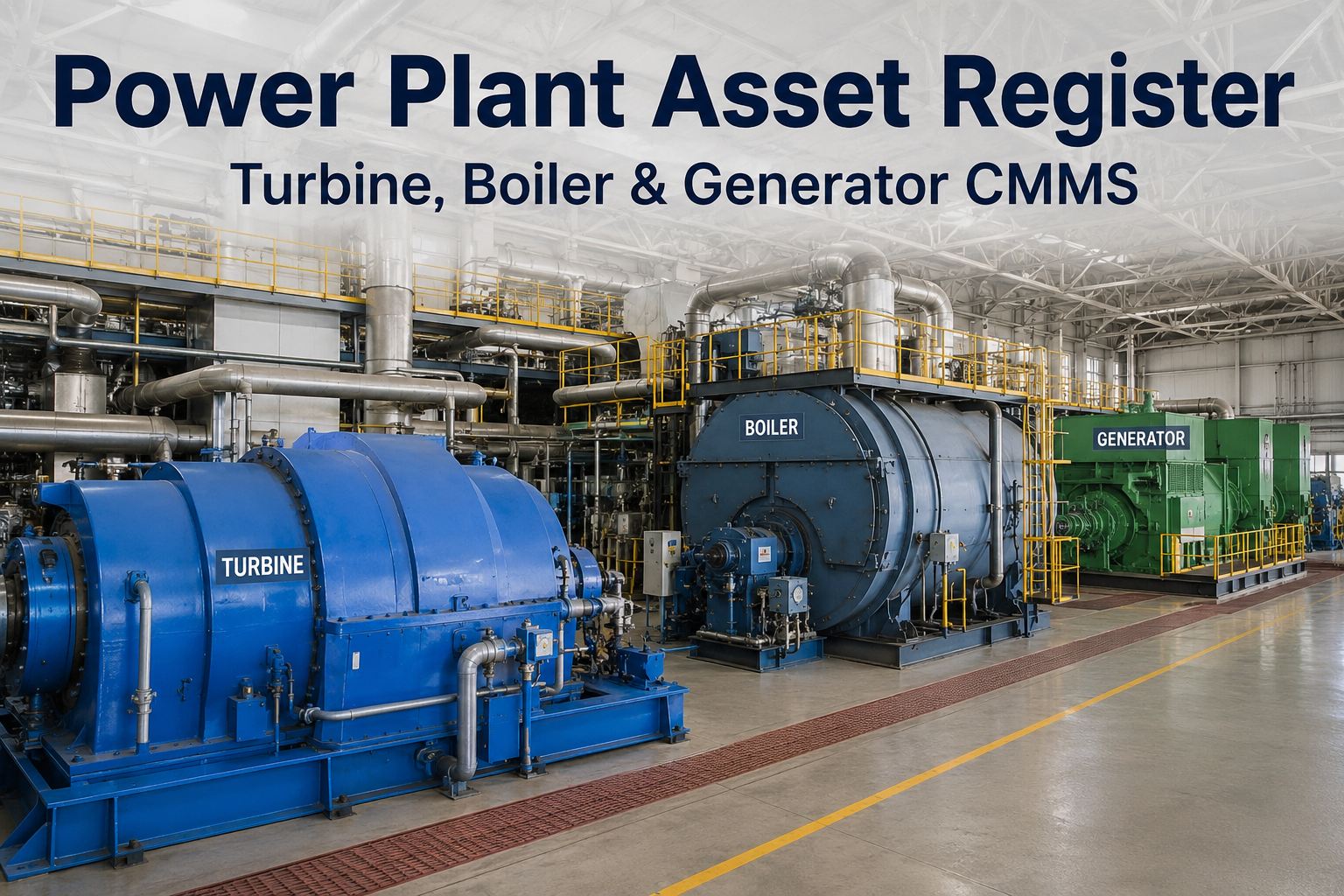
Steam / Gas Turbine
Blade erosion, bearing seizure, vibration trip
8-14 days
$200K-$500K/day
Daily readings, Weekly lubrication, Quarterly vibration analysis
Boiler / HRSG
Tube leak, creep damage, waterwall failure
5-10 days
$180K-$420K/day
Daily water chemistry, Weekly visual, Annual thickness testing
Generator and Excitation
Winding insulation failure, partial discharge
4-12 weeks
$10M+ total repair
Weekly hydrogen purity, Monthly insulation, Annual DGA analysis
HV Switchgear and Transformer
Relay misoperation, contact erosion, oil degradation
2-6 weeks
NERC violation plus repair
Monthly relay test, Semi-annual oil sampling, Annual thermal scan
Cooling Tower and CW System
Basin fouling, fill degradation, pump cavitation
3-7 days
Capacity derate plus repair
Daily chemistry, Weekly cell inspection, Monthly fan gearbox check
Balance-of-Plant (BOP)
Feed pump failure, valve seizure, instrument drift
1-5 days
28% of all forced outages
Weekly lubrication, Monthly valve exercise, Quarterly calibration
Steam Turbine Preventive Maintenance Checklist
Steam turbines operate under conditions that destroy components slowly and silently — high-pressure, high-temperature steam attacking blade roots, gland seals degrading over thousands of hours, and bearing babbitt wearing imperceptibly each shift. The checklists below structure every critical inspection interval so that the degradation is found by your technician, not by your trip system.
Steam Turbine - Daily Operational Checks
Performance Parameters
Main steam pressure, temperature, and superheat -- log readings per shift against design values
Turbine shaft vibration on all bearing pedestals -- compare to baseline and trip setpoints
Bearing metal temperature and lube oil inlet/outlet temperatures -- log all readings
Eccentricity and differential expansion readings -- confirm within OEM operating envelope
Governing system response -- speed stability and droop confirmed under current load
Oil and Seal Systems
Lube oil header pressure and reservoir level -- top up if required, log readings
Oil cooler differential temperature -- no fouling degradation since previous shift
Gland steam sealing pressure confirmed -- no steam leakage at gland seals or exhaust end
Condensate level in lube oil reservoir -- moisture ingress check, lab sample if discoloration noted
No active alarms on DCS/SCADA for turbine supervisory system -- all alarms investigated
Steam Turbine - Weekly Inspection
Mechanical Checks
Lube oil sample drawn -- viscosity, particle count, and moisture sent to lab if trending
All turbine flanges and pipe connections visually inspected -- no steam leaks or insulation damage
Turning gear engagement and disengagement tested -- clutch operation smooth, no abnormal noise
Drain and drip pot levels checked -- no water accumulation in steam lines feeding turbine
Trip and Protection Tests
Emergency trip solenoid manual test -- confirm operation without unit trip (test valve only)
Overspeed trip device mechanical reset confirmed -- no drift from calibration setpoint
Hydraulic trip pressure at trip header -- confirm supply pressure at OEM specification
Steam valve position indicators matched to DCS indication -- no discrepancy between local and remote
Boiler and HRSG Maintenance Checklist
Boiler tube failures are the single largest cause of forced thermal unit outages globally. A tube wall that loses 0.5mm of thickness per year reaches failure in a predictable window -- but only if someone measured it last year, and the year before, and entered the result into a system that flags the trend.
Daily Boiler Checks
Drum water level confirmed in both local gauge and remote indication -- no discrepancy between readings
Feedwater chemistry -- pH, conductivity, dissolved oxygen, phosphate dosing rate logged per shift
Steam pressure and temperature at all superheater stages -- no exceedance of design metal temperature
Furnace draft pressure and excess air ratio confirmed within combustion optimization target
Soot blower operation cycle completed -- blower travel confirmed, no tube contact or steam leakage
Continuous blowdown control valve operation -- conductivity at target, no hunting or instability
Monthly Boiler Inspection
Safety valve set pressure tested -- at least one valve tested per month per ASME Section I requirement
Low water level trip test -- all level switches and feedwater pump auto-start verified functional
Burner management system trip test -- fuel shutoff valve closure confirmed within 1 second of trip signal
External visual inspection -- tube rows visible through peepholes checked for bowing, scaling, or discoloration
Economizer inlet and outlet temperature differential -- no abnormal approach temperature indicating fouling
Ash handling system operational check -- hopper heaters, conveyors, and disposal system confirmed ready
Annual Boiler Outage Inspection -- ASME / National Board Requirements
Pressure Parts Inspection
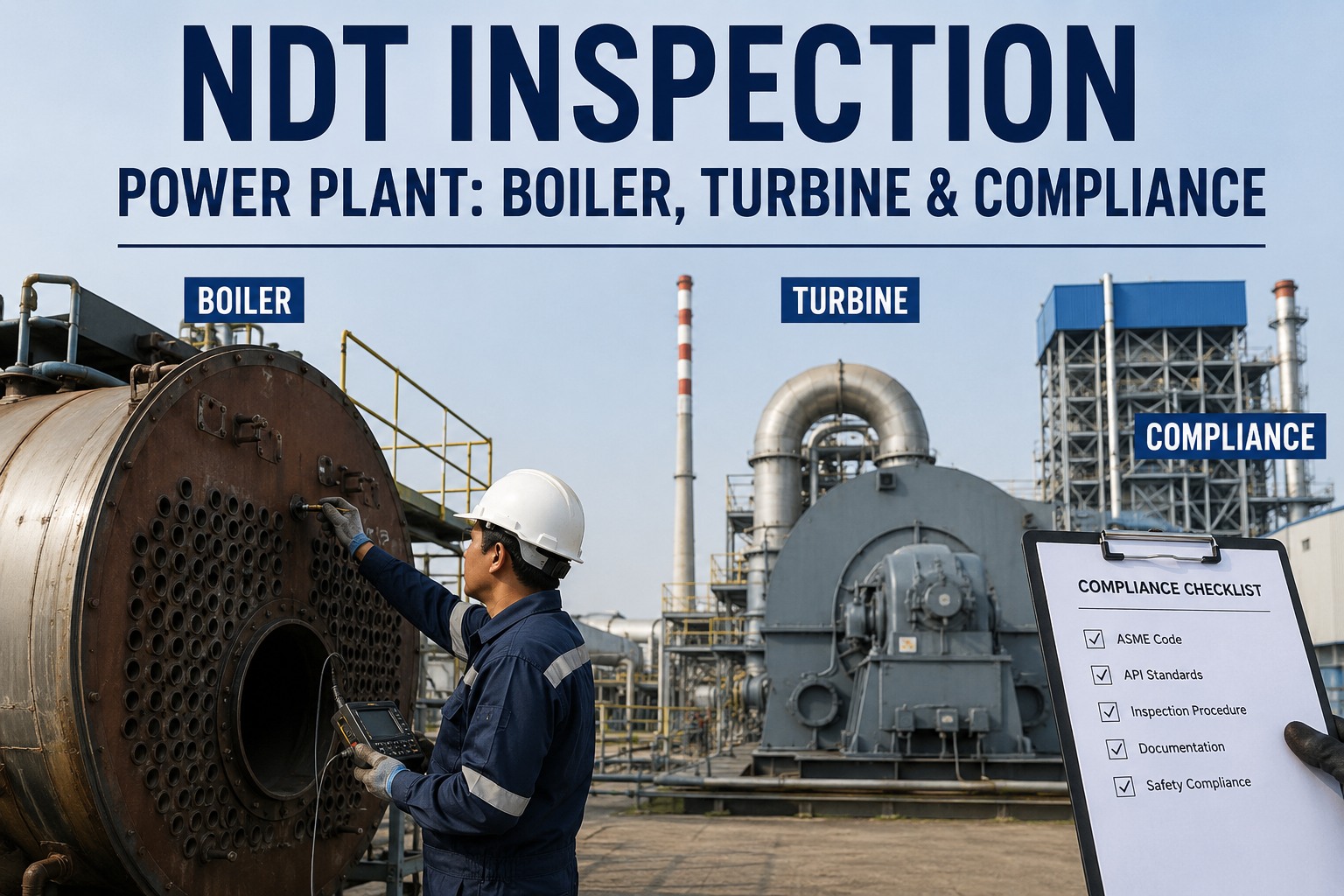
UT thickness measurement at all tube panel locations -- minimum wall confirmed against allowable per B31.1
Drum internal inspection -- scale deposits, corrosion, and baffle condition assessed and documented
Header inspection -- ligament cracking at tube stubs, pitting at drain saddles, weld condition at nozzles
Refractory and insulation condition -- no cold spots on casing, no hot spots on structural steel
Mechanical and Safety Systems
All safety valves removed, bench-tested, and recertified per ASME Section I by authorized inspector
Attemperator spray nozzles inspected -- no erosion, cracking, or thermal sleeve damage
Expansion joints inspected -- no bellows cracking or liner displacement at all duct connections
National Board inspection certificate issued and filed -- all findings documented with corrective action status
Free to Start -- No Credit Card Required
Automate Your Boiler and Turbine PM Schedule in OxMaint
OxMaint pre-loads ASME, NFPA, and NERC-aligned PM templates for every power plant system. Work orders auto-generate at the correct interval -- daily, weekly, monthly, or on equivalent operating hours -- and are pushed directly to technicians' mobile devices. Every completion is timestamped with a digital signature, ready for your next regulatory audit.
Generator and Electrical Systems Checklist
Generator winding insulation failure is the most expensive single-component failure in power generation -- and partial discharge activity builds for months before any conventional meter shows it. Hydrogen-cooled generators add explosive gas management to an already demanding maintenance scope. The checklist below addresses the full electrical maintenance program from daily readings to annual shutdown testing.
Weekly -- Generator and Excitation
Stator winding temperature -- all RTD readings within balanced range, no phase-to-phase delta above 5 degrees C
Hydrogen purity and pressure for H2-cooled units -- purity above 97%, no unexplained pressure drop
Hydrogen seal oil differential pressure -- seal oil pressure tracking confirmed above gas pressure setpoint
Exciter output voltage and field current -- compare to capability curve for current MW/MVAR output
Generator cooler inlet/outlet water temperature differential -- no fouling indicated by reduced delta-T
Brush gear inspection for slip ring type -- brush length, spring pressure, and contact surface condition
Monthly -- Switchgear and Protection
Partial discharge online monitoring review -- trend comparison to baseline and alert threshold review
Protection relay function test -- at least one relay per panel per month per NERC PRC-005 schedule
Transformer dissolved gas analysis sample sent to lab -- results compared to IEEE C57.104 limits
Switchgear panel thermal inspection -- no cabinet hot spots above ambient, all breaker indicators functional
Battery float voltage and charger output for all station batteries -- readings logged against setpoints
Power transformer oil level in conservator -- no unexplained oil loss or moisture ingress at bushings
Cooling Tower and Circulating Water System Checklist
Cooling tower failures rarely announce themselves. Basin chemistry drifts, fill media blocks progressively, fan gearboxes lose oil unnoticed, and circulating water pump impellers cavitate for weeks before performance drops enough to show on the condenser backpressure trend. By that point, LP turbine blade stress has already accumulated. This checklist stops the drift before it becomes a derate.
Daily Chemistry Control
Basin water pH, conductivity, and cycles of concentration -- log and dose biocide or scale inhibitor as required
Makeup water flow rate -- confirm within expected range for current evaporation load
Blowdown rate confirmed -- conductivity control valve or timer operation verified
Chlorine or biocide residual tested -- minimum effective concentration maintained
Legionella control log entry -- dosing, bleed, and temperature records per local health authority requirements
Weekly Cell Inspection
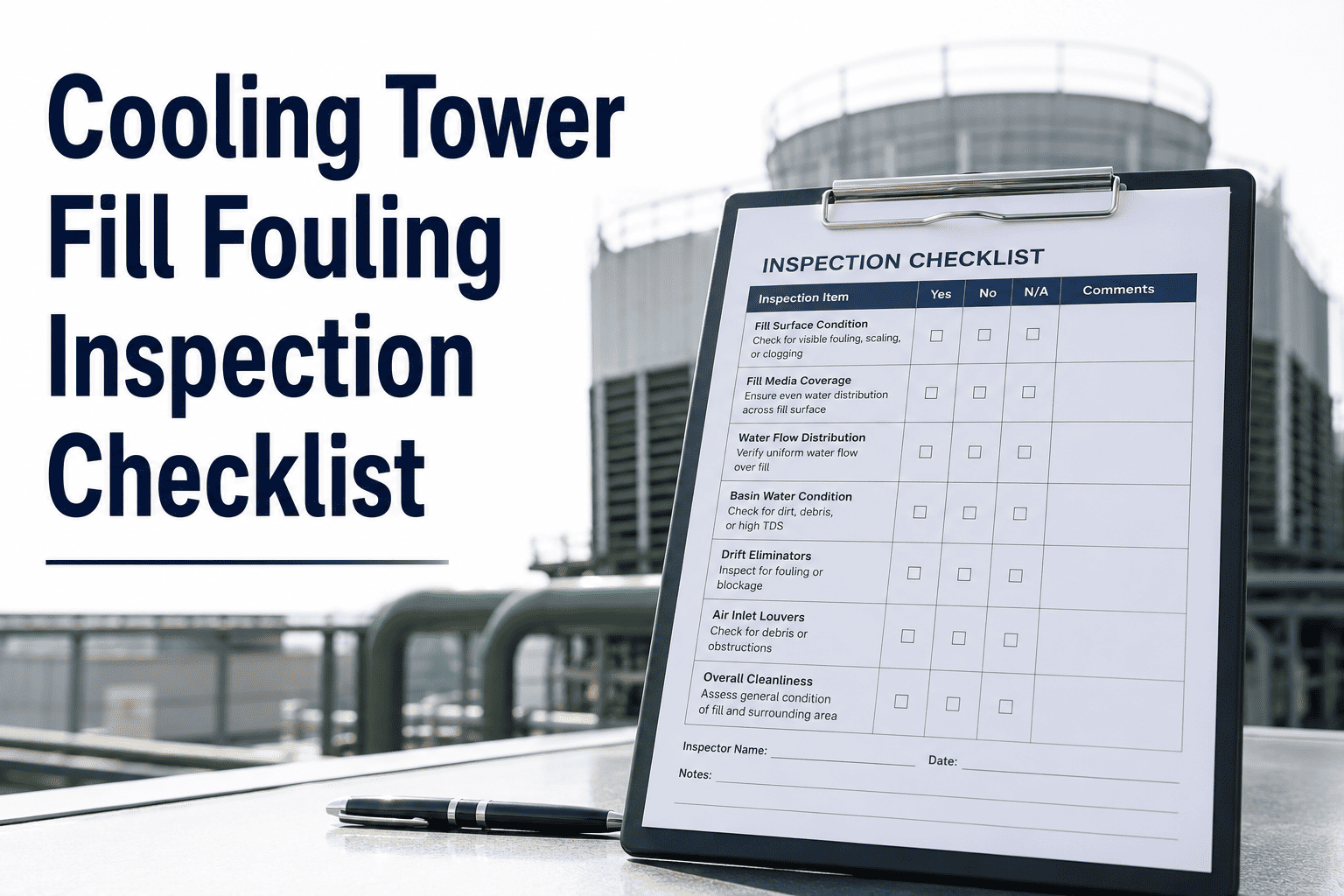
Each cooling tower cell inspected -- fill media condition, drift eliminator integrity, and distribution nozzle spray pattern
Fan blade pitch angle confirmed -- no visible erosion or pitch change since last inspection
Gearbox oil level and temperature -- no oil loss, temperature within operating range
Basin floor inspected through walkway -- no sediment accumulation, no structural cracking
Approach temperature calculated -- actual vs. design compared, degradation trending initiated if elevated
Quarterly Full Inspection
Fill media sample pulled and inspected -- blockage percentage estimated, replacement scope planned if above 20%
Fan gearbox oil sample sent for analysis -- particle count, viscosity, and water contamination confirmed
CW pump vibration measurement -- all bearings on spectrum analyzer, no defect frequencies identified
Condenser tube bundle performance -- waterside pressure drop compared to clean baseline
Thermal performance test -- measured range, approach, and L/G ratio compared to design at current conditions
Inspection Frequency Summary -- All Power Plant Systems
| Component |
Daily |
Weekly |
Monthly |
Quarterly |
Annual |
| Steam / Gas Turbine |
Vibration, bearing temp, lube oil readings |
Oil sample, trip device test, flange visual |
Governor calibration, seal performance |
Vibration analysis, EOH interval check |
Blade inspection, bearing replacement per OEM |
| Boiler / HRSG |
Drum level, water chemistry, soot blowing |
Safety interlock pre-test, visual inspection |
Safety valve test, BMS trip test |
Tube wall thickness spot checks |
Full UT inspection, National Board certificate |
| Generator and Excitation |
Winding temp, H2 purity, cooler delta-T |
Partial discharge review, brush inspection |
Relay test, DGA sample, thermal scan |
Insulation resistance, power factor test |
Winding inspection, full PD survey, hydrogen seal |
| HV Switchgear |
Panel alarms, SF6 pressure indicators |
Cabinet temperature, breaker positions |
Contact resistance, ops count log |
Timing test, thermal imaging |
Full contact overhaul, arc chute inspection |
| Cooling Tower |
Basin chemistry, pH, biocide residual |
Fill media, fan blade, gearbox oil level |
Fan vibration, CW pump performance |
Fill blockage survey, gearbox oil analysis |
Structural inspection, fill media replacement assessment |
| Balance-of-Plant |
Feed pump readings, instrument air quality |
Pump bearing temp, seal leak check |
Valve exercise, chemical dosing check |
Pump vibration spectrum, calibration verification |
Mechanical seal replacement, valve internal inspection |
Balance-of-Plant (BOP) Maintenance -- The 28% Problem
BOP failures account for 28% of all combined-cycle forced outages -- and because no single BOP component carries the same obvious consequence as a turbine trip, these systems are chronically under-scheduled. Feedwater pumps, condensate extraction pumps, fuel gas compressors, instrument air systems, and chemical dosing skids each have their own failure modes.
Feedwater and Condensate Systems
Weekly -- Monthly -- Quarterly
Pump bearing vibration and temperature -- baseline comparison per ISO 10816 limits
Mechanical seal condition -- no visible leakage at seal housing, flush water flow confirmed
Feed pump recirculation valve -- auto-open verified below minimum flow setpoint
Deaerator vent rate and oxygen content -- DO target maintained at feedwater quality specification
Fuel Gas and Compressed Air
Daily -- Weekly -- Monthly
Fuel gas pressure and heating value confirmed at GT fuel control valve inlet
Gas compressor lube oil system -- level, pressure, temperature, and vibration logged
Instrument air dryer dew point -- confirmed below -40 degrees C at system design pressure
Air compressor unloader and safety valve function tested -- no stuck unloaders or bypassed safeties
Water Treatment and Chemical Dosing
Daily -- Weekly -- Monthly
Demineralizer effluent quality -- conductivity and SiO2 within feedwater specification
Chemical dosing pump stroke rate and discharge pressure -- no check valve leakage or diaphragm failure
Mixed bed resin exhaustion -- pressure drop and effluent quality trigger regeneration per schedule
Chemical storage tank level and integrity -- no precipitation or contamination in inventory
Compliance Standards Every Power Plant PM Program Must Address
NERC PRC-005
Protection System Maintenance
Mandatory maintenance and testing intervals for all bulk electric system protection systems including relays, communications, control circuitry, voltage and current sensing, and station batteries. Maintenance basis must be documented and evidence retained for six years. OxMaint auto-tags every relay test work order with the applicable NERC standard and generates audit-ready evidence packages on demand.
ASME BPVC Section I
Boiler Pressure Vessel Code
Inspection, testing, and certification requirements for all pressure-bearing components including mandatory safety valve testing intervals, National Board inspection requirements, and as-found thickness documentation for tube walls and headers. Annual inspections must be documented with National Board certificates and retained for the life of the unit.
OSHA 29 CFR 1910.269
Electrical Safety in the Workplace
Lockout/tagout, arc flash boundary establishment, PPE selection, and energized electrical work permit requirements. Every PM task on HV equipment must carry a completed LOTO certificate and PPE specification. OxMaint embeds LOTO and arc flash documentation directly into HV work orders, ensuring safety compliance is part of the task, not a separate paper process.
NFPA 110
Emergency Power Supply Systems
Weekly battery inspections, monthly generator load tests at minimum 30% rated kW for 30 minutes, and annual full load bank testing are mandatory minimums for Level 1 EPSS. All tests must be documented and available to the Authority Having Jurisdiction on demand. Digital checklists in OxMaint satisfy this requirement with timestamped, technician-signed records for every test event.
Most Plants Go Live in Under One Week
Replace Spreadsheets with a PM System Built for Power Generation
OxMaint assigns each asset -- turbine, boiler, generator, cooling tower, and every BOP component -- its own automatically generated PM schedule. Technicians receive tasks on mobile, complete digital checklists with readings and photos, and sign off with a timestamp. Management sees live compliance dashboards and receives escalation alerts before overdue tasks create forced outage risk.
Frequently Asked Questions
How often should steam turbine bearings be inspected in a power plant?
Bearing metal temperature and lube oil readings should be logged every shift as part of daily operational checks. Lube oil sampling for laboratory analysis including viscosity, particle count, and moisture content should occur monthly. A formal bearing inspection during planned outage occurs based on equivalent operating hours as specified by the OEM, typically every 8,000-16,000 equivalent hours.
OxMaint tracks EOH-based intervals automatically, so your inspection schedule adjusts when your unit's operating profile changes due to increased cycling or cold starts.
What is the required frequency for NERC PRC-005 relay testing in power plants?
NERC PRC-005 sets maximum testing intervals by protection system component type -- most relay functions require testing at intervals ranging from 3 months to 12 years depending on the maintenance basis selected (time-based or condition-based). The standard requires a documented maintenance program defining the component, interval, and maintenance task.
OxMaint can pre-load your PRC-005 maintenance basis and automatically generate work orders at the correct interval, with every test result retained as NERC audit evidence for the required six-year retention period.
How does OxMaint handle equivalent operating hours for turbine PM scheduling?
OxMaint supports EOH calculations that weight base-load run hours, cold starts, warm starts, hot starts, and trip events using configurable multipliers based on your OEM's turbine inspection manual. When the calculated EOH reaches your inspection threshold, OxMaint automatically generates the work order regardless of calendar time. This prevents both premature outages from calendar-only scheduling and overdue inspections caused by unusually high cycling.
Start a free trial to configure your turbine's EOH model in minutes.
What should a power plant cooling tower PM program include to control Legionella risk?
A Legionella control program requires daily water chemistry logging including pH, conductivity, and biocide residual, weekly visual inspection of all cells including drift eliminator condition, monthly microbiological sampling, and quarterly thermal flush or shock chlorination documentation. Many jurisdictions now require a formal Water Management Plan with records available on regulatory demand.
OxMaint maintains a complete digital Legionella risk management log with all required entries timestamped and technician-signed for immediate regulatory access.
How do power plants manage PM documentation across multiple units for NERC and FERC audits?
Multi-unit plants need PM records immediately retrievable by asset, date, technician, and NERC standard -- and paper or spreadsheet systems reliably fail this requirement at scale. A digital CMMS stores every completed work order with timestamps, readings, and signatures against the specific asset and applicable standard.
OxMaint generates one-click audit export packages sorted by NERC standard, asset, and date range -- turning a historically week-long audit preparation exercise into a minutes-long report pull.
Power Plants Live in OxMaint Within One Week
Stop Managing Power Plant PM on Spreadsheets
Every checklist in this library -- turbine, boiler, generator, switchgear, cooling tower, and BOP -- can be deployed as a live, automated PM schedule in OxMaint today. Work orders auto-generate. Technicians complete tasks on mobile. Managers see real-time compliance. Auditors get one-click reports. Your first prevented forced outage pays for years of platform cost. Sign up free and deploy your first PM schedule today, or book a live demoto see the full power generation module.