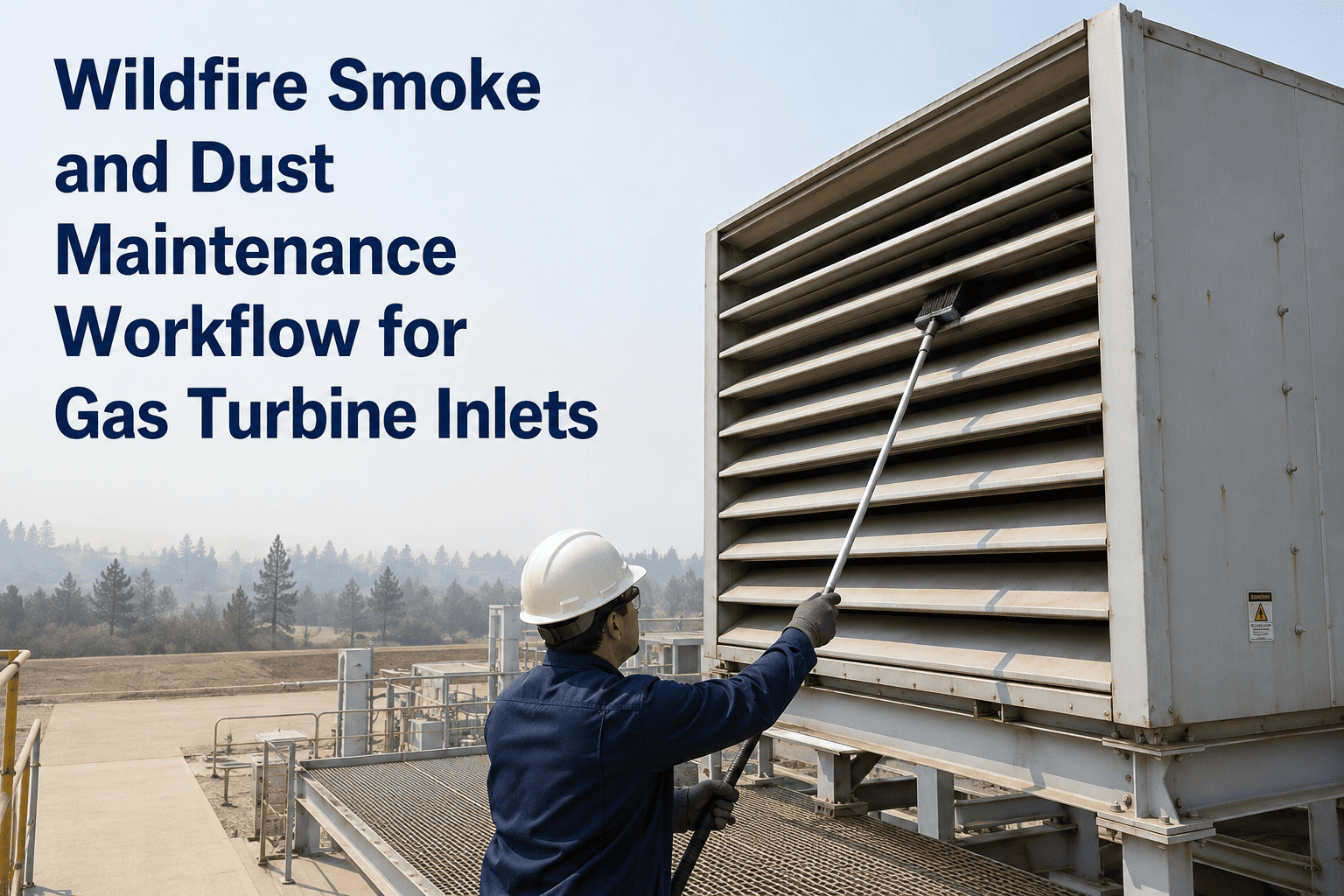
Wildfire smoke seasons no longer follow a predictable calendar. In the Western US, Canada, Australia, and Southern Europe, gas turbine power plants now face 90-to-150-day windows of elevated particulate matter, sub-micron smoke aerosols, and abrasive mineral dust — all arriving simultaneously through inlet air filtration systems never designed for this level of sustained contamination loading. The consequences are real: compressor efficiency drops 1.2–2.4% per 1,000 hours of fouled inlet operation, turbine blades suffer accelerated tip clearance erosion from abrasive ash particles, and differential pressure across inlet filters can spike from 0.5 to 4.2 inches W.G. within 72 hours of a major smoke event. A structured, trigger-based inspection and work order workflow — not a fixed calendar — is the only approach that keeps turbine inlet systems clean without over-maintaining during normal air quality windows. Start your gas turbine inlet inspection workflow in Oxmaint free and build condition-triggered work orders before the next smoke season arrives.
Climate Resilience
Gas Turbine Maintenance
Inspection Management
Wildfire Smoke & Dust Maintenance Workflow for Gas Turbine Inlets
A condition-triggered inspection system that responds to AQI events, dP spikes, and particle counts — not fixed calendar dates — protecting compressor efficiency through every smoke season.
What One Smoke Season Can Cost
2.4%
Compressor efficiency loss per 1,000 hrs fouled operation
8×
Faster filter loading rate during active wildfire smoke events
72 hrs
Time for dP to spike from 0.5 to 4.2 in W.G. in heavy smoke
$380K+
Estimated cost of one unplanned turbine wash + forced outage event
The Core Problem
Why Fixed-Schedule Inlet Maintenance Fails During Wildfire Season
Most gas turbine O&M manuals specify inlet filter inspection at 30 or 90-day intervals based on normal ambient air quality assumptions. A wildfire smoke event invalidates every one of those assumptions within hours. The three failure patterns below repeat across every region that has experienced multi-week smoke events since 2020.
Calendar vs. Condition Mismatch
A 30-day inspection interval was designed for 50–100 µg/m³ average particulate loads. During a wildfire event, PM2.5 concentrations of 400–900 µg/m³ load filters 8–18× faster. By day 10, the filter is already at change-out differential pressure — 20 days before the next scheduled inspection.
Sub-Micron Smoke Aerosol Bypass
Wildfire smoke contains particles below 0.3 µm — smaller than the rated efficiency of most F7/F8 pre-filters. These bypass the inlet filter stage entirely and deposit directly on compressor blades as a sticky carbonaceous coating, causing performance degradation that offline water washing cannot fully recover from.
No Workflow Trigger for AQI Events
Most CMMS systems have no mechanism to convert an AQI alert or regional air quality warning into a maintenance inspection. Operations teams see the smoke, but no work order is generated, no inspection checklist is deployed, and no dP monitoring frequency is increased. The system watches the air quality deteriorate and does nothing.
Workflow Architecture
The 4-Trigger Inspection Workflow That Protects Turbine Inlets During Smoke Events
Effective inlet maintenance during wildfire and dust events is not more maintenance — it is smarter maintenance triggered by the right conditions. Oxmaint's inspection management deploys four trigger types that activate the correct inspection protocol automatically.
AQI Threshold
PM2.5 > 150 µg/m³ (Unhealthy) or AQI > 200
Inlet inspection checklist + dP baseline reading + visual filter inspection
Every 24 hrs while elevated
dP Spike
Differential pressure rise > 0.8 in W.G. in 12 hrs
Emergency filter inspection + change-out readiness check + spare parts confirmation
Immediate — same shift
Performance Drop
Compressor inlet mass flow deviation > 1.5% from baseline
Compressor fouling assessment + offline wash scheduling + filter replacement work order
Work order generated automatically
Smoke Season Entry
Regional smoke season declaration or forecast AQI > 100 for 5+ days
Pre-season baseline inspection + spare filter inventory audit + wash water preparation
One-time event trigger
Each trigger auto-generates a pre-populated Oxmaint work order with checklist, asset ID, and required parts — no manual creation needed
Inspection Checklist
What a Wildfire-Condition Inlet Inspection Actually Covers
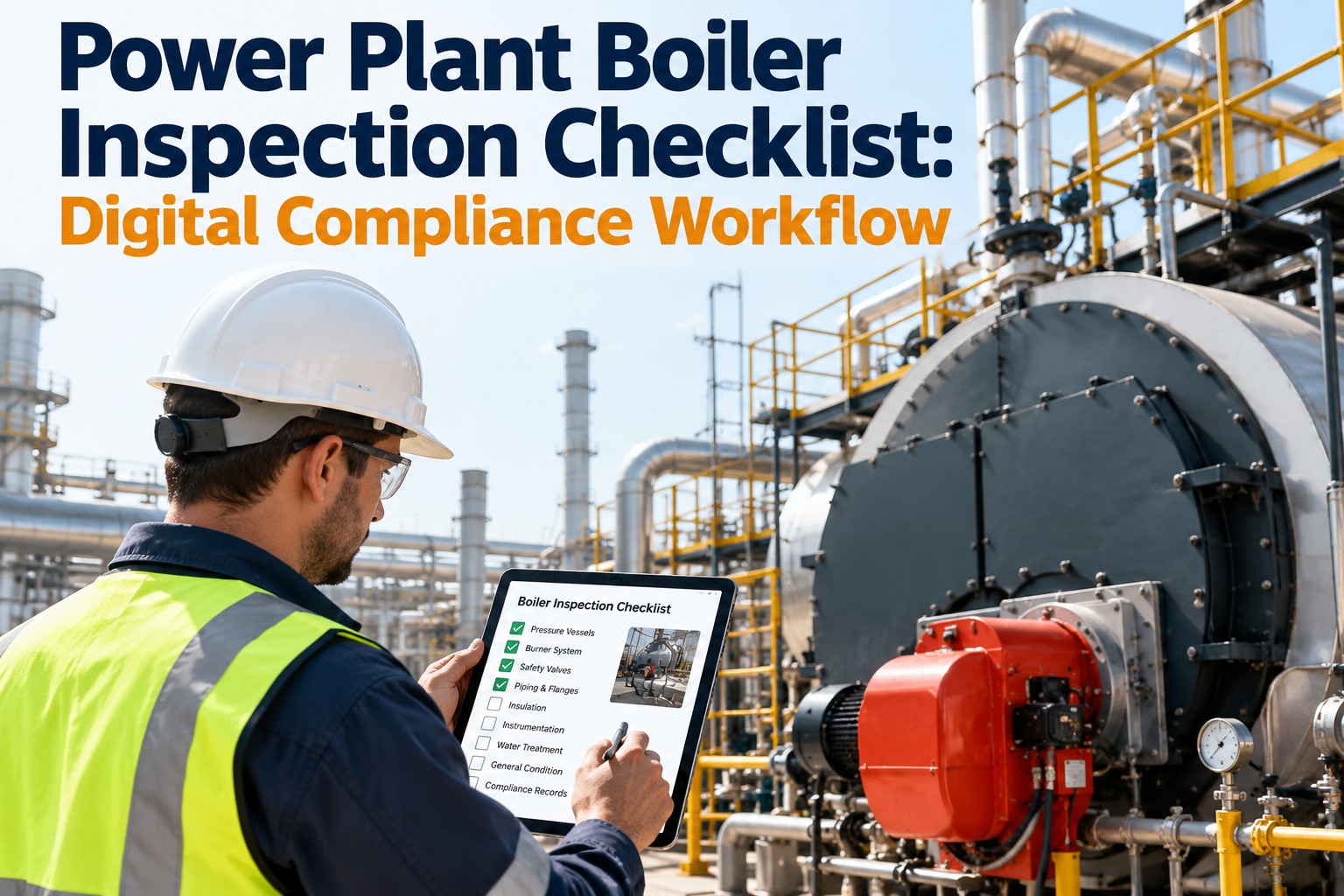
A standard filter change work order is not sufficient for wildfire conditions. The smoke-event inlet inspection checklist covers four systems simultaneously — because smoke contamination does not stop at the filter housing.
Zone 1 — Filter Housing & Pre-Filters
✓ Differential pressure reading vs. manufacturer change-out threshold
✓ Visual inspection for filter media discolouration (black/brown smoke staining)
✓ Filter frame seal integrity — smoke particles exploit any gap
✓ Pre-filter element condition — check for structural collapse under high dP
✓ Drain pan inspection for moisture + soot accumulation (wet smoke deposits)
Zone 2 — Inlet Duct & Silencer
✓ Inlet duct interior visual — smoke aerosol residue on duct walls
✓ Silencer baffle condition — soot accumulation increases acoustic resistance
✓ Anti-icing coil bypass check — keep clear during high-smoke operations
✓ Inlet bellmouth condition — carbonaceous deposit build-up check
Zone 3 — Compressor Inlet Stage
✓ IGV (inlet guide vane) visual — smoke deposit on leading and trailing edges
✓ Compressor fouling index calculation from mass flow and pressure ratio data
✓ Online wash effectiveness check — frequency increase assessment
✓ Offline wash scheduling recommendation based on performance degradation trend
Zone 4 — Spares & Readiness
✓ Spare filter inventory count vs. projected consumption rate at current AQI
✓ Filter replacement crew availability confirmation for next 72-hr window
✓ Wash water demineralizer capacity — enough for emergency offline wash if needed
✓ Supplier lead time for next filter order — long-lead items during regional events
Put this checklist into automated, condition-triggered work orders
Oxmaint deploys the complete smoke-event inspection workflow — with dP-triggered alerts, pre-populated checklists, and spare parts tracking — across every gas turbine unit on your site.
Seasonal Readiness
Pre-Season, In-Season, and Post-Season Maintenance Tasks — Mapped
A one-time inspection is not a wildfire resilience programme. The table below maps every task across the three phases of a smoke season — so nothing falls through the gap between an AQI warning and a planned outage.
Pre-Season (60 Days Before)
Baseline all inlet dP readings — document clean-filter reference values
Audit spare filter inventory — order 60-day buffer stock
Calibrate AQI monitoring integration with CMMS alert rules
Schedule pre-season compressor offline wash and performance baseline
Review and update smoke-event response procedure in Oxmaint
→
In-Season (Active Smoke Events)
Daily dP readings — auto-compared to baseline in Oxmaint dashboard
AQI-triggered inspection work orders generated automatically
Filter consumption tracked against inventory — auto-reorder at threshold
Compressor fouling index tracked — offline wash scheduled when threshold crossed
All inspection findings logged to turbine asset history in real time
→
Post-Season (30 Days After)
Full inlet duct and compressor inspection — confirm no residual fouling
Offline wash performance recovery measurement — document delta vs. pre-season
Filter consumption analysis — refine inventory model for next season
Inspection history review — identify any missed trigger events
Update smoke-season response thresholds based on actual performance data
FAQ
Frequently Asked Questions
How often should gas turbine inlet filters be inspected during a wildfire smoke event?
During active smoke events with PM2.5 above 150 µg/m³, daily dP checks are the minimum. If AQI exceeds 300 or dP rise rate exceeds 0.8 in W.G. in 12 hours, shift-level checks are warranted.
Oxmaint's inspection management automates this frequency escalation based on real-time trigger conditions — so the right frequency is applied without manual rescheduling.
Can sub-micron wildfire smoke particles damage gas turbine compressors even with good filters?
Yes. Particles below 0.3 µm bypass F7/F8 efficiency curves and deposit as sticky carbonaceous coatings on IGVs and early compressor stages. The solution is increased online wash frequency during smoke events and a scheduled offline wash within 30 days of a prolonged smoke exposure period to recover performance fully.
Book a demo to see how Oxmaint tracks fouling index trends and schedules compressor washes automatically.
What data does Oxmaint need to generate AQI-triggered work orders?
Oxmaint integrates with plant DCS for dP readings and can ingest AQI data feeds via API from national air quality monitoring networks (EPA AirNow, regional equivalents). Once thresholds are configured, trigger conditions automatically generate inspection work orders with the correct checklist, assigned technician, and required parts — no manual intervention required.
How much spare filter inventory should a plant hold for wildfire season?
A practical rule of thumb is 60 days of consumption at peak-smoke loading rates — typically 3–4× normal consumption. During regional wildfire events, supplier lead times extend as multiple plants compete for the same filter media.
Oxmaint's inventory module tracks consumption rate trends and auto-generates purchase orders when stock falls below the seasonal buffer threshold.
Does a structured inspection workflow actually prevent turbine damage, or just document it?
Documentation without action is just a record of failure. The Oxmaint workflow closes the loop: every triggered inspection results in a specific finding, a specific action (filter change, wash schedule, parts order), and a verified completion record. Plants using condition-triggered workflows report 60–75% fewer smoke-related turbine performance events than plants relying on calendar-based maintenance alone.
Condition-triggered inlet maintenance — deployed before the next smoke season
Oxmaint's inspection management converts AQI alerts, dP spikes, and performance deviations into structured work orders automatically — with checklists, spares tracking, and asset history built in from the first event.