A 36-building commercial portfolio in Atlanta ran its facilities operation the way most do: calendar-based preventive maintenance on every piece of equipment, regardless of condition. Every chiller got serviced on the same 90-day cycle. Every rooftop unit got the same filter change schedule. Every elevator got the same quarterly inspection. The problem was not that maintenance happened — it was that maintenance happened equally on equipment that was healthy and equipment that was dying. When a 200-ton chiller in their flagship Class A tower seized on a Tuesday in August, the building engineer pulled the work order history and discovered it had received a clean bill of health 11 days earlier during a routine PM visit. What the calendar could not see — and what an AI Asset Health Index would have flagged eight weeks prior — was a 23% increase in compressor current draw, a steady decline in kW-per-ton efficiency, and abnormal vibration signatures on the drive bearing. The emergency replacement cost $187,000. The tenant disruption triggered two lease non-renewals worth $940,000 in annual revenue. The total impact from one asset that looked fine on paper but was critically degraded in reality exceeded $1.1 million. Across U.S. commercial real estate, 40% of total emergency maintenance spending comes from HVAC failures alone, and early adopters of AI-powered predictive platforms are reporting maintenance cost reductions of 20 to 30% and emergency callout reductions of up to 40%. The Asset Health Index is the missing intelligence layer — a single, dynamic score for every piece of critical equipment that tells you exactly which assets need attention now, which can wait, and which are trending toward failure. Start your free trial today and see your portfolio's true asset health. Schedule a 30-minute demo to see live health scoring on real building equipment.
What Is an Asset Health Index?
A single 0–100 score for every piece of critical equipment — calculated in real time from operational data, maintenance history, age, and AI-detected degradation patterns
Critical
At-Risk
Healthy
Optimal
Traditional PM treats every asset the same. The Health Index tells you which ones actually need help — and which ones don't.
Why Calendar-Based Maintenance Fails Commercial Portfolios
Calendar-based preventive maintenance was designed for an era when equipment data did not exist. It applies the same schedule to every asset regardless of actual condition — servicing healthy equipment unnecessarily while missing degradation in equipment that needs urgent attention. The result is simultaneous overspending and underprotection. Industry data shows that facilities teams using only calendar-based approaches dedicate less than half their maintenance time to truly proactive strategies, even when they believe they are running preventive programs. The Asset Health Index replaces guesswork with precision: maintain what needs maintaining, defer what does not, and never be surprised by a failure that was predictable.
01
Treats All Assets Equally
A brand-new RTU and a 14-year-old chiller get the same 90-day inspection. One needs attention. The other does not. Resources are wasted on the wrong equipment.
02
Invisible Degradation
Current draw rising 2% per week is invisible to a quarterly visit but obvious to continuous monitoring. By the time the next PM arrives, the compressor has seized.
03
No Cross-Asset Priority
With 400 assets across 20 buildings, which one gets the next available technician? Calendars cannot rank urgency. Health scores can — instantly, across the portfolio.
04
Zero Capital Intelligence
Calendar PM cannot tell the CFO which assets will need replacement in 18 months. Health Index trending data builds condition-based capital plans backed by evidence.
How AI Calculates the Asset Health Index
The Health Index is not a single metric — it is a composite score built from five weighted input categories that AI evaluates continuously. Each category contributes a weighted portion of the 0–100 score. When any input deteriorates, the score drops — and the system generates alerts, recommended actions, and cost projections before the asset reaches failure. Properties deploying this intelligence through Oxmaint connect existing BMS, sensor, and CMMS data to generate health scores within weeks of activation.
What Property Managers See: The Health Dashboard
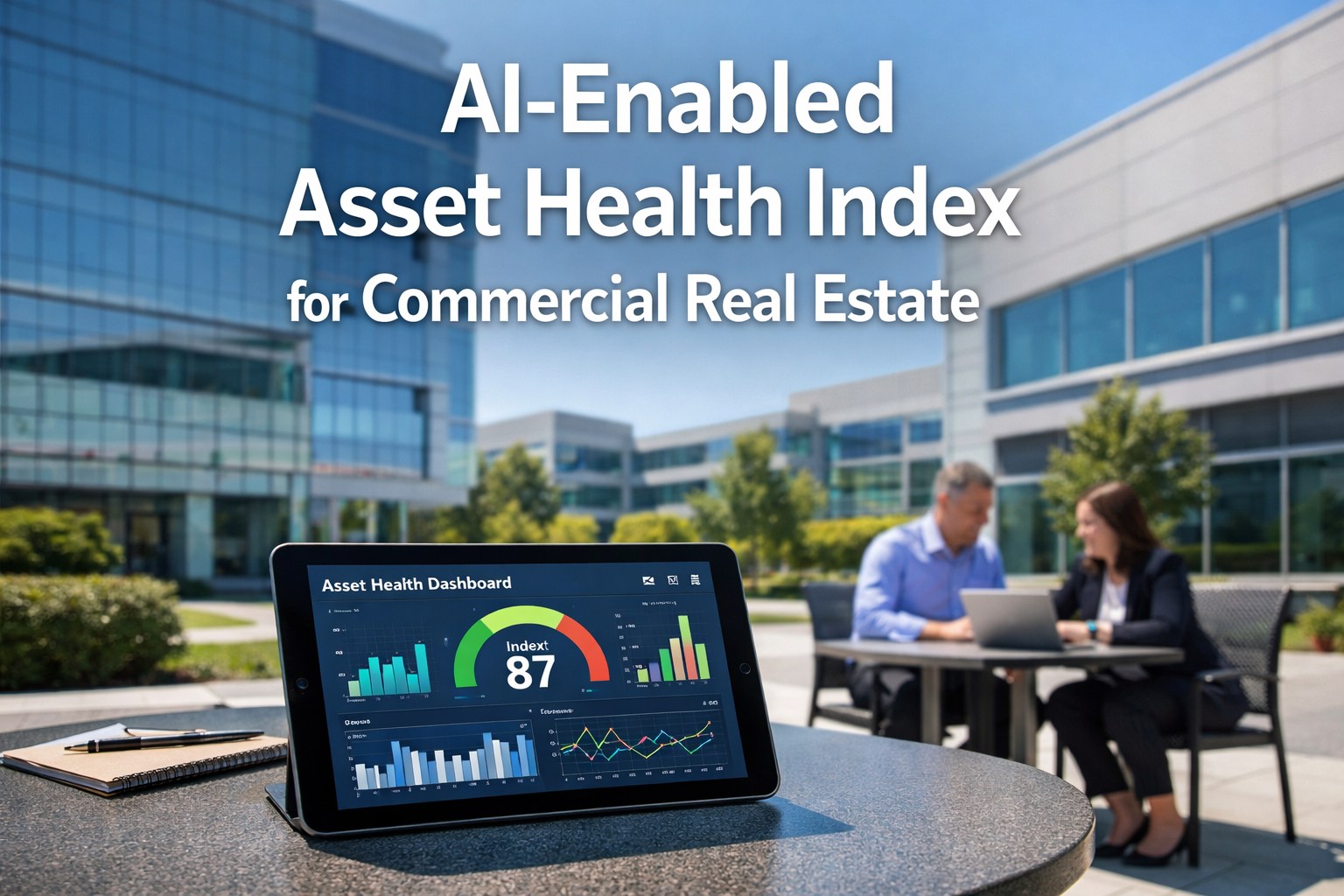
The Asset Health Index transforms portfolio maintenance from scattered work orders into a single prioritized view. Instead of asking "what's on the calendar this week?" the facilities team asks "which assets are declining fastest and what should we do about them?" Schedule a demo to see this dashboard running on live building data.
Portfolio Health Dashboard — 20 Buildings · 380 Monitored Assets
$1.4M
Failure Risk Exposure
Chiller #3 — Carrier 200TTower A31↓ DecliningBearing inspection — 3 weeks
AHU-7 — Trane?"Medical Office B52↓ DecliningBelt + VFD check — 6 weeks
Elevator #2 — Otis Gen2Retail Center78→ StableNo action — next PM in 45 days
RTU-12 — Lennox 15TTower C91↑ ImprovingDefer PM — asset performing above baseline
See Every Asset's True Health Score — Across Your Entire Portfolio
Oxmaint connects to your existing BMS, sensors, and CMMS to generate real-time health scores for every critical asset. Your team stops guessing which equipment needs attention and starts acting on data.
ROI: What Health-Index-Driven Maintenance Delivers
Shifting from calendar-based to health-index-driven maintenance does not just prevent failures — it fundamentally changes how maintenance budgets are allocated. Resources flow to the assets that need them, away from those that do not. The financial impact compounds as AI models mature and portfolio-specific patterns become more accurate.
Emergency Avoidance
12 prevented failures × $52K avg cost (4.8× multiplier eliminated)
$624K
PM Optimization
22% of scheduled PMs safely deferred — tech hours redirected to at-risk assets
$186K
Energy Fault Detection
Stuck valves, simultaneous heat/cool, equipment running off-hours — 15–20% HVAC waste eliminated
$340K
Equipment Life Extension
Condition-based timing extends asset life 15–25%, deferring $3.2M in capital replacement
$260K
Tenant Retention
Zero comfort disruptions from preventable failures — renewal rates improve 8–12%
$190K
Total Annual Value
$1.60M
Real Catches: What Health Scores Revealed
The most powerful evidence for the Asset Health Index comes from assets that scored perfectly on calendar-based PM visits but were flagged as critical by AI — and from assets scheduled for expensive service that the Health Index proved unnecessary.
Caught by AI
Chiller Compressor — Class A Office
Calendar PM said: Passed inspection — no issues noted
Health Index said: Score dropped from 82 → 44 in 6 weeks (current draw +23%, efficiency −18%)
Action taken: Bearing replacement scheduled — $6,200 planned repair
Emergency avoided: $187,000 compressor failure + $940K in lease non-renewals
Saved by AI
Rooftop Units — Suburban Office Park
Calendar PM said: 8 RTUs due for $4,800 each in quarterly service
Health Index said: 6 of 8 units scoring 88–95, performing above baseline
Action taken: Deferred 6 services, concentrated resources on 2 declining units
Saved: $28,800 in unnecessary PM · Prevented 1 failure worth $34,000
From Pilot to Portfolio: Implementation Path
Deploying AI health scoring does not require replacing your BMS or CMMS. The platform layers on top of existing infrastructure and begins generating scores within weeks. Schedule a demo to design a phased rollout for your portfolio.
01
Weeks 1–2: Connect
Integrate BMS, CMMS, and metering data · Select 3–5 pilot buildings · Map critical assets
02
Weeks 3–6: Learn
AI learns equipment baselines · First health scores generated · Initial anomalies surfaced
03
Months 2–4: Act
Health-driven work orders replace calendar PMs · First catches documented · Team trust builds
04
Month 5+: Scale
Expand to full portfolio · Capital planning driven by condition data · Board-ready ROI reports
Frequently Asked Questions
What types of equipment get health scores?
Any asset that produces operational data or has maintenance history can receive a health score. The highest-impact assets for commercial portfolios are chillers, boilers, cooling towers, rooftop units, air handlers, elevators, electrical switchgear, emergency generators, and pumps. These typically account for over 85% of emergency spend and unplanned downtime. The platform also scores secondary systems like VAV boxes, exhaust fans, and domestic water heaters — any asset tracked in your CMMS.
Sign up free to start building your scored asset inventory.
Do we need IoT sensors on every asset?
No. The platform generates meaningful health scores from whatever data exists today. Buildings with BMS connectivity get scores from existing sensor feeds at no additional hardware cost. For buildings with limited automation, standalone wireless sensors at $100–$500 per monitoring point can be added to high-priority assets. Even assets with only CMMS work order history receive a baseline health score from repair frequency, parts patterns, and age data. Most portfolios start with 15–20% of assets instrumented with IoT and expand based on proven value.
How quickly do health scores become accurate?
Fault detection (identifying current operational problems) works from day one with rules-based logic. Predictive health scoring needs 2 to 4 weeks to learn each asset's normal operating baseline. By month 3, scores reflect seasonal patterns and load variations. By month 6, most portfolios report 85 to 92% accuracy in predicting major failure modes. Accuracy compounds as the AI learns equipment-specific behaviors unique to your buildings.
Can health scores support capital planning decisions?
This is one of the most powerful applications. Instead of replacing equipment based on age alone, health score trending data shows which assets are actually approaching end-of-life and which have years of remaining useful life despite their age. Facilities teams using health-index-driven capital plans report deferring 15 to 25% of planned replacements while catching assets that need earlier-than-expected replacement — resulting in better-timed capital budgets and fewer surprises.
Book a demo to see how health trending supports capital planning for your portfolio.
Every Asset in Your Portfolio Has a Health Score. You Just Cannot See It Yet.
Some of your equipment is getting serviced unnecessarily while other assets are silently degrading toward six-figure emergencies. Oxmaint's Asset Health Index scores every asset in real time — so your team acts on evidence, not calendars.

.png)

.png)


