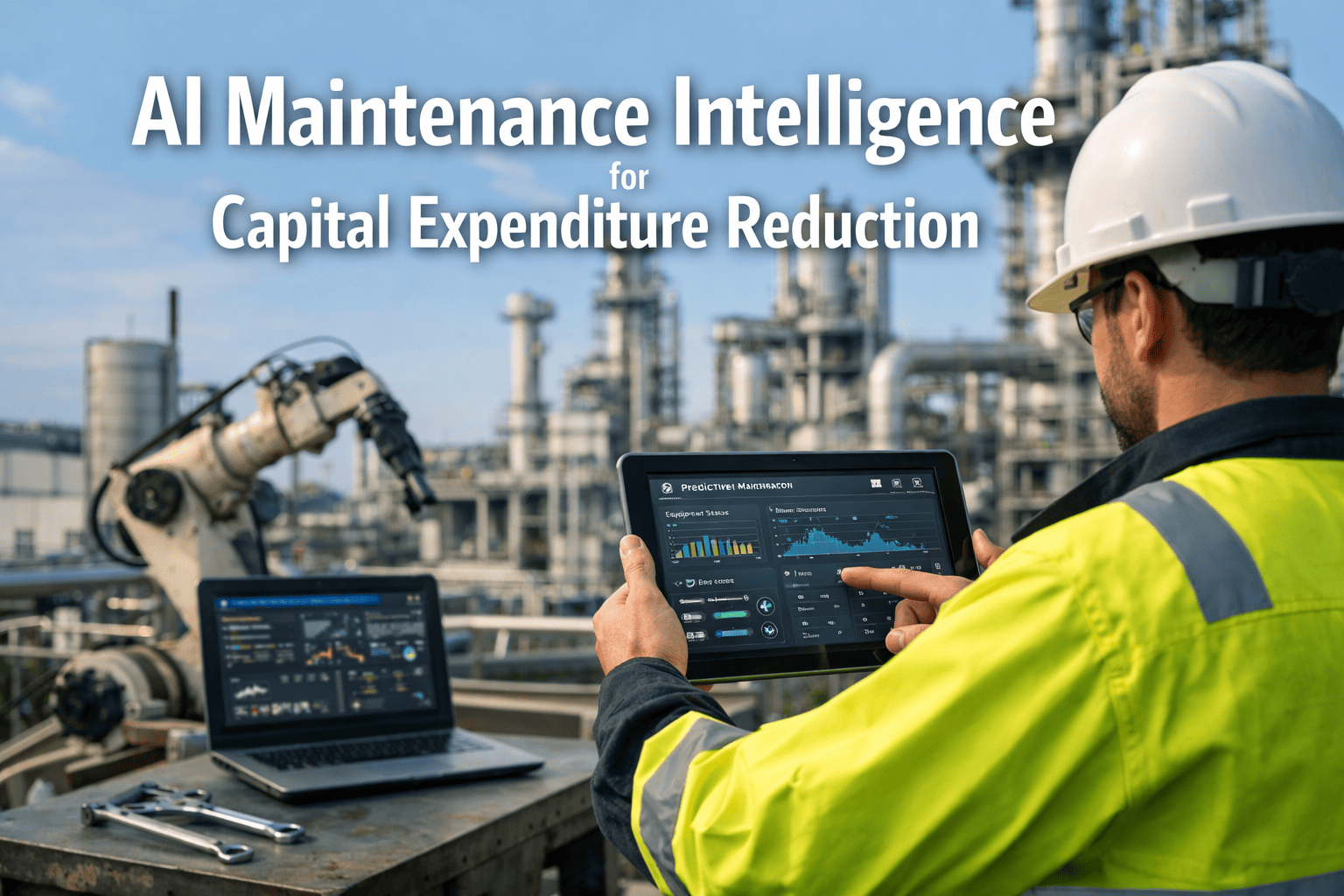
Managing maintenance across a portfolio of 5, 50 or 500 buildings with static schedules is like navigating with a paper map in the age of GPS. Every building ages differently, tenants stress systems in unique ways, and no two rooftop HVAC units degrade at the same rate. Self-learning maintenance systems powered by machine learning solve this by studying every work order, every sensor reading, and every repair outcome across your entire portfolio — then automatically adapting schedules, priorities, and predictions. In 2026, AI adoption in facility management is projected to surpass $12 billion, and the CMMS market itself is on track to exceed $5.37 billion by 2035. The shift from reactive firefighting to adaptive intelligence isn't coming — it's here. This guide explains how self-learning CMMS works, why multi-building portfolios benefit most, and how you can get started with a free maintenance management platform today.
Self-Learning CMMS at a Glance
Core Technology
Machine Learning + IoT
Maintenance Cost Savings
25–40% Reduction
Failure Prediction Accuracy
Up to 90%
Downtime Reduction
30–50% Less
What Makes a Maintenance System "Self-Learning"?
A self-learning maintenance system goes far beyond static preventive schedules and even traditional predictive maintenance. It uses machine learning algorithms that continuously refine their understanding of how your specific assets behave — across all your buildings, equipment types, and operating conditions. Every completed work order, sensor reading, and repair outcome feeds back into the model, making predictions sharper and scheduling smarter with each cycle.
Unlike conventional CMMS platforms that follow rigid manufacturer-recommended intervals, a self-learning system observes that your Building A chiller runs harder due to south-facing sun exposure, your Building C elevators get heavier weekend traffic, and your Building F boiler shows different wear patterns than identical models elsewhere. It adjusts scheduling for each asset individually — because no two buildings are truly the same. To see how adaptive, cloud-based maintenance scheduling works in practice, start your free trial and centralize all your building data in one platform.
✓
Adaptive Intelligence: ML algorithms continuously learn from outcomes of previous maintenance actions, reducing human bias and improving accuracy with each completed work order cycle.
✓
Cross-Building Learning: A failure pattern detected in one building immediately improves predictions across your entire portfolio — exponentially accelerating intelligence as you add more properties.
✓
Autonomous Optimization: The system self-adjusts maintenance intervals, work order priorities, and technician assignments without manual reconfiguration — saving hours of planning each week.
Why Static Maintenance Fails Multi-Building Portfolios
In 2025, 56% of facilities managers reported higher work order volumes while 43% said their teams are understaffed. Yet 58% of facilities still spend less than half their time on scheduled maintenance. This mismatch between demand and capacity means portfolio managers are perpetually fighting fires instead of preventing them. Meanwhile, unplanned equipment downtime costs Fortune Global 500 companies roughly 11% of annual revenue.
✗
One-Size-Fits-All Schedules: Manufacturer-recommended intervals ignore that identical equipment in different buildings degrades at different rates based on usage intensity, environment, and tenant behavior patterns.
✗
Knowledge Loss on Staff Turnover: When experienced technicians leave, decades of institutional knowledge about specific buildings walks out the door. Paper records and tribal knowledge cannot be transferred effectively.
✗
Portfolio Blind Spots: Without centralized intelligence, managers cannot compare asset health across buildings or identify which property needs capital investment most urgently — leading to misallocated budgets.
✗
Reactive Cost Spiral: The average manufacturing facility experiences 25 unplanned downtime incidents per month. Every hour of unexpected equipment failure compounds losses through emergency repair premiums, tenant disruption, and accelerated asset degradation.
The Continuous Learning Loop: How Self-Learning CMMS Works
Self-learning CMMS platforms operate as a closed feedback loop. Data flows in from every building, intelligence flows out as optimized decisions, and every action teaches the system something new. Here is the four-stage cycle that makes your maintenance operation smarter every day.
The Self-Learning Maintenance Cycle
1. Collect
Work orders, sensor data, energy readings, and repair logs from every building centralize into one CMMS platform.
2. Detect
ML algorithms identify anomalies — excess current draw, vibration spikes, unusual water usage — invisible to manual inspection.
3. Predict
Remaining Useful Life estimates rank maintenance urgency across your entire portfolio by operational and financial impact.
4. Adapt
Auto-generated work orders dispatch. Repair outcomes feed back into the model — refining all future predictions.
♻️ Every completed cycle makes the system smarter — predictions sharpen, costs decrease, uptime increases
"Facilities management tech stacks will reach a new level of maturity as facility managers integrate CMMS platforms, building automation systems, IoT sensors and asset data into a single system. Rather than collecting data for reporting's sake, they'll be using it to guide capital planning, staffing and risk mitigation."
— Griffin Hamilton
CRO, FlowPath — Facilities Dive, 2026 FM Predictions
See the learning loop in action
Discover how automated work orders and adaptive scheduling reduce downtime across your entire portfolio.
Schedule a Demo →
Static CMMS vs. Self-Learning CMMS: The Complete Comparison
The shift from traditional CMMS to a self-learning system is not incremental — it fundamentally changes how maintenance decisions are made across every building in your portfolio. Here is what changes when you move from rigid scheduling to adaptive AI intelligence.
| Capability |
Traditional CMMS |
Self-Learning CMMS |
| Scheduling Logic |
Fixed Intervals |
Condition-Based, Adaptive |
| Failure Response |
Reactive / Preventive |
Predicted 2–4 Weeks Ahead |
| Cross-Building Intelligence |
None — Siloed Data |
Patterns Transfer Across Sites |
| Work Order Priority |
Manual Assignment |
AI-Ranked by Impact |
| Knowledge Retention |
Lost on Staff Turnover |
Captured in the Model |
| Budget Accuracy |
±25% Variance |
±5% Variance |
| System Improvement |
Stays Static Forever |
Gets Smarter Every Quarter |
The Numbers: What Self-Learning Maintenance Delivers
Industry data consistently shows measurable ROI from AI-driven maintenance intelligence. Here are the benchmarks from real-world implementations across commercial property portfolios — and why organizations using a centralized work order and asset management platform are positioned to capture these gains faster.
40%
Maintenance Cost Reduction
AI-powered building automation platforms cut maintenance costs by 20–40% through proactive intervention and elimination of unnecessary PM tasks.
50%
Downtime Reduction
Predictive systems detect early warning signs and schedule repairs before failures occur — cutting unplanned downtime by up to half.
20%
Longer Asset Lifespan
Timely, condition-based maintenance extends equipment life by 10–20%, deferring costly capital replacements and maximizing ROI.
Why Multi-Building Portfolios Benefit Most
Self-learning systems become exponentially more powerful with more buildings. A single property gives you local insights. A portfolio gives you system-wide intelligence — where patterns from one property improve predictions across all of them. Organizations managing multi-site portfolios report anomaly detection speeds up to 10× faster than single-site operations.
Cross-Building Pattern Transfer
An HVAC failure pattern in Building A prevents the same issue in Buildings B through Z — before symptoms even appear.
10× Faster Detection
Unified Resource Dispatch
AI assigns the right technician with the right skills to the highest-priority job across all buildings — optimizing every labor hour.
30% Productivity Boost
Portfolio-Wide Benchmarking
Compare asset health, maintenance costs, and performance scores across every property from a single dashboard.
1 Source of Truth
Where Self-Learning Intelligence Applies
Every building system has its own degradation curve. Self-learning algorithms study each one independently — then correlate patterns across systems for deeper portfolio-level insights. Here are the highest-impact asset categories.
Highest ROI
HVAC Systems
Monitor compressor health, coil efficiency, and airflow. AI detects subtle efficiency losses and predicts failures weeks in advance — the top category for maintenance savings across commercial portfolios.
Safety-Critical
Electrical and Power
Detect thermal anomalies, load imbalances, and generator health issues. Self-learning models adapt thresholds to each building's unique electrical profile and seasonal usage patterns.
Damage Prevention
Plumbing and Water
Identify leak patterns, pressure anomalies, and pipe degradation early. AI correlates water meter data with weather and occupancy to flag issues that cost 10× less to fix proactively.
Tenant Experience
Elevators and Lifts
Track motor performance, door mechanics, and ride quality across all cabs. The system learns peak usage patterns and schedules overhauls to minimize tenant disruption.
Ready to digitize your multi-building operations?
Centralize work orders, asset data, and inspections across your entire portfolio in one platform.
Sign Up Free →
How to Get Started with Self-Learning Maintenance
Transitioning from static schedules to adaptive, AI-driven maintenance does not require ripping out your existing systems. The key is a structured, phased approach that validates ROI at each step — starting with a cloud-based CMMS as the data foundation. You can create your free account and start digitizing work orders in minutes.
1.
Digitize Your Operations: Move from paper and spreadsheets to a cloud-based CMMS. Centralize all work orders, asset records, and inspection history into one platform — this operational data is the fuel that powers machine learning.
2.
Start with One Building: Pilot in a single building or asset category (HVAC is ideal for highest ROI) to validate savings before portfolio-wide rollout. Measure baseline emergency repair costs, downtime frequency, and total maintenance spend.
3.
Let the Data Accumulate: Self-learning models need 3–6 months of consistent data to produce meaningful predictions. During this period, the system observes patterns and calibrates to your portfolio's unique behavior.
4.
Train Your Team: Equip maintenance staff to interpret AI insights and act on recommendations. The technology augments human expertise — it does not replace it. Focus training on mobile work order completion and data quality.
5.
Scale Across the Portfolio: As data maturity grows, expand predictive capabilities to additional buildings and systems. Cross-building learning accelerates with each property added to the platform.
6.
Review, Benchmark, Optimize: Use portfolio dashboards to compare performance across buildings, identify lagging properties, and continuously refine your maintenance strategy with data-backed decisions.
"The CMMS learns from outcomes — what works and what doesn't — and refines its recommendations over time. The result is a self-optimizing maintenance ecosystem where technicians' skills and AI-driven insights work together. The journey from reactive to prescriptive maintenance is about building the right foundation and advancing systematically."
— CMMS Roadmap 2026
ClickMaint Industry Analysis
Key Takeaways for Portfolio Managers
→
Self-learning systems adapt to your buildings: Unlike fixed-schedule CMMS, ML algorithms study how each asset actually behaves and adjust maintenance intervals automatically — no manual reconfiguration needed.
→
More buildings = smarter system: Cross-building pattern transfer means every property added to your portfolio accelerates intelligence for all the others — delivering compounding value at scale.
→
The data proves the ROI: 25–40% cost reduction, 50% less downtime, 20% longer asset life — these are industry benchmarks from Deloitte, PwC, and real-world portfolio implementations.
→
Start small, scale fast: Pilot on one building, validate savings within 6 months, then expand portfolio-wide with confidence. A phased approach with centralized CMMS data makes scaling seamless.
→
Institutional knowledge is preserved: When experienced staff leave, their operational insights remain embedded in the self-learning model — protecting your organization from knowledge loss.
Ready for Maintenance That Gets Smarter Every Day?
Get the foundation for self-learning maintenance — real-time asset tracking, automated work orders, adaptive scheduling, and cross-portfolio analytics in one platform. Start your free trial or book a personalized demo to see how it works for your buildings.
Frequently Asked Questions
What is the difference between predictive maintenance and self-learning maintenance?
Predictive maintenance uses sensor data to forecast when equipment might fail. Self-learning maintenance goes further — it continuously refines its predictions based on repair outcomes, adapts scheduling intervals automatically, and transfers patterns learned from one building to improve predictions across your entire portfolio. Think of it as predictive maintenance that improves itself with every completed work order.
How many buildings do I need to benefit from cross-building learning?
Even two buildings with similar equipment create transfer learning opportunities. However, benefits compound significantly with portfolios of 5 or more properties, where the system has enough data diversity to detect nuanced patterns. Single-building operations still benefit from adaptive scheduling and anomaly detection —
explore the full CMMS feature set with a free account.
How long before the system starts producing useful predictions?
Most self-learning CMMS platforms begin surfacing actionable insights within 3–6 months of consistent data input. Initial value comes from automated work order prioritization and anomaly detection. Deeper predictive accuracy — like Remaining Useful Life estimates — typically matures over 6–12 months as the model accumulates enough failure and repair data.
Do I need IoT sensors installed in all my buildings?
IoT sensors accelerate insights, but they are not required to start. Self-learning models can begin with work order history, inspection logs, and manual data entry. Many portfolios start with sensor-equipped pilot buildings and expand IoT coverage as ROI is proven. The CMMS itself captures valuable operational data from day one.
Will AI replace my maintenance team?
No. Self-learning systems augment human expertise — they handle data analysis, pattern detection, and schedule optimization so technicians can focus on skilled repair work and strategic decisions. These tools free your team from administrative overhead and enable them to be more productive, not less necessary.
How do I get started with self-learning maintenance workflows?
The first step is centralizing your maintenance data. You need real-time asset tracking, automated work order generation, mobile-first inspections, and cross-portfolio analytics all in one cloud-based platform. Once that data foundation is in place, adaptive scheduling and intelligent optimization follow naturally.
Book a free 30-minute walkthrough to see the complete workflow.