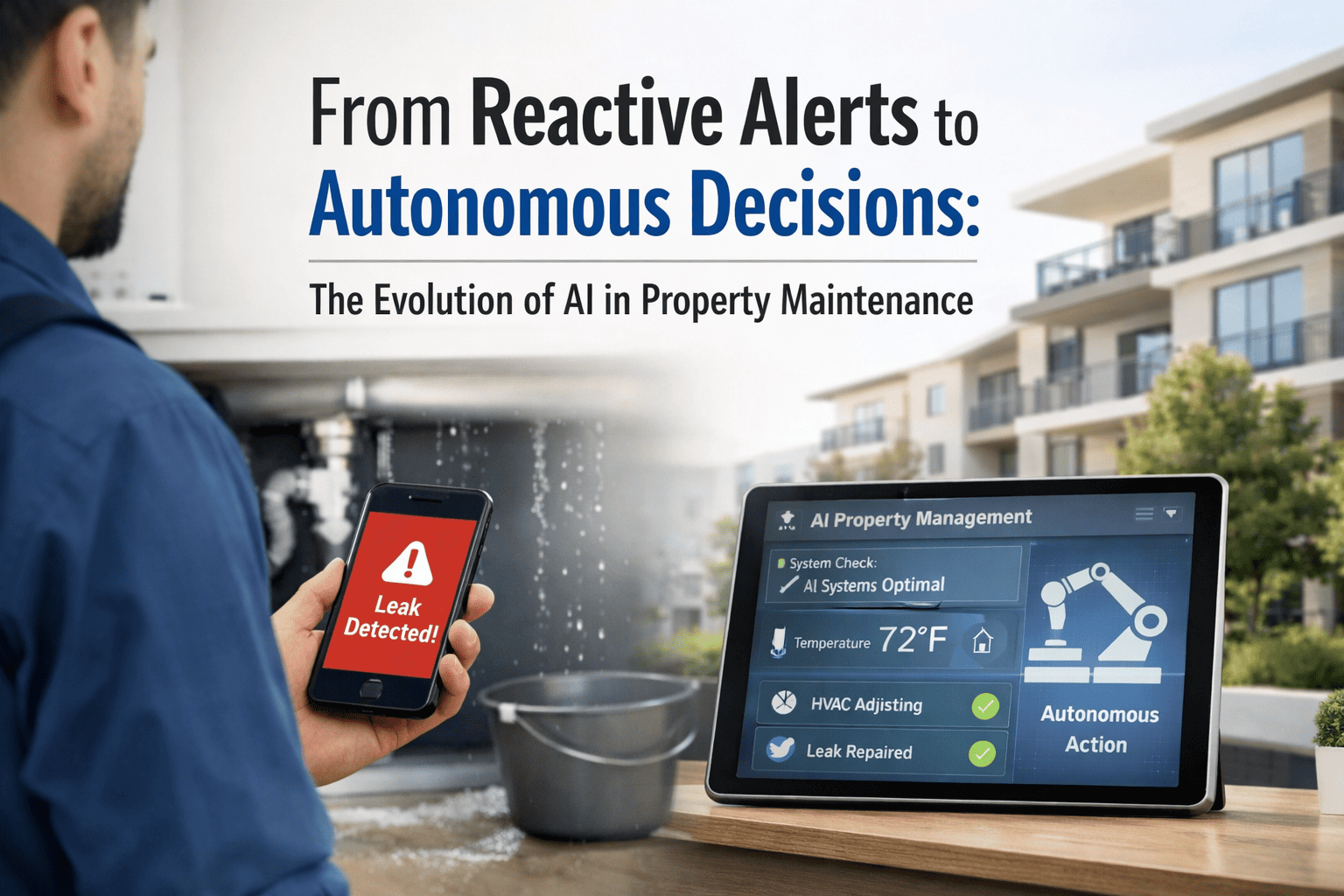
Most property maintenance teams still operate in firefighting mode — waiting for something to break, then scrambling to fix it. But the industry is shifting beneath their feet. In 2026, AI in facility management has moved from experimental pilot programs to operational backbone, with the global market projected to surpass $12 billion. The shift isn't just about adding sensors or dashboards. It's a fundamental evolution in how buildings are maintained — from reactive alerts that tell you something already failed, to autonomous systems that detect, decide, and act without human intervention. This guide maps the five stages of that evolution, shows you where your operation likely sits today, and outlines the path to each next level. Whether you manage a single building or a multi-site portfolio, understanding this progression is how you turn maintenance from a cost center into a strategic advantage. The journey starts with digitizing your work orders and asset data in one centralized platform.
Why This Evolution Matters Now
Property maintenance has always been information-intensive and time-sensitive. Managers juggle leasing, maintenance coordination, tenant inquiries, compliance, and portfolio analytics — often across disconnected systems. In 2025, 56% of facilities managers reported higher workloads while 43% said their teams are understaffed. The average cost of unplanned downtime has risen to over $22,000 per minute in heavy industries, and even commercial buildings face thousands in emergency repair premiums and tenant disruption costs. The old model of "fix it when it breaks" simply cannot scale.
AI changes this equation fundamentally. Not with one giant leap, but through a phased evolution that builds intelligence layer by layer — each stage unlocking new capabilities and measurable ROI. The organizations that understand this progression and advance deliberately through it are the ones capturing 25–40% lower maintenance costs, 50% less downtime, and 10–20% longer asset lifespans.
The Five Stages of AI in Property Maintenance
Every maintenance organization sits somewhere on this maturity curve. No matter where you start, the path forward follows the same progression — each stage building on the data and processes established in the one before it.
Reactive — Fix It When It Breaks
Maintenance happens only after equipment fails. No planning, no data capture, no visibility into what's coming next. Work orders live on paper, in emails, or in someone's memory. Technicians respond to emergencies all day. Costs are unpredictable, and asset life is shortened because equipment runs until failure.
Preventive — Schedule-Based Maintenance
The first leap: maintenance shifts from "fix after failure" to "maintain on a schedule." Equipment gets serviced at regular intervals — every 30 days, every 500 hours, or per manufacturer recommendation. A CMMS digitizes work orders, tracks asset history, and automates scheduling. Emergency repairs drop significantly, but some maintenance happens too early (wasting resources) or too late (missing emerging problems).
Predictive — Data-Driven Forecasting
Now maintenance is driven by actual equipment condition rather than the calendar. IoT sensors monitor vibration, temperature, pressure, and energy consumption in real time. Machine learning analyzes patterns and detects anomalies that human inspectors would miss — predicting failures 2–4 weeks before they happen. Work orders are triggered by condition thresholds, not schedules. Maintenance happens only when truly needed.
Prescriptive — AI Recommends Actions
The system doesn't just predict what will fail — it recommends exactly what to do about it. By leveraging digital twins, scenario simulation, and cross-asset intelligence, prescriptive AI balances cost, performance, and resource availability to suggest the optimal response. It generates prioritized work orders, recommends the right technician, checks parts inventory, and even adjusts related maintenance schedules to prevent cascading failures.
Autonomous — Self-Optimizing Operations
The frontier: AI systems don't just recommend actions — they execute them. Autonomous CMMS platforms auto-generate work orders, dispatch technicians, order replacement parts, and adjust operating parameters without human intervention. The system learns continuously from every outcome, getting smarter with each repair cycle. Human operators shift from managing tasks to governing strategy. In 2026, agentic AI is moving from concept to real business deployment in property management.
The Impact at Each Stage: What Changes When You Advance
Each stage of AI maturity unlocks measurably different outcomes for maintenance cost, downtime, asset lifespan, and team productivity. The further you progress, the more compounding the benefits become — especially for multi-building portfolios where intelligence transfers across properties.
| Metric | Reactive | Preventive | Predictive | Prescriptive+ |
|---|---|---|---|---|
| Emergency Repairs | 60%+ of work | 30–40% | 10–15% | <5% |
| Maintenance Costs | Highest | 15–20% lower | 25–35% lower | 35–40% lower |
| Asset Lifespan | Shortened | Normal | 10–15% longer | 15–20% longer |
| Decision Speed | Hours / Days | Scheduled | Minutes | Seconds (Auto) |
| Data Foundation | None | CMMS records | IoT + CMMS | Full ecosystem |
The Critical Foundation: Why Stage 2 Is the Unlock
Here's the truth most AI discussions skip: you cannot jump from reactive to predictive. Every advanced stage — predictive, prescriptive, autonomous — depends on the data generated by a well-implemented preventive maintenance program. Without digitized work orders, centralized asset records, and consistent maintenance history, ML models have nothing to learn from.
This is why the single highest-ROI action for most property operations is moving from Stage 1 to Stage 2: adopt a cloud-based CMMS and start capturing every work order, asset, and inspection digitally. This one step creates the data foundation that powers everything else. Organizations that have implemented a CMMS report 200–400% ROI within two years.
What Each Stage Looks Like in a Real Building
Abstract maturity models only help if you can see what they mean for your actual daily operations. Here's what an HVAC compressor issue looks like at each stage of the evolution.
Compressor fails on a July afternoon. Tenants complain. Manager calls an emergency technician. Parts are unavailable — 3-day wait. Cost: $8,500+ emergency repair, lost tenant satisfaction, potential lease risk.
Compressor is serviced every 90 days per manufacturer schedule. The last PM was 60 days ago — issue still caught them off guard. Slightly better, but the rigid schedule missed an accelerated wear pattern caused by a record-hot June.
Vibration sensors detect abnormal patterns 3 weeks before failure. The CMMS generates a condition-triggered work order. Technician replaces the failing component during a scheduled low-occupancy window. Cost: $1,200 planned repair. Zero tenant impact.
AI detects the pattern, cross-references weather data and tenant schedules, recommends optimal repair timing, auto-orders the replacement part, and dispatches the highest-rated technician. Manager receives a summary notification — no action needed. Cost: $900. System updates the predictive model for all similar compressors across the portfolio.
Where Most Organizations Are Today
Despite the AI buzz, the reality is that most property operations are still in Stage 1 or early Stage 2. Industry data shows that only about 5% of commercial real estate organizations have achieved their AI goals. The vast majority still rely on paper logs, spreadsheets, or disconnected tools for maintenance tracking. The good news? This means there's enormous untapped value available — and the organizations that digitize first will compound their advantage as they advance through each stage. You can start building your digital maintenance foundation with a free CMMS account today.



.png)


